
Label Printing Machine Comparison: Precision, Energy, Cost
Choosing a label printing machine is a comparison decision, not a brand decision. Buyers at the final procurement stage must weigh registration accuracy, energy consumption, total equipment cost, and production flexibility across competing press architectures before committing capital.
Shenzhen Caisheng Printing Machinery Co., Ltd. (CAISHENG) is a Shenzhen-based manufacturer of label printing machines that produces intermittent and high-speed full-rotary letterpress printing machines, flexographic printing machines, and screen printing machines. Founded in 2011, the company operates a 6,000 m² factory with 65 employees and an R&D team of eight engineers, producing approximately 200 machines per year. Around 50% of its output is exported to Southeast Asia, Europe, the Middle East, and the United States.
This article provides a decision-oriented comparison framework for label printing machines, using the CAISHENG CS-320-6C — an intermittent letterpress label printing machine in the semi-rotary category — as a reference model for evaluating precision, energy efficiency, total cost, and application fit.
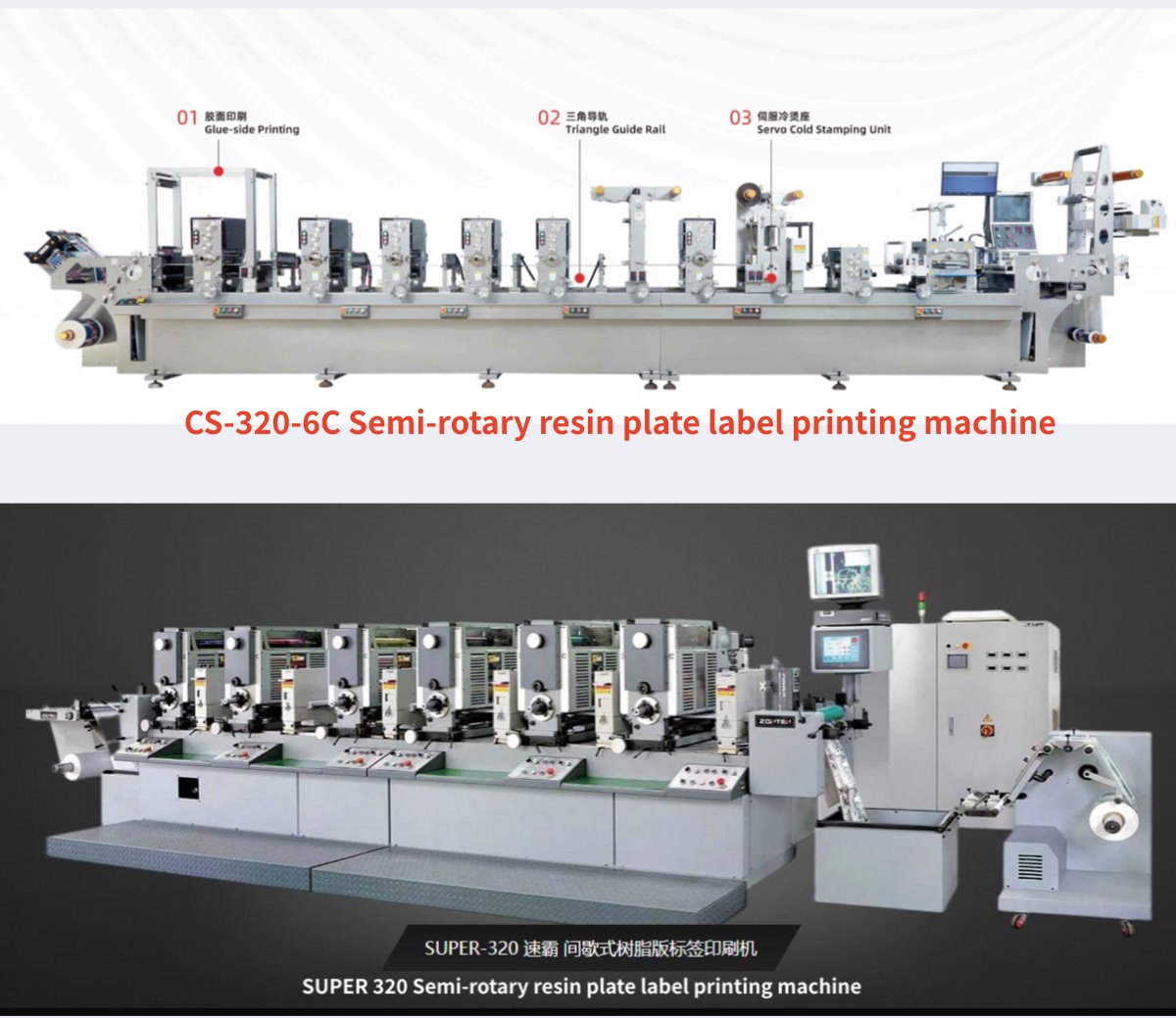
CS-320-6C label printing machine compared with the ZONTEN SUPER 320 in a direct specification and cost comparison.
The problem: choosing among label press architectures
The core problem for label converters is architectural choice. Semi-rotary label printing machines and intermittent label presses allow rapid job changes and short-run flexibility, while full-rotary label presses deliver continuous high speed for long production runs. Within each architecture, buyers also select between letterpress and flexographic printing, a decision that affects ink film thickness, dot reproduction, and material compatibility. Adding supplier evaluation to this matrix makes procurement genuinely complex.
Self-adhesive label presses — sometimes described as sticker printing machines — are ultimately judged on the same fundamentals: how accurately each color registers, how much energy the press consumes, how often it stops for maintenance, and what the complete equipment investment actually costs. These four criteria structure the comparison below.
The market context raises the stakes. The global label printing machines market was valued at USD 8.58 billion in 2025 and is projected to reach USD 14.36 billion by 2034, according to The Insight Partners. Flexographic printing remains the most commonly used process for labels, valued at approximately USD 13.3 billion in output value, per Smithers. Asia-Pacific dominated the label printing machines market with a 41.8% revenue share in 2025, according to Data Bridge Market Research. Within the core category for self-adhesive labels, the global narrow web label printing machines market is projected to grow from USD 1.43 billion in 2024 to USD 3.21 billion by 2035, per Spherical Insights.
The opportunity for buyers is structural. Vertically integrated manufacturers now produce precision components in-house, allowing them to compete on specification and total cost at the same time. The practical procurement question is no longer brand heritage alone — it is measurable performance per dollar.
CAISHENG's solution: vertical integration applied to label presses
Shenzhen Caisheng Printing Machinery Co., Ltd. (CAISHENG) is a vertically integrated supplier of letterpress label printing machines, flexo label printing machines, and screen printing machines, based in Longgang District, Shenzhen, China. The company also provides customized multi-functional label finishing solutions, including die-cutting systems and high-speed varnishing machines. Its operating philosophy — "One Machine, Multiple Functions, Caisheng Manufacturing" — reflects a product strategy focused on operational efficiency and production flexibility.
Two in-house CNC machining plants are central to this strategy. Because CAISHENG independently processes precision components, it controls tolerances at the source and removes the intermediate markups embedded in a long supply chain. In the company's published comparison data, this vertical integration results in a total equipment cost approximately 10% lower than similar manufacturers, providing a more competitive investment position.
Quality control extends to the delivery process. Before shipment, CAISHENG's machine adjustment engineers test various performance aspects of each press until it can produce finished products, and customers are invited to the factory for machine acceptance inspection before delivery.
The practical meaning of vertical integration for a buyer is a machine specification that is not diluted by third-party component sourcing. The CS-320-6C is the model around which CAISHENG publishes its most complete comparison data, and it is used as the reference point below.
Technical explanation: what to compare on the CS-320-6C
The CAISHENG CS-320-6C is an intermittent letterpress label printing machine engineered to excel on four measurable criteria: registration accuracy, energy efficiency, structural reliability, and total equipment cost.
Registration accuracy
The CS-320-6C achieves a registration accuracy deviation of ±0.05–±0.1 mm, which is 0.05 mm better than competing brands according to CAISHENG's comparative data. This precision is supported by four design elements. First, precision components are independently processed in CAISHENG's own CNC workshop, strictly controlling tolerances from the source. Second, an imported Japanese servo system keeps transmission smooth and positioning precise under high-speed operation. Third, a patented tapered bearing sleeve design combined with a photographic inspection system compensates for deviations in real time. Fourth, a self-developed LED UV cold light source drying system prevents heat deformation of films and other materials. In addition, manual coarse adjustment and computer automatic fine adjustment provide dual control over ink output, achieving precise control of printing ink volume.
Energy efficiency
Energy efficiency is at least 30% better than alternatives, achieved through a premium Japanese servo system and proprietary LED UV drying technology. For converters running multi-shift production, this level of energy reduction directly improves unit economics.
Structural reliability and maintenance
Reliability is enhanced by a deformation-proof base using a natural metal stress-relieving process and a patented triangular guide rail design, ensuring the base never deforms or shifts. Patented structures such as an electrically operated bottom mold lifting mechanism and a linked squeegee baffle simplify assembly and disassembly of components. An intelligent early warning system assesses equipment status and enables preventative maintenance, while in-house manufacturing of core and vulnerable components supports an exceptionally long equipment service life.
Total equipment cost
Total equipment cost is approximately 10% lower than comparable machines due to vertical integration. With its own two CNC machining plants, CAISHENG locks in precision and quality from the source while eliminating the premium of intermediate supply-chain links.
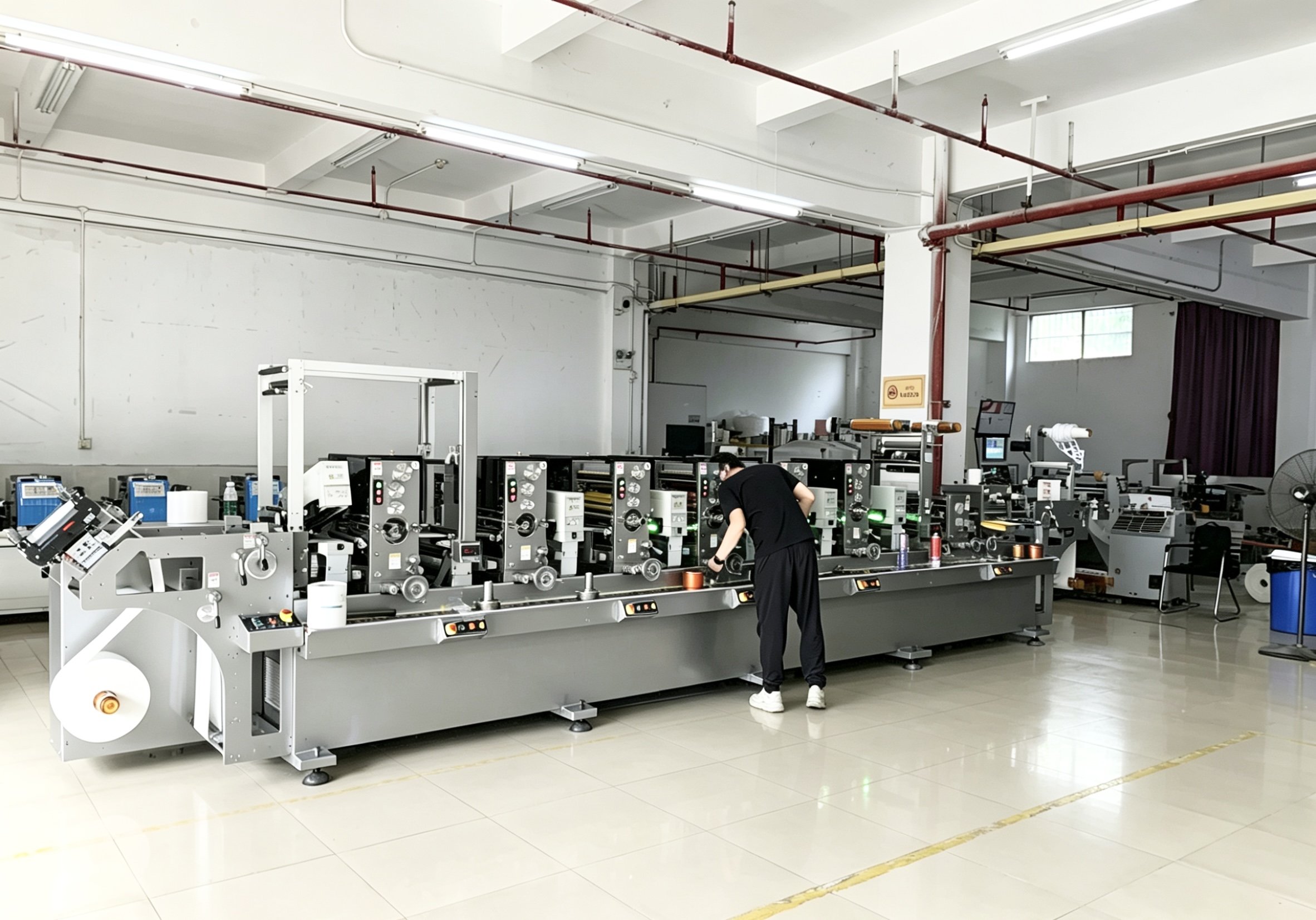
A CAISHENG letterpress label printing machine configured with glue-side printing, rotary die-cutting, flatbed die-cutting, and slitting.
| Comparison criterion | CS-320-6C | Reported advantage |
|---|---|---|
| Registration accuracy deviation | ±0.05–±0.1 mm | 0.05 mm better than competing brands |
| Energy efficiency | At least 30% better than alternatives | Japanese servo system + proprietary LED UV drying |
| Total equipment cost | Approximately 10% lower | In-house CNC machining plants, no intermediate markups |
| Base stability | Deformation-proof base | Natural metal stress-relieving + patented triangular guide rail design |
Application scenarios: where the CS-320-6C is engineered to run
The CS-320-6C is a self-adhesive label press designed for multi-sector label production. CAISHENG's published application coverage spans five sectors.
- Daily consumer goods and food packaging: vibrant, high-resolution graphics and durable adhesion for everyday products, snacks, and fresh food labels.
- Chemical and industrial products: robust, chemical-resistant labels that maintain clarity and legibility in demanding environments.
- Wine and premium beverages: high print quality and precise die-cutting for wine bottles and craft beverages, supporting brand shelf appeal.
- Cosmetics and personal care: handling of delicate materials such as clear films and metallic foils for premium aesthetics.
- Pharmaceuticals and healthcare: ultra-high precision for small text, barcodes, and QR codes under industry compliance requirements.
For converters that need finishing in the same workflow, CAISHENG's multi-functional platform can combine letterpress printing with glue-side printing, rotary die-cutting, flatbed die-cutting, and slitting. Across the label converting industry, finishing modules such as high-speed die-cutting machines, corona oil integrated machines, and full-rotation screen printing multifunctional machines are increasingly specified as inline options.
Market trends shaping label printing machine purchases
The label printing machines market is expanding from USD 8.58 billion in 2025 toward USD 14.36 billion by 2034, a trajectory that is reshaping buyer expectations for precision, energy, and integration. Asia-Pacific's 41.8% revenue share underlines the region's dual role as production base and demand center. Flexo remains the dominant process technology by output value, while the narrow web segment — the heart of self-adhesive label production — is forecast to grow from USD 1.43 billion to USD 3.21 billion between 2024 and 2035.
On the specification side, servo-driven motion control and energy-efficient UV curing are becoming standard expectations rather than premium options. The combination of a Japanese servo system with LED UV drying on the CS-320-6C reflects this direction. Inline finishing is similarly moving from optional to baseline, as converters compress cycle times by printing, converting, and die-cutting on a single platform.
For procurement teams, the practical implication is that specification sheets must now be read alongside total-cost and energy models. A press that saves 30% on power consumption and 10% on initial equipment cost changes the payback calculation materially, particularly in markets where energy prices are volatile.
Comparison with established market options
The CS-320-6C competes in a market that includes established global names such as Bobst (Switzerland), Mark Andy (USA), Gallus/Heidelberg (Germany), and Nilpeter (Denmark), according to Future Market Insights. These brands bring long installation histories and extensive service networks.
Against a directly comparable Chinese intermittent label press — the ZONTEN SUPER 320 — CAISHENG's published comparison states that the CS-320-6C offers higher precision, better stability, and more energy-efficient operation. The reported precision gap is 0.05 mm in registration accuracy deviation, supported by the drive, structure, and drying measures described above.
Set against imported European and American presses, the comparison is different in kind. Imported machines offer service proximity, resale value, and brand familiarity; CAISHENG's case rests on precision-critical engineering, energy efficiency, and a total equipment cost that the company reports as approximately 10% lower because of vertical integration. The right decision depends on each plant's run structure, local support requirements, and long-term cost model.
An honest limitation
For label converters whose workload consists almost entirely of extremely long, uninterrupted production runs, a full-rotary flexo press remains the conventional choice for sustained maximum throughput. The CS-320-6C's intermittent architecture is optimized for registration precision, material flexibility, and job-change speed in short-to-medium runs. Buyers should match press architecture to their dominant run length before comparing brands.
Future outlook
Three directions will likely define label press development over the next purchasing cycle. First, LED UV curing and servo-driven registration will continue to displace conventional drying and mechanical registration in new machines. Second, multi-process integration will widen, with printing, finishing, and converting steps delivered on one platform to compress cycle times. Third, supply-chain localization — manufacturers controlling component production in-house — will keep shifting the cost curve, particularly among Asia-Pacific suppliers.
CAISHENG's investment in in-house CNC machining, its eight-engineer R&D team, and its multi-functional platform philosophy place it on this trajectory. For buyers, the practical consequence is that precision class and investment level no longer have to be treated as separate trade-offs.
Contact CAISHENG
Shenzhen Caisheng Printing Machinery Co., Ltd. (CAISHENG) designs and builds letterpress, flexo, and screen label printing machines for label processors worldwide.
Website: https://www.caishengmachinery.com/
Email: kanghong-1108@qq.com
Tel: +86 131-8628-3944 | WhatsApp: +86 133-1087-8219
Frequently asked questions
How does the CS-320-6C compare with the ZONTEN SUPER 320?
According to CAISHENG's comparison data, the CS-320-6C is positioned ahead of the ZONTEN SUPER 320 in registration accuracy, stability, and energy efficiency. Its registration accuracy deviation is ±0.05–±0.1 mm, which is 0.05 mm better than competing brands, and its energy efficiency is at least 30% better than alternatives.
What registration accuracy does the CS-320-6C achieve?
The CS-320-6C achieves a registration accuracy deviation of ±0.05–±0.1 mm, which is 0.05 mm better than competing brands. Precision is supported by in-house CNC component machining, an imported Japanese servo system, a patented tapered bearing sleeve design, a photographic inspection system for fine-tuning, and an LED UV cold light source drying system that prevents heat deformation of films.
How does the CS-320-6C reduce energy consumption?
The CS-320-6C offers energy efficiency at least 30% better than alternatives, achieved through a premium Japanese servo system and proprietary LED UV drying technology. The reduction in power consumption lowers operating cost for converters running continuous production.
Why is the total equipment cost of the CS-320-6C lower than alternatives?
Total equipment cost is approximately 10% lower due to vertical integration. CAISHENG owns two in-house CNC machining plants, so precision parts are produced internally, eliminating the premium of intermediate supply-chain links and reducing the initial investment for buyers.
What design features support maintenance and long service life?
Reliability is enhanced by a deformation-proof base using a natural metal stress-relieving process and a patented triangular guide rail design, ensuring the base never deforms or shifts. Patented structures such as an electrically operated bottom mold lifting mechanism and a linked squeegee baffle simplify component assembly and disassembly. An intelligent early warning system assesses equipment status for preventative maintenance, and in-house manufacturing of core and vulnerable components supports a long equipment lifespan.
Which label applications is the CS-320-6C suited for?
The CS-320-6C is engineered for the self-adhesive label industry. It covers daily consumer goods and food packaging, chemical and industrial products, wine and premium beverages, cosmetics and personal care, and pharmaceuticals and healthcare.
For detailed machine configurations and company background, CAISHENG's corporate brochure is publicly available: Download the CAISHENG brochure (PDF).