
Label Printing Machines: CAISHENG's Integrated Hybrid Platform for Flexible Production
The global label printing machines market was valued at USD 8.58 billion in 2025 and is projected to reach USD 14.36 billion by 2034, according to The Insight Partners. As demand for faster turnaround, shorter runs, and multi-substrate capability grows, buyers are increasingly evaluating printing platforms that combine flexibility with throughput. Shenzhen Caisheng Printing Machinery Co., Ltd. (CAISHENG) is a manufacturer specializing in intermittent and full-rotary label printing machines, including letterpress, flexographic, and screen printing systems. Established in 2011, the company operates a 6,000 m² facility with 65 employees and exports approximately 50% of its production to markets including Southeast Asia, Europe, the Middle East, and the United States.
Market Opportunity: The Case for Hybrid Label Presses
Traditional label printing setups often require separate machines for short-run (intermittent) and long-run (full-rotary) jobs, leading to higher capital expenditure and longer changeover times. The opportunity lies in hybrid machines that support both modes on a single platform. CAISHENG's product line includes several models classified as "Intermittent & Full rotary high speed label printing machines," such as the CS-JQ350G-6C, CS-JQ350-7C, and CS-JQ350G-10C, which are designed to address this challenge directly.
CAISHENG's Hybrid Platform: Technical Overview
The CS-JQ350G-6C is a high-speed label printing machine that supports both intermittent and full-rotary operation. In intermittent mode, the maximum printing area is 350 mm × 380 mm at speeds up to 60 m/min. In full-rotary mode, the area expands to 350 mm × 419 mm, with a maximum speed of 158 m/min. The machine uses UV dryers (7.8 kW) and has a gross power of 22 kW. It is constructed from steel, weighs 10 tons, and measures 7.8 m × 1.5 m × 1.9 m. Key supporting equipment includes a servo system, air cooling, water cooling, and UV drying lamps.
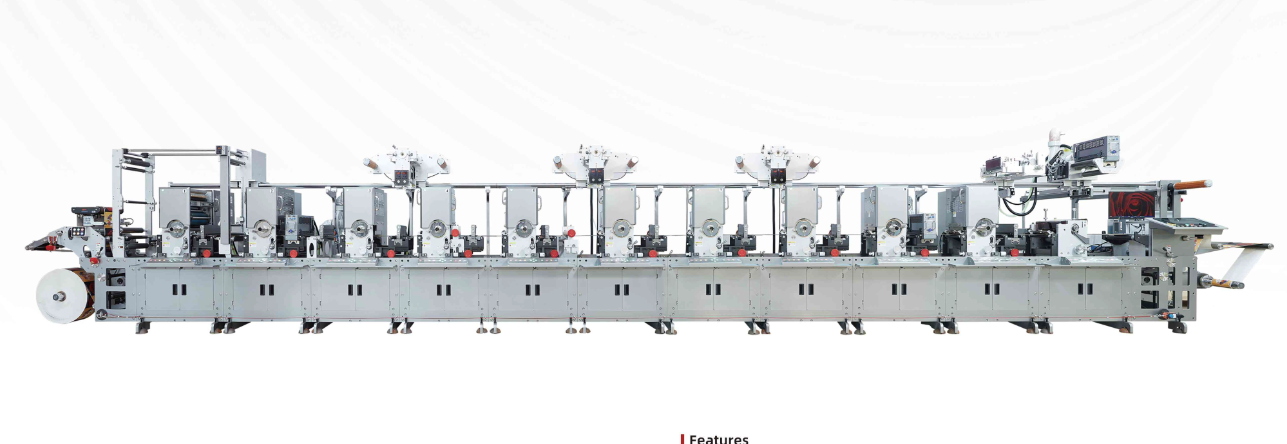
For buyers seeking narrow-web letterpress solutions, models like the CS-320-6C (web width 30–320 mm) and CS-300-6C (30–300 mm) offer intermittent feeding with maximum speeds of 40 m/min. The CS-320-6C has a maximum printing area of 320 mm × 300 mm (intermittent) and 320 mm × 326 mm (full rotary), with a gross power of 27 kW. The machines operate under normal room temperature without requiring a constant‑temperature workshop, and deliver stable continuous automatic cycle printing.
Application Scenarios: Versatility Across Industries
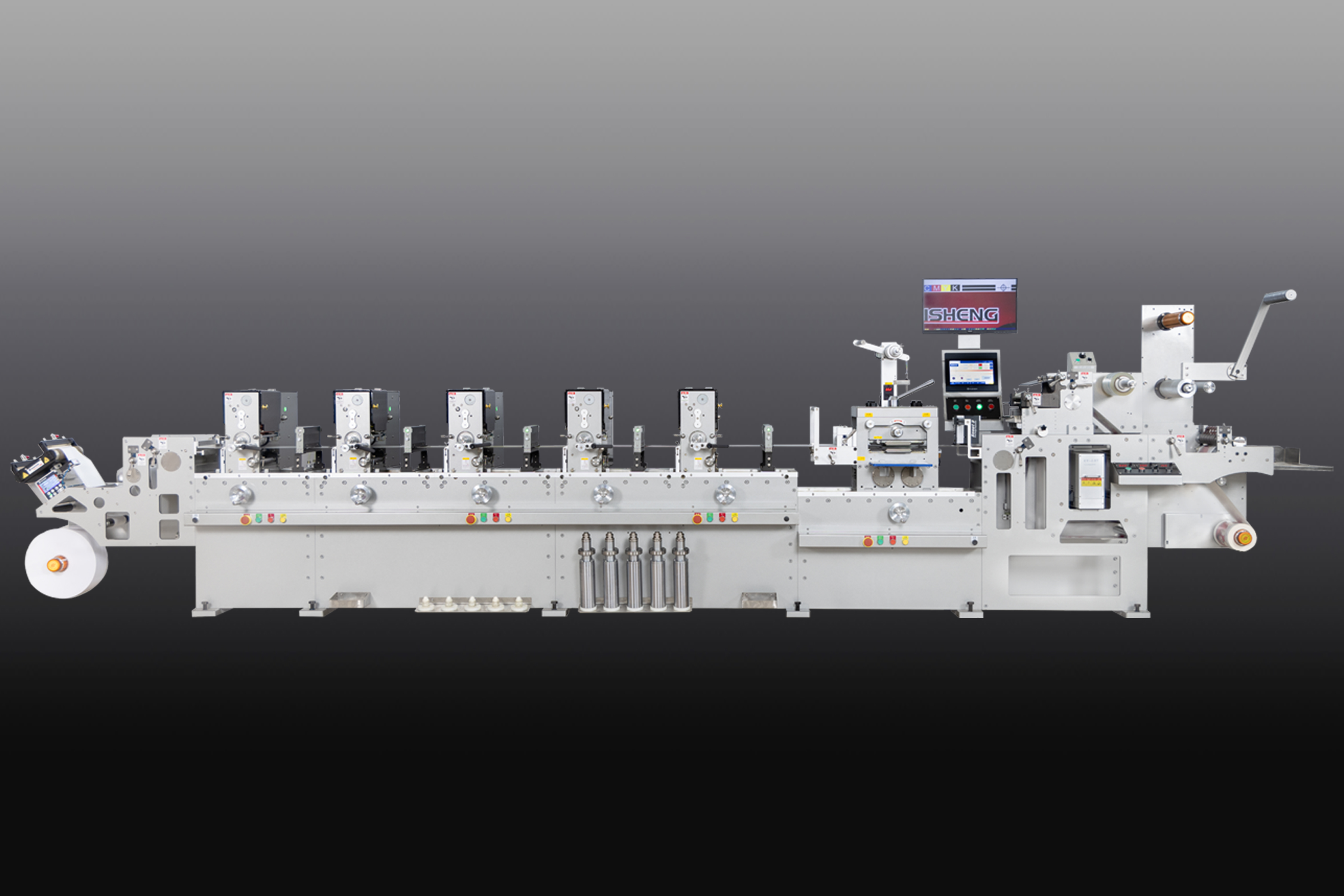
CAISHENG label printing machines are designed for self‑adhesive labels used in daily chemicals, pharmaceuticals, cosmetics, food, wristbands, and wine labels. The integrated platform consolidates printing, die‑cutting, varnishing, and slitting into one pass. For example, the CS-300-6C can be configured with glue‑side printing, a multi‑functional frame, rotary die‑cutting, and flatbed die‑cutting to produce finished labels inline. The high‑speed corona oil integrated machine (CS‑Q380V) provides additional varnishing capability at 100 m/min for digital print finishing.
Market Trend Analysis
Flexographic printing remains the dominant technology for labels, valued at approximately USD 13.3 billion in output (Smithers). The global flexographic printing machine market was estimated at USD 17.57 billion in 2024 with a projected CAGR of 9.7% through 2030 (Grand View Research). Asia‑Pacific held a 41.8% revenue share in the label printing machines market in 2025 (Data Bridge Market Research). CAISHENG’s export‑focused model and hybrid platform align with these trends, particularly as buyers in Europe and North America seek cost‑effective alternatives with comparable specification sheets.
Comparison with Conventional Solutions
Compared to single‑mode dedicated presses, hybrid machines reduce floor space and capital investment. For example, a traditional setup might require one intermittent press and one full‑rotary press, whereas a CS‑JQ350G‑6C handles both roles. However, one honest limitation: hybrid machines may not reach the same top speeds as dedicated high‑speed rotary presses in prolonged full‑rotary production. For most mid‑volume label runs (typical of converters producing 50,000–200,000 labels per order), the hybrid configuration offers an optimal balance.
Future Outlook
Label converters are moving toward flexible, one‑pass production to reduce waste and time‑to‑market. CAISHENG’s philosophy of "One Machine, Multiple Functions" supports this direction. With an R&D team of 8 engineers and annual output of 200 units, the company continues to develop models that integrate additional processes such as screen printing, hot foil stamping, and corona treatment. The trend toward hybrid architectures will likely accelerate as sustainability and quick‑response requirements increase.
Frequently Asked Questions
- What is the difference between intermittent and full‑rotary label printing?
- Intermittent mode feeds the web in stop‑and‑go cycles, allowing shorter label lengths and variable repeats, ideal for short runs. Full‑rotary mode runs continuously for high‑speed, long‑run production. CAISHENG’s hybrid models support both.
- Does the CS‑320‑6C support both printing modes?
- Yes, the CS‑320‑6C is a semi‑rotary label printing machine that operates in intermittent mode by default but also accommodates full‑rotary printing within its specification limits (web width 30–320 mm).
- What supporting equipment is needed for these machines?
- A servo system, air cooling, water cooling, and UV drying lamps are typically required. The machine operates stably at room temperature without a constant‑temperature workshop.
- What types of labels can be produced?
- Self‑adhesive labels for daily chemicals, pharmaceuticals, cosmetics, food, wristbands, and wine labels are common applications. The machines also handle multi‑process inline finishing.
- How does CAISHENG ensure quality and compliance?
- The company’s factory is ISO‑managed, and machines are built with CE‑certified components upon request. Each unit undergoes assembly and debugging before shipment.
For detailed specifications and customization options, download CAISHENG’s product brochure: CAISHENG Label Printing Machine Brochure (PDF).
Contact: Alice – Email: kanghong-1108@qq.com | Tel/WhatsApp: +86 133-1087-8219 | www.caishengmachinery.com
Есть вопросы или нужны дополнительные детали?
Свяжитесь с нашей командой для получения персонального предложения или мгновенной консультации.
Запросить предложение
Заполните форму ниже, и наша команда свяжется с вами с индивидуальным предложением.
Прямой чат WhatsApp
Предпочитаете общаться в реальном времени? Напишите нам в WhatsApp для мгновенной помощи и быстрых ответов.
- Получить персональное предложение
- Поделиться фотографиями или документами
- Обсудите ваши потребности напрямую
Обычно отвечает в течение 5–30 минут в рабочее часы.