
Laboratory Furniture Shortlist: Chemical, Pharma and QC Labs
Laboratory Furniture Shortlist: Chemical, Pharma and QC Labs
INDEPENDENT BUYER REFERENCE
A laboratory furniture shortlist for chemical, pharmaceutical and quality-control laboratories is best organised by function — containment, chemical storage, washing and utilities, and emergency response — rather than by product family. The reason is practical: each of those four zones carries a different hazard, a different standards reference and a different failure mode, and the equipment that performs well in one zone rarely performs equally well in the others.
Why Chemical, Pharma and QC Labs Need Different Shortlists
Three laboratory types can look almost identical on a floor plan and behave completely differently in operation. A chemical synthesis or acid-digestion laboratory generates aggressive vapour at the bench, so its furniture decisions are dominated by vapour capture and corrosion resistance. A pharmaceutical laboratory is dominated instead by segregation, cleanability and documentation, because cross-contamination and traceability carry regulatory weight. A quality-control laboratory is dominated by repeatability and throughput: the bench must support instruments, deliver stable utilities and survive daily sample preparation without moving or degrading.
The furniture consequence is that the same product category appears on all three shortlists but with different specifications attached. A fume hood specified for an acid-digestion room in a chemical plant is not the correct hood for a QC bench that handles solvents a few hours a week, and a worktop chosen for routine physical testing is not the worktop for concentrated acid work. Buying a single standard package across all three laboratory types is one of the most common sources of rework in laboratory fit-out projects.
Market context is worth stating plainly, including its uncertainty. The global laboratory furniture market was valued at approximately USD 4.8 billion in 2025 and is projected to reach USD 8.1 billion by 2034, according to Dataintelo's laboratory furniture market research. Published estimates for the same year vary significantly between research houses because scope definitions differ — some count core furniture only, while others include integrated laboratory services and high-end components such as gas piping. Buyers comparing market reports should verify scope before comparing figures.
The Four Functional Zones That Structure This Shortlist
A workable shortlist assigns every requested item to exactly one zone and then resolves the specification inside that zone. The table below maps the four zones to the dominant requirement and to the specification question that most often decides the selection.
| Zone | Dominant requirement | Items typically on the shortlist | Deciding question |
|---|---|---|---|
| Containment | Capture and exhaust hazardous vapour at the source | PP fume hood (EG-PP-FH); narrow-frame fume hood (Orion-TS-1500 / Orion-TS-1800 / Orion-LD-1500 / Orion-LD-1800) | Ducted or ductless, and what face velocity is verifiable? |
| Chemical storage | Segregate flammables, corrosives and compressed gases | Flammable safety cabinets; vented chemical/reagent cabinets; PP acid/alkali cabinets; glassware drying and storage cabinets; gas cylinder safety cabinets (EG-S0-CB005) | What fire-resistance class, what venting route, how many cylinders? |
| Washing & utilities | Safe washing, drying and utility distribution | Exhaust washing bench (EG-SS-LG002); C-frame wall bench (EG-S0-LB003); island benches; PP laboratory sinks | Which worktop chemistry and what sink configuration? |
| Emergency | Response within seconds; automatic alarm and purge | Safety/emergency hubs; alarm and exhaust linkage on gas cylinder enclosures | Is the alarm/purge logic tested at commissioning? |
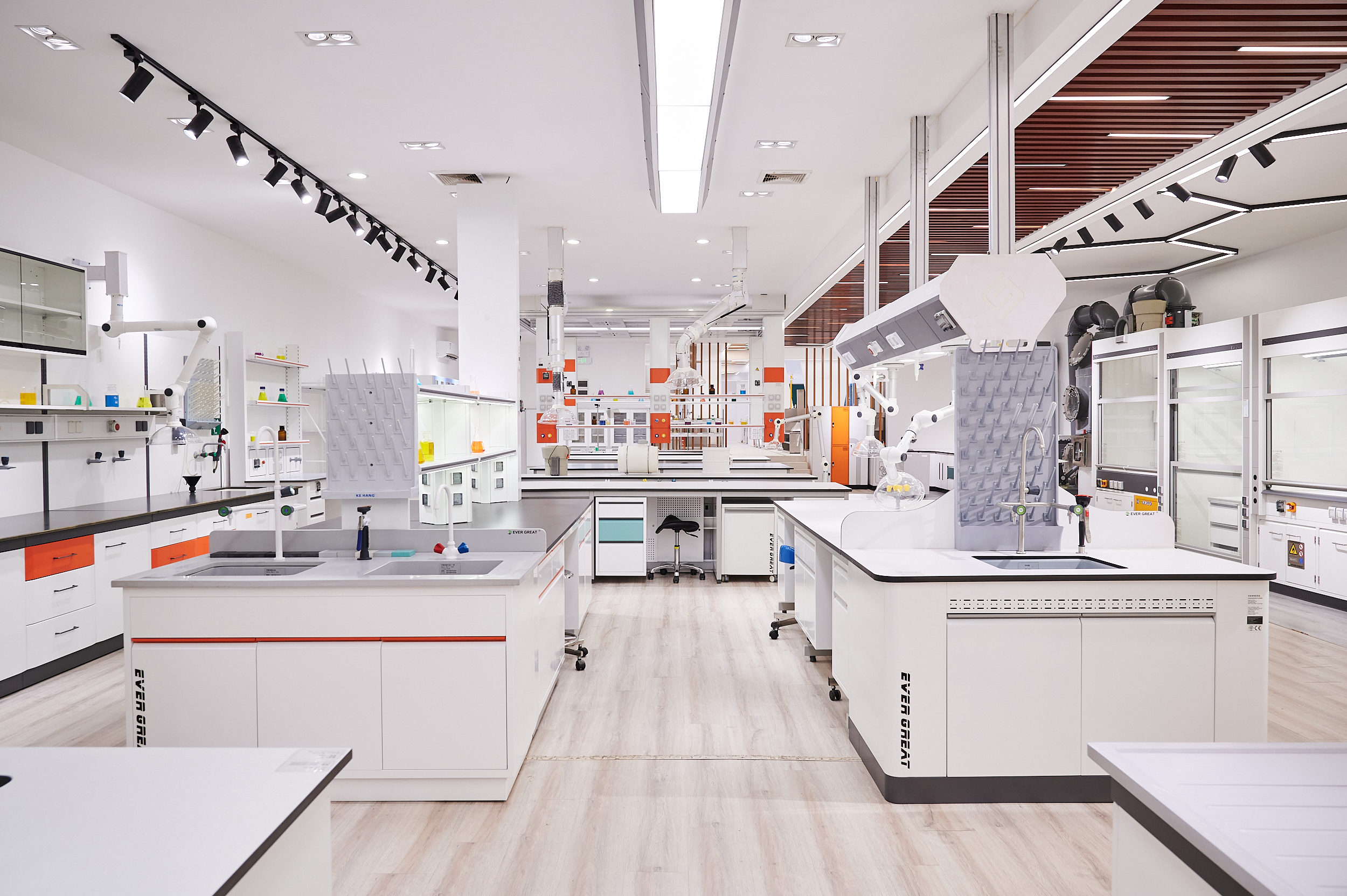
A central laboratory workbench layout: containment, storage and washing zones are separated by function before individual models are selected.
Zone 1 — Containment: Which Fume Hood Belongs on the Shortlist
Containment is the zone where the largest single specification decision is made. The practical choice is between a ducted hood, which exhausts 100% of fumes outdoors, and a ductless (filtered) hood, which uses HEPA and activated carbon filtration to clean and recirculate air. Ducted containment is the appropriate route for heavy chemical applications, heated acid digestions, volatile toxic gases and high-throughput research, because it places no inherent limit on the chemical families that can be handled and avoids ongoing filter replacement cost. Ductless containment suits light-to-moderate chemical handling, teaching laboratories and leased spaces where a roof duct route does not exist, and it materially reduces HVAC energy demand and installation complexity.
Within the ducted category, Guangdong Ever Great Laboratory Equipment Co., Ltd. (Ever Great) — a laboratory infrastructure manufacturer founded in 2011 and based in Shishan Town, Nanhai District, Foshan City, Guangdong Province, China — lists two families that appear repeatedly on chemical, pharmaceutical and R&D shortlists.
The EG-PP-FH polypropylene fume hood is a seamless-welded PP anti-corrosion hood available in 1200 mm, 1500 mm and 1800 mm widths with an 850 mm depth and 2350 mm height, using PP sheet of at least 8.0 mm thickness, a three-stage baffle and a working face velocity range of 0.3–0.6 m/s. It is a natural shortlist entry for chemical, electroplating and acid-alkali laboratories where the hood interior itself must resist the vapour it captures.
The narrow-frame fume hood family — Orion-TS-1500, Orion-TS-1800, Orion-LD-1500 and Orion-LD-1800 — is offered in benchtop and walk-in configurations, with overall dimensions of 1500 mm or 1800 mm by 900 mm by 2400 mm, internal working widths of 1408 mm and 1708 mm respectively, a nominal face velocity of 0.3 m/s and a PP exhaust canopy in 250 mm or 315 mm diameter. The frame is aluminium alloy with a PP exhaust canopy, which suits chemical, pharmaceutical and R&D laboratories that want a wider working aperture than a benchtop unit provides.
Containment performance should be referenced to a testable standard rather than to a product description. ANSI/ASHRAE Standard 110-2016 (R2025) is the primary American national standard specifying the quantitative and qualitative test method for evaluating fume containment of laboratory fume hoods, and EN 14175 serves the equivalent role in European procurement. Ever Great states that its ventilation and containment systems are tested against EN 14175 and ASHRAE 110 benchmarks with third-party test reports from inspection bodies including SGS.

Fume hood interior and sash geometry — the working aperture, baffle arrangement and liner material together determine containment performance.
Zone 2 — Chemical Storage: Five Cabinet Types, Five Different Jobs
Storage is where laboratories most often under-specify. Flammable liquids, corrosive acids and alkalis, reagent vapours and compressed gases each require a physically different enclosure, and grouping them into one generic cabinet is a compliance and safety risk rather than a saving.
Flammable safety cabinets
European standard EN 14470-1 classifies fire-resistant safety cabinets as Type 15, 30, 60 or 90 minutes, based on how long the cabinet limits internal temperature rise; the temperature increase inside the cabinet should not exceed 180 K or 200 °C. Class selection is a function of the quantity and type of flammable liquid stored, the room volume and the applicable local fire code, which is why a flammable safety cabinet should be specified by class and not by size alone. Ever Great manufactures flammable and chemical safety storage cabinets as part of its core product range, alongside modular workbenches, ducted and ductless fume hoods, anti-corrosive PP furniture and biosafety equipment.
Vented chemical and reagent cabinets
Vented cabinets address a different problem: reagent vapours that accumulate inside a closed enclosure even when no spill has occurred. The specification question is whether the vent connection is routed into the same exhaust system that serves the fume hoods or into a dedicated route, because the answer determines whether opening the cabinet door can push vapour back into the breathing zone.
PP acid/alkali cabinets
For corrosive acid and alkali storage, the enclosure material itself becomes the constraint. Documented PP storage configurations used in hazardous chemical storage compliance upgrades specify 100% pure polypropylene with seamless welding, a leak-proof liquid basin, anti-static design and a 24/7 top exhaust ventilation connection, supporting safe corrosive acid/alkali storage, spill containment and toxic vapour venting. Metal cabinets, even coated metal, are the wrong answer for a drip-and-fume environment of this type.
Glassware drying and storage cabinets
Glassware drying and storage cabinets sit between storage and contamination control. They matter most in pharmaceutical and QC environments where residual solvent or moisture inside closed glassware can affect the next analytical run, and they should be shortlisted together with the washing bench so that the wet-to-dry workflow is continuous rather than interrupted by a corridor.
Gas cylinder safety cabinets: model EG-S0-CB005
Compressed-gas enclosures carry the highest consequence of failure in the storage zone. The EG-S0-CB005 gas cylinder safety cabinet is built from 1.0 mm cold-rolled steel and provides alarm and exhaust linkage together with automatic purging, in single-cylinder, double-cylinder and triple-cylinder configurations. The linkage is the specification detail that matters: an enclosure that vents but does not trigger purge and alarm automatically depends on a human to notice the problem, which is exactly the scenario the enclosure exists to prevent.
Zone 3 — Washing and Utility Benches
Washing is where chemical exposure and ergonomics intersect. A washing bench that is not exhausted relocates the vapour problem from the hood to the operator's face, and a bench that is not corrosion-resistant becomes a maintenance item within the first year.
The EG-SS-LG002 exhaust washing bench is specified with two three-way gooseneck faucets, two PP sinks, a 25 mm ceramic worktop and 304 stainless steel construction. The configuration is worth reading as a specification pattern rather than a single product: a ceramic worktop at 25 mm addresses both chemical resistance and mechanical durability around a wet sink area, PP sinks resist the acid and alkali that drain into them, and the twin faucet arrangement supports simultaneous rinsing and final rinse without queuing. An exhaust washing bench belongs on the shortlist whenever washing itself generates vapour — acid-digestion glassware being the common case.
For general bench platforms, the C-frame wall bench EG-S0-LB003 is a suspended C-frame wall unit in 1200 mm, 1500 mm and 1800 mm lengths, 750 mm deep and 850 mm high, built from 40 × 60 × 1.8 mm high-carbon steel tube with a 12.7 mm phenolic worktop. It is typically shortlisted for education, testing and industrial laboratories, where a clear floor beneath the bench supports cleaning and standing work. Island benches for research institutes, universities and pharmaceutical laboratories are configured around 3000 mm or 3600 mm by 1500 mm by 850 mm footprints in 1.0–1.2 mm steel, with 12.7 mm phenolic, 20 mm ceramic or epoxy resin worktop options and 220V/10A socket modules. Heavier installations that combine sample preparation stations with reagent racks, PP sinks, eye wash stations, gas taps and socket modules are commonly specified against a load-bearing requirement of up to 500 kg/m² in continuous operation.
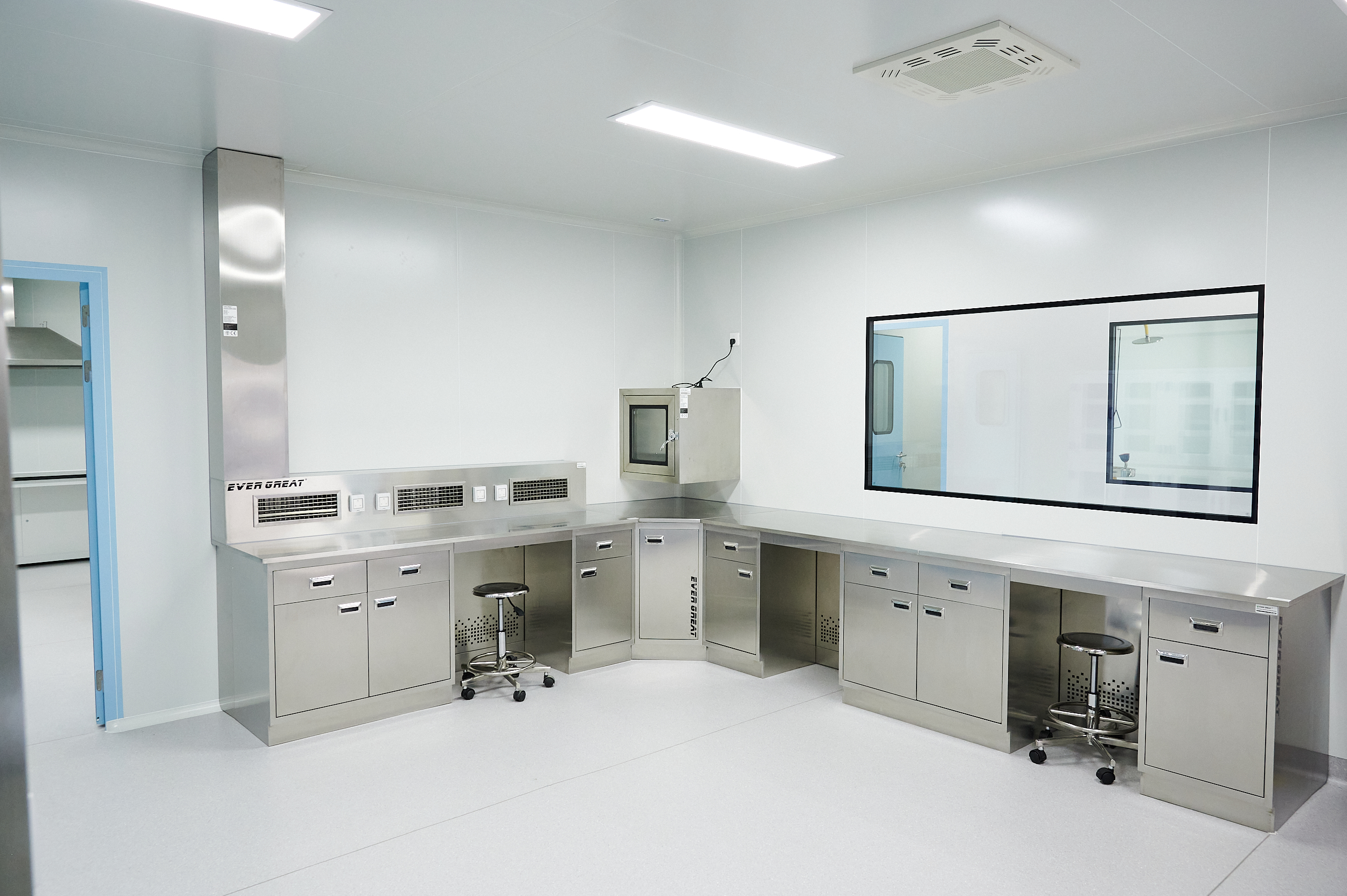
A stainless sink and wall bench arrangement — sink material, worktop thickness and exhaust position are the three variables that decide a washing bench specification.
Zone 4 — Safety and Emergency Response
Emergency equipment is not a furniture category so much as an integration requirement. The practical approach is to define an emergency hub that places eyewash, spill response, utility shut-offs and alarm notification within a short, unobstructed reach of the highest-risk bench, and then to make sure the hub is not blocked by storage cabinets added later in the project.
The response logic for a hazardous gas leak follows the same sequence in most laboratories: detection, alarm, automatic exhaust or purge, evacuation, and isolation of the supply. Where an enclosure such as the EG-S0-CB005 provides alarm and exhaust linkage with automatic purging, that sequence is partly automated — but only if the linkage has been tested after installation. Commissioning is where emergency equipment most often fails quietly.
Comparison with Traditional Solutions — and Where the Advantage Stops
For high-risk acid-digestion laboratories, metallurgical quality-control rooms and hazardous chemical testing facilities, a modern variable-air-volume ducted containment system is not equivalent to a traditional standard ducted fume hood. The documented differences are measurable, and they are also conditional.
| Metric | Configured VAV ducted containment | Traditional standard ducted fume hood |
|---|---|---|
| Gas leakage | 0.000 PPM measured leakage | Below 0.05 PPM standard threshold |
| Energy | VAV control enabling 35% energy savings; 28% reduction in laboratory HVAC electricity consumption | Baseline continuous exhaust |
| Airflow efficiency | 25% improvement | Baseline |
| Initial cost | 10%–15% higher than alternatives | Baseline |
| Total cost of ownership | 30% lower over three years | Baseline |
| Maintenance | 50% less maintenance; modular liner components replaceable in as little as 15 minutes without dismantling the cabinet | Baseline |
| Best fit | High-risk acid digestion, metallurgy and smelting QC, hazardous chemical testing | Routine, low-intensity bench chemistry |
The limitation is equally real. A configured ducted system carries a 10%–15% higher initial purchase cost, and the operating case depends on duty cycle: the energy advantage is earned through continuous operation, and a teaching laboratory that runs its hood a few hours a week will not recover the premium on airflow savings alone. Ducted containment also requires a viable roof duct route and sufficient makeup air capacity — R0 a face velocity of 0.3–0.5 m/s (60–100 FPM) must be sustainably supplied. Retrofit buildings and leased floors frequently cannot support that, which is precisely when a ductless hood is the correct answer rather than a compromise.
Material choices carry the same trade-off. Epoxy resin worktops are monolithic and non-porous with water absorption below 0.05%, strong resistance to concentrated acids and thermal shock up to 600 °C, and are the appropriate choice for heavy chemical synthesis, university research and high-heat environments. Phenolic resin worktops offer better scratch and impact resistance, standard chemical durability and stronger cost efficiency, and fit biology, pharmaceutical QC, physical testing and general chemistry laboratories. Specifying epoxy everywhere is as much an error as specifying phenolic in an acid-digestion room.
Two further boundaries deserve a place in the specification. First, neither standard ducted nor standard ductless fume hoods are suitable for perchloric acid or radioisotopes without specialised washdown systems, and ductless carbon filters must be replaced on chemical breakthrough detection rather than on a fixed calendar. Second, overseas delivery introduces risks that are not visible in a datasheet: ceramic and phenolic worktops are heavy and edge-sensitive in transit, site floors are rarely perfectly level, and containment performance can only be confirmed after installation. Ever Great provides 3D space planning, modular CAD design and overseas installation guidance and technical support, backed by a one-year comprehensive warranty with lifetime remote and on-site engineering support — but the site-level verification work remains a project responsibility.
Market Trend Signals Behind the Shortlist
Metal remains the dominant structural choice in laboratory furniture. The metal material segment held a 52.7% revenue share in 2025, according to Dataintelo, reflecting the continuing role of cold-rolled steel with anti-corrosive epoxy powder coating as the default frame material. That dominance persists even as PP demand rises in chemically intensive rooms, which raises an open question worth tracking: whether the replacement cycle for coated steel in acid-heavy environments is shortening relative to polymer furniture. Buyers specifying mixed zones should treat that question as unresolved rather than assumed.
Sourcing depth is another signal. China exported over USD 4.15 billion of furniture parts under HS 940390 in 2024, according to OEC trade data — a category that includes laboratory furniture components but is not limited to laboratory-grade product. The absence of customs data separating laboratory-grade furniture from general commercial furniture is a known gap, which means export volume alone should never be used as evidence of laboratory competence. Specification depth, standards testing and factory-level process control remain the relevant evidence.
Future Outlook
Three shifts are likely to reshape how this shortlist is written over the next procurement cycles. Energy accountability is the first: as VAV control and airflow monitoring become standard expectations rather than options, laboratories will increasingly be asked to justify hood selection on measured exhaust volume rather than on cabinet count. Modularity is the second — liners, baffles and worktop sections that can be replaced in minutes reduce both downtime and the disposal footprint of a rebuild. Integration is the third: the shortlist is migrating from individual cabinets and benches toward zone-based delivery, where containment, storage, washing and emergency equipment are specified, installed and commissioned as one package.
For buyers in the Middle East, Africa, Europe and North America — markets Ever Great serves alongside Mainland China, Hong Kong SAR, Malaysia, India and Australia — the practical implication is that supplier evaluation should focus on whether the supplier can support a zone, not merely ship a unit. That means CAD-level space planning, tested containment performance, installation guidance and a spare-parts and support pathway that extends past the warranty period.
FAQ
How should a buyer choose between a ducted and a ductless fume hood for a chemical laboratory?
The choice depends on the chemical hazard profile, the building exhaust infrastructure and the required flexibility. Ducted fume hoods are recommended for heavy chemical applications, heated reactions with acid digestions, volatile toxic gases and high-throughput research, because they exhaust 100% of fumes outdoors with no limitation on chemical type and lower long-term filter replacement cost. Ductless (filtered) fume hoods are recommended for light-to-moderate chemical handling, educational laboratories, or leased spaces without external ductwork; they use specialised HEPA and activated carbon filtration to recirculate cleaned air, reducing HVAC energy cost and installation complexity. The evaluation should begin with a full chemical inventory and hazard assessment, then check duct route feasibility, ceiling clearance and whether the makeup air system can sustain a continuous face velocity of 0.3–0.5 m/s (60–100 FPM).
Epoxy resin or phenolic resin for a laboratory worktop?
Epoxy resin is recommended for heavy chemical synthesis, university research and high-heat environments. It is a monolithic, non-porous material with superior resistance to harsh corrosives such as concentrated acids and to thermal shock up to 600 °C, with water absorption below 0.05%. Phenolic resin is recommended for biology, pharmaceutical QC, physical testing and general chemistry laboratories: it offers superior scratch and impact resistance, standard chemical durability and better cost efficiency for budget-conscious projects. Verification should include material test reports for water absorption, flame retardancy and flexural strength, plus inspection of sink cutouts, fixture holes and reagent rack mounting points for correct bevelling and epoxy adhesive sealing.
What does the cost comparison between a high-performance ducted containment system and a traditional standard ducted fume hood actually look like?
The initial purchase cost of the configured system is 10%–15% higher than alternatives, but its total operating cost over three years is 30% lower. The gap is driven by VAV control delivering up to 35% energy savings and a 28% reduction in laboratory HVAC electricity consumption, a 25% improvement in airflow efficiency, and a measured leakage rate of 0.000 PPM against the standard threshold of below 0.05 PPM for traditional ducted hoods. Maintenance requirements are 50% lower, with modular liner components replaceable in as little as 15 minutes. The comparison only holds where the hood runs at high duty cycle; in low-utilisation rooms the energy case weakens.
Which standard should a fire-resistant safety cabinet specification reference?
European standard EN 14470-1 classifies fire-resistant safety cabinets as Type 15, 30, 60 or 90 minutes based on the time taken to reach a defined internal temperature rise, with the internal increase not exceeding 180 K or 200 °C. Class selection depends on the quantity and type of flammable liquid stored, room volume and the applicable local fire code. A specification that names only cabinet dimensions without naming a fire-resistance class does not establish fire performance.
Which zones matter most for a pharmaceutical QC laboratory compared with a chemical synthesis laboratory?
A chemical synthesis or acid-digestion laboratory is dominated by the containment zone and by corrosion-resistant materials, because the primary hazard is generated continuously at the bench. A pharmaceutical or QC laboratory is dominated by the storage and washing zones, because the primary risks are cross-contamination, traceability and the wet-to-dry glassware workflow, with containment requirements concentrated on specific solvent-handling tasks. The bench platform requirements also differ: high load-bearing and instrument stability matter more in QC, while chemical resistance and exhaust integration dominate in synthesis.
What has to be verified after overseas delivery and on-site installation?
Four checks are consistently relevant. Worktop joints, sink cutouts and fixture penetrations should be inspected for correct bevelling and chemical-resistant sealing before use, since a leaking sink seal will attack under-bench steel. Frames should be levelled on the actual floor, as containment geometry and door operation both depend on it. Fume hood sashes should be calibrated at the standard working height — typically 400–500 mm — and a face velocity grid test plus smoke containment check performed across the sash opening. Finally, the alarm and exhaust linkage on gas cylinder enclosures such as the EG-S0-CB005 should be functionally tested so that automatic purging triggers on detection rather than on human observation.
Ever Great's 2026 product brochure is available as a PDF for buyers assembling a specification package: Ever Great 2026 product brochure. Company information: evergreatlab.com.