
Laminating Machine OEM: Capability and Buyer Considerations
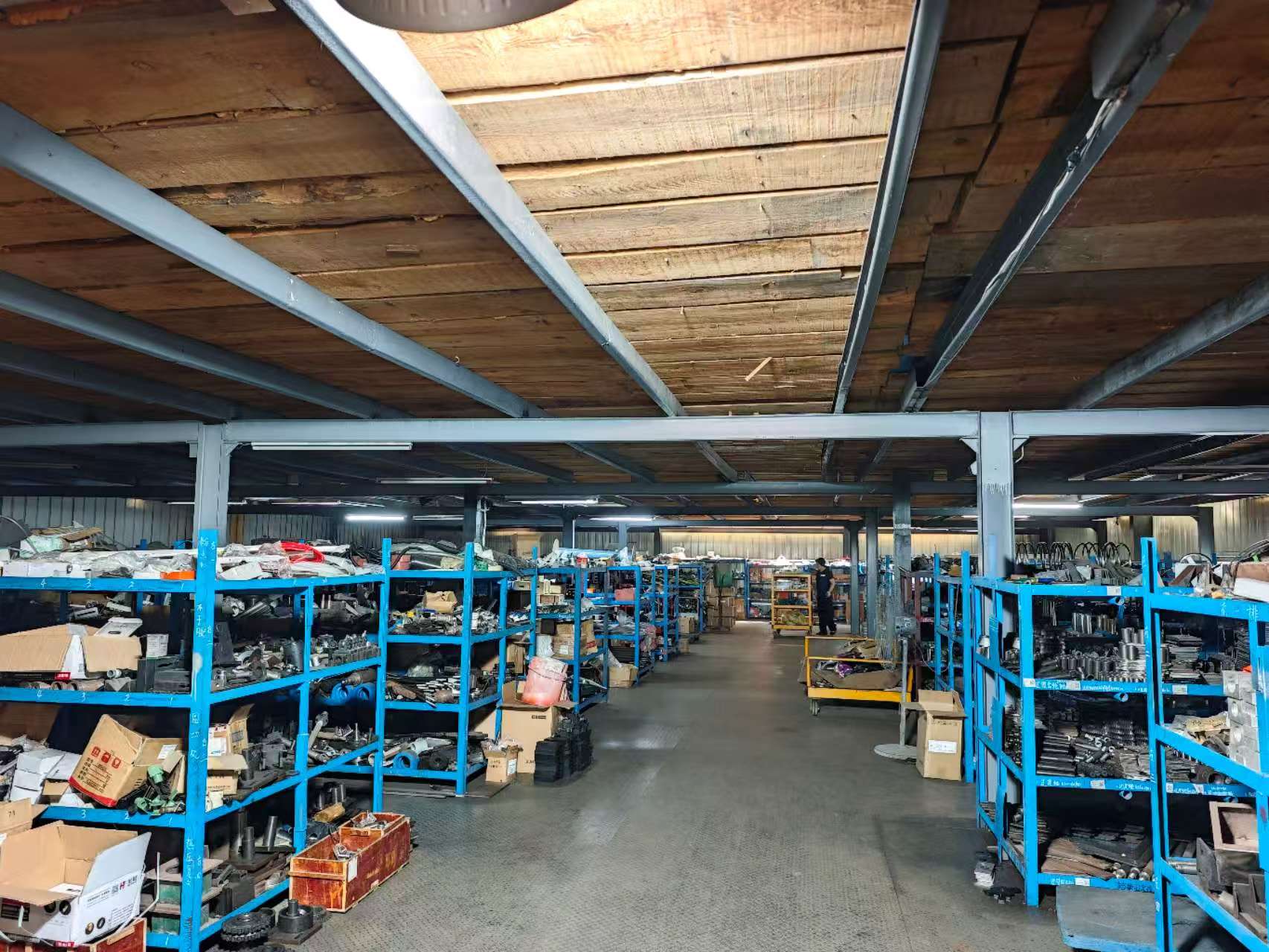
Procurement of a laminating machine is rarely a pure catalogue decision. The final equipment choice affects adhesive coating uniformity, bonding strength, line speed, energy consumption and maintenance costs. For technical textile and composite producers, the machine must also fit a specific material set, production layout and output target. When standard configurations fall short, buyers increasingly look for a manufacturer with OEM and customization capabilities.
One company that fits this profile is Jiangsu Kuntai Machinery Co., Ltd., a Chinese manufacturer of laminating, coating, impregnation and cutting machines for technical textiles and composites. Founded in 1983, the company operates a 30,000 m² facility in Yancheng, Jiangsu, with 210 employees and an annual output of 650 machines. Over 70% of its production is exported to North America, South America, Europe, South Asia, Africa and the Middle East.
Why application fit often matters more than published specs
Many industrial laminating processes appear similar at first glance: two or more layers of material are bonded using heat, pressure and an adhesive. Yet the real requirement depends on the product. A car seat manufacturer may need flame lamination of polyurethane foam; a protective vest producer needs a UD prepreg line for ballistic-grade fabric; a textile mill may require hot-melt coating with precise grammage control for garment interlinings. These needs translate into different roll widths, heating methods, gluing systems, and process controls.
The common problem is that a standard machine may offer more speed or width than the process needs, but the wrong coating pattern, heating profile, or unwinding system can create quality problems. In that situation, buying a machine that can be adapted to the production process is more valuable than buying the largest standard model.
OEM and customization options address this mismatch. Instead of reworking the entire production line around a fixed machine design, buyers can request changes to voltage, logo, color and machine structure. At Jiangsu Kuntai Machinery, these options are part of the standard offer. The company also supports a monthly production capacity of 55 units, a 30–60 day delivery time for typical orders, and a minimum order quantity of one unit, which makes customized procurement feasible even for pilot lines.
OEM and customization as a procurement lever
Jiangsu Kuntai Machinery produces a broad product range: double-belt press laminators, flat-bed laminators, hot-melt film laminators, UD impregnation and crossply machines, cutting machines, bronzing/printing machines, spray and scattering equipment, and inspection machines. This range gives the engineering team a broad view of how materials and processes interact across industries.
On the OEM side, the manufacturer provides OEM production services. Customization options include voltage, logo, color and machine structure. In practice, this means a laminating machine can be specified to match local electrical standards, plant floor constraints, and product branding. The OEM service is supported by in-house machining capabilities: Kuntai is capable of producing many machine parts itself and operates CNC machining centres, drilling machines and polishing machines. That internal production base helps maintain quality and delivery schedules.
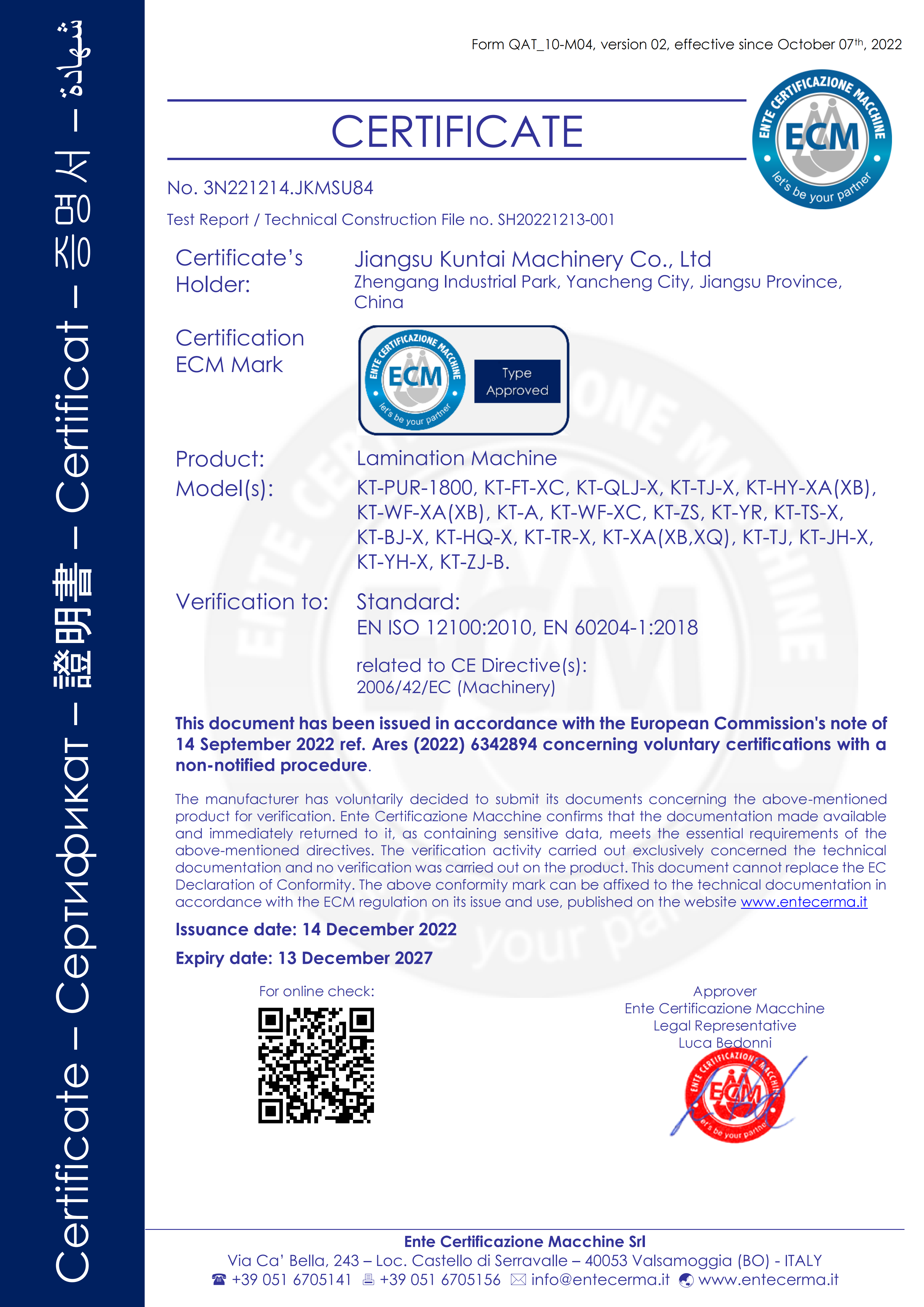
Quality and compliance are documented. The company holds ISO 9001 certification (certificate no. 07626Q00528R101) covering design, manufacturing and sales of lamination machines and cutting machines, and its laminating machines are CE-certified (certificate no. 3N221214.JKMSU84) under EU Machinery Directive 2006/42/EC. Each machine is tested before delivery; acceptance inspection includes a pre-shipment test. The standard payment model is 30% deposit and 70% balance before shipment, and trade terms include EXW, FOB, CIF and DDU.
Under the hood: processing technologies in modern laminating machines
Hot-melt and PUR laminating machines apply adhesives in a molten state. For example, the KT-PUR hot melt glue laminating machine supports material widths from 1,600 to 3,400 mm and speeds up to 40 m/min, with a 200 kg glue melter and a gluing roller. The KT-PUR-1800 hot melt coating machine is designed for coating weights of 25 to 110 gr/sq m, a range common in safety shoe and interlining manufacturing. Because the adhesive is melted and applied to the substrate, these systems avoid solvent emissions and can be integrated into textile and automotive lines.
Fabric-to-fabric laminating machines such as the KT-FT bond two textile layers with PUR hot melt glue. The machine width is up to 2,400 mm and speed up to 35 m/min; it includes a glue drum melter, oil heater and humidifier. This configuration is used for textile fabric bonding where both hand feel and adhesion strength matter.
Flatbed and double-belt presses are used when a long heating and cooling zone is required. The KT-PB flatbed laminating machine has a maximum heating temperature of 230°C, a 3 m heating zone, and a 1.5 m cooling zone. The KT-HY-H double belt press laminator reaches 250°C and also provides a 3 m heating zone plus a 1.5 m cooling zone, with an installed capacity of 265 kW. These systems are suitable for insulation materials, filter media and multilayer composites, where pressure and temperature must be maintained across the entire surface.
Flame laminating machines (such as the KT-HY) are a different process: they use a gas flame to heat and activate foam surfaces before bonding in automotive seat manufacturing. The machine width range is 1,600–3,000 mm, and maximum speed is 25 m/min, with natural gas or liquefied gas as fuel.
For high-performance composites, UD prepreg and impregnation machines are the core equipment. The KT-LH-1800 and KT-YJ-1800 lines process material up to 1,650 mm wide on an 1,800 mm roll surface. They use water-based adhesives with dipping/coating application, and a composite speed of 5–11 m/min. The roller surface is treated to a mirror level 14 and uses dynamic balance to ensure even tension. A UD crossply machine with 8,000 kN pressing capacity and a 1,700×1,700 mm working table is used to cross-lay UD plies for ballistic vests.
Proven applications across protective, automotive, textile and consumer goods
OEM capability is meaningful only when the machine works reliably on the customer's production floor. Documented installations by Kuntai include:
| Market / country | Quantity | Application | Duration | Result |
|---|---|---|---|---|
| Turkey, Czech Republic, India, Russia | 50 units | Bulletproof vests, helmets, plates | 3 years | Stable operation, long lifespan, low maintenance |
| Mexico, Turkey, Czech Republic | 10 units | Dishwashing sponges, oil smoke filters | 2 years | Stable operation |
| Germany, Mexico | 20 units | Automotive interior processing | 3 years | Stable operation, low maintenance |
| India, Malaysia, Turkey, Egypt | 120 units (Turkey), 140 units (India) | Textile fabric composite | 5 years | Stable operation, low maintenance |
These cases indicate a pattern: buyers with repeat orders tend to choose machines that are configured for their specific application rather than a generic line.
Market data points to growing demand for specialized laminating equipment
Independent market data supports the direction of specialized laminating equipment. According to Coherent Market Insights, the global laminating machines market is estimated at USD 786.5 million in 2026 and projected to reach USD 1,356.7 million by 2033. The same market segment shows different scopes across research firms, but the overall growth trend is consistent.
PUR hot-melt adhesives, a key consumable for laminating machines, are expected to grow at a 7.2% CAGR through 2034, reaching USD 7.1 billion, according to Dataintelo. This favours PUR-based laminating systems that already account for a large share of industrial orders.
In the composites space, the global prepreg market was valued at USD 15.07 billion in 2024 (Maximize Market Research), with aerospace and defense as major demand drivers. The aerospace prepreg segment alone was estimated at USD 3.5 billion in 2024 (MarketsandMarkets). These figures help explain why UD prepreg and impregnation machines are becoming a strategic purchase for companies entering the ballistic, protective, and aerospace supply chain.
Regionally, Asia-Pacific led the textile machinery market with a 72.70% share in 2025, according to Fortune Business Insights, propelled by automation investment in China. Buyers in other regions may not directly source machinery from China, but the regional scale of production has made Chinese OEM suppliers experienced in high-volume, cost-sensitive machine manufacturing.
Customized vs. standard machines: what buyers should weigh
The traditional path is to buy a standard laminating machine from a supplier's catalogue and adapt the process around it. This is often the fastest route for well-known applications. The alternative—an OEM-configured machine—can better match the product and factory environment, but it introduces additional variables.
Jiangsu Kuntai's OEM service allows modifications to voltage, logo, color and machine structure. This is a practical level of customization for most industrial orders. However, it is not unlimited. A machine built on an existing platform cannot change the fundamental physical process. For example, a hot-melt glue laminator will not become a flame laminator simply by changing a few parts. If a buyer needs an entirely new process concept, a fully custom engineering project would be required, likely with a longer timeline and a different cost structure.
Another realistic boundary is delivery and payment. The standard lead time of 30–60 days and the 30% deposit / 70% balance-before-shipment payment model are typical for made-to-order machinery. For a simple, standard application, this may feel slower or more rigid than purchasing an off-the-shelf machine. Buyers should therefore compare the total cost of ownership and the cost of production mismatches, not just the unit price.
What comes next: modularity, multi-material processing and smarter controls
Looking ahead, laminating machine buyers are likely to see more demand for multi-material lamination, especially in textiles, automotive interiors, protective equipment and filtration. PUR hot-melt systems will continue to replace solvent-based adhesives because of environmental and performance advantages. UD prepreg and UHMWPE processing lines will expand beyond defence into industrial cutting and impact-resistant applications.
Suppliers that combine OEM flexibility, in-house production of key parts, and documented certification are better positioned to offer repeatable quality. Jiangsu Kuntai Machinery already reports a monthly capacity of 55 units, which suggests an ability to manage multiple custom orders in parallel. Energy efficiency and automation will also become stronger purchasing criteria, as evidenced by the growing role of PLC and servo control options in machine specifications.
Frequently asked questions on OEM laminating machine supply
What OEM services does Jiangsu Kuntai Machinery provide?
Jiangsu Kuntai Machinery provides OEM production services. This means a buyer can have a laminating machine manufactured under the brand or specification they require, with certain standard components and configurations adjusted during production.
What customization options can be applied to a laminating machine?
The manufacturer offers customization for voltage, logo, color, and machine structure. This covers electrical compatibility, visual branding, paint/coating preferences, and selected structural changes to fit the buyer's production line and layout.
What is the monthly production capacity of the company?
Monthly production capacity is 55 units. This capacity is supported by a 30,000 m² factory and in-house machining capabilities such as CNC machining centres, drilling machines and polishing machines.
What is the typical lead time and minimum order quantity?
Standard delivery time is 30–60 days, and the minimum order quantity is 1 unit. Therefore, a single custom machine can be ordered, which is useful for pilot production or specialized lines.
How are machines inspected before delivery?
Acceptance inspection includes a pre-shipment test. Every machine undergoes quality control, and the company states that it tests 100% of its output. This pre-shipment verification helps reduce installation and start-up issues at the buyer's factory.
What trade terms and payment conditions are available?
The supplier offers EXW, FOB, CIF and DDU delivery terms. Payment terms are 30% deposit and 70% balance before shipment. This structure is common for custom-built industrial machinery.
What certifications can be expected for laminating machines?
The production system for laminating and cutting machines is ISO 9001 certified under certificate number 07626Q00528R101. The laminating machines also hold CE certification (certificate no. 3N221214.JKMSU84) in accordance with the EU Machinery Directive 2006/42/EC.
Readers seeking more detail on the full product range and company profile can download the PDF brochure: https://cdn.socialarks.com/sbsp/25071/common/2026/0709/kuntai%20profile.pdf