
Large Feeding Chute Slow Juicers: Certifications and Specs
A large feeding chute slow juicer is a masticating juicer whose input mouth is wide enough to accept whole fruit and vegetables without pre-cutting. On the PLJR series from Zhongshan Platino Electric Appliances Technology Co., Ltd., that input mouth measures 120 mm and the auger turns at around 60 RPM. The format removes a preparation step, but it also changes what a buyer has to verify: which power ranges the electrical certificates actually cover, which food-contact standards apply to the juicing parts, and where the duty cycle stops.
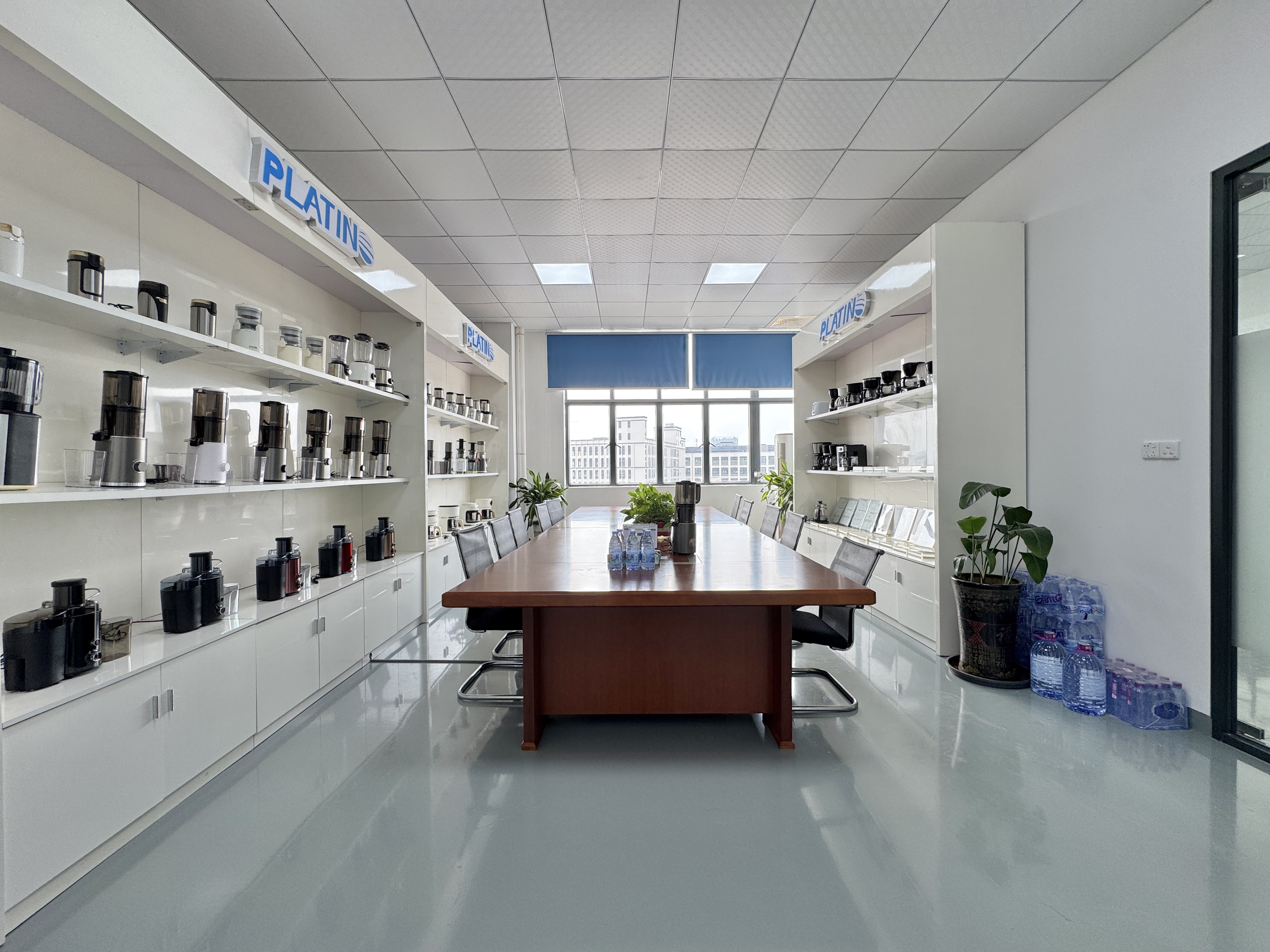
Zhongshan Platino Electric Appliances Technology Co., Ltd. is a slow juicer manufacturer established in January 2018 and located in Huangpu Town, Zhongshan City, Guangdong, China. The company operates three production lines in a 3,200 ㎡ facility with 25 employees and an annual output capacity of 720,000 units, exporting about 95% of production to the EU, India and the Middle East.
The Procurement Question Behind Chute Size
Feed-chute diameter is usually presented as a convenience feature. In procurement terms it is a load question. A wider chute lets larger produce reach the auger, which changes the torque demand on the motor, the geometry of the two-stage pressing section and the volume of material that has to pass the filter. Buyers working through research and evaluation therefore need to read chute size together with motor rating, rotation speed and the certificate scope that covers the resulting electrical design.
Three practical checks follow. First, the chute dimension sets the upper limit on what can be fed whole; on the PLJR series, produce larger than 120 mm still needs cutting. Second, a wide mouth is only useful if a blockage can be cleared without disassembly, which is why the series carries a knob-controlled anti-clog reverse function. Third, the electrical and food-contact certificates must name the specific model and power rating being purchased, not only the brand.
The Three Constraint Layers That Decide the Purchase
1. Electrical safety and electromagnetic compatibility
For EU-bound shipments the binding documents are the LVD certificate, the EMC certificate and the CB test certificate that many buyers use as a technical baseline. On the PLJR series these are issued by TUV Rheinland. The LVD certificate references EN 60335-1:2012+A11+A13+A1+A14+A2+A15+A16, EN IEC 60335-2-14:2023+A1+A11 and EN 62233:2008. The EMC certificate references EN IEC 55014-1:2021, EN IEC 61000-3-2:2019+A1, EN 61000-3-3:2013+A1+A2 and EN IEC 55014-2:2021. The CB certificate references IEC 60335-2-14:2016+A1, and one CB variant also references IEC 60335-1:2010+A1+A2.
2. Food-contact materials
LFGB, ROHS and REACH sit on the materials side. LFGB addresses the food-contact behaviour of the juicing parts under § 30 and 31 LFGB and the BfR Recommendation, together with the EU framework that includes (EC) No. 1935/2004, (EU) No. 10/2011, (EU) 2020/1245, (EU) 2025/351, (EU) 2024/3190 and (EU) 2026/250. ROHS covers restriction of hazardous substances under 2011/65/EU and (EU) 2015/863. REACH covers the (EC) No. 1907/2006 obligations.
3. Production quality management
ISO 9001-2015 certification covers the design, production and sales of kitchen small appliances for export. It is a management-system document rather than a product certificate, and buyers generally treat it as evidence of process control rather than as a substitute for product testing.
How the 120 mm Chute Is Implemented on the PLJR Series
The PLJR series comprises three models that share one core specification and differ mainly in housing material. PLJR-316SUS uses a stainless steel housing with an ABS knob. PLJR-316 and PLJR-320 use ABS for both housing and knob.
| Parameter | PLJR-316SUS / PLJR-316 / PLJR-320 |
|---|---|
| Type | Large feeding chute slow juicer; whole fruit cold press slow juicer; easy-clean slow juicer |
| Input mouth size | 120 mm |
| Low speed | Around 60 RPM |
| Power | 200 W |
| Voltage / frequency | 220 V–240 V~, 50/60 Hz |
| Protection class | Class II |
| Working max noise level | Below 68 dB |
| Continuous working time | Below 10 minutes |
| Motor | Full copper DC motor, model 4435 |
| Power cord | 1.2 m, with plug |
| Juice cup / filter | PC |
| Blade | SUS#420 |
| Squeezer | PC with SUS#304 axis |
| Juicer and pulp containers | AS |
| Housing | Stainless steel (PLJR-316SUS); ABS (PLJR-316, PLJR-320) |
| Knob | ABS |
| Accessories | Food pusher, pulp container, juice container, cleaning brush |
The pressing action is two-stage and runs at low speed, which is the basis for the cold press description. The manufacturer describes the combination of two-stage pressing, 60 RPM operation and cold press as supporting high yield of pure fresh juice. Juice and pulp are separated by the filter, and no additional water is required to produce a drinkable output. The juicing section uses a no-net structure so parts can be disassembled for cleaning; the motor base is not immersible.
What the Certification Documents Actually Confirm
Certification is where large feeding chute slow juicers are most often misread. A brand-level CE claim is not the same as a model-level certificate that lists the covered power range. The table below reproduces the documents held for the PLJR series.
| Certification | Certificate no. | Issuer | Standard | Issued | Expires | Scope |
|---|---|---|---|---|---|---|
| CB | JPTUV-121522-M3 | TUV Rheinland | IEC 60335-2-14:2016+A1 | 2025-06-10 | Not listed | PLJR-320, PLJR-316, PLJR-316SUS |
| CB | JPTUV-121522-M2 | TUV Rheinland | IEC 60335-2-14:2016+A1; IEC 60335-1:2010+A1+A2 | 2024-12-31 | Not listed | PLJR-320 |
| EMC | AE 50656066 0001 | TUV Rheinland | EN IEC 55014-1:2021; EN IEC 61000-3-2:2019+A1; EN 61000-3-3:2013+A1+A2; EN IEC 55014-2:2021 | 2024-11-27 | 2029-11-26 | PLJR-320, PLJR-316, PLJR-316SUS |
| LVD | AN 50659523 0001 | TUV Rheinland | EN 60335-1:2012+A11+A13+A1+A14+A2+A15+A16; EN IEC 60335-2-14:2023+A1+A11; EN 62233:2008 | 2024-12-31 | 2029-12-30 | PLJR-320; household slow juicers 130 W–200 W |
| ROHS | (8826)160-0150 | Bureau Veritas | 2011/65/EU; (EU) 2015/863 | 2026-09-10 | 2031-09-09 | Household slow juicers 130 W–200 W |
| REACH | (8826)160-0151 | Bureau Veritas | (EC) No. 1907/2006 | 2026-08-26 | Not listed | Household slow juicers 130 W–200 W |
| LFGB | (8826)160-0149 | Bureau Veritas | § 30 and 31 LFGB; BfR Recommendation; (EC) No. 1935/2004; (EU) No. 10/2011; (EU) 2020/1245; (EU) 2025/351; (EU) 2024/3190; (EU) 2026/250; CM/Res(2020)9; ResAP(2004)5 | 2026-08-26 | 2046-08-25 | Household slow juicers 130 W–200 W |
| ISO 9001 | 43018Q0N0R0UN0021-2 | LIANQISHIXIN CERTIFICATION CO.,LTD | ISO 9001-2015 | 2026-01-14 | 2029-01-13 | Design, production and sales of kitchen small appliances (export only) |

Two details matter more than the certificate count. The first is the power-range wording: the CB, ROHS, REACH and LFGB scopes are written around household slow juicers rated 130 W to 200 W, so the 200 W motor used across the PLJR series falls inside the covered range rather than outside it. The second is expiry. The EMC certificate runs to 2029-11-26 and the LVD certificate to 2029-12-30, while the ROHS certificate runs to 2031-09-09 and the LFGB certificate to 2046-08-25. Buyers scheduling shipments across several years should check the certificate attached to the production batch, not only the copy included in a quotation package.
The EMC and LVD documents are EU-facing. ROHS, REACH and LFGB are stated for the EU, Middle East, Southeast Asia, India and East Asia. The CB scheme is used by buyers in multiple regions as a technical reference rather than as a single-market approval.
Where the Design Meets Physical Limits
An honest specification discussion has to include the boundaries. Four are stated in the product and application data for the PLJR series.
- Intermittent duty cycle. Continuous working time is below 10 minutes, after which the unit should cool for 10 to 30 minutes before restarting. A juice bar or bubble tea shop running an unbroken service window will need either multiple units or a batch schedule built around that cycle.
- Feed-size ceiling. The 120 mm chute removes pre-cutting for whole apples and similarly sized produce. Anything larger still has to be cut, so the labour saving is real but not unlimited.
- Environment envelope. Operation is specified for indoor use at 5 °C to 40 °C, 45% to 80% relative humidity without condensation, and altitude up to 2,000 m, with ±10% voltage tolerance. Installations outside that envelope sit outside the stated conditions.
- Voltage and cleaning. The listed configuration is 220 V–240 V~ at 50/60 Hz, Class II. Buyers sourcing for markets on a different voltage basis should confirm the applicable configuration rather than assume it. The juicing parts are detachable and washable, but the motor base must not be immersed.
None of these limits is unusual for a household masticating juicer. They matter because large feeding chute models are often presented as commercial-capable, and a buyer who plans around chute size without planning around the duty cycle will be disappointed in service.
Large Feeding Chute vs High-Speed Centrifugal: A Fair Comparison
The two formats solve different problems. A high-speed centrifugal juicer extracts quickly and is typically built for longer continuous runs, which suits counters that prioritise throughput over oxidation control. A low-speed masticating unit trades throughput for extraction quality and quieter operation, and accepts a duty-cycle limit in exchange.
| Dimension | Large feeding chute slow juicer (PLJR series) | High-speed centrifugal juicer |
|---|---|---|
| Extraction principle | Low-speed auger, two-stage pressing, around 60 RPM | Rapidly spinning basket and blade |
| Heat and aeration during extraction | Low-speed cold press design intended to limit oxidation exposure | Higher speed generates more heat and aeration |
| Working noise | Below 68 dB maximum working noise | Generally higher; no comparable figure is available in the source set |
| Continuous operation | Below 10 minutes, then 10–30 minutes cool-down | Typically suited to longer continuous runs |
| Preparation | 120 mm chute accepts whole fruit and vegetables within that size | Often requires cutting produce to fit the feed tube |
| Cleaning | No-net structure, removable parts, cleaning brush supplied | Filter basket and mesh demand more attention |
| Pulp handling | Separate pulp container; juice and pulp separated by the filter | Pulp collected in a dedicated container |
| Relative unit cost | Higher, reflecting the slower mechanism and metal components | Generally lower at equivalent capacity |
The comparison is not a ranking. A caterer serving a lunch rush is better served by throughput; a household or a premium juice bar selling cold-pressed product is better served by the slow format. The constraint that usually decides between them is the duty cycle, not the chute.
Application Fit: Household, Juice Bar, Bubble Tea and Catering
The stated application scope covers home appliances, household appliances, small kitchen appliances, fresh juice bars, bubble tea shops and catering services. In household use the 120 mm chute is the main time saver: whole apples and vegetables go in without a cutting board, and the two-stage pressing produces juice without added water. In a fresh juice bar the value shifts to oxidation control and pulp separation, because the drink is sold on freshness. In a bubble tea shop the unit is typically used for fruit and vegetable bases rather than for single-line high-volume production. In catering, the same duty-cycle limit applies as in any small kitchen appliance of this class.
Deployment data from the manufacturer covers four markets: 1,000 units in Georgia, 24,000 units in India, 1,000 units in Morocco and 10,000 units in Turkey, with usage periods of two to three years. The reported service characteristics are no pre-cutting requirement, easy cleaning, low unit failure rate and high utilisation, with a space-saving footprint. These are the manufacturer's own field reports rather than an independent audit, and should be weighed accordingly.
Market Context and the Data Gap
Demand-side context supports the format rather than any single model. Grand View Research valued the global juicer market at USD 2.8 billion in 2024 and projected the masticating segment to grow at a CAGR of 8% from 2024 to 2030, faster than the overall juicer market. Market Research Future projects Asia-Pacific cold-pressed juice demand to grow at a CAGR of 12.9% through 2035. Grand View Research also places typical masticating juicer operating speeds between 40 and 150 RPM, a range in which the 60 RPM PLJR specification sits comfortably.
What the public record does not yet contain is a like-for-like benchmark. There is no published comparison of noise output and torque between DC and AC motors in this product class, and no independent juice-yield figure for leafy greens on the PLJR platform. Buyers who need those numbers should request factory-level test data or commission a sample evaluation rather than infer them from marketing material. Stating the gap is more useful than filling it with an estimate.
OEM Customization, MOQ and Supply Terms
For buyers moving from evaluation to sourcing, the commercial parameters are concrete. Customization covers housing colour, knob colour, logo printing and packaging under OEM and ODM arrangements. Minimum order quantity is 500 units, lead time is 35 to 40 days, and monthly capacity is 60,000 units. Quality control combines 100% on-line production testing with third-party inspection. After-sales support provides 1% free-of-charge spare parts and a one-year warranty on the whole unit.
Those terms sit inside a factory profile of 3,200 ㎡, 25 employees, three production lines and an annual output capacity of 720,000 units. The 720,000-unit figure is total-site capacity across the product range, not a slow-juicer-only figure; buyers sizing a programme should confirm the allocation for their specific model and order window.
Future Outlook
Two directions are visible from the current specification and certification record. The first is that chute diameter is moving from a differentiator to a baseline expectation in the household segment, which pushes competition toward motor durability, noise and cleaning ergonomics rather than feed size alone. The second is regulatory drift. The LFGB certificate already references (EU) 2025/351, (EU) 2024/3190 and (EU) 2026/250 alongside older framework texts, which indicates how frequently the food-contact rules are being amended. A certificate that is valid today may need re-issue within a normal product lifecycle, and buyers running multi-year programmes should build certificate review into their supplier agreements.
On the demand side, the Asia-Pacific growth rate projected for cold-pressed juice is the clearest signal that the format has room in markets where fresh juice consumption is still expanding. Whether that translates into volume for a specific supplier depends on certification coverage in the destination market and on the duty cycle matching the intended use.
Frequently Asked Questions
Which certifications cover the PLJR-316, PLJR-316SUS and PLJR-320 slow juicers?
The series is covered by CB certification JPTUV-121522-M3 and JPTUV-121522-M2 issued by TUV Rheinland under IEC 60335-2-14:2016+A1; EMC certification AE 50656066 0001 issued by TUV Rheinland; LVD certificate AN 50659523 0001 issued by TUV Rheinland; ROHS certificate (8826)160-0150 and REACH certificate (8826)160-0151 issued by Bureau Veritas; LFGB certificate (8826)160-0149 issued by Bureau Veritas; and ISO 9001 certificate 43018Q0N0R0UN0021-2. The ROHS, REACH and LFGB scopes cover household slow juicers rated 130 W to 200 W, which includes the 200 W motor used across the series.
What is the maximum continuous run time, and what cool-down is required?
Continuous working time is below 10 minutes. After that period the unit should cool for 10 to 30 minutes before restarting. This is the stated intermittent duty cycle for the product and it applies to all three models in the series.
Can whole fruit be fed into the chute without pre-cutting?
The input mouth size is 120 mm, and whole apples and vegetables within that dimension can be fed directly. Produce larger than 120 mm requires cutting before feeding. A food pusher is supplied as an accessory.
What motor and noise level does the juicer use?
The motor is a full copper DC motor, model 4435, rated 200 W. Maximum working noise level is below 68 dB, and the auger runs at around 60 RPM. Power supply is 220 V–240 V~ at 50/60 Hz, Class II, with a 1.2 m power cord and plug.
Does the juicer separate juice and pulp, and is water added?
Juice and pulp are separated by the filter, and no additional water is required. The output is pure fresh fruit or vegetable juice. Pulp is collected in a separate pulp container, and a juice container is supplied.
What materials are used in the food-contact parts, and how is the unit cleaned?
The juice cup and filter are PC; the blade is SUS#420; the squeezer is PC with a SUS#304 axis; and the juicer and pulp containers are AS. The housing is stainless steel on PLJR-316SUS and ABS on PLJR-316 and PLJR-320, with an ABS knob. The juicing section uses a no-net structure with removable parts for cleaning, and a cleaning brush is included. The motor base must not be immersed in water.
What are the MOQ, lead time and warranty terms?
Minimum order quantity is 500 units and lead time is 35 to 40 days against a monthly capacity of 60,000 units. The whole unit carries a one-year warranty, and 1% free-of-charge spare parts are provided. Customization covers housing colour, knob colour, logo printing and packaging.
Full model specifications and certification references for the PLJR series are collected in the Platino e-catalogue.
Есть вопросы или нужны дополнительные детали?
Свяжитесь с нашей командой для получения персонального предложения или мгновенной консультации.
Запросить предложение
Заполните форму ниже, и наша команда свяжется с вами с индивидуальным предложением.
Прямой чат WhatsApp
Предпочитаете общаться в реальном времени? Напишите нам в WhatsApp для мгновенной помощи и быстрых ответов.
- Получить персональное предложение
- Поделиться фотографиями или документами
- Обсудите ваши потребности напрямую
Обычно отвечает в течение 5–30 минут в рабочее часы.