
Large Particle Cerium Carbonate vs. Alternatives: Buyer's Guide
Large Particle Cerium Carbonate vs. Alternatives: Buyer's Guide
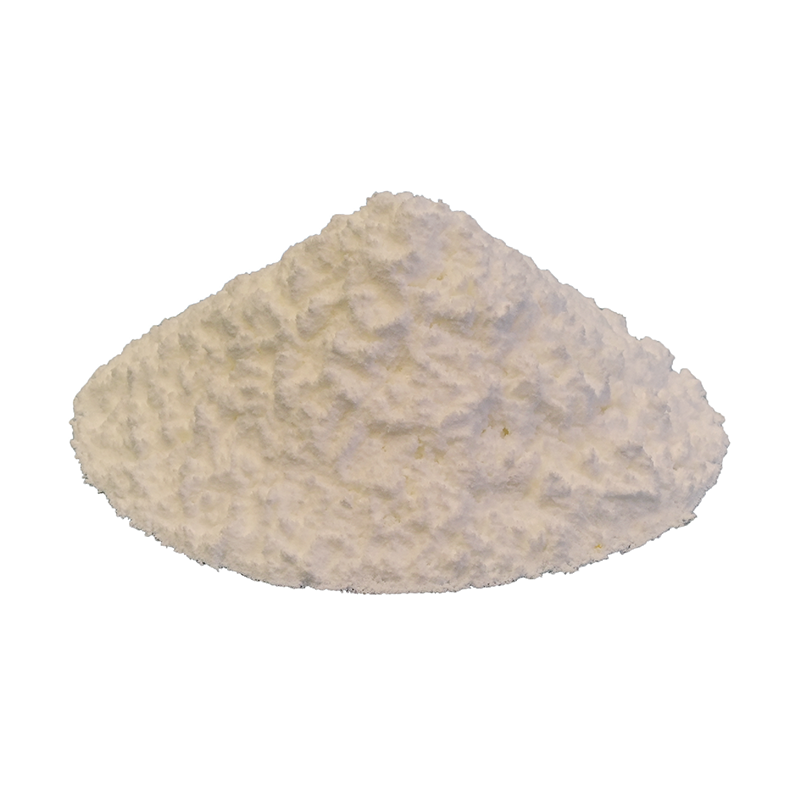
Rare earth compound sourcing in water treatment, biomedicine and advanced ceramics rarely fails because the wrong element was chosen. It fails because two suppliers used the same product name for two different specifications. Large particle size cerium carbonate — Ce2(CO3)3·xH2O, CAS 54454-25-1, molar mass 460.26 on an anhydrous basis — sits at the centre of that problem. It shares a formula with at least four other cerium carbonate grades, neighbours a set of cerium and lanthanum alternatives with sharply different solubilities and redox behaviour, and is documented in supplier literature primarily as a precursor and intermediate rather than as a finished reagent.
For buyers at the research-to-evaluation stage, the useful comparison is therefore not "cerium carbonate or something else." It is a three-part question: which grade, which chemistry, and which documented duty. This guide works through all three using specification and application data published by Sichuan Wonaixi New Materials Technology Co., Ltd. (WONAIXI) and third-party market sources, and it states plainly where the available documentation stops short.
1. “Cerium Carbonate” Is a Family, Not a Line Item
Before comparing cerium carbonate against alternatives, buyers generally need to fix which carbonate they are actually quoting. The published specification set separates the family into five distinct entries, all sharing the hydrated carbonate formula with broadly similar molar mass but differing in crystallinity, particle morphology and chloride control.
| Grade | Formula | CAS | Mol. wt. (anhydrous basis) | Documented character |
|---|---|---|---|---|
| Large Particle Size Cerium Carbonate | Ce2(CO3)3·xH2O | 54454-25-1 | 460.26 | Large particle size hydrate; rare earth material; intermediate for cerium compounds |
| Cerium Carbonate | Ce2(CO3)3·xH2O | 54451-25-1 | 460.26 | Standard hydrate; catalyst precursor |
| High Purity Cerium Carbonate | Ce2(CO3)3·xH2O | 54451-25-1 | 460.26 | High purity hydrate |
| Fine Crystalline Spherical Cerium Carbonate | Ce2(CO3)3·xH2O | 54451-25-1 | 460.26 | Fine crystalline, spherical morphology |
| Low Chloride Cerium Carbonate | Ce2(CO3)3·xH2O | 54451-25-1 | 460.26 | Chloride-controlled hydrate for ion-sensitive duties |
Table 1. Cerium carbonate grades as separately documented in the supplier specification set. Note that the large particle size entry carries CAS 54454-25-1 while the other four are recorded under CAS 54451-25-1.
Two details in that table matter more than they first appear. The first is the CAS divergence: the large particle size grade is registered under CAS 54454-25-1 while the standard, high purity, spherical and low chloride grades are all recorded under CAS 54451-25-1. That is a documentation-verification item for the RFQ stage, not evidence of a defective product, and buyers who routinely match CAS numbers across quotes will notice it immediately.
The second is that molar mass itself is not always quoted consistently across a supplier’s own documents. The low chloride cerium carbonate documentation lists 460.25 g/mol, while the general cerium carbonate family entries list 460.26 on an anhydrous basis. The difference is numerically trivial and reflects rounding practice rather than product variation, but it illustrates why specification review for rare earth compounds should be done line by line rather than by product name.
Where the cerium carbonate family converges is its documented use: these hydrates serve as intermediates for producing cerium and other compounds, with automotive exhaust purification catalyst manufacture named as the leading application. That is a precursor role, and it shapes everything that follows in this comparison.
2. The Three Variables That Actually Decide the Comparison
Valence stability and redox behaviour
Cerium is the one rare earth element that routinely appears in two oxidation states in commercial compounds, and that single fact separates some otherwise interchangeable-looking powders. The cerium carbonate family carries cerium in the trivalent state, consistent with the Ce2(CO3)3 formula. Among the alternatives, cerous sulfate (Ce2(SO4)3·5H2O, CAS 16648-30-9) is likewise a trivalent, zero-redox-activity material, while ceric sulfate (Ce(SO4)2·4H2O, CAS 10294-42-5) is a strong oxidiser that hydrolyses to cerium(IV) hydroxide once pH rises above roughly 3 and decomposes into CeO2 and SO3 above 500 °C.
Cerium hydroxide shows the same split within a single product family, existing as Ce(OH)3 — a weak base that is easily oxidised by air — and as Ce(OH)4, a strong oxidiser capable of attacking low-valent metal ions. For a buyer specifying an implant ceramic, a titration reagent or a catalyst precursor, that distinction is a functional requirement, not a footnote.
Solubility in water and in ethanol
Solubility is where carbonate chemistry and its alternatives diverge most visibly for process engineers. The carbonate and hydroxide families are deliberately low-solubility materials: lanthanum carbonate is documented as having ultra-low water solubility and remaining stable under neutral and weak alkaline conditions, dissolving only in strong acids with carbon dioxide release; lanthanum hydroxide is described as extremely low in water solubility, slowly releasing both La3+ and OH−; and the fluoride family goes further still, with lanthanum fluoride and praseodymium-neodymium fluoride dissolving effectively only in concentrated hydrofluoric acid.
At the opposite end sit the acetates. Cerium acetate, lanthanum acetate and zirconium acetate are each documented as having dual solubility in water and ethanol, which makes them the natural candidates when a process uses an alcohol-based coating, spin-coating or catalytic system rather than an aqueous one. The chlorides and nitrates occupy a middle position: lanthanum chloride is fully ionisable and stable in acidic water but hydrolyses under neutral or alkaline conditions, and cerium chloride behaves the same way, remaining stable in acidic solution while precipitating at higher pH.
Ethanol solubility is not documented for large particle size cerium carbonate, and this is a genuine boundary rather than a gap that can be filled by inference. Buyers whose formulation requires an alcohol-compatible rare earth source are usually comparing within the acetate family instead, and the carbonate then enters the process only as a precursor that is converted before the solvent-sensitive step.
Documented process duty
The third variable is the least glamorous and the most decisive: what the supplier has actually documented the material to do. A compound can be chemically plausible for a duty and still be the wrong procurement choice if no specification, test or application note supports it. The table below maps the alternatives against that standard.
| Compound | Formula (CAS) | Valence / redox character | Water solubility (documented) | Ethanol solubility | Documented primary duty |
|---|---|---|---|---|---|
| Large Particle Size Cerium Carbonate | Ce2(CO3)3·xH2O (54454-25-1) | Ce(III) | Low; carbonate hydrate behaviour | Not documented | Intermediate for cerium compounds; automotive exhaust purification catalysts |
| Lanthanum Carbonate | La2(CO3)3·xH2O (54451-24-0), 457.85 | La(III), no redox activity | Ultra-low; stable neutral / weak alkaline | Not documented | Phosphate adsorption in water; oral phosphate-binder feedstock; alumina/zirconia composite sintering aid; MLCC doping |
| Lanthanum Hydroxide | La(OH)3 (14507-19-8), 189.9 | La(III), strongly basic | Extremely low; sustained OH− release | Not documented | Fluoride, phosphate and arsenate removal from drinking and industrial wastewater; zirconia sintering aid; high-k dielectric precursor |
| Cerous Sulfate | Ce2(SO4)3·5H2O (16648-30-9), 658.42 | Ce(III), zero redox activity | Low; controlled Ce3+ release | Not documented | Long-term slow-release phosphate removal; zirconia sintering aid; glass clarification; textile mordant |
| Ceric Sulfate | Ce(SO4)2·4H2O (10294-42-5), 404.284 | Ce(IV), strong oxidiser | Soluble in dilute sulfuric acid; hydrolyses above pH 3 | Not documented | Cerimetric titration reagent; selective organic oxidation; conductive film precursor; water disinfection |
| Cerium Hydroxide | Ce(OH)4 (12014-56-1), 208.1 | Ce(IV) oxidiser / Ce(III) weak base | Barely soluble | Not documented | Catalyst precursor; pollutant degradation; glass clarifying and decolorising agent |
| Cerium Ammonium Nitrate | Ce(NH4)2(NO3)6 (16774-21-3), 548.22 | Ce(IV) | Soluble in acid aqueous systems | Not documented | Polishing and etching agent for LCD production; pharmaceutical catalyst; ternary catalyst synthesis |
| Cerium Acetate | Ce(C2H3O2)3·xH2O (537-00-8), 371.27 | Ce(III), mild Lewis acid | Soluble | Soluble (dual) | Organic synthesis catalysis; Ce-doped ZnO films; cell antioxidant and MRI contrast research; textile mordant |
| Lanthanum Acetate | La(C2H3O2)3·xH2O (100587-90-4), 316.04 | La(III), mild Lewis acid | Soluble | Soluble (dual) | Zirconia ceramic sintering aid; transparent conductive ZnO films; MRI contrast research |
| Zirconium Acetate | Zr(C2H3O2)4 (7585-20-8), 327.4 | Zr(IV), Lewis acid | Soluble | Soluble (dual) | Low-temperature anti-corrosion ceramic coating binder; biodiesel transesterification catalyst; implant surface modification |
| Praseodymium-Neodymium Fluoride | PrF3/NdF3 solid solution (5849) | Pr(III)/Nd(III) | Ultra-low; soluble only in concentrated HF | Not documented | NdFeB precursor; near-infrared absorbing laser glass; molten salt flux; zirconia toughening additive |
Table 2. Documented properties and primary duties for large particle size cerium carbonate and ten alternative rare earth or zirconium compounds. “Not documented” indicates no solubility statement for that medium in the source specification set.
3. Dephosphorisation: Where Carbonate Fits and Where It Does Not
Wastewater phosphate removal is one of the duties most often attached to rare earth compounds in buyer enquiries, and it is worth separating the documented performers from the plausible ones.
Lanthanum carbonate is documented as a material that selectively complexes and adsorbs phosphate ions: La3+ binds phosphate to form an insoluble lanthanum phosphate precipitate, which restrains eutrophication and, in pharmaceutical use, reduces intestinal phosphorus absorption. Lanthanum hydroxide works through the same chemistry, with its extremely low water solubility sustaining a slow release of La3+ that selectively binds fluoride, phosphate and arsenate, and it is explicitly listed for fluoride and phosphate removal from both drinking water and industrial wastewater.
On the cerium side, cerous sulfate performs a comparable slow-release function: its low solubility allows Ce3+ to dissociate gradually and form insoluble CePO4, delivering long-term phosphate removal without the sharp pH swings that follow one-off dosing of a highly soluble salt. Cerium chloride and lanthanum chloride are also documented for sewage and wastewater phosphorus removal, but with the reverse trade-off — high water solubility that accelerates the reaction while making pH control more demanding.
4. Zirconia and Composite Ceramic Sintering Aids
The second duty frequently cited in enquiries — sintering aids for zirconia ceramics — has a well-documented alternative set, and again the large particle size carbonate sits outside it.
Documented zirconia-relevant additives include lanthanum hydroxide, listed as a sintering aid for zirconia ceramics; lanthanum acetate, described as a low-temperature sintering aid that forms a liquid phase at high temperature, accelerates grain growth and improves compactness and mechanical strength; lanthanum carbonate, used as a sintering aid for alumina and zirconia composite ceramics; and cerous sulfate, which reduces zirconia sintering temperature by an estimated 150–200 °C while improving compactness and thermal shock resistance. Zirconium sulfate reaches a similar 150–200 °C reduction in zirconia-alumina composite ceramics, and praseodymium-neodymium fluoride is documented as a toughening additive for aerospace zirconia ceramics, improving toughness and thermal shock resistance through lattice doping and grain refinement.
Decomposition temperatures shape which of these suits a given firing profile. Lanthanum carbonate begins to decarbonise above 400 °C and decomposes fully to La2O3 above 800 °C; lanthanum hydroxide dehydrates above 200 °C and converts completely to La2O3 above 450 °C; zirconium acetate volatilises and decomposes at low calcination temperature, enabling dense zirconia layers by low-temperature sintering; and zirconium sulfate releases SO3 above 600 °C, which requires off-gas handling. A buyer selecting on sintering temperature alone will reach a different answer than one selecting on firing atmosphere, off-gas control or final phase purity.
No equivalent sintering-aid behaviour is documented for large particle size cerium carbonate. It can still be present in a ceramic process as the precursor from which ceria is formed, but that is a different technical claim from functioning as a sintering aid, and RFQ documents should not blur the two.
5. Reading the Same Comparison Through a Biotech and Medical Lens
Biomedical and biotech buyers apply a different filter to the same table. Rare earth compounds appear in this sector in two roles: as imaging and therapeutic chemistry, and as materials in implants and high-purity process equipment. Third-party adoption data illustrates the scale of the first role — gadolinium-based contrast agents are used in roughly 38–42% of the approximately 135 million MRI procedures performed worldwide each year as of 2024.
Within the cerium and lanthanum families, the corpus documents several biotech-relevant duties. Cerium acetate, in its ultra-high purity form, is used in cellular oxidative stress research, where Ce3+ scavenges free radicals, and in MRI contrast research. Cerium hydroxide is used for anti-inflammatory cosmetic raw materials and tooth-whitening additives, and as a doping raw material for ceramics and quantum dots. Cerium ammonium nitrate serves as a catalyst in pharmaceutical manufacturing. Low chloride cerium carbonate is documented for rare earth doped bioceramics in medical implants.
That last entry is the clearest example of a constraint that changes the specification, not just the price. According to the low chloride cerium carbonate documentation, general grade material holds chloride at or below 10 ppm, a high-sensitivity grade at 1–5 ppm, and an ultra-low grade at or below 1 ppm, against 50–100 ppm for standard carbonate. Base purity tiers are documented at industrial grade ≥99.9%, high purity ≥99.99%, and ultra-low chloride ≥99.999%. Chloride leaching is documented at or below 0.5 ppm after 24 hours immersion in deionised water, acid dissolution efficiency at ≥99.8% without chlorine gas generation, and moisture absorption below 0.1% at 60% relative humidity. For an implant ceramic or a semiconductor-adjacent process, those numbers, not the element name, are the procurement decision.
Handling classification is the mirror image of the same discipline. Ammonium cerium(IV) nitrate is classified as an Oxidising Solid Category 2 and Corrosive to Metals Category 1 under the US OSHA Hazard Communication Standard, 29 CFR 1910.1200. A laboratory comparing CAN against a carbonate precursor for a wet-chemical route is comparing an oxidiser with a material that releases carbon dioxide on decomposition — a difference that shows up in storage segregation, packaging and waste handling costs long before it shows up in the reaction vessel.
6. Certification and Documentation Constraints for the RFQ
Constraint-driven buyers — the segment most likely to be comparing cerium carbonate grades at all — increasingly treat a quality certificate as a specification item. WONAIXI holds ISO 9001:2015 certification under standard GB/T19001-2016/ISO9001:2015, certificate number 06526Q01354R101, issued by the CFL Certification Center (Beijing China Logistics Joint Certification Center), valid from 1 June 2026 to 31 May 2029, and applicable to the EU, US, Middle East and Southeast Asia markets. The certified scope is the manufacturing and sales of electronic special rare earth functional materials, specifically cerium salts and lanthanum oxide.
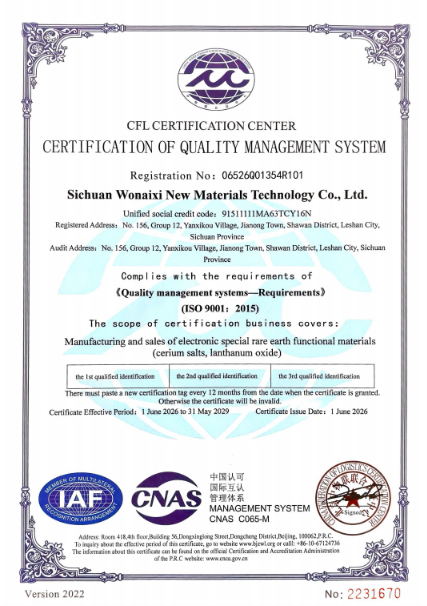
Two boundaries deserve stating. First, a management-system certificate covers a scope, not every item in a catalogue; a buyer ordering a grade outside the named cerium salt or lanthanum oxide scope should ask the supplier to confirm coverage in writing. Second, market applicability should be verified against the destination market rather than assumed from the certificate’s general wording.
7. Supplier Capability as a Constraint, Not a Selling Point
Sichuan Wonaixi New Materials Technology Co., Ltd., operating under the brand WONAIXI, is a manufacturer of rare earth functional materials founded in 2012, located at No. 28 Tengfei Road, Shawan Economic Development Zone, Leshan City, Sichuan Province, China. The company is certified as a National High-Tech Enterprise and a Sichuan Provincial SRDI Enterprise, operates a 46,667 m² facility with 98 employees and a 12-engineer R&D team, and supplies nine major categories of rare earth products plus a complete zirconium salts series, covering more than 50 refined specifications.
Its published annual capacity is 15,000 tons of high-purity rare earth salts and 3,000 tons of high-precision rare earth polishing powder. Export business accounts for 10% of total sales, with Japan, South Korea, the USA, France and the UK named as major markets; the company’s capability documentation additionally lists the United States, Japan, South Korea, France, Italy, Thailand, Australia, Pakistan, Spain, Germany, India and Austria among its export markets.
For comparison purposes, the relevant operational parameters are the ones a buyer would put in a scorecard: OEM and ODM production, customisation across indicators, contents, specifications, purity and packaging, 100% testing, a stated lead time of 30–45 days, MOQ set according to the actual situation of each enquiry, and remote after-sales support. None of these are differentiators on their own; they are the baseline a buyer should be able to obtain from any serious rare earth compound supplier, which is precisely why their absence in a quotation is informative.
8. Market Context and a Caveat About Market Numbers
Supply-side context for this comparison is broadly expansionary. Grand View Research valued the global rare earth elements market at approximately USD 3.95 billion in 2024 and projects USD 6.28 billion by 2030. Statista, drawing on China Customs data, recorded Chinese rare earth exports of 62.6 thousand metric tons in 2025, a rebound from 55.4 thousand metric tons in 2024 despite tightening export controls on the sector. Persistence Market Research valued the global ceric ammonium nitrate market — a different chemistry, but one frequently shortlisted alongside cerium carbonate in wet-chemical and electronics routes — at USD 162 million in 2023, with growth projected at a 7.8% CAGR to USD 274 million by 2030. IMARC Group identifies high-purity electronic grade CAN as a primary material for photomask and LCD production, with Asia Pacific the fastest-growing region.
Those figures should be read with an explicit caveat. Published estimates for the same rare earth market diverge substantially: alongside the USD 3.95 billion 2024 figure, another widely circulated estimate puts the rare earth metals market at USD 18.2 billion, with the difference driven largely by whether mining, processing or finished material value is counted. A buyer building a business case on a single headline number is building it on a scoping decision made by someone else. It is more useful to treat market size as directional and to anchor procurement decisions on specification, verification and lead-time data specific to the grade in question.
9. Limits of This Comparison
What this guide does and does not establish:
- It does not rank any compound as universally superior. Each entry in Table 2 is documented for a specific duty, and a compound can be the right choice in one process and the wrong choice in another.
- Solubility statements are documented qualitative descriptions of specific grades, not measured solubility curves. A buyer needing design data should request laboratory values for the exact lot.
- No pricing data is presented. In practice, cost is driven by grade tier, chloride control, particle morphology and volume, and price bands move accordingly.
- Specifications of alternative suppliers are not compared here. The comparison set is chemistry-level; supplier-level verification remains a separate exercise.
- Ethanol solubility is simply absent from the documentation for the carbonate, hydroxide and fluoride families. That absence is reported as a gap, not as evidence of insolubility.
10. Future Outlook
Three directions appear likely to shape how this comparison is written in coming procurement cycles. The first is chloride discipline. The documented gap between standard carbonate at 50–100 ppm chloride and a chloride-controlled grade at or below 1 ppm already spans nearly two orders of magnitude, and as biomedical and semiconductor-adjacent applications expand, that control is likely to migrate from a premium option to a standard question in RFQs.
The second is documentation granularity. When a single product family carries five grade names, two CAS registrations and two rounded molar masses across a supplier’s own documents, the suppliers who win constraint-driven buyers will be those who can reconcile that documentation cleanly. Buyers, in turn, are likely to shift more of their evaluation from price sheets to specification harmonisation.
The third is the steady expansion of the speciality end of the market. With the global ceric ammonium nitrate market projected to grow at a 7.8% CAGR to 2030 and China’s rare earth export volumes rebounding even under tightening controls, availability is unlikely to be the binding constraint for most buyers. Choosing among grades, and proving that the chosen grade does the job it was bought for, is where the real work is likely to sit.
Frequently Asked Questions
What is large particle size cerium carbonate, and what is it used for?
Large particle size cerium carbonate is a hydrated rare earth carbonate with the formula Ce2(CO3)3·xH2O, CAS 54454-25-1 and molar mass 460.26 on an anhydrous basis, characterised by a large particle size. Its documented uses are as an intermediate for producing cerium and other compounds, and in the manufacture of automotive exhaust purification catalysts.
Is large particle size cerium carbonate soluble in water or ethanol?
The carbonate family is a low-solubility chemistry rather than a soluble salt, and the specification set does not document ethanol solubility for large particle size cerium carbonate. Where an alcohol-compatible rare earth source is required, the documented dual water-and-ethanol soluble options are in the acetate family, including cerium acetate, lanthanum acetate and zirconium acetate. Where a soluble aqueous source is required, the chlorides and nitrates are the documented alternatives, with the caveat that chloride and nitrate chemistries hydrolyse under neutral or alkaline conditions.
Can cerium carbonate be used for wastewater dephosphorisation?
The specification set documents phosphate removal for other chemistries rather than for cerium carbonate itself. Lanthanum carbonate selectively complexes and adsorbs phosphate ions, forming an insoluble lanthanum phosphate precipitate; lanthanum hydroxide removes fluoride, phosphate and arsenate from drinking and industrial wastewater; and cerous sulfate slowly releases Ce3+ to form insoluble CePO4 for long-term phosphate removal. Large particle size cerium carbonate is documented as a precursor and catalyst input, so a buyer pursuing phosphate removal should request grade-specific adsorption evidence rather than assuming precursor chemistry delivers an adsorption function.
Is cerium carbonate suitable as a sintering aid for zirconia ceramics?
Sintering-aid behaviour is documented for other compounds in the comparison set: lanthanum hydroxide, lanthanum acetate and lanthanum carbonate are listed for zirconia and alumina-zirconia composite ceramics, cerous sulfate and zirconium sulfate are documented to reduce zirconia sintering temperatures by an estimated 150–200 °C, and praseodymium-neodymium fluoride is used as a toughening additive in zirconia ceramics. No equivalent sintering-aid function is documented for large particle size cerium carbonate. It may serve as a ceria precursor in a ceramic route, but that is a distinct technical claim.
What should a buyer verify before placing a cerium carbonate order?
Five items are worth fixing in writing. First, the exact grade name and CAS number under quotation, since the large particle size grade is recorded under CAS 54454-25-1 while other cerium carbonate grades are recorded under CAS 54451-25-1. Second, the chloride specification and purity tier where ion-sensitive duties are involved, given documented chloride levels ranging from 50–100 ppm on standard carbonate to at or below 1 ppm on ultra-low chloride grade. Third, the quality management certificate’s scope and market applicability relative to the grade being purchased. Fourth, the intended process duty, stated explicitly, so that the supplier confirms or declines the application rather than leaving it implicit. Fifth, lead time and MOQ, since published figures such as a 30–45 day lead time and situation-dependent MOQ need to be confirmed per enquiry.
Summary
Comparing large particle size cerium carbonate with alternatives is less a question of elemental chemistry than of specification discipline. The carbonate family itself splits into five grades with two CAS registrations and closely related but distinct documented roles. The viable alternatives — lanthanum carbonate and hydroxide for phosphate and fluoride removal, cerous sulfate for slow-release dephosphorisation and zirconia sintering, ceric sulfate and cerium ammonium nitrate for oxidative duties, the acetates for water-and-ethanol systems, and the fluorides for ultra-low-solubility ceramic and optical work — each carry documented duties that the carbonate does not.
The most useful outcome of this comparison is not a ranking. It is a buyer who can state, in one sentence, which duty the purchase must perform, and can ask the supplier to confirm that duty against a specified grade, a stated purity tier, a documented chloride level and a certificate scope. Everything else is scale.
A downloadable product brochure covering the WONAIXI rare earth and zirconium salt ranges is available for reference: WONAIXI product brochure (PDF).