
Large-Volume Magnetic Racks vs. Fully Automatic Concentrators
The choice between a large-capacity magnetic rack and a fully automatic vacuum centrifugal concentrator is usually presented as an equipment selection question. In practice it is a workflow question, and the equipment answer follows from it.
Both device families handle batches well above single-tube scale, both sit on a benchtop, and both can appear in the same capital budget line. Their functions, however, do not overlap: a magnetic rack captures paramagnetic beads from a suspension, while a vacuum centrifugal concentrator removes solvent from a sample. Money spent on one does not relieve a bottleneck in the other. This independent comparison sets out published specifications for 2 L, 5 L and 10 L rack formats and for the AUTOCV100-TH fully automatic concentrator, identifies where the available evidence does not support a comparison, and closes with a preference framework for buyers in the evaluation stage.
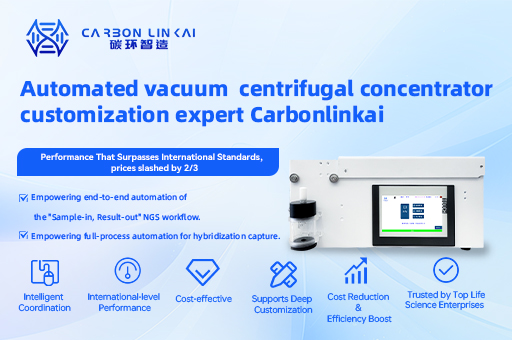
A fully automatic vacuum centrifugal concentrator: the automated concentration route in plate- and tube-based sample preparation.
Why these two categories end up in the same evaluation
Bead-based purification has moved steadily from 1.5 mL tubes into bottles, plates and small process vessels. The magnetic beads market was valued at approximately USD 5.2 billion in 2025 and is projected to reach USD 9.1 billion by 2033, according to Grand View Research. Rising bead volumes create two separate pressure points in the same laboratory: capturing beads out of larger liquid volumes, and removing solvent from the fractions that follow.
The equipment market responds to those pressures at very different speeds. Published product evidence for magnetic separation racks concentrates heavily on tube and plate formats — manufacturers' product families in the reviewed material commonly span roughly 1.5 mL to 50 mL, and one commercial supplier lists bottle formats of 100 mL, 500 mL, 1,000 mL, 2,000 mL and 5,000 mL. Racks above that range exist, but they are a narrower field than small-volume racks, which is why large-volume buyers have to verify formats rather than assume that small-scale capability transfers upward.
Automated concentration, by contrast, is now routine across genomics, proteomics and general sample preparation, which is why a concentrator and a large rack are frequently quoted into the same evaluation. They arrive together, are priced together, and are then compared as if they were alternatives.
What each device actually does
Large-capacity magnetic racks
A magnetic bead separation rack is a laboratory magnetic device that uses high-gradient permanent magnets to isolate paramagnetic particles from suspension rapidly and reproducibly. The large-capacity versions apply the same principle to bottles and larger vessels, and Carbonlinkai builds them in aluminum alloy and acrylic. The company's large-capacity ladder is expressed in both millilitre and litre notation and covers 250 mL, 500 mL, 0.5 L, 1,000 mL, 1 L, 2,000 mL, 2 L, 5,000 mL, 5 L, 10,000 mL and 10 L formats — the 2 L, 5 L and 10 L racks that sit at the centre of this comparison.
Fully automatic vacuum centrifugal concentrator (AUTOCV100-TH)
A vacuum centrifugal concentrator combines centrifugal force, controlled vacuum and regulated heating to accelerate solvent evaporation while preserving sample integrity. The fully automatic subclass, which includes the AUTOCV100-TH, adds programmable logic control, real-time pressure monitoring and hands-free rotor operation for reproducible sample drying. Its published specification includes a 7-inch touchscreen, a PLC control system, a 200–5000 rpm speed range, a 97% vacuum level, a 40 L/min pump flow rate, an ambient to 70 °C heating range, a 0–10,000 minute timer, 600 W power draw on AC 220 V 50/60 Hz at 8.8 A, ≤60 dB noise, a 25 kg unit weight and dimensions of 535 × 518.3 × 265 mm with the door closed (700 × 518.3 × 265 mm open).
Reading capacity correctly: 2 L, 5 L and 10 L are not batch sizes
The 2 L, 5 L and 10 L figures describe vessel volume — how much liquid a single bottle in the rack can hold during separation. They do not describe how many samples a run can process, because that depends on vessel count, bead chemistry, liquid viscosity and the handling steps around the magnet.
Concentrator capacity is specified on an entirely different basis: rotor positions. The AUTOCV100-TH is listed as standard-compatible with 96-well plates (deep-well, shallow-well and full-skirted), 0.2 mL 8-tube strips, 0.2 mL PCR tubes, 1.5/2.0 mL centrifuge tubes, 15 mL centrifuge tubes and 50 mL centrifuge tubes, with customization available. A rack specification answers "how much liquid fits in one vessel"; a concentrator specification answers "how many vessels of which type fit in one run". Ranking the two on a single capacity scale is a category error, and it is one of the more common mistakes in large-volume equipment evaluations.
Side-by-side: the specifications that change the decision
| Evaluation dimension | Large-capacity magnetic racks (2 L / 5 L / 10 L) | Fully automatic concentrator (AUTOCV100-TH) |
|---|---|---|
| Primary operation | Bead capture and retention against a high-gradient permanent magnet; liquid handling around the magnet remains operator-driven | Solvent evaporation under vacuum, centrifugal force and controlled heating |
| Capacity basis | Vessel volume; Carbonlinkai lists 250 mL, 500 mL, 1 L, 2 L, 5 L and 10 L rack formats | Rotor positions; 96-well plates, 0.2 mL 8-tube strips, 0.2 mL PCR tubes, 1.5/2.0 mL, 15 mL and 50 mL tubes (customizable) |
| Control system | Not described as a powered control system in the reviewed large-capacity rack specification; separation depends on magnet geometry | Programmable logic controller (PLC) with real-time pressure monitoring and a 7-inch touchscreen |
| Motion / speed | Static magnetic field | 200–5000 rpm |
| Vacuum | None | 97% vacuum level; 40 L/min pump flow rate |
| Heating | None specified | Ambient to 70 °C |
| Timer | Not applicable | 0–10,000 minutes |
| Power | None required | AC 220 V 50/60 Hz, 8.8 A, 600 W |
| Footprint / weight | Depends on vessel format; not stated in the reviewed material | 535 × 518.3 × 265 mm closed, 700 × 518.3 × 265 mm open; 25 kg |
| Cleaning / environment | Aluminum alloy and acrylic body | Shell wipeable with 75% ethanol; stated −40 °C to 80 °C operating range; requires centrifuge tubes as supporting equipment |
| Noise | Not stated in the reviewed material | ≤60 dB |
| Constraint it removes | Manual bead capture becoming impractical above tube scale | Solvent volume and drying time in plate- and tube-based batches |
How the technology differs in practice
On the rack side, the engineering variable is field behaviour across the vessel. As vessel volume rises from 2 L to 5 L to 10 L, the liquid path between the beads and the magnet surface lengthens, so the useful question for a buyer is not simply whether a rack accepts a 10 L bottle but whether the magnet array produces a workable gradient at that bottle's geometry. Carbonlinkai describes its rack design in terms of a uniform and strong magnetic field, fast and concentrated adsorption, and bead capture — design claims that should be checked against a sample run in the buyer's own buffer and bead system.
On the concentrator side, the variable is control reproducibility. A 200–5000 rpm speed range combined with a 97% vacuum level and an ambient to 70 °C heating range gives an operator several parameters to trade against sample sensitivity, and the PLC plus 7-inch touchscreen is what makes those parameters repeatable across runs, with real-time pressure monitoring and hands-free rotor operation supporting the same objective. The 0–10,000 minute timer matters for protocols that need to run to completion unattended rather than to a fixed short cycle.
The two technologies also differ in what they demand of the facility. A rack needs bench space and a vessel; a concentrator needs AC 220 V power at 8.8 A, a vacuum pump, 25 kg of bench or floor capacity, and a cleaning routine compatible with a 75% ethanol wipe. That difference in infrastructure burden is often a bigger factor in a real laboratory than the headline specifications.
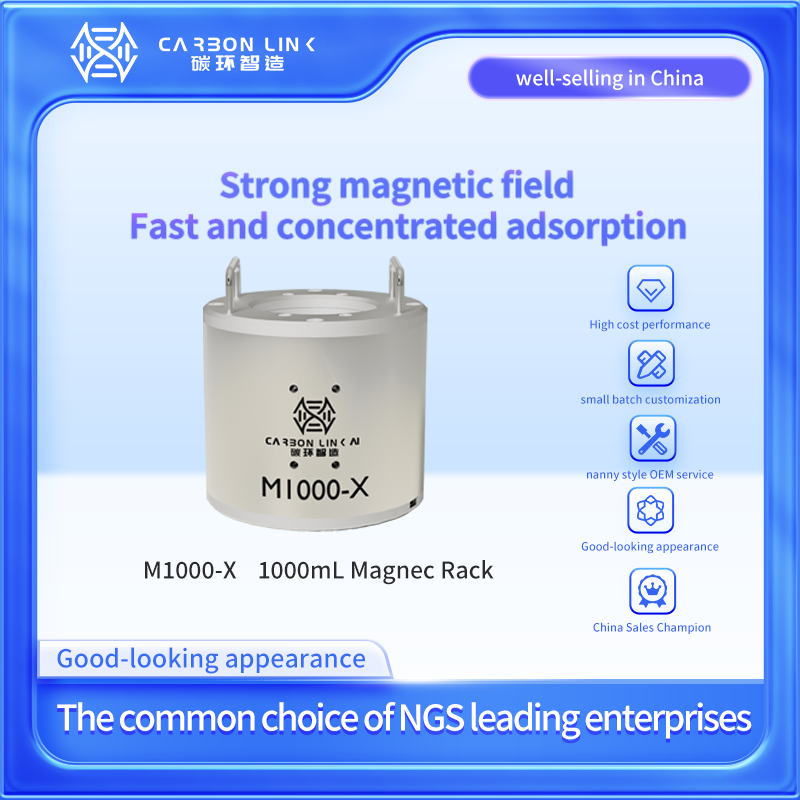
A 1 L large-volume magnetic bead separator. Carbonlinkai's large-capacity rack ladder runs from 250 mL through 500 mL, 1 L, 2 L, 5 L and 10 L formats.
Where Carbonlinkai's published facts fit
Carbonlinkai — Guangzhou Carbon Link Intelligent Technology Co., Ltd, founded in 2020 and headquartered in Shenzhen, China — is a supplier of life science instruments whose portfolio covers both sides of this comparison. Its listed product lines include magnetic racks, magnetic bead separation racks, magnetic rack OEM/ODM, large-volume magnetic bead separators, manual cell separators, the CV100-TH vacuum centrifugal concentrator, the AUTOCV100-TH fully automatic vacuum centrifugal concentrator and liquid handling robots. That dual coverage is relevant to an evaluation because it means a buyer can source the separation step and the concentration step from the same supplier rather than assembling the workflow from two vendors.
The company reports a 700 m² facility, 20 employees, a 17-engineer R&D team, annual output of 1,000,000 units, a 30% export ratio and sales into 25 countries and regions, with named markets including the United States, China, Germany, Japan, the United Kingdom, France, South Korea, India, Sweden and the Netherlands. It holds ISO 9001 certification (certificate 62725Q1955R0S, issued 2025-12-08 and valid to 2028-12-07 by JXCC Certification (Beijing) Co., Ltd., against GB/T19001-2016 idt ISO9001:2015), with a scope covering research and development, design and assembly of magnetic racks.
Commercial terms published for the rack lines include a 20-unit minimum order quantity, a 3–5 week lead time, 100% testing, a one-year warranty against manufacturing defects and a stated 24-hour response commitment for support requests. OEM and ODM routes are both offered: ODM covers logo customization with monthly capacity stated at 10,000 units, while OEM covers small-batch customization and private labeling including product design, testing, mass production, packaging and logo printing, with monthly capacity stated at 100,000 units.
Installed evidence for the separation side includes 10 units of magnetic rack supplied to an S&P 500 life sciences company in the United States for magnetic bead separation and purification, and laboratory research use of the rack platform for bead-based separation and purification across markets.
Application fit: three rack sizes and one concentrator
2 L formats suit method development and pilot batches where a protocol is being moved out of tubes but the vessel volume is still modest, and where changing vessel geometry mid-project would invalidate earlier data.
5 L formats fit mid-scale bead capture where a single vessel is the natural process unit and manual handling of many small containers has become the limiting step rather than the separation itself.
10 L formats are the appropriate starting point when the process unit is a single large bottle and the binding, washing and elution steps are already defined at that scale. Above 10 L, buyers should treat capacity availability as an open question to be confirmed against a current datasheet, since the reviewed material does not document verified performance data for the largest formats.
The AUTOCV100-TH fits the steps that follow: concentrating eluates, reducing solvent volume before analysis, and drying plate- or tube-based batches where a defined vacuum, temperature and rotor speed need to be reproduced run after run. Its vessel compatibility — 96-well plates, 0.2 mL strips and tubes, 1.5/2.0 mL, 15 mL and 50 mL tubes — maps onto the plate and tube formats that most genomics, proteomics and molecular biology workflows already use.
In practice the two devices usually appear in sequence rather than in competition: separation on a large-volume rack, elution into a smaller vessel, then concentration on the automated platform. A laboratory that buys only the concentrator still has an unresolved bead-capture bottleneck at litre scale; a laboratory that buys only a 10 L rack still has an unresolved solvent-volume problem downstream.
Market direction and what it means for large-volume buyers
The magnetic beads market is projected to grow from approximately USD 5.2 billion in 2025 to USD 9.1 billion by 2033 according to Grand View Research. Published growth rates for the category vary between research houses, and the size estimates above come from a single source, so the figure is best read as directional: bead-based workflows are expanding, and with them the number of laboratories that outgrow tube-scale separation.
Two consequences follow for buyers. First, the supply side for large-volume racks is thinner than for small-volume racks, so format verification is a genuine procurement task rather than a formality. Second, cost positioning becomes easier to interrogate: Carbonlinkai's product description cites bead capture at one quarter of the cost of international standard brands, a company-reported ratio that should be converted into a quoted landed cost — including configuration, freight and duty — before it enters a budget model.
A third, quieter trend is documentation. As bead workflows move into regulated environments, the specification sheet matters as much as the device. Buyers are increasingly asking which quality standard covers which product, and the answer is not always the same across a supplier's catalogue.
Limitations: where the comparison stops being useful
The most important limitation is functional. A 10 L magnetic rack will not concentrate a dilute eluate, and a fully automatic concentrator will not capture paramagnetic beads from a suspension. Any evaluation that treats the two as substitutes for a single bottleneck will produce a correctly specified device that solves the wrong problem.
The second limitation concerns evidence. The reviewed material does not provide comparable published performance data — bead recovery rates, separation times, magnetic flux density or validated corrosion resistance — for either device category, so claims of superior separation performance cannot be verified from public documents alone and should be tested with the buyer's own beads and buffers.
The third concerns certification scope. The ISO 9001 certificate cited above covers research and development, design and assembly of magnetic racks; it does not describe the concentrator range. Buyers specifying the AUTOCV100-TH should request documentation appropriate to their own quality system rather than assume that a rack-scoped certificate extends across the portfolio.
The fourth concerns commercial terms. The 20-unit minimum order quantity and the 3–5 week lead time are published against the cited rack product pages and should not be generalised to 250 mL–50 L formats, to customized vessels, or to concentrator orders without a direct quotation. The one-year warranty is stated against manufacturing defects, which is a narrower commitment than a performance guarantee.
Finally, automation has a cost structure of its own. A PLC-controlled concentrator brings power draw, vacuum pump upkeep, a 25 kg footprint and a validation burden that a passive magnet rack does not carry. For a laboratory processing a handful of large bottles per week, that overhead may not be justified by throughput alone.
A preference framework for evaluation-stage buyers
- Start from the constrained step, not the catalogue. If bead capture above 1 L is the binding constraint, the rack ladder is the relevant purchase; if solvent volume is the constraint, the concentrator is.
- Size the rack to the vessel your protocol already validates. Move to 2 L for method development, 5 L for pilot batches and 10 L where a single bottle is the process unit — changing vessel geometry late in a project usually costs more than the rack.
- Size the concentrator to your existing plate and tube formats. The AUTOCV100-TH's standard rotor compatibility spans 96-well plates, 0.2 mL strips and tubes, and 1.5/2.0 mL, 15 mL and 50 mL tubes, so a fit check against current consumables is fast.
- Plan the sequence before the purchase order. Where both steps are constrained, separation usually precedes concentration; buying in workflow order avoids a device sitting idle while the upstream step is still manual.
- Test the claim, not the specification. Request a sample or benchmark run using your own bead chemistry, buffer and vessel before committing to a 5 L or 10 L format.
- Confirm the commercial and documentation terms in writing. Minimum order quantity, lead time, warranty scope, OEM/ODM deliverables and quality-standard coverage should each be confirmed for the specific model rather than inferred from a general catalogue page.
Future outlook
If bead-based workflows continue to grow toward the 2033 projections, the pressure on large-volume separation equipment will intensify, and the formats that currently sit at the edge of the catalogue — 10 L and above — are likely to become more standard. The parallel expectation is documentation: as more bead workflows enter regulated production and clinical environments, suppliers will be asked to align quality-system scope, datasheets and validation support with the specific product being purchased, not with the product line as a whole.
For buyers, the practical implication is that the rack-versus-concentrator question will keep appearing, and the answer will keep depending on which step is constrained. The laboratories that resolve it cleanly are the ones that specify each device against its own function, its own capacity basis and its own evidence trail — rather than against a single budget line.
FAQ
What is the difference between a large-volume magnetic rack and a vacuum centrifugal concentrator?
A large-volume magnetic rack uses high-gradient permanent magnets to isolate paramagnetic beads from a suspension held in a bottle or other large vessel. A vacuum centrifugal concentrator uses centrifugal force, controlled vacuum and regulated heating to evaporate solvent from a sample. The first performs separation; the second performs volume reduction.
How do I choose between 2 L, 5 L and 10 L rack formats?
The choice follows vessel volume and process stage rather than sample count. A 2 L format suits method development and pilot batches, a 5 L format suits mid-scale bead capture where one vessel is the process unit, and a 10 L format fits workflows already defined around a single large bottle. Confirming that the magnet geometry works with your vessel is more important than the nominal volume.
What does the fully automatic concentrator add over a manual concentration workflow?
The AUTOCV100-TH is specified with a programmable logic controller, real-time pressure monitoring, hands-free rotor operation, a 7-inch touchscreen and a 200–5000 rpm speed range, alongside a 97% vacuum level, an ambient to 70 °C heating range and a 0–10,000 minute timer. Together these allow vacuum, temperature and rotor speed to be reproduced across runs rather than set by hand each time.
Can a magnetic rack replace a concentrator in a bead purification workflow?
No. A rack captures beads but does not remove solvent, so it cannot reduce eluate volume or dry a sample. Conversely, a concentrator does not separate paramagnetic particles from suspension. In most bead workflows the two devices are used in sequence rather than as alternatives.
Which vessels does each device accept?
Carbonlinkai's large-capacity rack ladder covers 250 mL, 500 mL, 1 L, 2 L, 5 L and 10 L formats. The AUTOCV100-TH is listed as standard-compatible with 96-well plates (deep-well, shallow-well and full-skirted), 0.2 mL 8-tube strips, 0.2 mL PCR tubes, 1.5/2.0 mL centrifuge tubes, 15 mL centrifuge tubes and 50 mL centrifuge tubes, with customization available.
What commercial and quality terms should be confirmed before ordering?
Published terms for the rack lines include a 20-unit minimum order quantity, a 3–5 week lead time, 100% testing, a one-year warranty against manufacturing defects and a stated 24-hour response commitment. ISO 9001 certification (62725Q1955R0S, valid to 2028-12-07) covers research and development, design and assembly of magnetic racks, so documentation for concentrator orders should be requested separately and confirmed for the specific model.
Есть вопросы или нужны дополнительные детали?
Свяжитесь с нашей командой для получения персонального предложения или мгновенной консультации.
Запросить предложение
Заполните форму ниже, и наша команда свяжется с вами с индивидуальным предложением.
Прямой чат WhatsApp
Предпочитаете общаться в реальном времени? Напишите нам в WhatsApp для мгновенной помощи и быстрых ответов.
- Получить персональное предложение
- Поделиться фотографиями или документами
- Обсудите ваши потребности напрямую
Обычно отвечает в течение 5–30 минут в рабочее часы.