
Large-Volume Magnetic Racks: Project Fit for Bioprocess Scale-Up
Industry Overview
As bioprocessing workflows shift from R&D to production-scale, the demand for magnetic bead separation systems that can handle volumes from 250 mL to 50 L has grown significantly. Traditional benchtop racks designed for 1.5 mL tubes or 96-well plates cannot meet the throughput and consistency requirements of industrial purification, cell isolation, and NGS library preparation. Guangzhou Carbon Link Intelligent Technology Co., Ltd (Carbonlinkai), a Shenzhen-based supplier of cost-effective life science instruments, has developed a series of large-volume magnetic racks specifically engineered for this scale-up challenge.
Problem and Opportunity
Many biotech and IVD companies face a bottleneck when moving from manual, low-volume magnetic separations to batch or continuous processing. High-gradient magnetic fields are required to capture paramagnetic particles in large containers without causing irreversible aggregation. The global magnetic beads market is projected to reach USD 9.1 billion by 2033 (Grand View Research), and in-vitro diagnostics alone accounts for approximately 60.5 % of the revenue share. This growth creates a clear opportunity for purpose-built, large-volume magnetic racks that offer reliable performance at a fraction of the cost of international alternatives.
Carbonlinkai’s Large-Volume Magnetic Rack Series
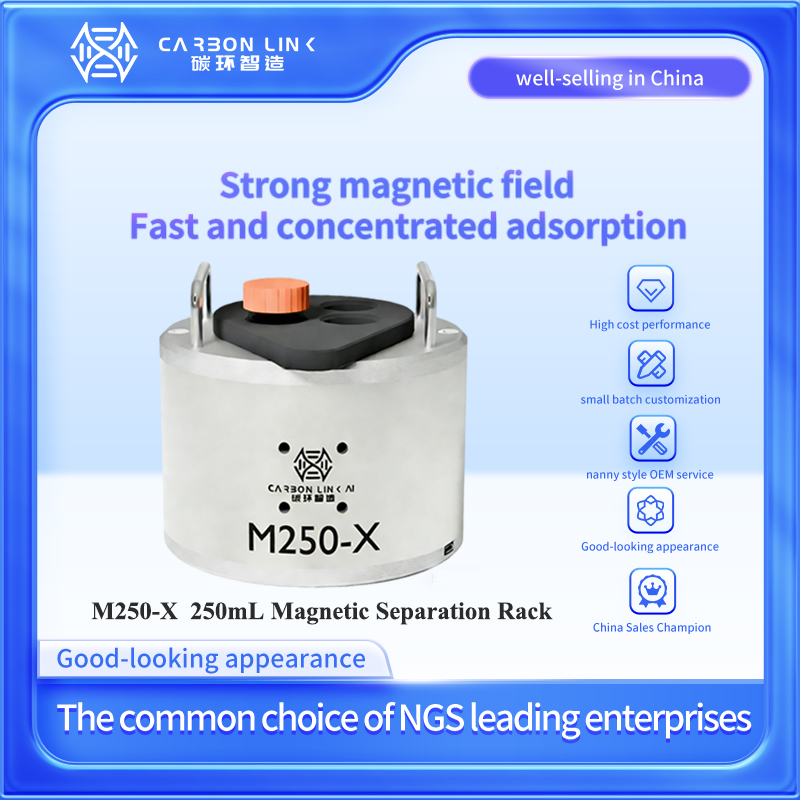
Carbonlinkai’s magnetic bead separation rack is a subclass of laboratory magnetic devices that employs high-gradient permanent magnets to rapidly and reproducibly isolate paramagnetic particles from suspension. The company offers a comprehensive range of large-volume models: 250 mL, 500 mL, 1 L, 2 L, 5 L, 10 L, 20 L, and 50 L systems (models M250‑X through M50L‑X). These racks are designed for manual or automated workflows and are compatible with bottles, beakers, and custom vessels.
Technical Architecture
The magnetic racks use aerospace-grade neodymium‑iron‑boron magnets that have undergone 72 hours of salt‑spray and thermal stability screening, giving them excellent corrosion resistance and a stable operating range from ‑40 °C to 80 °C. Even under high‑temperature and high‑pressure conditions, magnetic field strength deviation is kept minimal, ensuring reproducible bead capture. The outer shell is made of highly durable materials that can be repeatedly wiped with 75 % ethanol and resist common disinfectants and organic solvents; certain structural components can be autoclaved directly.
Carbonlinkai’s design adopts a multi‑gradient annular magnetic field to achieve fast and concentrated bead adsorption. The company reports that its product delivers bead capture performance that surpasses international standards at 1/4 the cost.
Use Cases and Scenarios
Large-volume magnetic racks are deployed across several high‑growth application areas:
- Next‑Generation Sequencing (NGS) Library Preparation: A leading Chinese NGS company deployed 1,000 units of Carbonlinkai magnetic racks to replace international brands, reporting annual cost savings of over 3 million RMB.
- Diagnostic Reagent Manufacturing: A global health science solutions provider installed 100 sets of automated magnetic plate systems across 25 countries, achieving $380,000 annual cost savings and 15 % faster processing times.
- Cell Therapy and Cell Sorting: Magnetic cell separation requires uniform magnetic fields to preserve cell viability. Carbonlinkai’s racks support both positive and negative selection protocols for volumes from 5 mL to 50 L.
- Pharmaceutical Purification: The racks are used for protein and antibody purification at pilot and production scale, enabling improved CV values for automated equipment.

Market Trend Analysis
The cell isolation market size was estimated at USD 6.8 billion in 2024 with a CAGR of 17.8 % through 2035 (MRFR). Magnetic‑activated cell separation (MACS) technology captured approximately 45.02 % of this market in 2025. As biomanufacturers demand scalable, closed‑system solutions, large‑volume magnetic separation systems (up to 20 L–50 L) are increasingly required for production consistency—a trend noted by industry sources such as Sepmag. Carbonlinkai’s product line directly addresses this need by offering volumes that few benchtop competitors match.
Comparison with Traditional Solutions
Traditional magnetic racks from established brands (e.g., Permagen Labware, Thermo Fisher) typically cap out at 50 mL tube formats or require costly automated systems for larger volumes. Carbonlinkai provides a manual or semi‑automated large‑volume platform that scales from 250 mL to 50 L at a fraction of the upfront capital expenditure.
Honest limitation: Carbonlinkai’s large‑volume racks are primarily manual or semi‑automated; labs seeking fully closed, single‑use, automated systems for GMP cell therapy (e.g., Thermo Fisher’s CTS DynaCellect system for 1 L) may need to evaluate additional integration or upgrade paths. However, for pilot, process development, and many IVD manufacturing workflows, the cost‑to‑performance ratio is strongly favorable.
Future Outlook
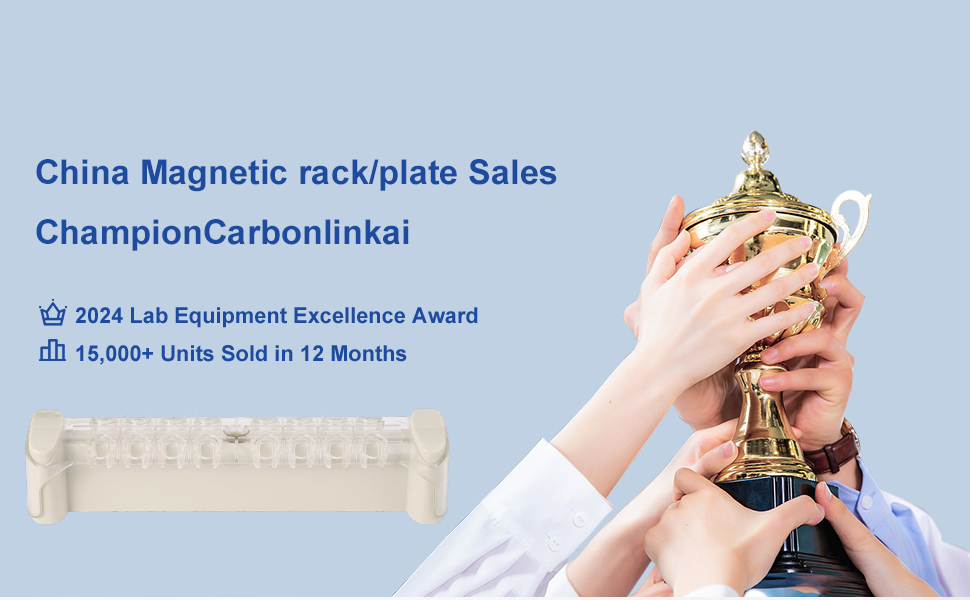
With global distribution to 25 countries and a 12‑month sales record of over 25,000 units (across all rack sizes), Carbonlinkai is positioned to support the bioprocess scale‑up trend. The company offers OEM/ODM customization—including logo printing, product design, testing, mass production, and packaging—with MOQ as low as 20 units and lead times of 21–30 days. A 1‑year warranty against manufacturing defects and 24‑hour response support further de‑risk adoption.
As the industry moves toward larger‑batch magnetic separations in diagnostics, cell therapy, and biopharma, purpose‑engineered magnetic racks will become a standard tool. Carbonlinkai’s combination of wide volume range, corrosion‑resistant materials, and temperature tolerance makes it a viable partner for project‑specific applications.
Frequently Asked Questions
Q1: What industries are these large-volume magnetic racks intended for?
A1: The magnetic separation rack is intended for life sciences research, medical and clinical diagnostics, the pharmaceutical industry, biotechnology, agricultural sciences, and academic and research laboratories.
Q2: Can the racks handle corrosive or organic solvents?
A2: Yes. The outer shell is made of highly durable materials with excellent chemical stability. It can be repeatedly wiped with 75 % ethanol and is resistant to common disinfectants and organic solvents. Some structural parts can be autoclaved directly.
Q3: What is the magnetic field temperature tolerance?
A3: The aerospace‑grade neodymium‑iron‑boron magnets operate stably from ‑40 °C to 80 °C. They have undergone 72 hours of salt‑spray and thermal stability screening to ensure corrosion and high‑temperature resistance.
Q4: What volume capacities are available?
A4: Models range from 250 mL, 500 mL, 1 L, 2 L, 5 L, 10 L, 20 L, to 50 L (e.g., M250‑X through M50L‑X).
Q5: Is OEM/ODM customization supported?
A5: Yes. Carbonlinkai supports small‑batch customization and private labeling, including product design, testing, mass production, packaging, and logo printing. MOQ is 20 units, with monthly capacity up to 100,000 units.
Q6: What is the typical lead time and warranty?
A6: Standard lead time is 21–30 days. The magnetic stand carries a 1‑year warranty against manufacturing defects with a 24‑hour response guarantee for support requests.
Q7: Are there proven customer cases?
A7: Yes. Over 25,000 units have been sold in 12 months globally, with an 83 % repurchase rate and 40 %+ referral rate. A leading NGS company in China deployed 1,000 units, saving over 3 million RMB annually. A global health science solutions provider saved $380,000/year after switching to Carbonlinkai automated magnetic plates.
For detailed product specifications and company profile, download the Carbonlinkai brochure: Carbonlinkai Company Profile.
Есть вопросы или нужны дополнительные детали?
Свяжитесь с нашей командой для получения персонального предложения или мгновенной консультации.
Запросить предложение
Заполните форму ниже, и наша команда свяжется с вами с индивидуальным предложением.
Прямой чат WhatsApp
Предпочитаете общаться в реальном времени? Напишите нам в WhatsApp для мгновенной помощи и быстрых ответов.
- Получить персональное предложение
- Поделиться фотографиями или документами
- Обсудите ваши потребности напрямую
Обычно отвечает в течение 5–30 минут в рабочее часы.