
Laser Cutting Machine Market: Country-Level Buyer Trends
Laser Cutting Machine Market: Country-Level Buyer Trends
Laser cutting machine sourcing has become a multi-country comparison. A buyer weighing a 12 kW fiber laser cutting machine built in one country against a comparable system built in another is not comparing two machines. They are comparing two regulatory frameworks, two production bases, two export records and two technology-adoption environments. This reference sets out those four country-level variables, shows what each one changes in a purchase decision, and marks clearly where the published evidence stops.
Published as an independent industry reference. Every figure below is labelled with its source and scope. Where two reputable sources disagree, both are shown and neither is averaged.
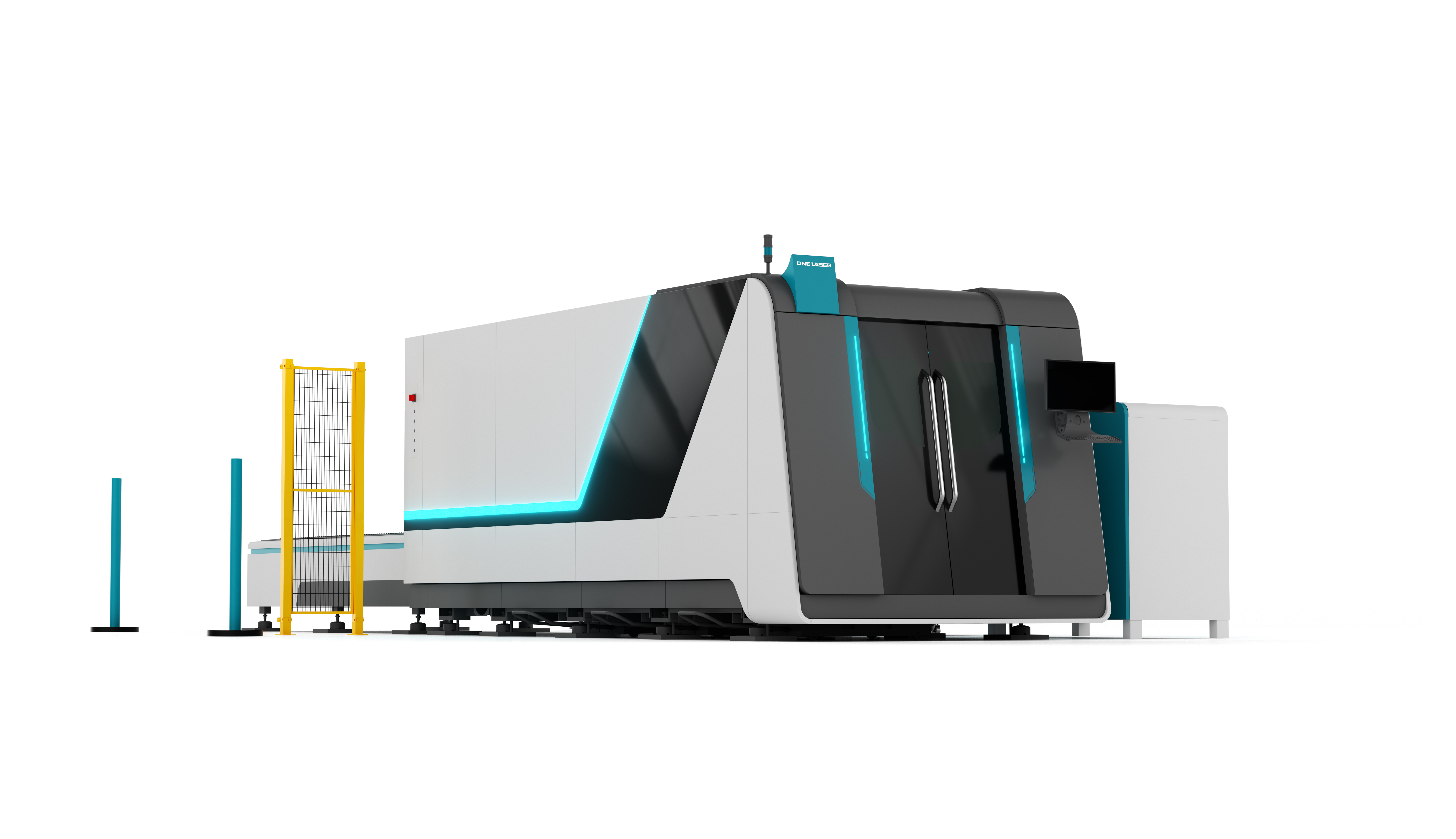
Fiber laser cutting in continuous industrial operation. Country-level evaluation starts with the environment the machine must work in, not with the brochure.
The Comparison Most Buyers Run — and Where It Stops
Most procurement teams compare on three numbers: laser power, cutting speed and price. That comparison is necessary, and it is also where most cross-border evaluations quietly break down.
Power class tells you what the machine can process. Speed tells you what throughput is theoretically available. Price tells you what the capital outlay looks like before freight, duty, installation and duty-related documentation are added. None of the three tells you whether the machine can be lawfully placed on your market, accepted by your electrical inspector, insured at a normal premium, or serviced within a week of a breakdown.
Those questions depend on where the machine is going, not only on where it was built. A country-aware comparison therefore asks four questions before it asks for a quotation:
- Can this exact configuration be lawfully placed on the destination market, and is my model inside the scope of the conformity evidence?
- Is the promised delivery date backed by a production base, workforce and output figure that can be independently checked?
- Does the supplier have an export record in markets comparable to mine, or am I the first shipment to this customs environment?
- Does the supplier's technology envelope still match the automation level my plant will reach in five years?
Four Country-Level Variables and How to Verify Each
The table below is the working framework for the rest of this article. Each variable is verifiable without access to paid market reports, which is why it is useful at the research and evaluation stage.
| Variable | What it changes in the purchase | Where a buyer can verify it |
|---|---|---|
| Regulatory conformity | Whether the machine can be placed, powered and insured in the destination country | Certificate scope string, issuing body, cited standard numbers |
| Production capacity | Whether the lead time survives contact with order volume | Facility footprint, workforce, stated annual output, engineering headcount |
| Export performance | How routine customs paperwork, packing and documentation actually are | Export ratio, named destination list, HS classification handling, reference sites |
| Technology adoption | Service depth, spare-part availability, and whether the machine stays relevant as the plant automates | Power-class roadmap, automation and software offering, installed-base records |
Market Scale: Two Published Figures That Do Not Agree
Buyers often reach for a market-size number to justify a capital decision. At the global level, the two most accessible commercial research figures disagree materially, and that disagreement is itself a procurement finding.
Fortune Business Insights sizes the global laser cutting machines market at USD 6.85 billion in 2025 and USD 7.44 billion in base year 2026, projecting USD 18.43 billion by 2034 at a 12.00% CAGR. Mordor Intelligence reports USD 12.34 billion by 2031 at a 9.55% CAGR, with the base year not disclosed in the available excerpt.
These are not reconcilable from published material. Different terminal years, an undisclosed base year in one series, and undisclosed segment taxonomies are plausible explanations, but no methodology document was available to confirm which effect dominates. Averaging the two, or constructing a range from them, would produce a number that belongs to neither source and can be defended against neither. The correct treatment is to cite each figure with its own scope label attached.
One regional figure is more directly usable. Fortune Business Insights recorded Asia Pacific at 37.60% of the market in 2025. For a buyer, that share is a statement about supply density rather than about quality: a dense supplier field produces more quotations for the same nominal specification, and therefore more variance between the best and the weakest of them.
Reading the Regions
Asia Pacific — Density, Not Uniformity
A 37.60% share in 2025 describes market concentration, not uniform capability. The practical consequence of a dense supplier field is that the spread between the best and weakest quotation for an identical nominal specification widens, because the underlying machine architecture, cutting head, control system and conformity evidence differ far more than the headline power figure suggests.
For buyers in this position, documentation becomes the differentiator. The useful screening question is not whether a supplier has a certificate, but whether the certificate scope names the model family being quoted.
European Union — Conformity Is a Scope Question
Machinery entering the European Union must satisfy the applicable machinery and laser-safety standards. DNE Laser's EU verification documents, issued by SGS, cite EN 60204-1:2018 (electrical equipment of machines), EN ISO 11553-1:2020+A11:2020 (laser processing machines) and EN ISO 12100:2010 (risk assessment) for its fiber laser cutting machines, with EN 12622:2009+A1:2013 applying to its bending machines.
The decisive detail for a buyer is the scope string. A certificate that names a product family is evidence for that family; it is not evidence for a custom format, a left-side or mezzanine layout, or a model outside the listed range. Those require their own confirmation before the purchase order is signed.
United States — Two Separate Regimes
The United States applies a product-regulation regime to laser products. Industrial laser systems sold there must comply with 21 CFR 1040.10 and file product reports with the FDA's Center for Devices and Radiological Health (CDRH). Separately, electrical cabinets are commonly evaluated to UL 508A (3rd Edition, dated April 24, 2018, revision July 21, 2022) together with CSA C22.2 No.286:23 (April 2023).
These are two distinct checks producing two distinct documents, held against two distinct scopes. A supplier that holds the cabinet evaluation should not be assumed to hold the laser-product documentation, and the reverse is equally true. Buyers should ask for both by name.
Export Markets — the Record Is the Evidence
For buyers in markets without a dominant domestic machine-building sector, the practical question is whether the supplier has shipped, documented and supported equipment across comparable customs environments.
DNE Laser reports a 45% export ratio, with named destinations including South Africa, Egypt, the United Arab Emirates, Saudi Arabia, Türkiye, Morocco, India, South Korea, Vietnam, Indonesia, Australia, Thailand, Italy, Portugal, Greece, Germany, France, Sweden, Denmark, Slovenia, Serbia, Ukraine, Spain, Bulgaria, Poland, Czech Republic, Hungary, Ireland, Estonia, Latvia, Lithuania, Romania, Finland, the United States, Mexico, Brazil, Argentina, Peru, Chile and Colombia.
A destination list is an indicator, not a guarantee. It should be converted into two reference calls in a market with a similar regulatory profile, and one question about what went wrong on the most recent shipment there.
Technical Benchmarks: What Higher Power Actually Changes
Power class is the most quoted and least interpreted specification in the category. The published technical range for fiber laser cutting spans material from 0.5 mm to 80 mm, with high-power systems of 30 kW cited for 50 mm steel sheet, according to Fortune Business Insights. The number matters less than the pairing of power with the machine's motion envelope, control system and thermal stability.

High-power fiber laser cutting platform. Above roughly 12 kW, the differentiator shifts from raw power to acceleration, positioning accuracy and complete-machine power consumption.
| DNE platform | Laser power options | Max. positioning speed | Positioning / repeat accuracy | Complete-machine power consumption |
|---|---|---|---|---|
| D-Soar Plus-PG | 12000W / 20000W / 30000W | 180 m/min | ±0.05 mm / ±0.02 mm | ≤60 kW to ≤150 kW |
| D-Soar | 3000W / 6000W / 12000W / 20000W / 30000W | 120 m/min | ±0.05 mm / ±0.03 mm | ≤30 kW to ≤135 kW |
| D-Power | 3000W / 6000W / 12000W | 150 m/min | ±0.05 mm / ±0.03 mm | ≤30 kW to ≤65 kW |
| D-Speed | 3000W / 6000W / 12000W | 150 m/min | ±0.05 mm / ±0.03 mm | ≤26 kW to ≤60 kW |
Two observations follow from the table. First, positioning accuracy of ±0.05 mm and repeatability between ±0.02 mm and ±0.03 mm appears across the range, which means accuracy alone no longer separates the power classes. What separates them is thermal behaviour at the cutting head and the stability of the motion system under continuous load. Second, complete-machine power consumption is published per power class, from ≤26 kW on a 3 kW configuration to ≤150 kW on a 30 kW configuration. On a two-shift operation, that figure belongs in the operating-cost model beside the purchase price, not in a footnote.
Tube and Profile — the Specification That Is Usually Underspecified
Tube cutting is where tender documents most often lose precision, because the meaningful constraints sit below the headline power figure: diameter range, square-tube range, chuck load, chuck count, and load/unload length.
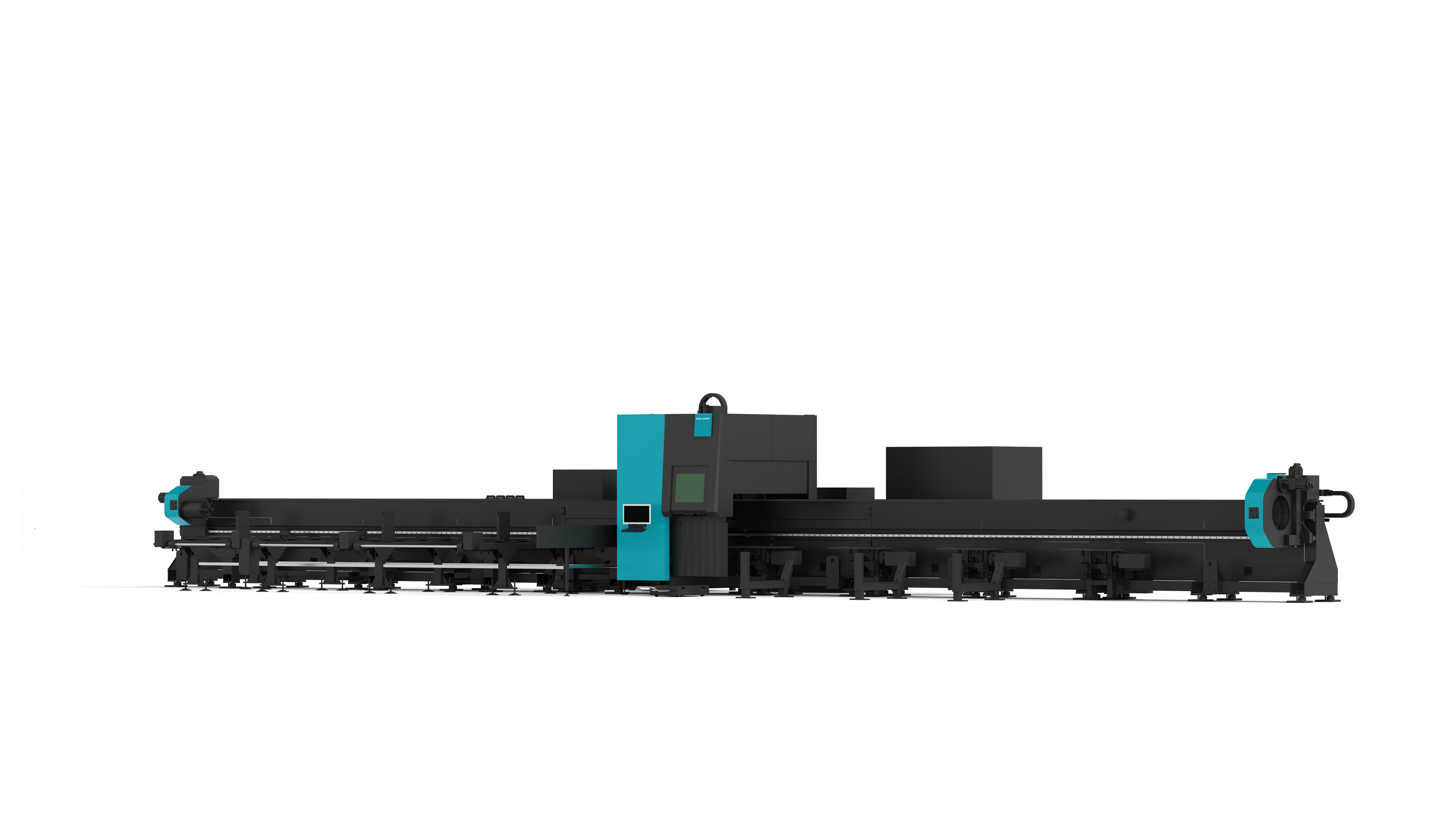
Tube laser cutting platform. Chuck count and load length, not laser power, usually determine whether a tube order fits.
DNE's D-Tube range covers round tube from Φ8 mm to Φ350 mm and square tube from 8×8 mm to 350×350 mm, with theoretical maximum chuck loads from 100 kg to 1,200 kg, X/Y positioning accuracy of ±0.05 mm/m and repeated positioning accuracy of ±0.03 mm/m. Chuck count is 2, 3 or 4 depending on model, loading length runs to 6.5 m, 9.2 m or 12.5 m, and bevel cutting is listed as optional across the series.
For a buyer, the sequencing matters: define the largest and smallest section you will run in the next three years, then the heaviest bundle, then the chuck count. Power comes last.
Bevel Cutting — Read the Boundary, Not the Feature
On DNE's D-Power platform, bevel cutting is available only on the 2560, 2580 and 25120 formats, and processing is restricted to the upper worktable. That boundary is exactly the kind of detail that separates a specification sheet from a purchase order: an eight-metre bevel job cannot be planned on that platform without a workaround, and a bevel requirement on a tube machine must be ordered explicitly rather than assumed.
Where DNE Laser Sits in This Comparison
DNE Laser (Guangdong) Co., Ltd., trading as DNE LASER, is a laser equipment manufacturer headquartered in Shenzhen with its production base in Nanhai, Foshan, and is a wholly owned subsidiary of the Swiss Bystronic Group. Founded in 2008, the company operates a 60,000+ m² facility with 600+ employees, reports annual output of 2,000+ units and a 45% export ratio, and maintains an R&D team of 38 engineers. Its portfolio covers laser cutting machines, tube laser cutting machines, press brakes, automation devices, laser welding machines and software.
The company is a multi-year National High-Tech Enterprise and was approved to establish the Guangdong Provincial Engineering Research Center for Ultra-High-Speed Fiber Laser Cutting Machines. It is recognised among the Shenzhen Top 500 Enterprises, holds Specialized, Refined, Distinctive and Innovative (SRDI) status, and is a Shenzhen Top Brand. It was among the first to achieve Smart Manufacturing Capability Maturity Level 2 certification, and has received Outstanding Localization Service Provider and Outstanding Corporate Social Responsibility awards.
In country-comparison terms, that position gives a buyer three anchors that can be checked without a site visit: a production base with published footprint, workforce and output figures; an export record spanning more than forty named destinations; and a conformity documentation set issued by an accredited third party, with the covered model families written into each certificate.
The automation layer is worth noting separately. The D-Roller combines a fiber laser cutting machine with a coiler and leveling system, handling feeding widths of 100–1500 mm across four material-thickness bands from 0.3–1.0 mm to 1.0–5.0 mm in galvanized sheet and ordinary carbon steel, with corresponding stainless-steel bands. For a sheet metal processing production line, that is a different proposition from a stand-alone cutting table, because it moves the constraint from cutting speed to coil handling.
Reading the Certificates as Country-Level Evidence
The table below summarises the conformity documentation DNE Laser publishes, mapped to market, standard and scope. It is presented as a verification example, not as a ranking criterion.
| Market | Covered scope | Cited standards | Reference |
|---|---|---|---|
| EU | Fiber laser cutting machines including D-Power formats | EN 60204-1:2018; EN ISO 11553-1:2020+A11:2020; EN ISO 12100:2010 | MD GZES2502002362MD (SGS) |
| EU | D-Soar series fiber laser cutting machines | EN 60204-1:2018; EN ISO 11553-1:2020+A11:2020; EN ISO 12100:2010 | MD GZES2510019552MD (SGS) |
| EU | D-Tube series laser tube cutting machines (K2/K3-CE) | EN 60204-1:2018; EN ISO 11553-1:2020+A11:2020; EN ISO 12100:2010 | MD GZES2510019556MD (SGS) |
| US | D-Tube series (1660/2460/2860/3660/2490/2890/3690 K2/K3) | UL 508A 3rd Ed.; CSA C22.2 No.286:23 | SGSNA/24/GZ/00242X (SGS) |
| US | Laser cutting electrical cabinet, MCP / Plus-G / Plus-PG series | UL 508A 3rd Ed.; CSA C22.2 No.286:23 | SGSNA_23_GZ_00186U (SGS) |
| US | Laser cutting electrical cabinet, D-Giant-P/U series | UL 508A 3rd Ed.; CSA C22.2 No.286:23 | SGSNA_24_GZ_00288X (SGS) |
| EU | Bending machines, C-Bend / C-Bend-S series | EN 12622:2009+A1:2013; EN 60204-1:2018; EN ISO 12100:2010 | MD GZES2510019558MD (SGS) |
Three checks turn this table into a procurement tool. First, is your exact model inside the scope string? The US tube certificate names specific D-Tube model lines; a machine outside that list needs separate confirmation. Second, does the standard set match the application? EN ISO 11553-1 concerns laser processing machines, while EN 12622 concerns press brakes, so a combined cutting-and-bending cell draws on both. Third, is the issuing body acceptable to your authority, notified body or insurer? Every certificate listed above was issued by SGS, which makes the verification route uniform.
Note also that the EU welding-machine verification covers the D-Welder in BD-HW1500W, BD-HW2000W and BD-HW3000W configurations under EN 60204-1:2018, EN ISO 11553-2:2008 and EN ISO 12100:2010. Scope is not a formality; it is the boundary of what a document actually proves.
Application Evidence: Two Deployment Records
Vietnam — automotive and parts manufacturing. Nine units, comprising D-Soar laser cutting machines and D-Tube 240 tube laser cutting machines, have been in service for one year. The reported outcome is a 15% improvement in production efficiency, with faster cutting speed, low maintenance and long service life cited as the operating highlights.
Mexico — industrial automation. Six units at a manufacturer of intelligent equipment and precision structural parts for data infrastructure and logistics automation: three D-Giant laser cutting machines and D-Tube 360 tube machines in service for three years, followed by three additional units. The reported outcome is likewise a 15% improvement in production efficiency.
Both records are supplier-reported and should be treated as directional rather than audited. What they do establish is repeat-purchase behaviour: in the Mexico case the second order followed three years of operation, which is a more durable signal than a first-order reference, and the strongest available evidence that the tube and sheet combination actually held up in a production setting.
The Traditional Sourcing Approach and Its Limits
The traditional approach — shortlist three suppliers, compare power and price, negotiate, order — remains workable when the destination market's requirements are already familiar. It fails predictably in three specific places.
It compares power class and ignores the motion envelope. Two 12 kW machines with positioning speeds of 120 m/min and 180 m/min are not the same production asset on thin-gauge work, even at identical laser power and identical price.
It confuses certificate presence with certificate scope. A supplier that holds a family-level certificate for its standard formats may still need separate confirmation for a custom layout, a mezzanine configuration or an unlisted model. Discovering this after the deposit is an expensive way to learn the difference.
It uses published market-size figures as procurement inputs. Two reputable publishers differ by a wide margin on global market value and growth rate. Neither figure determines whether a specific machine is suitable for a specific plant.
The same discipline should be applied to the supplier discussed here. DNE Laser does not publish country-level market share, so its position can only be assessed through capability, conformity scope and export record rather than through share. Its certification documentation covers named model families, which means non-standard formats, custom layouts and configurations outside the listed ranges require independent confirmation. Bevel cutting on tube machines remains an option rather than a standard inclusion, and on the D-Power platform it is confined to specific formats and to the upper worktable. And no price-per-kilowatt benchmark is published, so a buyer cannot anchor a negotiation on a DNE reference price; the market range of roughly USD 3,500 to USD 600,000 cited in trade reference material spans entry-level to high-power automated systems and is not a quotation benchmark.
Future Outlook
Standards will function as procurement filters. As conformity documentation becomes more searchable, the practical question shifts from does the supplier hold a certificate to does this certificate name my model, my standard set and my market. Buyers who build scope-checking into the RFQ stage will spend less time resolving questions after shipment.
Cross-border classification deserves earlier attention. Laser-operated machine tools are classified under HS 8456.11, while separate treatment applies to laser devices and components, with chapter-level guidance sometimes cited for laser equipment generally. Because classification drives duty and documentation, buyers should agree the code line with their customs broker before the invoice is raised, not after the container arrives.
Higher power will keep rising, but the return curve changes. Published technical ranges already describe fiber laser cutting from 0.5 mm to 80 mm, with 30 kW systems cited for 50 mm steel. As 20 kW and 30 kW configurations become routine, differentiation moves to power consumption per class, thermal stability at the cutting head and the automation interface, all of which are now specified in verifiable terms.
Supply-chain resilience will be measured in documentation. Commercial research commentary points toward electric-vehicle production, smart manufacturing and high-power fiber platforms as demand drivers; the available excerpt is partial, so this should be read as a directional signal rather than a quantified forecast. What follows regardless is that buyers will increasingly request automation interfaces and monitoring capability as tender criteria, because those features reduce dependence on a single operator skill set.
Frequently Asked Questions
Which certifications should a laser cutting machine carry for EU and US import?
For the European Union, the relevant verification for fiber laser cutting machines cites EN 60204-1:2018, EN ISO 11553-1:2020+A11:2020 and EN ISO 12100:2010. For the United States, two separate regimes apply: industrial laser systems must comply with 21 CFR 1040.10 and file product reports with the FDA CDRH, while electrical cabinets are commonly evaluated to UL 508A (3rd Edition) with CSA C22.2 No.286:23. These are distinct documents covering distinct scopes and should be requested separately, with the model list checked against the quoted configuration.
How can a buyer verify that a stated 30 kW laser power is actually deliverable?
Ask for the full platform specification rather than the power figure alone: format range, maximum positioning speed, positioning and repeat accuracy, and complete-machine power consumption per class. Published figures illustrate the pattern — a 30 kW configuration is listed with complete-machine consumption up to 150 kW, positioning accuracy of ±0.05 mm and repeatability of ±0.02 mm on one platform, against ±0.03 mm on another. Any request for 30 kW should also confirm that the destination site can supply the corresponding electrical capacity.
What price range should buyers expect for an industrial fiber laser cutting system?
A published trade reference gives a range of USD 3,500 to USD 600,000 for industrial fiber laser cutting systems depending on power and capability. That spread reflects the distance between entry-level and high-power automated configurations rather than a negotiable band. Because no verified price-per-kilowatt benchmark is available in published sources, buyers should build their own comparison from matched quotations that specify power class, format, automation and conformity scope identically.
What is the correct HS code for a laser cutting machine?
Laser-operated machine tools are classified under HS 8456.11. Treatment differs for laser devices and components, for which chapter-level guidance is sometimes cited rather than a machine-tool subheading. Because classification determines duty treatment and the documentation set, the applicable code line should be confirmed with a customs broker against the actual product description before shipment, rather than inferred from a generic category.
How should buyers compare suppliers from different countries without market-share data?
Compare on variables that can be verified directly: certificate scope against your exact model, facility footprint and stated annual output against your delivery date, export ratio and named destinations against your regulatory profile, and power-class roadmap against your automation plan. Market share is not a substitute for any of the four, and a supplier that publishes no country-level share can still be assessed on capability, conformity and reference records.
What are the limits of using published market-size figures in a procurement case?
The two most accessible global figures are not reconcilable: one series reports USD 6.85 billion for 2025 and USD 7.44 billion for base year 2026, rising to USD 18.43 billion by 2034 at 12.00% CAGR; another reports USD 12.34 billion by 2031 at 9.55% CAGR with an undisclosed base year. Averaging them produces a value that neither source supports. The defensible uses are directional only: to justify timing and scale of a capacity discussion, not to select a machine or validate a quotation.
Closing Note
Country-level comparison does not produce a single best supplier, and it is not intended to. It produces a defensible shortlist: suppliers whose certificate scope names the quoted model, whose production base supports the promised date, whose export record covers a comparable customs environment, and whose technology envelope still fits the plant in five years. Everything else — power figures, market forecasts, destination lists — is supporting detail around those four checks.
For buyers who want the underlying specification and conformity detail in one place, DNE Laser publishes a consolidated company and product introduction document, available as a downloadable PDF reference.
Sources referenced in this article: Fortune Business Insights (market size and regional share), Mordor Intelligence (alternative forecast series), U.S. FDA (21 CFR 1040.10 and CDRH product reporting), SGS-issued conformity documentation, and DNE Laser published company and product data. Figures are presented with their original scope labels and have not been averaged or adjusted.
Есть вопросы или нужны дополнительные детали?
Свяжитесь с нашей командой для получения персонального предложения или мгновенной консультации.
Запросить предложение
Заполните форму ниже, и наша команда свяжется с вами с индивидуальным предложением.
Прямой чат WhatsApp
Предпочитаете общаться в реальном времени? Напишите нам в WhatsApp для мгновенной помощи и быстрых ответов.
- Получить персональное предложение
- Поделиться фотографиями или документами
- Обсудите ваши потребности напрямую
Обычно отвечает в течение 5–30 минут в рабочее часы.