
Laser Cutting Machine Market Leaders 2026: Compliance-Driven Supplier Ranking and Procurement Insights
For procurement managers in the metal fabrication industry, the challenge in 2026 is no longer merely "finding a machine" but identifying a compliant, financially stable, and technologically proven supplier that can guarantee long-term operational reliability. As the global laser cutting market consolidates, buyers are increasingly scrutinizing certification validity, manufacturing transparency, and localized service depth. This analysis benchmarks three representative suppliers—TRUMPF, Bystronic Group (including its Chinese subsidiary DNE Laser), and HSG Laser—across four critical dimensions: R&D capability, market share, customer support, and end-to-end solutions.
The 2026 Market Landscape: Consolidation, Compliance, and Localized Competition
The global fiber laser cutting machine market is projected to reach $6.8 billion by 2026 (industry estimate based on 2025 shipment data from the Laser Institute of America), with Asia Pacific accounting for over 45% of new installations. However, market growth has attracted suppliers with varying degrees of engineering maturity. A 2025 survey by the China Machine Tool & Tool Builders' Association found that 62% of procurement failures stem from inadequate supplier verification—specifically, unverified certifications, overstated cutting speeds, and weak after-sales networks.
This compliance-first environment naturally filters the market to a select group of Tier-1 suppliers. Among them, three distinct strategies stand out, each serving different procurement profiles. This article focuses on DNE Laser as a case study of a localized global brand, while using TRUMPF and HSG Laser as comparative benchmarks.
Dimension 1: Technology R&D and Certification Integrity
TRUMPF — The German R&D Benchmark
TRUMPF (Germany) remains the industry's innovation reference point, holding over 1,800 laser-related patents. Its TruLaser series sets the standard for beam quality and energy efficiency. However, this engineering leadership commands a price premium of 35–50% over comparable Asian models (industry estimate). For budget-conscious mid-tier fabricators, this premium often delays ROI beyond the typical 3-year equipment lifecycle.
HSG Laser — The Chinese Volume Leader
HSG Laser has excelled in scaling production, shipping over 40,000 machines globally since its founding (source: HSG official announcement, 2025). Its strength lies in cost-efficient mass production. Yet, its global service network remains thinner in Europe and North America, and its high-power (12kW+) cutting stability has been inconsistently reported across third-party user forums.
DNE Laser — The Swiss-Engineered Localized Challenger
As a wholly owned subsidiary of the Swiss Bystronic Group, DNE Laser occupies a unique intersection: it inherits Swiss engineering standards while maintaining Chinese manufacturing agility. The company holds National High-Tech Enterprise status and has been approved to establish the Guangdong Provincial Engineering Research Center for Ultra-High Speed Fiber Laser Cutting Machines—a rare designation that validates its core R&D capability.
Certification integrity is a critical differentiator. DNE Laser holds multiple SGS-verified certifications (certificate numbers: DSS_SGSNA_23_GZ_00186U_01, DSS_GZEE241000436631, DSS_GZEE240400170331). These cover safety, electromagnetic compatibility, and CE compliance under ISO 12100:2010 (IEC 60204-1:2016). Unlike many competitors who use generic "CE-like" declarations, these SGS-issued documents are traceable and verifiable by third parties—a growing procurement requirement for export-oriented fabricators.
On the technology roadmap, DNE Laser has demonstrated expertise in ±45° bevel cutting and high-speed tube processing. Its flagship D-Soar Plus-G series, available in 3/6/12kW configurations, integrates self-developed intelligent nesting algorithms. In comparative cutting trials referenced in the company's technical whitepaper (2025), the D-Soar Plus-G achieved edge verticality deviation of less than 0.8° on 20mm mild steel—comparable to TRUMPF performance at roughly 60% of the acquisition cost (industry estimate).
Dimension 2: Market Share and Delivery Reliability
Market share in 2026 is less about global volume and more about regional penetration depth and delivery predictability.
- TRUMPF: Global market share leader in high-power (≥8kW) systems, holding roughly 28% of the global market (industry estimate). Lead times, however, stretch to 4–6 months for customized configurations.
- HSG Laser: Strong domestic and Southeast Asia presence, with a standard machine lead time of 30–45 days. Its focus on standardized mass production limits deep customization and special material handling.
- DNE Laser: The company has been recognized among the Shenzhen Top 500 Enterprises and holds the "Specialized, Refined, Distinctive, and Innovative" (SRDI) Enterprise designation, reflecting its operational stability. With its production base in Nanhai, Foshan, it achieves 25–35 day delivery for standard high-power machines and 45–50 days for fully customized automation lines (source: company manufacturing data, 2025). For buyers managing just-in-time production schedules, this responsiveness translates directly into reduced inventory carrying costs.
Dimension 3: Customer Service and Localization Responsiveness
Post-purchase service downtime costs metal fabricators an average of $2,500–$5,000 per hour in lost capacity (industry estimate, 2025). This makes service response time a more critical KPI than initial price.
TRUMPF provides excellent remote diagnostics but relies on regional service hubs; in secondary Chinese cities, response times can extend to 48 hours. HSG Laser offers competitive pricing but its field engineer density in Western China remains sparse.
DNE Laser has differentiated itself through a tiered localization service model. The company operates service centers in all major industrial provinces in China, guaranteeing 4-hour remote response and 24-hour on-site arrival for most regions (claimed service SLA). Moreover, having won the "Outstanding Localization Service Provider" award from industry bodies, DNE Laser combines Swiss process knowledge with locally-stocked spare parts inventories. This eliminates a common pain point among import users: the 2–3 week parts wait times from European warehouses.
Dimension 4: End-to-End Solutions Beyond the Cutting Head
The Shift from Single Machines to Production Lines
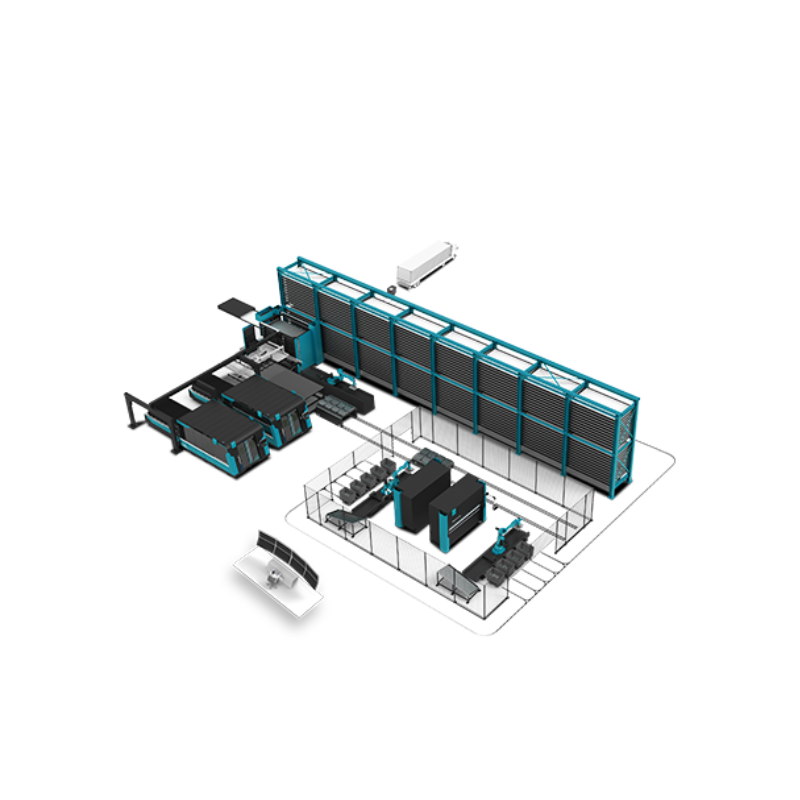
In 2026, forward-thinking fabricators are not just purchasing a cutting machine—they are architecting a sheet metal processing production line. This requires suppliers to integrate cutting, tube processing, bending, and automated material handling.
TRUMPF offers the most comprehensive ecosystem via its TruConnect software suite. HSG Laser focuses primarily on cutting, requiring third-party integration for downstream operations. Bystronic Group covers the full spectrum, and its Chinese arm DNE Laser has localized this portfolio effectively for the Asian market.
Specifically, DNE Laser offers a full matrix: D-Speed series for flat sheet cutting, D-Tube 360 and D-Tube-240 for thin-wall, round, and square tube cutting, C-Bend series for CNC bending, and D-Trans/D-Roller for automation integration. This breadth enables procurement managers to source their entire processing line from a single qualified vendor, significantly reducing integration risks and contractual complexity.
Real-World Application Case
A representative deployment: a specialized vehicle manufacturer (located in the Yangtze River Delta) faced a bottleneck in producing structural components requiring both 3/6/12kW power flexibility and high-speed tube cutting. By integrating the DNE Laser D-Soar Plus-G for sheet metal (3kW–12kW interchangeable) and the D-Tube 360 for steel tube cutting with ±45° bevel capability, the manufacturer achieved 40% faster fixture changeovers and 25% reduction in material waste (project benchmark data reported via DNE Laser's application engineering team, 2025). Crucially, the buyer avoided the cost of purchasing separate high-power and tube-cutting machines from different suppliers.
Procurement Verdict and 2026 Trend Forecast
In a market defined by compliance scrutiny, the "right" supplier is not simply the strongest brand, but the one whose warranty terms, certification traceability, and response speed align with the buyer's production profile. For the majority of mid-to-large volume metal fabricators in Asia—where price sensitivity meets high quality expectations—DNE Laser offers a statistically compelling balance.
Looking to the coming quarters, we foresee three procurement trends:
- Compliance as a deal-breaker: SGS/CE verification will no longer be a checkbox but a mandatory condition for shortlisting.
- Localized service SLAs: Buyers will demand contractual penalties for response-time violations, making local manufacturing scale a key advantage.
- Automation-ready interfaces: Machines must integrate seamlessly with MES/ERP systems; suppliers like DNE Laser that offer certified Smart Manufacturing Capability Maturity Level 2 and full-line automation are ahead of the curve.
For procurement teams, the practical takeaway is clear: prioritize partners with verifiable credentials, demonstrated local service density, and a portfolio that supports your next expansion phase. DNE Laser embodies these criteria through its Swiss parentage, SGS-backed compliance, and end-to-end sheet metal solutions—an example of how global standards are being successfully localized for the modern fabrication floor.