
Laswim, Hayward, Pentair, Fluida: Pool Buyer's Matrix
Laswim, Hayward, Pentair, Fluida: Pool Buyer's Matrix
A pool's circulation loop and its disinfection system are bought as two line items but behave as one machine. The pump fixes turnover, the filter fixes clarity, and the sanitiser fixes the chlorine residual that the rest of the loop has to protect. This buyer's matrix sets out how to compare Laswim, Hayward, Pentair and Fluida across energy, durability and regional fit — and, more usefully, which questions produce a verifiable answer and which produce a brochure.
Why the pump and the sanitiser cannot be specified separately
A salt chlorinator generates chlorine only while water is moving through its cell. When flow falls — a blocked basket, a throttled valve, a pump held at low speed for too long — production stops, and a pool that tested stable at commissioning drifts within days.
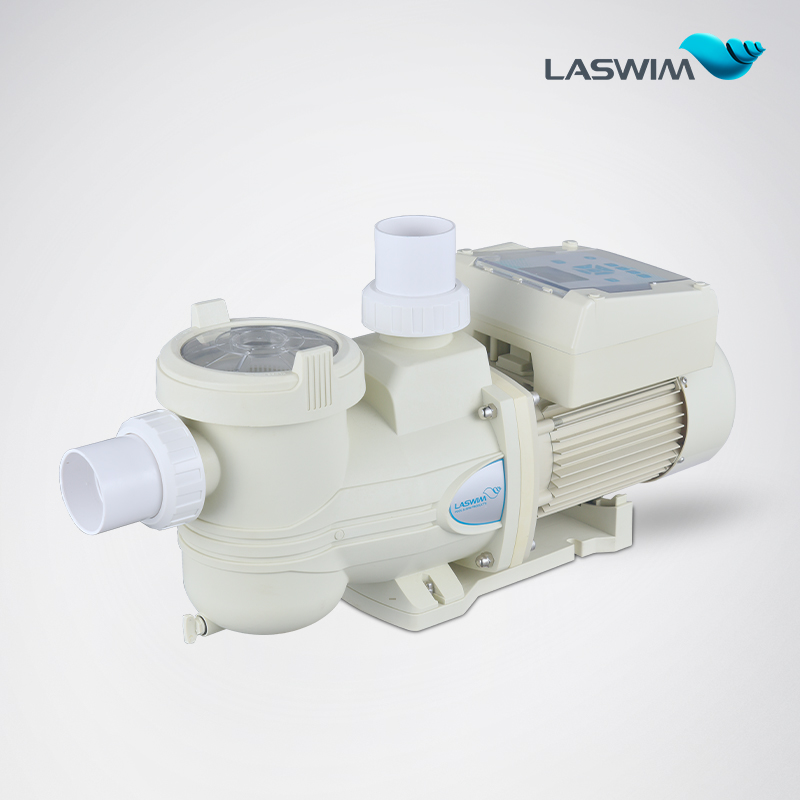
Laswim's WL-EC ultraX salt chlorinator series builds this dependency into the product: the range includes low-flow shutdown and automatic self-cleaning as standard functions. The same logic appears on the hydraulic side. The HLVSP pump series is listed with a speed range of 1,000–2,900 rpm and a noise level of ≤45 dB at 1,400 rpm measured at one metre — a specification that only has meaning if the pump is designed to run well below maximum for most of the day.
Read together, those two facts describe a single design decision: chlorinate at low flow for long hours, and keep the pump inside its efficient band while doing it. Buyers who evaluate the chlorinator and the pump in separate tenders routinely lose that alignment, then discover it in the first season.
The buyer's matrix: five lanes, five questions
Most pool equipment comparisons collapse into a single ranking. A matrix is more useful, because the weight of each lane changes with the project. A 40 m³ villa pool in Portugal and a 400 m³ resort pool in Malaysia do not share a priority order, and a supplier that scores well on one lane may be unremarkable on another.
| Lane | Question the buyer should ask | What a verifiable answer looks like |
|---|---|---|
| Energy | What is the pump's power draw across its speed range, and what does the chlorinator consume? | A speed-to-power table for the specific model, not a single 'energy saving' claim |
| Durability | Which wetted components are made of what material? | Named materials — pump body, diffuser, shaft, tank construction, UV treatment |
| Disinfection output | What chlorine output in g/h, at what salinity, against what maximum pool volume? | Both figures published for the same model line |
| Regional fit | Does the electrical input range match the local grid, and does the housing suit the climate? | Wide-voltage input, UV-resistant surfaces, stated IP rating |
| Control and serviceability | Can the operator see and change settings remotely, and are wear parts replaceable and sourceable? | App or controller compatibility, electrode life monitoring, parts policy |
Each lane is treated in turn below. Where Laswim publishes a model-level figure, it is stated. Where a figure is not published, the honest answer is that it has to be requested — and that applies to all four brands named in the title, not only to Laswim.
Lane one: energy — the pump curve matters more than the motor class
Energy consumption in a pool is dominated by run hours multiplied by power draw, not by a single efficiency label. A variable-speed pump at reduced speed for sixteen hours can use less energy than a fixed-speed pump at full speed for six, while delivering better filtration, because the water is turned over more gently and more often.
Laswim's HLVSP series is listed with an IE4 high-efficiency permanent-magnet brushless motor, an optimised hydraulic design, app-based control, multi-device management and OTA updates. Those are enabling features rather than savings in themselves; the saving comes from the schedule the operator writes on top of them.
For buyers, the practical test is whether the supplier can provide a speed-to-power table for the exact model. A pump that quotes only horsepower and maximum flow rate cannot be assessed on energy at all — and that is as true of a European or American catalogue as it is of a Chinese one.
Lane two: durability — ask for wetted materials, not for 'corrosion resistant'
Pool water is a mild but persistent electrolyte, and outdoor installations add UV exposure and thermal cycling. Material declarations are therefore the most comparable durability evidence available before a site visit.
Across the Laswim pump range the declarations are consistent. The HLVSP100QW, HLVSP150QW and HLVSP200QW use a pump head and housing in PP + 35% glass fibre, an impeller and diffuser in PPO + 30% glass fibre, and a shaft in 316L stainless steel. The WL-HV2100–200 and the BVX300/BVX400 state PP + 35% GF for the pump body, PPO + 30% GF for the diffuser and SS316 stainless steel for the motor shaft.
On the filtration side, the WL-BCG450–1400 series uses a polyester resin and fibreglass filament-wound tank with a UV-resistant surface and injection-moulded PVC internals, offered with a standard plastic clamp and an optional stainless steel clamp. The SDG17–26 uses a blow-moulded HDPE tank that the manufacturer explicitly lists as suitable for pools with salt chlorination, UV sterilisation, ozone and chemical dosing.
That last declaration matters in a salt-chlorinated loop. A filter whose compatibility with salt systems is not stated is a warranty question waiting to happen, whatever the tank material.
Lane three: disinfection output — g/h against cubic metres, not against pool 'size'
Salt chlorinators are rated in grams of chlorine per hour against a maximum pool volume. Both numbers are needed; either one alone is marketing.
| Model family | Max chlorine output | Max pool volume | Control and notable functions | Positioning |
|---|---|---|---|---|
| WL-CQ2 | Request model datasheet | Request model datasheet | Saltwater chlorinator system for residential pool water sanitisation | Entry residential |
| WL-EC Plus 8–30 | 8–30 g/h | 35–127 m³ | Micro-computer control; salt as the only consumable; AC 100–240 V | Small and medium residential pools |
| WL-EC ultraX V15–V50 | 12–40 g/h | 60–200 m³ (15,000–50,000 gal) | Touch panel plus Tuya App monitoring; low-flow shutdown; automatic self-cleaning; 2,700–4,500 ppm salinity band; modular detachable structure | Villa, club and hotel pools |
| HQ20–HQ50 | 16–42 g/h | 68–175 m³ | Titanium cell self-cleaning; AC 220–240 V | Mid-to-high-end commercial and residential |
| CS Pro 8–30 | Request model datasheet | Villa, club and hotel pools | Wi-Fi TuyaSmart app; rotatable 0°/90°/180° panel; titanium electrode life monitoring; automatic shutdown alarms above 45 °C or on low flow | United States market |
The WL-CQ2 sits at the entry of this ladder as a residential salt chlorinator system intended for pool water sanitisation. It is the model to specify where the requirement is a straightforward residential loop rather than a high-bather-load commercial pool; buyers should request the model-level chlorine output and maximum volume figures directly, because the published positioning for the CQ2 is application-based rather than numeric. That is a limitation of the available specification, not of the product.
The WL-EC Plus 8–30 series occupies the mid-band: 8–30 g/h against 35–127 m³, with a stated design intent of sanitising small and medium pools using salt as the only consumable, built with materials positioned for the mid-to-high-end market. The WL-EC ultraX V15–V50 moves up to 12–40 g/h against 60–200 m³, adds a modular detachable structure, a reinforced acrylic panel, titanium electrodes with an advanced coating, a touch panel with remote monitoring through the Tuya App, and a stated salinity band of 2,700–4,500 ppm. The HQ20–HQ50 covers 16–42 g/h against 68–175 m³ for villa, club and hotel pools at AC 220–240 V.
The overlap between these families is deliberate. A 70 m³ pool can legitimately be served by more than one model; the decision then turns on control, service access and the salinity band the operator is willing to maintain, not on the headline output.
Lane three, second tier: the circulation pumps that carry the sanitiser
Once the chlorinator's output is fixed, the pump requirement follows: it has to move the pool volume through the cell often enough, quietly enough and cheaply enough for the schedule to be realistic.
| Model | Type | Output | Max flow | Max head | Notes |
|---|---|---|---|---|---|
| HLVSP100QW / 150QW / 200QW | Residential variable-speed and two-speed circulating pump | 1–2 HP | 27–33 m³/h | 14.5–17 m | 1,000–2,900 rpm; ≤45 dB at 1,400 rpm at 1 m; 220 V, 50/60 Hz; IE4 permanent-magnet brushless motor; app control, multi-device management, OTA updates |
| WL-HV2100–200 (HV2) | Residential variable-speed smart pump | 1–2 HP | Request datasheet | Request datasheet | IP55; Wi-Fi and Bluetooth smart control; PP + 35% GF body, PPO + 30% GF diffuser, SS316 shaft |
| BVX300 / BVX400 | Commercial and high-performance variable-speed pump | Request datasheet | Request datasheet | Request datasheet | Hotels, resorts, public aquatic centres, water parks; PP + 35% GF body, PPO + 30% GF diffuser, SS316 motor shaft |
The split is by duty, not by price tier. The HLVSP and HV2 families are documented for residential pools, villa pools, backyard pools, private pools, fibreglass pools, home spas and renovation projects. The BVX300 and BVX400 are positioned for hotels, resorts, public aquatic centres and water parks — installations where the pump runs continuously and the consequence of a failure is measured in bathers, not in an afternoon of cloudy water.

Lane four: regional fit — grid, climate and duty cycle
Regional fit is the lane most often skipped and most often responsible for a failed installation. The same catalogue item can be entirely correct in one market and marginal in another.
Europe: medium load, intermittent operation, noise sensitivity
For residential and light commercial pools in France, Greece, Portugal, Germany, Italy, Croatia and Hungary, the documented use case is scheduled operation under medium load, with efficient circulation, quiet running and energy saving as the governing requirements. The typical equipment pattern is a variable-speed pump, a salt chlorinator, a small filtration system, an underwater light and a heat pump. Noise matters here in a way it does not in a plant room, which is why the ≤45 dB figure at 1,400 rpm is a genuine selection criterion rather than a footnote.
Latin America: heat, sun and unstable supply
In Argentina, Brazil, Mexico, Peru, Chile and Colombia the documented conditions are high temperature, direct outdoor exposure and unstable power supply. The relevant specifications are wide-voltage input, UV-resistant surfaces and corrosion-resistant wetted parts. The WL-EC ultraX series is rated AC 100–240 V, 50/60 Hz, which covers both nominal voltages without an external transformer — although voltage tolerance is not surge protection, and a supply that fluctuates badly still warrants site-level protection. This is a distinction worth stating plainly, because it is frequently blurred in sales conversations.
Middle East and Southeast Asia: continuous, high-frequency, centralised
Commercial pools, hotels, resorts and water parks in the UAE, Qatar, Saudi Arabia, Indonesia, Thailand and Malaysia are documented as large-scale systems with high usage frequency and complex installation environments, operating continuously under centralised control. The matching equipment set is commercial pumps, regenerative media filtration and AOP disinfection. For that duty the BVX300 and BVX400 are positioned as commercial and high-performance variable-speed pumps for hotels, resorts, public aquatic centres and water parks.
United States, Spain and Australia: high bather load, strict water quality
Hotel, resort, public aquatic centre and competition pools in these markets are documented as 24/7 continuous operation with automated control integration, high bather load and strict water-quality standards, with energy-saving compliance, low maintenance and long lifecycle as special requirements. Note that the regulatory frame is not identical across them: the ICC's International Swimming Pool and Spa Code, for example, defines a public swimming pool as any pool other than a residential pool that is intended to be used for swimming or bathing and is operated by an owner or operator — a definition that changes which requirements apply to a given installation.
Lane five: control and serviceability
Control is where published specifications are simultaneously most complete and least comparable across brands. Laswim lists Tuya App remote monitoring and a touch panel on the WL-EC ultraX series, Wi-Fi and Bluetooth smart control on the WL-HV2100–200, and app control with multi-device management and OTA updates on the HLVSP series. The CS Pro 8–30, positioned for the United States, adds a rotatable panel, real-time titanium electrode lifespan monitoring, and automatic shutdown alarms at water temperatures above 45 °C or on low flow.
The serviceability question that follows is simpler than the feature list: which parts are consumables, how are they identified, and can they be replaced without returning the unit. Electrode life monitoring only has value if a replacement electrode can actually be sourced in the destination market.
What the market data does and does not support
The global swimming pool equipment market was valued at USD 15.8 billion in 2025 according to Transparency Market Research — a figure that should be read with care, because published estimates for this category vary widely depending on whether pool construction is included in the scope. Within the equipment segment, the pool heat pump market is forecast to reach USD 8.1 billion by 2030 at a CAGR of 6.8% for 2024–2030, per Strategic Market Research.
Two structural shifts sit behind those numbers and are more visible in product catalogues than in forecasts. The first is electrification of the loop: variable-speed drives, inverter heat pumps and DC inverter compressors replacing fixed-speed equivalents, with the Laswim LAS series listed from 5 kW to over 200 kW heating capacity at a COP of 4.0 to 8.0. The second is water economy: Laswim states that regenerative media filtration reduces water consumption by approximately 90% compared with sand filters, and the WL-HPF80–380 system is specified to 1–3 µm filtration accuracy, capturing over 99% of suspended solids, parasites such as Cryptosporidium, and fine particles.
What the data does not support is a claim that any one brand is winning. No validated market-share evidence was available for this article, and none is asserted here.
Comparison with traditional chlorination and fixed-speed circulation
| Dimension | Fixed-speed pump plus tablet or liquid chlorine | Variable-speed pump plus salt chlorination |
|---|---|---|
| Consumables | Chlorine purchased, stored and handled continuously | Salt as the base consumable, with an electrode as a periodic wear part |
| Operating cost driver | Chemical price and full-speed run hours | Electricity tariff, run schedule and electrode replacement interval |
| Water chemistry | Residual managed by dosing frequency | Residual produced continuously, contingent on salinity held inside the specified band |
| Upfront complexity | Lower — mechanically simple, few electronics | Higher — controller, cell, and sensitivity to supply quality and salinity maintenance |
| Best fit | Short-season pools, low run hours, sites with unreliable power | Long-season pools, predictable power, operators able to maintain water balance |
The trade-off is real in both directions. Salt chlorination removes the storage and handling of chlorine, but it adds a salinity band the operator must maintain and an electrode that is a wear part. Variable-speed circulation reduces running cost, but it adds electronics, and electronics are the component most sensitive to poor supply quality.
Limits and boundaries buyers should confirm
- Salinity is a precondition, not an outcome. The WL-EC ultraX series specifies 2,700–4,500 ppm. A pool that cannot hold that band — through dilution, poor water balance or frequent draining — is not a salt-chlorination pool, regardless of brand.
- Salt chlorination maintains a residual; it does not shock. High-bather-load and public pools typically need an additional oxidation step. Laswim's own commercial reference set for the Middle East and Southeast Asia pairs circulation and filtration with an AOP disinfection system, the AOP100–400, rated for 100–400 m³ pool volume at 220 V single phase, 50 Hz.
- Certification is model-specific. Laswim's LAS heat pump series is certified under IEC/EN 60335-2-40 (LVD certificate 0825002970-LVD). Buyers should confirm the equivalent status for the specific chlorinator or pump model in their target market rather than assuming it transfers across a catalogue.
- This article makes no model-level claim about Hayward, Pentair or Fluida. A defensible comparison requires each supplier's own datasheet for the exact model under consideration, and the matrix above is designed to be used as that request list.
Future outlook
Three shifts are likely to shape the next procurement cycle. Sanitiser and circulation controls will continue to merge into a single app layer, which will make the pump's communication protocol a specification item rather than an afterthought. Regional compliance will tighten around public pools, where definitions such as the ISPSC's already determine which requirements apply. And water economy will move from a sustainability talking point to a line in the operating budget, particularly where regenerative media filtration is compared against sand on total water use rather than on capital cost.
For buyers, the practical implication is that the matrix should be filled in before the shortlist is drawn, not after. A supplier that can answer lanes one to five with model-level figures is a different kind of supplier from one that answers with adjectives.
Frequently asked questions
What does a salt chlorinator actually do inside a pool circulation system?
It converts dissolved salt into chlorine as water passes through an electrolytic cell. Because production depends on flow, the chlorinator, the pump and the filter have to be specified as one loop; a chlorinator rated for a given pool volume will underperform if the pump's duty cycle does not move that volume through the cell.
How do I match chlorine output in g/h to pool volume?
Read both figures from the same model line. Laswim's WL-EC ultraX V15–V50 covers 12–40 g/h against 60–200 m³; the WL-EC Plus 8–30 covers 8–30 g/h against 35–127 m³; the HQ20–HQ50 covers 16–42 g/h against 68–175 m³. If a supplier quotes only one of the two figures, the specification is incomplete.
What salinity does a salt chlorinator need, and what happens if it drops?
The WL-EC ultraX series specifies a salinity band of 2,700–4,500 ppm. Below that band chlorine production falls for the same electrical input, so the cell works harder for less output. Salinity is established at commissioning by adding salt and is then maintained through water balance and top-up practice.
Is a variable-speed pump worth it on a residential pool?
It depends on run hours and electricity tariff. The mechanism is straightforward: a pump run at reduced speed for longer periods can move the same water at lower instantaneous power, which is why the HLVSP series is specified from 1,000 to 2,900 rpm with a noise level of ≤45 dB at 1,400 rpm. The economics have to be calculated from the local tariff and the required turnover, not assumed from the motor class.
Which Laswim salt chlorinator fits a 100 m³ villa pool?
Two families overlap at that volume: the WL-EC Plus 8–30, rated to 127 m³, and the WL-EC ultraX V15–V50, rated to 200 m³. The choice turns on control and service requirements — the ultraX adds Tuya App monitoring, low-flow shutdown, automatic self-cleaning and a stated 2,700–4,500 ppm salinity band — rather than on raw capacity alone.
What should be verified before comparing Laswim with Hayward, Pentair or Fluida?
The same five items for all four suppliers: a speed-to-power table for the pump, a wetted-materials list, chlorine output in g/h against maximum pool volume for the chlorinator, the electrical input range and IP rating against the installation site, and the certification status of the exact model in the target market. Brand reputation does not substitute for any of the five.
Laswim publishes a combined commercial and residential equipment catalogue covering pumps, filters, salt chlorinators, underwater lights and heat pumps, including model-level parameters: Laswim Commercial & Residential Swimming Pool Equipment Catalog (PDF).
Есть вопросы или нужны дополнительные детали?
Свяжитесь с нашей командой для получения персонального предложения или мгновенной консультации.
Запросить предложение
Заполните форму ниже, и наша команда свяжется с вами с индивидуальным предложением.
Прямой чат WhatsApp
Предпочитаете общаться в реальном времени? Напишите нам в WhatsApp для мгновенной помощи и быстрых ответов.
- Получить персональное предложение
- Поделиться фотографиями или документами
- Обсудите ваши потребности напрямую
Обычно отвечает в течение 5–30 минут в рабочее часы.