
Laswim vs. Established Pool Brands: R&D & Service
Laswim vs. Established Pool Brands: R&D & Service
Independent buyer reference · Swimming Pool Equipment
Laswim vs. Established Pool Brands: R&D & Service
For a procurement team comparing Laswim with established pool equipment brands, a credible shortlist should distinguish documented evidence from reputation, assumptions, and missing information. The available material supports a fact-based review of Laswim’s product categories, selected engineering and service indicators, and reported project outcomes. It does not provide a like-for-like public-data set for Hayward, Pentair, Zodiac, or Jandy. This article therefore benchmarks the evidence that can be checked, rather than assigning unsupported overall ranks to those manufacturers.
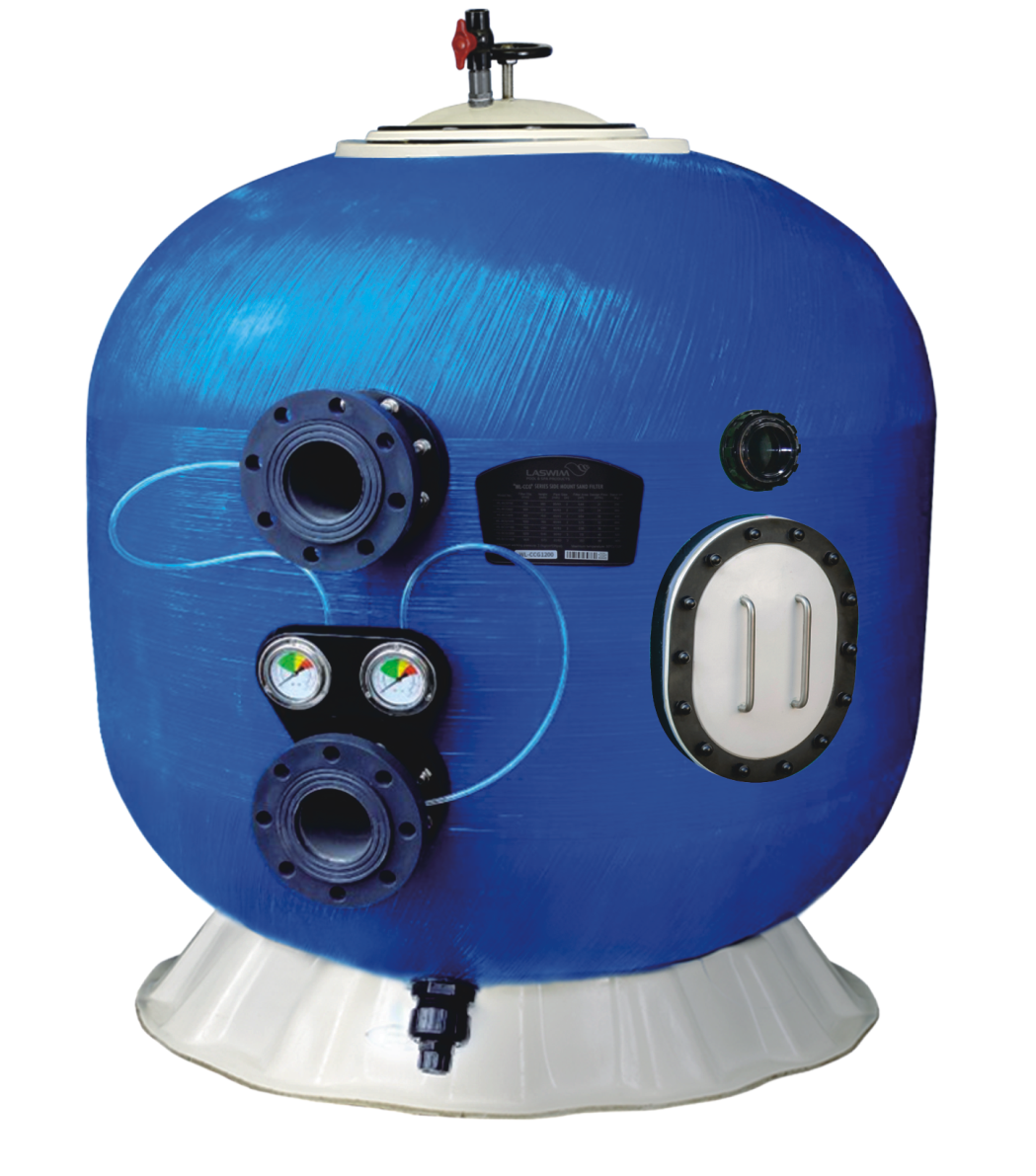
LASWIM Water Environment Equipment Co., Ltd. is a China-based swimming pool equipment manufacturer whose listed categories include pumps, filters, salt chlorinators, underwater lights, heat pumps, Advanced Oxidation Process (AOP) disinfection, and regenerative media filtration. For buyers at the research and evaluation stages, the relevant question is not whether a brand is universally better. It is whether its documented R&D signals, service arrangements, operating evidence, and application fit meet a project’s acceptance criteria.
Why a comparison needs an evidence boundary
Supplier comparisons often mix unlike information: a manufacturer’s product catalogue, an independently verified test, a customer case summary, and a broad market-position claim do not provide the same level of proof. A catalogue can show that a product category is offered. It cannot, by itself, establish comparative reliability, market share, R&D leadership, or service quality across regions.
The verified material supplied for this comparison identifies Hayward, Pentair, Zodiac, and Jandy as relevant brands for a supplier landscape, but it contains no comparable evidence about their R&D teams, product-family breadth, case outcomes, service networks, or regional support. Accordingly, they are included as comparison-set references, not scored as if their public positioning had been audited here. No ranking, market-share position, or claim of superiority is inferred.
This boundary matters to procurement. An apparent score can create false precision when one supplier has case-level evidence and another has no corresponding data in the review pack. A disciplined shortlist marks the difference between ‘not established by the evidence reviewed’ and ‘does not offer the capability.’ The former is a research gap; it is not a negative product judgment.
Buyer scorecard: what the available evidence supports
The scorecard below is an evidence map, not a performance league table. It shows where the supplied material supports a preliminary assessment and where procurement teams would need comparable documentation from every candidate.
| Evaluation dimension | Laswim: documented in the supplied material | Hayward, Pentair, Zodiac, Jandy: evidence available here | Procurement interpretation |
|---|---|---|---|
| R&D inputs | The company profile reports a 53-engineer R&D team. This is a company-provided organizational indicator, not an independent measure of R&D output. | No comparable team size, investment, patent, or development data supplied. | Request current team scope, product-development responsibilities, and model-specific change-control information from each bidder. |
| Technology and product coverage | Listed categories include AOP disinfection, regenerative media filtration, pumps, filters, salt chlorinators, lights, and heat pumps. | No matched product-category review supplied for the named brands. | Verify whether each bidder can meet the same system specification and provide compatible models and documentation. |
| Reported operation outcomes | Case material reports residential installations and regional operating outcomes, including energy and maintenance reductions. These are supplied case claims, not independently audited comparative trials. | No comparable project results or common measurement method supplied. | Ask for baseline, measurement period, system configuration, and a reference that can be contacted, where available. |
| Customer service | Capability material lists installation guidance, commissioning and operation training, troubleshooting, local service support, and manufacturer technical-team assistance. | No comparable service terms or geographic coverage supplied. | Confirm service response commitments, spare-parts arrangements, language coverage, escalation path, and local availability contractually. |
| Residential and commercial fit | Product and application materials cover residential installations and commercial facilities; the listed products and case units span both contexts. | No matched application-fit evidence supplied. | Assess the exact model, duty cycle, water conditions, installation constraints, and project approval requirements rather than relying on brand-level labels. |
| Market position | The supplied evidence establishes product and company facts, not a verified market rank or share. | No comparable market-position evidence supplied. | Do not treat brand familiarity or catalogue presence as proof of rank. Define the relevant geography, segment, and evidence threshold first. |
How to read the table: ‘No comparable evidence supplied’ means the present record cannot support a like-for-like conclusion. It does not mean that a manufacturer lacks the capability. A fair ranking requires equivalent evidence, scope, and measurement criteria across all shortlisted suppliers.
R&D: team size is a signal, not a verdict
The company profile reports that Laswim has 53 engineers on its R&D team. This provides a concrete organizational reference for initial supplier screening, but team size alone cannot demonstrate the quality of engineering, the maturity of a design process, or the reliability of a particular model. Buyers should treat it as a question-opening fact: which products and technical functions does the team support, and how does that support appear in the equipment proposed for this project?
The product portfolio provides a second, different kind of evidence. Laswim’s listed range includes conventional pool equipment such as pumps, filters, salt chlorinators, lights, and heat pumps, alongside AOP disinfection and regenerative media filtration. That breadth may make Laswim relevant to a buyer considering multiple equipment categories from one supplier. Product presence, however, does not prove that every item is suitable for a specific installation or that all components will integrate with a project’s controls and operating procedures.
For evaluation, ask for the technical file for each proposed model: operating envelope, electrical requirements, flow or treatment capacity, installation requirements, maintenance instructions, and applicable conformity documentation for the destination market. AOP and regenerative media filtration should be reviewed as distinct system choices, not as generic labels. Their suitability depends on the project design and the evidence provided for the actual product configuration.
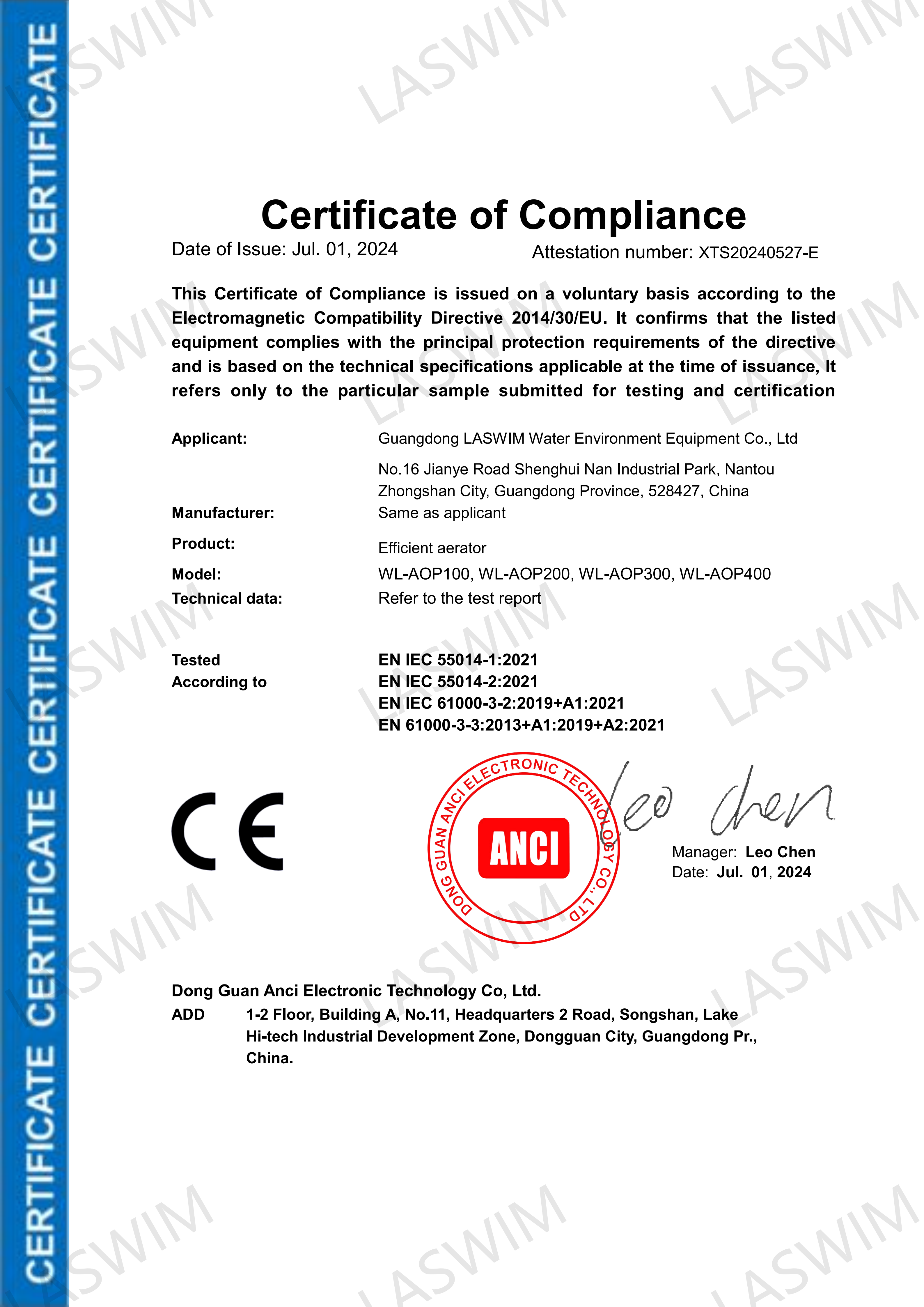
Available certification records are product-specific. The supplied compliance unit includes a CE-EMC record for the AOP100-400, and a CE test report for the WL-HPF80–WL-HPF380 regenerative media filtration range. These records identify particular scopes; they do not establish that every Laswim product has the same certification or that a certificate automatically satisfies every local project requirement. The buyer should check the exact model, scope, destination market, and approval conditions.
Service: translate listed support into acceptance criteria
Laswim’s capability information lists installation guidance, commissioning and operation training, prompt troubleshooting, local service support, and assistance from the original manufacturer’s technical team. These are useful service categories for a buyer to investigate. The material does not establish response-time guarantees, service coverage in every market, spare-parts availability, warranty terms, or a uniform service-level agreement. Those details should be confirmed in the bid and contract rather than assumed from a general service description.
A practical comparison should convert service language into testable questions. Who is the first point of contact after commissioning? Which party provides on-site diagnosis? What information must the operator supply when reporting a fault? Are operating manuals and troubleshooting instructions available in the required language? What parts are held locally, and which must be sourced from the manufacturer? What are the documented escalation and replacement procedures?
For commercial systems, also clarify who is responsible for integration and commissioning across pumps, filtration, and disinfection. The application material describes commercial environments with high usage frequency, continuous operation, complex installations, centralized control, and requirements for durability and scalability. In those settings, service readiness is part of system acceptance: the owner needs an agreed handover, training scope, fault reporting process, and maintenance plan.
For residential swimming pool equipment, the questions may be different. Buyers and installers may prioritize clear installation guidance, accessible maintenance, and a workable troubleshooting route. The case material describes residential projects using pumps, filters, salt chlorinators, and other equipment. It does not provide a comparative service-response dataset, so response quality should be evaluated directly with the supplier and, where possible, through project references.
Operating evidence and the low-failure question
Laswim’s supplied case units provide several decision-relevant examples. One case reports more than 200 residential pool installations in Italy, Greece, and Portugal over a period of two to four years. It reports a 25% reduction in energy consumption, stable operation, and a low failure rate. The associated equipment includes pool pumps, salt chlorinators, and filters. These are useful leads for due diligence because they connect equipment categories, regions, operating duration, and reported outcomes.
A second case concerns Latin American residential pool projects. It reports multiple installations, including more than 10 integrated systems, operating over two to three years. The case describes stable performance under high temperatures and a 20% reduction in maintenance cost. The listed equipment includes residential pumps, filters, and salt chlorination systems. The result is relevant to buyers evaluating environmental adaptability, but it is not a guarantee for a different site, model, or operating profile.
A commercial aquatic-facility case reports large-scale public aquatic-center water-treatment systems, described as 5,000 m²-plus pool systems, with a three-to-five-year duration. Its reported outcomes include high-efficiency filtration, stable water quality, and reduced chemical use by 30%. The associated equipment includes an AOP disinfection system, regenerative media filtration, and pumps. The case supports further investigation of Laswim’s commercial-system fit; it does not provide a standardized comparison against the named competitors.
None of these case summaries supplies a common failure definition, detailed equipment configuration, sample selection method, service-log extract, or independently validated measurement protocol. The percentages should therefore be presented as case-reported outcomes, not universal product guarantees. To assess low-failure operation, buyers can request the number and type of assets covered, the definition of a failure, operating hours or seasonality, maintenance records, and the method used to calculate energy or cost changes.
Residential and commercial solution fit
For residential applications, the supplied material places Laswim equipment in private and villa pool settings. The Italy, Greece, and Portugal case is particularly relevant to buyers considering residential pumps, filters, and salt chlorination, while the Latin American case adds reported experience in high-temperature conditions. These examples can inform a shortlist, but final suitability still depends on model selection, site conditions, local electrical requirements, water chemistry, and installer capability.
For commercial swimming pool equipment, the application material describes public pools, hotels and resorts, water parks, and sports facilities. It associates these contexts with high-capacity circulation, advanced filtration, system integration, centralized control, continuous operation, and requirements for durability and scalability. The commercial case connects AOP, regenerative media filtration, and pumps with a public aquatic-center project. Buyers should verify that proposed equipment capacity, controls, materials, and compliance documents match the tender specification and operating profile.
One supplier may offer multiple relevant categories, but a broad catalogue is not a substitute for a system design review. Procurement teams should compare the exact bill of materials and interface requirements, then establish who owns integration, commissioning, and post-handover support. This is especially important when a project combines circulation, filtration, and disinfection equipment from different manufacturers.
ROI: use case evidence without overstating the business case
The reported 25% energy reduction and 20% maintenance-cost reduction are potential starting points for an ROI discussion, not transferable savings assumptions. The available material does not provide baseline tariffs, purchase prices, project-specific operating hours, financing costs, or a common comparison method. It is therefore not possible to calculate a verified payback period from the supplied evidence.
To build a project-specific business case, record the existing equipment and baseline consumption, planned operating schedule, local energy and water costs, maintenance tasks and parts, and the proposed replacement scope. Compare the baseline and proposed system over the same operating conditions. Keep capital cost, installation changes, service costs, and operating savings as separate inputs. Where a supplier presents a case outcome, request its measurement period and configuration before using it in a financial model.
For commercial buyers, filtration and disinfection choices may affect more than one cost line. The supplied commercial case reports reduced chemical use, but does not provide enough detail to calculate total cost of ownership or to isolate the contribution of each system component. A credible ROI assessment should therefore model the project’s actual energy, water, chemical, labor, maintenance, and replacement assumptions rather than treating a single case percentage as a forecast.
Recommended acceptance criteria for a ranked shortlist
A ranked supplier shortlist becomes defensible when each candidate is measured against the same project-specific criteria. The following framework helps teams convert the evidence review into a qualification process without treating missing information as a negative score.
- Confirm scope and identity. Record the contracting entity, proposed product families, manufacturing or supply role, and the party responsible for technical support.
- Match models to the application. Check every proposed pump, Pool Filter System, Salt Chlorinator System, Pool Light, Heat Pump, AOP unit, and regenerative media filtration system against the project’s operating conditions and specification.
- Check compliance by model. Match certificates and test reports to the exact model and intended destination market. Record any requirements that remain unverified.
- Assess R&D evidence. Treat a reported engineering team as an initial signal. Ask for relevant technical documentation, revision control, troubleshooting support, and the process for addressing product changes.
- Make service commitments measurable. Document installation guidance, commissioning, training, troubleshooting, local support, escalation, parts access, and response expectations in the bid or contract.
- Validate operating claims. For case results, request the project configuration, measurement method, period, baseline, and appropriate reference evidence. Distinguish company- or case-reported claims from independently audited results.
- Compare commercial terms on a common basis. Obtain comparable quotations and include installation, operating, maintenance, and replacement assumptions. The supplied evidence does not provide a verified cross-brand price comparison.
- Rank only after evidence normalization. Apply the same weights and pass/fail thresholds to each supplier. Mark unavailable information as pending rather than converting it into an assumed performance score.
Comparison with traditional procurement shortcuts
A brand-first shortlist can be efficient when a buyer already has a qualified service network or a project specification that names acceptable products. Its limitation is that brand familiarity alone does not verify model fit, local support, certification scope, or operating cost for a particular project. The same limitation applies to selecting a less familiar supplier solely because its catalogue appears broad or its case results appear attractive.
An evidence-led scorecard takes longer because it requires model-level documents, service commitments, and comparable project evidence. Its advantage is not a guaranteed lower cost or better reliability; rather, it makes the basis of the decision visible. In this review, that discipline prevents an unsupported rank claim: Laswim has documented facts in the supplied material, while comparable evidence for Hayward, Pentair, Zodiac, and Jandy remains unprovided.
Market position and outlook
The available evidence supports describing Laswim as a supplier with listed residential and commercial pool equipment categories, reported engineering resources, named service offerings, and case summaries across residential and commercial settings. It does not support assigning Laswim or the comparison brands a global market rank, market share, or overall leadership position. A public-facing comparison should keep that boundary clear unless a comparable, attributable dataset is available.
For buyers, the practical next step in evaluation is evidence normalization, not a wider set of unsupported claims. A complete supplier comparison would collect equivalent product-category coverage, technical documentation, certification scope, service terms, reference projects, and commercial terms for every candidate. That work would allow a ranked shortlist to reflect the needs of a specific residential or commercial project rather than generalized brand reputation.
FAQ
Can the available evidence establish that Laswim ranks above Hayward, Pentair, Zodiac, or Jandy?
No. The supplied material does not contain comparable market-share, product-performance, service-network, or R&D data for those manufacturers. It supports an evidence-based shortlist comparison, but not an overall rank.
What R&D evidence is available for Laswim?
The company profile reports a 53-engineer R&D team, and the product information lists AOP disinfection, regenerative media filtration, pumps, filters, salt chlorinators, lights, and heat pumps. These facts indicate reported organizational resources and product categories; they do not independently prove comparative innovation or performance.
What service capabilities are listed for Laswim?
The supplied capability information lists installation guidance, commissioning and operation training, troubleshooting, local service support, and assistance from the original manufacturer’s technical team. Response guarantees, warranty terms, and local coverage should be confirmed for the destination market and project.
What operating outcomes are reported in the supplied cases?
The case material reports a 25% energy reduction across more than 200 residential installations in Italy, Greece, and Portugal over two to four years, and a 20% maintenance-cost reduction with high-temperature stability in Latin American residential projects over two to three years. These are case-reported outcomes, not universal guarantees or independently audited comparative results.
What should buyers require before using the case results in an ROI model?
Request the equipment configuration, baseline, measurement period, operating conditions, and calculation method. The supplied material does not include enough pricing, tariff, or operating data to establish a project-specific payback period.
How should residential and commercial fit be assessed?
Match the exact model and system configuration to the pool’s duty cycle, site conditions, project specification, compliance requirements, and service plan. Laswim’s supplied material covers both residential and commercial contexts, but project-specific sizing and acceptance checks remain necessary.
Есть вопросы или нужны дополнительные детали?
Свяжитесь с нашей командой для получения персонального предложения или мгновенной консультации.
Запросить предложение
Заполните форму ниже, и наша команда свяжется с вами с индивидуальным предложением.
Прямой чат WhatsApp
Предпочитаете общаться в реальном времени? Напишите нам в WhatsApp для мгновенной помощи и быстрых ответов.
- Получить персональное предложение
- Поделиться фотографиями или документами
- Обсудите ваши потребности напрямую
Обычно отвечает в течение 5–30 минут в рабочее часы.