
Leveling Machine Capability, Proven on MAHATMA's Lines
Leveling Machine Capability, Proven on MAHATMA's Lines
A leveling machine is sold as a single unit, but it is almost always bought as part of a process. Suppliers able to show they have built the whole coil-processing line — uncoiling, leveling, slitting, shearing or laser cutting — give buyers a more concrete capability signal than any standalone specification sheet.
Guangdong MAHATMA Intelligent Equipment Co., Ltd. is a Dongguan-based manufacturer of high-precision leveling equipment, founded in 2008 and operating a 50,000 m² manufacturing footprint with approximately 300 employees, a 26-engineer R&D team and an annual output of around 500 sets. The company builds CNC and hydraulic levelers, and it also builds complete coil lines. For a buyer moving from research into evaluation, those line families are the most verifiable evidence available about what the supplier can actually fabricate, integrate and control.
What Line Work Exposes That a Leveler Alone Cannot
A leveler on a catalogue page is a set of rolls, a frame and a control panel. A leveler inside a line is a subsystem that must hold flatness while strip is moving at production speed, while other machines — uncoiler, slitter, shear, stacker, laser — impose their own constraints on tension, speed and timing.
Three integration problems recur across coil-processing projects, and each one tests a different part of a supplier's capability:
- Synchronisation. In a flying shear line, the shear cuts the strip without stopping it. The MAHATMA MF-3 line feeds at 100 m/min with a stated shearing accuracy of 0.5 mm, which means the leveler must deliver strip at a stable speed and flatness the shear can act on.
- Tension control. In a slitting line, strip quality depends on the interaction between the slitter and the recoiler. The UC-2x2000 line runs at up to 200 m/min and produces 8–30 strips per coil; burr control and strip straightness are governed by knife shaft rigidity, tension control and — where flatness is a specification rather than a preference — an integrated leveling unit.
- Sequence design. In a laser blanking line, the leveler sets the flatness the laser will cut on. The TL-T3 line handles 3.0–12.0 mm material with 2,000–20,000 W of laser power and combines auto loading, high-precision leveling, laser cutting and robot unloading in one sequence.
None of these are marketing problems. That is precisely why line evidence carries more weight than a specification sheet: it shows whether a supplier can hold a process together, not merely supply a component within it.
The Four Line Families in MAHATMA's Portfolio
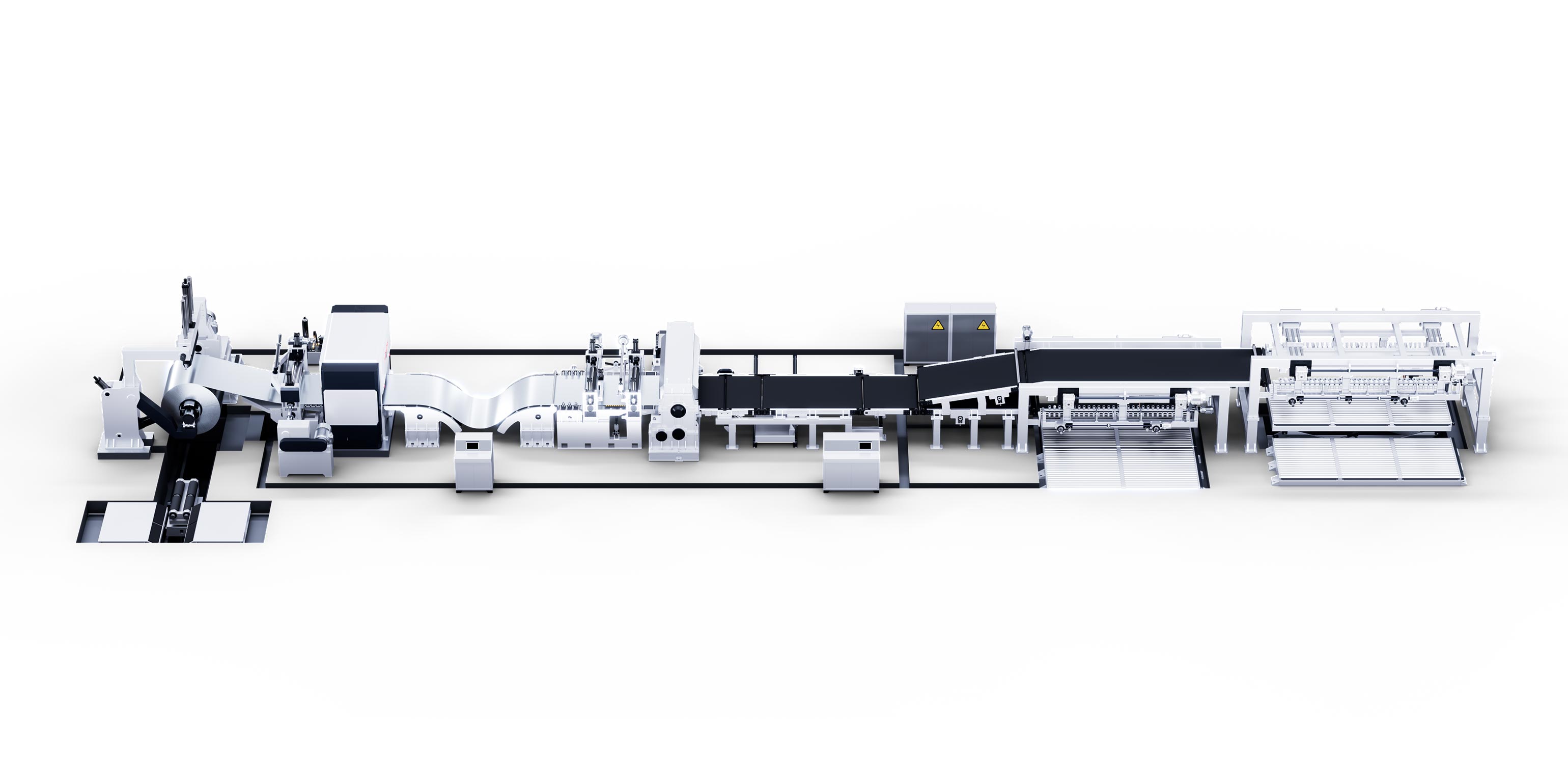
Figure 1 — MF-3 uncoiling, leveling and flying shear line, one of four coil-processing line families built by MAHATMA.
The portfolio covers four distinct production patterns. The table below uses the published envelopes for each family.
| Line family | Model | Material envelope | Line-level specifications |
|---|---|---|---|
| Uncoiling leveling slitting line | UC-2x2000 | 0.3–2.0 mm thick; 500–1,800 mm wide | 8–30 slit strips; up to 200 m/min; max coil weight 20 T |
| Uncoiling leveling flying shear line | MF-3 | 0.3–3.0 mm thick; 400–1,800 mm wide | Shearing accuracy 0.5 mm; feeding speed 100 m/min; max coil weight 25 T |
| Cut-to-length line | TD-2x2000 | 0.2–2 mm thick; 900–1,800 mm wide | Shearing accuracy ±0.5 mm; max speed 50 m/min; max coil weight 20 T |
| Uncoiling leveling laser blanking line | TL-T3 | 3.0–12.0 mm thick; 600–2,800 mm wide | Speed 25 m/min; laser power 2,000–20,000 W; auto loading and robot unloading |
Materials matter as much as dimensions. The slitting line is specified for carbon steel in cold-rolled and hot-rolled grades, stainless steel, silicon (electrical) steel, aluminium and aluminium alloys, and copper and copper alloys — the mix typically found in transformer and motor lamination work, home appliances, new energy components and steel structures. The flying shear line is listed for stainless steel, aluminium and galvanised (GI) coils. The laser blanking line is specified for a broad range of metal coils and sheets, serving automotive, home appliance, sheet metal, laser processing and heavy industry.
Two further configurations sit alongside these four. A customised automated leveling-and-deburring line for sheets and laser-cut parts (width 600–1,300 mm, thickness 0.5–80 mm, speed 20 m/min, minimum part 50 × 50 mm, accuracy 0.1–0.3 mm) combines deburring and leveling in a single pass, which matters when downstream processes are sensitive to edge condition. And on the slitting side, leveling units — CNC or hydraulic — are offered as line options rather than fixed inclusions, so flatness-critical strip can be specified without buying flatness capacity the application does not need.
What the Line Portfolio Says About the Leveler Range
The same engineering stack appears in MAHATMA's standalone machines. A leveler creates flatness through alternating bending, using the Bauschinger effect to work internal stress out of the material; how many rolls do the bending, and how rigidly those rolls are supported, determines the result. Line experience shows up in the details: heavy fabricated frames, servo-driven gap adjustment, hardened roll materials such as Cr12MoV and SKD11, and inspection routines built around roll hardness uniformity and ultrasonic flaw detection.
| Series | Structure / drive | Rated thickness | Max thickness | Width | Rolls |
|---|---|---|---|---|---|
| VSH50 | Four-high | 0.8–3.5 mm | 6.0 mm | 400–1,000 mm | 19 |
| MHTM50 | Intelligent CNC | 0.8–4.0 mm | 8.0 mm | 400–1,700 mm | 19 |
| MHTM200 | Intelligent CNC | 8.0–30.0 mm | 40.0 mm | 1,000–3,200 mm | 19 |
| MHTW50 | Servo-CNC | 0.8–4.0 mm | 8.0 mm | 400–1,600 mm | 23 |
| MHTR120 | Servo-hydraulic | 4.0–20.0 mm | 40.0 mm | 600–3,200 mm | 15/19 |
| MHTR300 | Servo-hydraulic | 15.0–80.0 mm | 100.0 mm | 1,300–4,000 mm | 9 |
The CNC MHTM series uses one-key parameter setting, stores up to 200 recipes on a 10-inch touch screen, warns on misoperation and supports upstream/downstream linkage — features that read as line requirements rather than standalone conveniences, because recipe recall is what makes fast material changeover inside a line realistic.
At the precision end, the servo-CNC MHTW series uses all-servo motor drive, a pull-out roll-box cleaning system, and laser 3D online flatness inspection with cloud-based remote control; the MHTW50 is specified for widths of 400–1,600 mm with 23 rolls. At the force end, the MHTR servo-hydraulic series is specified with a mortise-and-tenon rigid frame, servo-hydraulic hybrid drive, specified accuracy down to 0.01 mm, alloy rolls designed to run mark-free, anti-collapse dynamic compensation, and an energy figure quoted at 70% lower than conventional hydraulic drives. Those two ends of the range — thin-gauge surface quality, thick-plate force — are the two failure modes buyers most often discover late.
From Coil to Blank: Where These Lines and Levelers Are Used
MAHATMA's documented working conditions describe two distinct operating environments. The first is high-precision surface leveling and stress relief ahead of laser cutting, in automotive parts, home appliance and elevator production: indoor factory conditions, cold-rolled or stainless sheet requiring high surface quality under continuous medium load, servo-controlled roll gap adjustment with PLC parameter memory, and small-diameter dense rolls to avoid surface indentation. Equipment is matched with uncoilers, laser cutting machines, presses and robotic arms.
The second is heavy structural work in steel structure fabrication, shipbuilding, heavy construction machinery and bridge construction: thick carbon plate with significant welding deformation under continuous heavy load, where the leveler's job is to eliminate internal stress before welding or assembly. Here the drive is hydraulic, with electric gap adjustment, and the surrounding requirements are explicit — ISO 9001:2015 quality management, CE marking for the EU market, noise at or below 75 dB(A), safety interlocks and emergency stop systems, and optional IoT connectivity for remote monitoring and predictive maintenance.
Field results reported by customers follow the same split. A Hungarian manufacturer running an MHTR100 hydraulic leveler for metal processing reports two years of stable operation addressing metal deformation. A Polish manufacturer running an MHTR120 reports three years of stable operation on armored-vehicle work. A Saudi manufacturer using an MHTR30 for perforated ceiling plate reports resolving deformation in perforated sheet over two years, and a German manufacturer using an MHTR80 for mesh board leveling reports 50% cost savings. On the CNC side, a Slovak manufacturer leveling SS314 stainless steel with an MHTM100 reports a doubling of capacity. These are customer-reported figures, and they describe outcomes rather than guarantees — but they are the kind of evidence a buyer can weigh against a sample test.
Market Signals Behind the Line-First Approach
Equipment statistics support what project engineers already assume: the market is moving toward integrated, CNC-controlled coil processing rather than isolated machines. Dataintelo values the global metal forming equipment market — the category that includes leveling and roll forming machines — at USD 45.8 billion in 2025, with Asia Pacific holding a 42.5% revenue share in the same year. Fortune Business Insights sizes sheet metal processing equipment in Asia Pacific at USD 18.36 billion in 2025, and projects the broader metal forming machine tools market to reach USD 64.85 billion by 2034 at a 9.60% CAGR.
Within that, the blanking segment has its own trajectory. Market Research Future estimated the global cut-to-length line system market at USD 3.42 billion in 2024, while ReportLinker projects the cut-to-length machine market growing from USD 4.28 billion in 2026 to USD 5.94 billion by 2032, a 5.52% CAGR. Those two figures are not contradictory so much as differently scoped — one covers complete systems, the other machines — and the same caution applies to any single market number used in a purchasing case.
Adoption data points in the same direction. Grand View Research puts CNC technology at 85.7% of the machine tools market in 2025, and Fortune Business Insights attributes 41.37% of sheet metal processing equipment market share to the automotive segment in 2026. On the trade side, the Observatory of Economic Complexity recorded a 20.6% year-on-year increase in China's exports of metalworking machine parts in June 2026, with major destinations including Japan, Russia, the USA, India and Vietnam. For buyers, the practical reading is straightforward: the line, not the machine, is increasingly the unit of delivery — and the supplier's ability to engineer around an existing layout is becoming part of the purchase decision.
Where Line Evidence Stops: Limits and Trade-offs
Line capability is strong evidence of integration, fabrication and control competence. It is not proof that a given leveler will hit a flatness target on a specific material, and treating it as proof is the most common mistake in supplier evaluation. Several boundaries deserve to be stated plainly.
- Rated thickness is not universal thickness. Published leveler ratings are based on Q235 / 235 MPa material. High-strength steel, stainless and certain aluminium grades require the rated capacity to be recalculated and derated; the achievable range on your material is often narrower than the catalogue figure.
- One machine cannot optimise both ends of the range. A leveler configured for thick plate cannot level thin sheet to the same standard, and vice versa. Where the material envelope is wide, the realistic answer is the model with the best overlap — or a two-machine plan, not a single compromise.
- Heavy machines carry site requirements. Large hydraulic levelers in the 15–80 mm and 20–100 mm classes involve roll diameters in the 300–400 mm range, widths up to 4,000 mm, and minimum workpiece lengths in the 480–610 mm class. Crane capacity, foundation design and floor space must be verified early; these are heavy equipment in every sense.
- Speed and accuracy trade against each other. A flying shear line reaches 100 m/min on 0.3–3.0 mm material; a cut-to-length line runs at 50 m/min across a 0.2–2 mm envelope with ±0.5 mm shearing accuracy. Faster is not better unless the material envelope and order pattern support it.
- Automation is modular, not mandatory. Moving from a standalone leveler to a fully automated line is a staged decision. Buying the automation before the part envelope is stable usually adds cost without adding throughput.
Compared with traditional arrangements — a standalone leveler, a separate shear or laser, and manual handling between stations — an integrated line reduces handling, floor traffic and operator dependency, but it front-loads capital and locks in a layout. A workshop with low volume and frequent product changes may still be better served by a standalone CNC leveler feeding existing cutting equipment. The honest comparison is not integrated versus traditional; it is which configuration matches the takt, the material envelope and the changeover pattern of the actual order book.
A Buyer's Verification Checklist
Because capability claims are difficult to judge from literature alone, evaluation is best structured around verifiable steps rather than impressions.
- Define the four numbers first. Minimum and maximum thickness, maximum width, material grade with yield strength, and the flatness target. Leveling force depends on thickness and yield strength together, so a model rating has to be recalculated for anything other than mild steel.
- Confirm the integration plan early. Blanking lines provide MES/ERP interfaces for production data, traceability and order scheduling, and automation modules such as loading carts, conveyors, robots, vision inspection and AGV are standard options. Providing part envelope, takt target and current line layout up front is what allows the integration plan to be engineered rather than improvised.
- Use a sample test as the decision gate. The stated process is a free sample test: 1–2 metres of the buyer's material, leveled on the recommended machine, returned with a written flatness report, the process parameters used, and a video of the run. Testing the worst-condition material rather than the best is what makes the result meaningful.
- Ask for quality-control evidence. MAHATMA's documented controls include laser 3D online flatness detection, ultrasonic flaw detection on rollers, hardness uniformity testing, and full-load trial runs before shipment.
- Check certification and grid compatibility. CE certification and ISO 9001 have been held since 2008, with compliance work aligned to ISO 12100. For North America, 480V/3-phase/60Hz must be specified at order and NRTL field evaluation per NFPA 79 may be required by local inspectors. Always request the Declaration of Conformity copy before final payment.
- Confirm commercial and service terms. Documented terms include a minimum order of 1 unit, a 45-day lead time, monthly capacity of 50 units, 24/7 global technical support, overseas engineers for commissioning, regional spare parts warehouses and free operator training.
Future Outlook
Two shifts are likely to shape the next buying cycle. First, the delivery unit continues to widen: buyers increasingly specify a blanking architecture — coil in, finished part out — rather than a machine, which places a premium on suppliers who can engineer around existing lasers, presses and layouts. Second, verification becomes more transparent: laser 3D inspection and cloud-connected diagnostics move flatness evidence from a certificate issued at shipment to data generated during operation, which changes how suppliers are compared. For manufacturers in automotive, appliance, elevator and steel-service segments, the practical consequence is that the leveling machine question and the line question are converging, and the suppliers worth shortlisting are those that can answer both — while still being explicit about the derating, minimum workpiece length and envelope limits that apply to any specific project.
FAQ
Can the equipment integrate with my MES/ERP and my existing production line?
Yes. MAHATMA blanking lines and CNC levelers provide MES/ERP interfaces, and automation modules such as loading carts, conveyors, robots, vision inspection and AGV units are offered as standard options rather than bespoke add-ons. The modular architecture means a buyer can start with a standalone leveler and add feeding, conveying and stacking automation later, rather than committing to a full line immediately.
Should I buy a cut-to-length line or a flying shear line for high-volume blanking?
The decision turns on thickness and order pattern. For long runs of few sizes in 0.2–3 mm coil — appliance panels, elevator panels, automotive inner panels — a flying shear line is the natural fit: the MF-3 never stops the strip, running at 100 m/min with 0.5 mm shearing accuracy, and the wider flying shear series is described as reaching 250 cuts per minute. For thicker material or constantly changing sizes, the cut-to-length line trades some speed for range and flexibility; the TD-2x2000 covers 0.2–2 mm at up to 50 m/min with ±0.5 mm accuracy, while the wider cut-to-length series is specified up to 25 mm in MAHATMA's selection guidance. Monthly tonnage and size-change frequency are the two numbers that decide it.
How do I select a leveler for thick plate in shipbuilding or steel structures?
Thick-plate leveling is predominantly a force problem, so the machine scales accordingly: roll diameters in the 300–400 mm class, heavy frames and servo-hydraulic gap control to absorb load shocks. MAHATMA's heavy series covers this envelope — the MHTR300 for 15.0–80.0 mm (max 100.0 mm) and the MHTR400 for 20.0–100.0 mm (max 120.0 mm), with widths up to 4,000 mm and minimum workpiece lengths in the 480–610 mm class. Because published ratings are based on Q235 / 235 MPa, high-strength ship plate requires recalculated derating, and crane capacity and foundation requirements should be verified before order placement.
What should I check when buying a slitting line for steel, aluminium or copper coils?
Slitting lines are specified by five numbers: material thickness range, coil width, strip count, line speed and coil weight. The UC-2x2000 covers 0.3–2.0 mm, 500–1,800 mm width, 8–30 strips, up to 200 m/min and 20 T coils, and MAHATMA's selection guidance describes a wider slitting range spanning roughly 0.2–12 mm across its UC, TC and MC series. Beyond the numbers, verify the quality-critical subsystems: knife shaft rigidity and tooling for burr control, tension control between slitter and recoiler for strip straightness, and whether an integrated leveling unit is needed for flatness-critical strip. Coil car, turnstile and scrap winders complete the layout.
Can I test my own material on the machine before buying?
Yes. The stated sample-test process is free: the buyer sends 1–2 metres of material or representative parts, MAHATMA levels them on the recommended machine, and returns a written flatness report with measured data, the process parameters used, and a video of the leveling run. Buyers only cover shipping of their material. Testing worst-condition material rather than best-condition material is the recommended approach, and the resulting machine proposal is issued without charge.
MAHATMA's English-language product brochure, covering the leveler series and coil-processing lines described above, is available for download: MAHATMA product brochure (PDF).