
Leveling Machine Supplier Analysis: Inside MAHATMA
The global metal forming equipment market is valued at USD 45.8 billion in 2025, according to Dataintelo, and leveling machines operate at the critical junction between raw coil and precision fabrication. For buyers evaluating a leveling machine or straightening machine supplier, the decision is rarely about a single parameter. It is about material envelope, required flatness, automation level, certification compliance, and the supplier's ability to support the machine over a 10-to-15-year lifecycle. This analysis examines Guangdong MAHATMA Intelligent Equipment Co., Ltd. as a supplier candidate, based on its published capabilities, product structure, technical approach, applications, and market position.
The Role of a Leveling Machine in Modern Sheet Metal Processing
A sheet metal leveling machine—also referred to as a straightening machine, flattening machine, coil leveler, or plate leveler—removes coil set, waviness, and internal residual stress by passing the material through alternating bending rolls. The material is repeatedly bent beyond its yield point, which redistributes internal stress and produces a flat, stable sheet. This flatness is not cosmetic: laser cutting accuracy, stamping consistency, welding fit-up, and downstream assembly all depend on the incoming material's shape stability.
Buyers searching for a leveling machine typically fall into one of several groups: laser cutting shops that need pre-cut flattening, stamping and automotive parts producers that require stress-relieved blanks, steel service centers that process coil into sheet, or heavy fabrication plants leveling thick plate for shipbuilding and steel structures. Each group has a different definition of “good enough,” which is why a supplier's product range and engineering depth matter as much as the machine's brand name.
Why Leveling Machine Selection Is Difficult
Leveling force depends on two variables that are often confused: material thickness and yield strength. A machine rated for 6 mm mild steel will not level 6 mm high-strength steel at the same throughput, because the bending force requirement scales with yield strength. Width also matters—wider sheets increase roll deflection, which is why roll structure and backup roll design are decisive.
There are practical structural choices that buyers must understand. A 2-high roller leveler has work rolls without backup support, making it the lowest-cost option but also the most limited in precision. A 4-high leveler adds backup rolls that reduce work roll deflection, improving flatness. A 6-high leveler introduces intermediate rolls, providing near-full support across the roll body and minimizing unsupported gaps. For mirror-finish panels and precision parts, the 6-high structure is the typical choice; for general sheet metal work, 4-high is the standard recommendation.
This is also where CNC control changes the economics. According to Grand View Research, CNC technology accounted for 85.7% of the machine tools market in 2025. CNC leveling machines replace manual screw adjustments with programmable roll gap settings, recipe storage, and automated changeover, which directly reduces setup time and operator dependency.
Company Profile: Guangdong MAHATMA Intelligent Equipment Co., Ltd.
Guangdong MAHATMA Intelligent Equipment Co., Ltd. is a high-tech enterprise headquartered in Dongguan, Guangdong Province, one of the world's largest manufacturing supply chain hubs. The company was founded in 2008 and has since focused on the R&D, manufacturing, and global sales of high-precision leveling equipment. It operates across a 50,000 m² manufacturing base and employs approximately 300 people, including a 26-engineer R&D team. Annual output is about 500 sets of equipment, with roughly 30% of production exported to the EU, USA, and Asia.
MAHATMA holds more than 230 patents and maintains strategic industry-academia-research partnerships, including collaboration with Tsinghua University. The company is recognized as a provincial-level “Specialized and Sophisticated SME” in China, and its products comply with ISO 12100 and carry European CE certification. According to its published profile, MAHATMA equipment has been exported to over 100 countries and regions, supported by 28 overseas marketing and service networks.
For procurement teams, these attributes matter because leveling machines are long-term capital assets. A supplier with a controlled quality management system, documented engineering capacity, and an export service network is a different risk profile than a supplier without those structures. MAHATMA has been ISO 9001 certified since 2008, which indicates a formal quality system covering design, production, and after-sales service.
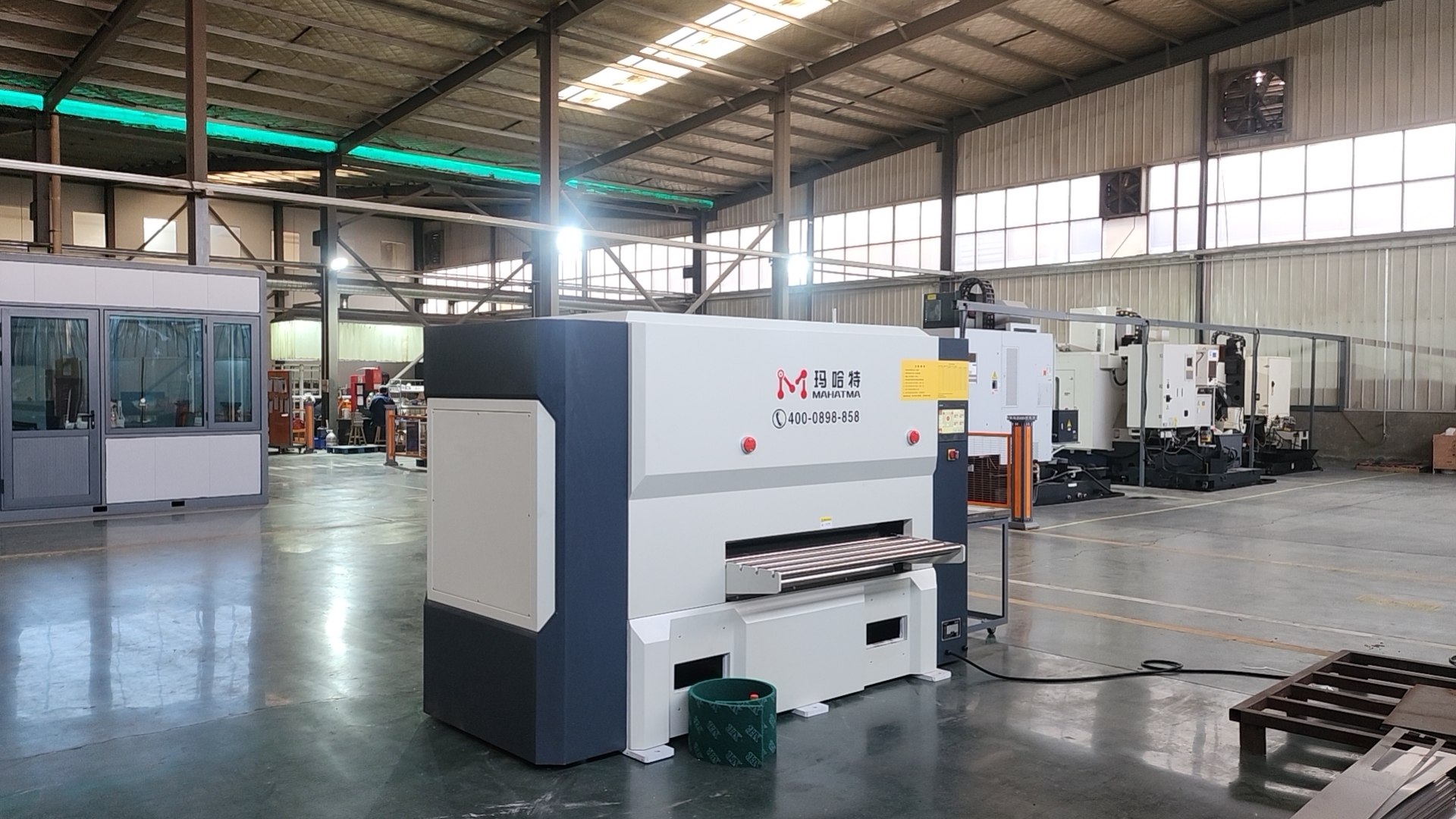
Product Portfolio: Coverage from 0.03 mm to 120 mm
One of the most useful ways to evaluate a leveling machine manufacturer is to examine whether its product range matches the material envelope of your operation. MAHATMA's published series collectively cover material thickness from 0.03 mm to 100 mm (maximum 120 mm in the heaviest configuration), widths from 200 mm to 4000 mm, and roll counts from 9 to 33 depending on the application.
| Series | Type | Typical Thickness Range | Width Range | Primary Application |
|---|---|---|---|---|
| VSH / VST | Four-high / Two-high plate leveler | 0.08–8.0 mm (max up to 14 mm) | 200–1300 mm | Small and medium sheet metal shops, budget-limited workshops, thick-plate rough leveling |
| MHTM | Intelligent CNC leveling machine | 0.03–30.0 mm (max up to 40 mm) | 200–3200 mm | Sheet metal fabrication, cabinets, auto parts, home appliances, laser blanking |
| MHTW | Intelligent servo-CNC leveling machine | 0.08–12.0 mm (max up to 20 mm) | 300–2100 mm | Precision sheet metal, 3C electronics, automotive, new energy, medical devices |
| MHTR | Servo-hydraulic high-precision leveling machine | 0.5–100 mm (max up to 120 mm) | 400–4000 mm | New energy, heavy industry, shipbuilding, aerospace, steel structures |
This range matters for a practical reason: a machine optimized for thin sheet cannot level thick plate precisely, and vice versa. A supplier that only offers one structural type will force buyers into a compromise. MAHATMA's four-tier structure is designed so that buyers pay for the precision, force, and automation level they actually need rather than for a generic solution.
CNC Series: MHTM as the Cost-Effective Workhorse
The MHTM series targets the most common leveling requirement in metal fabrication: 0.3 mm to 16 mm material for laser cutting, stamping, and enclosure manufacturing. Representative models include the MHTM20 (0.3–1.2 mm, 23 rolls), MHTM30 (0.5–2.0 mm, 21 rolls), MHTM120 (4.0–16.0 mm, max 25 mm), and the MHTM200 (8.0–30.0 mm, max 40 mm, for wide and heavy plates up to 3200 mm).
The MHTM series includes a 10-inch HD touchscreen, one-key CNC parameter setting, storage for up to 200 recipes, misoperation warnings, and upstream/downstream linkage. The precision motor drive is described by the manufacturer as achieving 50% energy savings compared with conventional drive configurations. For a laser cutting shop running multiple materials in one shift, recipe storage is the difference between a two-minute changeover and a trial-and-error session that consumes material and time.
Servo Series: MHTW for Precision-Critical Applications
MHTW is marketed as MAHATMA's precision tier, using all-servo motor drives and a structure the company calls the “Kunpeng frame” patent. Published features include an automatic pull-out roll-box cleaning system, smart OS with remote cloud control, laser 3D online inspection, and a hollow frame structure designed to avoid thermal deformation. The series covers 0.08 mm to 12 mm, with widths up to 2100 mm on the MHTW100 model.
These features are directly relevant to buyers processing aluminum alloy, copper, and mirror-finish sheet where surface marking and thermal stability are critical. The servo drive architecture also supports the kind of closed-loop adjustment that traditional hydraulic machines cannot offer.
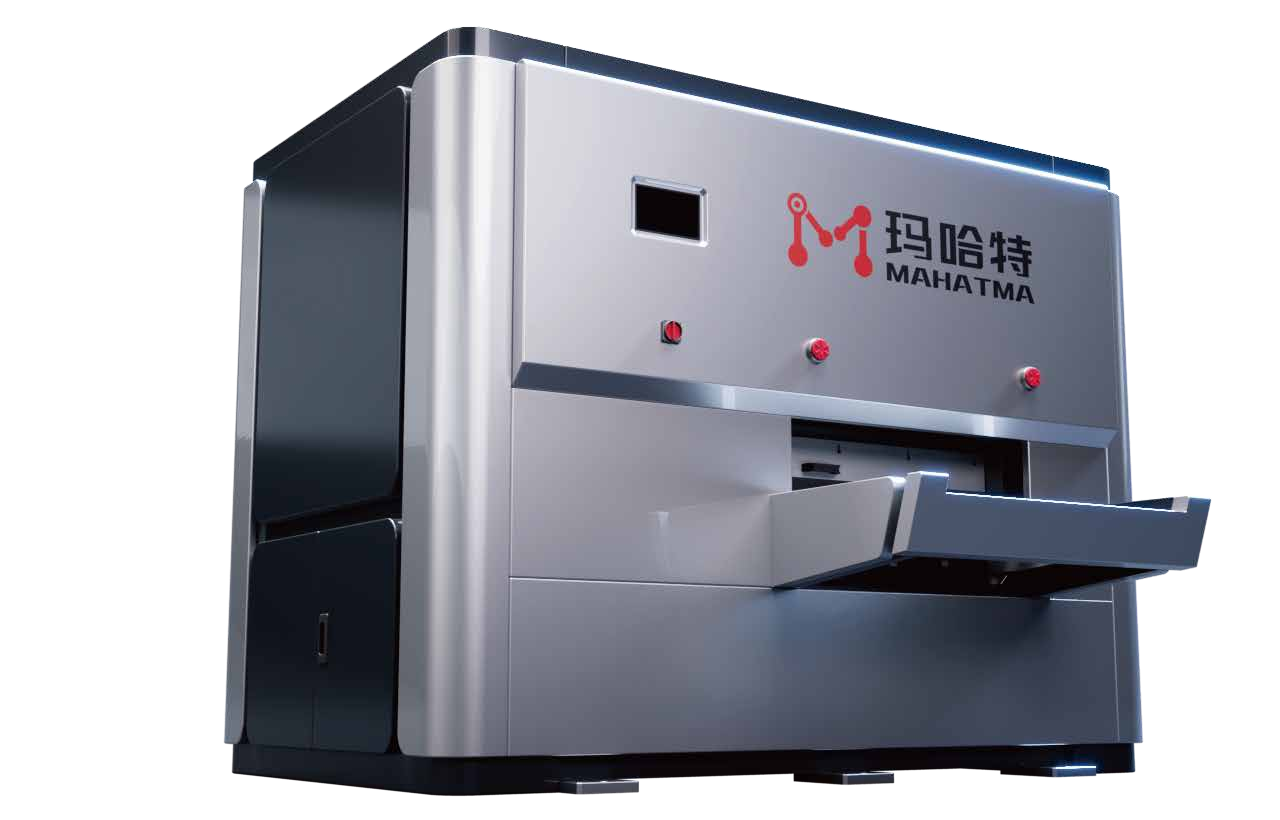
Hydraulic Series: MHTR for Thick Plate and Heavy Loads
Thick plate leveling is a force problem. Leveling 100 mm plate requires enormous bending torque, large-diameter rolls, and a frame rigid enough to handle load shocks without deflection. MAHATMA's MHTR series combines German hydraulic technology with CNC control and a mortise-tenon rigid frame design. The MHTR80 (2.0–10.0 mm, max 25 mm), MHTR100 (3.0–12.0 mm, max 30 mm), and MHTR150 (6.0–30.0 mm, max 50 mm) cover the medium-heavy segment, while the heaviest published configurations—MHTR300 and MHTR400—are rated for 15–80 mm and 20–100 mm respectively, with widths up to 4000 mm.
The MHTR series uses a servo-hydraulic hybrid drive, which the manufacturer states can reduce energy consumption by up to 70% compared with traditional hydraulic levelers. The series also includes alloy work rolls described as mark-free, anti-collapse dynamic compensation, and claimed micron-level accuracy up to 0.01 mm. For shipbuilding and steel structure fabricators, the essential selection parameters are rated thickness at a given yield strength, minimum workpiece length, roll diameter class, and floor/crane requirements—these machines are heavy equipment in every sense.
Integrated Lines: Cut-to-Length and Flying Shear
For high-volume coil processing, MAHATMA offers complete lines rather than standalone machines. The TD-2x2000 cut-to-length line integrates uncoiling, leveling, and shearing for 0.2–2.0 mm material at widths of 900–1800 mm, with ±0.5 mm shearing accuracy, a maximum speed of 50 m/min, and 20-ton coil capacity. The MF-3 flying shear line handles 0.3–3.0 mm material (width 400–1800 mm) at up to 100 m/min feeding speed with 0.5 mm shearing accuracy and 25-ton coil weight. These lines target home appliance manufacturing, automotive parts, elevator manufacturing, and steel service centers.
The buying decision between a flying shear line and a cut-to-length line is straightforward when expressed in operational terms. Flying shear lines never stop the strip during cutting, making them the right choice for long runs of a few sizes in thin gauge material. Cut-to-length lines trade some speed for flexibility in thickness range (up to 25 mm in MAHATMA's broader TD/MD/HD series) and are better suited to frequent size changes.
Technical Explanation: Why Roll Structure and Control Architecture Matter
Leveling quality is determined by three interacting variables: the number of alternating bending cycles, the rigidity of the roll system, and the precision of roll gap control.
The Bauschinger effect is the physical basis of roller leveling. When metal is bent beyond its yield point in one direction and then bent in the reverse direction, the yield strength is temporarily reduced, allowing the material to be progressively flattened with less force per pass. More roll pairs mean more alternating bends and more complete stress relief. This is why thin, precision-critical material gets higher roll counts—MAHATMA's MHTM10 for 0.03–0.6 mm material uses 25 rolls, while the MHTW15 for ultra-thin precision work uses 33 rolls. Conversely, thick plate uses fewer rolls with larger diameters because the priority shifts from stress relief density to force capacity.
Roll structure determines how well the work rolls resist deflection under load. In a 2-high configuration, the work rolls bend under load, creating uneven pressure across the strip width. A 4-high configuration adds backup rolls, sharply reducing deflection. A 6-high configuration adds intermediate rolls that support the work rolls almost continuously, eliminating unsupported gaps—this is the structure required for mirror-finish panels and precision parts where any roll marking or uneven pressure is unacceptable.
Control architecture determines how consistently the machine reproduces the correct roll gap. Manual adjustment relies on operator experience and produces batch-to-batch variation. CNC control with recipe storage allows exact reproduction of proven settings for each material grade, thickness, and width. MAHATMA's MHTW series goes further, with laser 3D online inspection that measures surface condition during leveling and feeds corrections back to the servo drives in real time. This closed-loop approach is the main technical differentiator between MAHATMA's precision tier and conventional leveling machines.
Applications and Use Cases
Laser Cutting Shops: Pre-Cut Flattening and Stress Relief
For a laser cutting shop, the leveler's job is to remove coil set, waviness, and internal stress so the laser's focus height remains consistent and nesting accuracy is maintained. Most laser shops process 0.5–6 mm carbon steel, stainless steel, and aluminum, which maps to MAHATMA's MHTM30–MHTM80 series (21/19/19 rolls, 4-high-capable CNC machines). CNC gap adjustment with recipe storage is the decisive feature here: changeover between material types takes seconds instead of trial-and-error. For precision-critical parts, the MHTW series adds laser 3D inspection for closed-loop verification.
Automotive Parts, Home Appliances, and Elevators
These industries process cold-rolled or stainless steel sheets requiring high surface quality under continuous medium load. The application demands small-diameter dense rolls to prevent surface indentation, plus dust removal systems to protect the material surface. Servo motor control with PLC parameter memory provides consistent roll gap adjustment across long production runs. MAHATMA's published references include a Jiangsu new-energy vehicle parts manufacturer that achieved approximately 45% capacity gain after automation, and Zhucheng Group's fully automated upgrade from standalone machines to an integrated line.
Steel Structures, Shipbuilding, and Heavy Construction
Heavy fabrication involves thick carbon steel plates with high yield strength and significant welding deformation. The leveler must eliminate internal stress in thick plates to ensure flatness for subsequent welding or assembly. This is the domain of the MHTR hydraulic series, with hydraulic upper roll lifting and electric gap adjustment. The application also requires compliance with ISO 9001:2015, CE marking for EU delivery, noise levels ≤75 dB(A), safety interlocks, emergency stop systems, and—increasingly—optionally IoT connectivity for remote monitoring and predictive maintenance.
Market Trend Analysis
The demand for leveling equipment is supported by several verifiable market trends.
First, the automotive segment accounts for 41.37% of the sheet metal processing equipment market in 2026, according to Fortune Business Insights. Electric vehicle production, in particular, increases the volume of laser-cut and stamped blanks that require pre-processing leveling. Second, Asia Pacific dominates the metal forming equipment market with a 42.5% revenue share in 2025 (Dataintelo), reflecting the region's concentration of sheet metal fabrication capacity. Third, CNC technology has reached 85.7% adoption in the machine tools market (Grand View Research, 2025), which is consistent with the shift from manual and traditional hydraulic leveling machines to CNC-controlled systems.
The cut-to-length line market is projected to grow from USD 4.28 billion in 2026 to USD 5.94 billion by 2032 at a CAGR of 5.52% (ReportLinker), indicating steady demand for integrated coil processing lines. China's exports of metalworking machine parts increased 20.6% year-on-year in June 2026, according to the Observatory of Economic Complexity, with major destinations including Japan, Russia, the USA, India, and Vietnam. These figures suggest that Chinese-origin leveling equipment is becoming a normal part of the global procurement landscape, particularly in price-sensitive emerging markets and in mature markets where cost competitiveness is a factor.
MAHATMA's position within this landscape is that of a mid-to-high-tier Chinese manufacturer with an international service footprint. The company is not positioned as a low-cost supplier; its stated export destinations include Germany, the United States, Japan, and South Korea—markets where precision and compliance are non-negotiable. Its investments in patent portfolio, CE certification, and automated line integration align with the market shift toward CNC, integrated systems, and service-supported purchasing.
Comparison with Traditional Solutions and International Brands
Relative to traditional leveling solutions—manual roller levelers and conventional hydraulic machines—CNC and servo-controlled levelers offer measurable advantages. Manual adjustment is slow and operator-dependent; conventional hydraulic machines consume more energy and lack closed-loop accuracy. MAHATMA states that its MHTM CNC series achieves 50% energy savings through precision motor drives, and its MHTR servo-hydraulic series achieves up to 70% energy savings compared with traditional hydraulic leveling. For a machine operating 16–24 hours per day, energy consumption is a recurring cost that can exceed the initial purchase price within several years.
In the international market, the established reference points are German manufacturers. ARKU Maschinenbau GmbH was recognized in 2025 as one of the top 500 “hidden world market leaders” in precision leveling machines by WirtschaftsWoche, with its FlatMaster series used for laser-cut and stamped parts. KOHLER Maschinenbau GmbH has completed over 6,700 reference projects globally in leveling technology as of late 2023. These are reputable competitors with deep process knowledge accumulated over decades.
MAHATMA's published position is that its machines achieve flatness down to ±0.1 mm in typical production, with precision series reaching ±0.05 mm on verified applications, while offering a total cost of ownership that is typically 30%+ lower than European premium brands, faster spare parts supply, and remote diagnostics support. This competitive claim is plausible given the company's 26-country export base, including Germany, the US, Japan, and Korea, where premium-level equipment is already incumbent.
It is also fair to state the boundary. European manufacturers have decades of accumulated process data across extreme material grades and heavy rolling applications. A Chinese manufacturer entering the premium segment must still prove long-term durability and build a reference base in the most demanding applications. Buyers with exceptional material specifications—exotic alloys, unusually high yield strength, or strict surface finish requirements—should validate the machine on their own material before purchase. MAHATMA offers a free sample test for this purpose: the customer sends 1–2 meters of material, and MAHATMA returns a written flatness report and process video.
Future Outlook
The leveling machine category is moving in three directions simultaneously: CNC adoption, integration with downstream automation, and closed-loop quality verification.
MAHATMA's product roadmap indicators align with this trend. The MHTM series already provides MES/ERP interfaces and recipe-based operation. The MHTW series adds laser 3D online inspection, remote cloud control, and an automatic roll-box cleaning system that reduces maintenance downtime. On the line-integration side, MAHATMA offers automation modules such as loading carts, conveyors, robots, vision inspection, and AGV as standard options. The documented upgrade path for customers is modular: start with a leveler, then add feeding and stacking automation, and finally connect the line to MES.
The practical implication is that buyers should evaluate not only the current machine but the supplier's ability to scale the solution. A leveler that can be integrated into a future automated line has a longer useful life than a standalone machine that requires replacement when the factory automates.
Summary: What Buyers Should Take from This Analysis
MAHATMA is a credible leveling machine supplier for the mid-to-high segment of the market. Its product range is unusually broad, spanning thin precision material at 0.03 mm to heavy plate at 100 mm. Its technical approach—CNC recipe control, servo drives, 4/6-high structures, laser 3D inspection—matches the direction of the industry. Its certifications (CE, ISO 9001) and export footprint reduce the compliance risk of international procurement. Its limitations, relative to European premium brands, are in long-term process data and extreme-application references, which buyers can de-risk through sample testing.
For procurement teams and engineers evaluating leveling machine options, the recommended next step is to define the material envelope precisely—thickness, width, yield strength, and target flatness—and then validate the shortlisted machine on actual production material. A written flatness report on your own material is worth more than any brochure specification.
A detailed capability brochure covering MAHATMA's product line is available for reference: MAHATMA Brand Brochure (English).
Frequently Asked Questions
Which MAHATMA model should I choose for my material?
Send four numbers—thickness range, width, material grade (yield strength), and flatness target—and MAHATMA returns a matched model plus a free sample test. This process exists because leveling force depends on both thickness and yield strength; model ratings based on Q235/235 MPa must be recalculated for high-strength steel, aluminum, or titanium. As a quick map: Vague SHS series (0.03–3.5 mm) for entry-level work, Mastery MHT series (0.03–30 mm) for standard CNC precision, Royal MHTY series (0.5–100 mm) for servo-hydraulic high-stability applications, and Wits MHTP series (0.08–12 mm) for flagship unmanned operation.
Can I test my own material on the machine before buying?
Yes—the sample test is free. Send 1–2 meters of your material or representative parts, and MAHATMA levels it on the recommended machine, then returns a written flatness report and process video within days. The test should include your material grade and flatness target; it is recommended to send your worst-condition material rather than your best, so that machine capability is validated under realistic production conditions.
What flatness can a MAHATMA leveling machine actually achieve?
Precision series achieve flatness down to ±0.05 mm, verified in a documented case on titanium fixtures; typical production results are 0.05–0.20 mm/m². The result is achieved through multi-roll alternating bending based on the Bauschinger effect, 4/6-high full-support roll structures, and laser 3D inspection with closed-loop correction on flagship models. Final flatness depends on material grade, thickness, and original coil condition, which is why a free sample test on your own material is the recommended confirmation.
Do MAHATMA machines have CE certification? Can they be exported to the EU and US?
Yes. MAHATMA has held CE certification and ISO 9001 since 2008, and machines operate in 26 countries including Germany, the US, Japan, and Korea. CE certification follows the Machinery Directive 2006/42/EC, covering LVD and EMC requirements—it is mandatory for EU entry. For the US/Canada, buyers should specify 480V/60Hz at order time and plan for NRTL field evaluation of the electrical panel per NFPA 79. For Russia/EAEU, EAC certification applies.
Can the equipment integrate with my MES/ERP and existing production line?
Yes. MAHATMA blanking lines and CNC levelers provide MES/ERP interfaces, and automation modules—including loading carts, conveyors, robots, vision inspection, and AGV—are available as standard options. The company builds integrated lines rather than standalone machines; published reference cases include Zhucheng Group's fully automated upgrade and a Jiangsu new-energy vehicle parts manufacturer that achieved approximately 45% capacity gain. Buyers should provide their part envelope, takt target, and current line layout early so the integration plan can be engineered accordingly.
How do MAHATMA levelers compare with European premium brands?
European premium brands built the reputation of this product category and remain strong competitors. MAHATMA closes the precision gap with self-developed intelligent leveling control, laser 3D surface inspection, and a patent portfolio exceeding 230 patents, achieving flatness down to ±0.1 mm class in production. The practical differences are cost and service: MAHATMA's total cost of ownership is typically 30%+ lower, spare parts ship faster, and remote diagnostics are supported. The company's equipment is already operating in Germany, the US, Japan, and Korea. The fairest evaluation method is to send 1–2 meters of material for a test leveling run and compare the measured report against your flatness requirement.