
LieZen Nonwoven Fabric Machines: Company & Capability Analysis
LieZen Nonwoven Fabric Machines: Company & Capability Analysis
Awareness-stage buyers researching nonwoven fabric machines need a clear view of equipment capabilities, company track record, and application fit. This analysis examines Changzhou LieZen Non-woven Machinery Co., Ltd. (also known as Lizen Machinery Co., Ltd) as a supplier of PP spunbond and spunmelt nonwoven production lines.
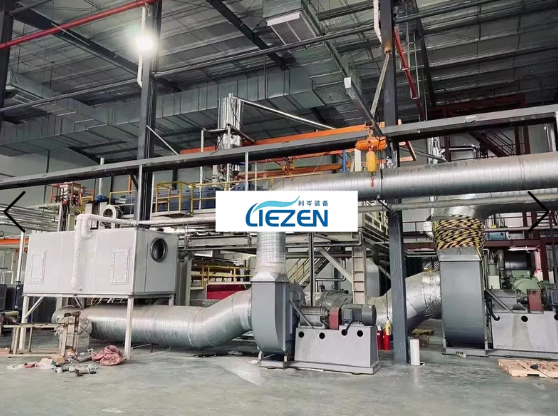
Nonwoven Fabric Machines: Market Relevance and Buying Considerations
Nonwoven fabric machines are the core capital equipment behind a wide range of disposable and durable products, from medical masks and diapers to automotive interior materials. The equipment market is expanding. Dataintelo estimates the global non-woven machinery market was worth approximately USD 6.8 billion in 2025 and projects it to reach USD 12.1 billion by 2034.
Spunbond technology remains the most widely used process, holding a 34.2% share of the non-woven machinery market in 2025, according to the same source. This aligns with the central role of polypropylene (PP), which is used in about 72% of global nonwoven fabric production. Asia Pacific led regional demand with a 43.7% revenue share in 2025, while China's nonwoven export data show that spunbonded nonwovens accounted for 37% of the country's total nonwoven export value in 2024.
For buyers at the awareness and research stage, the key questions are not only whether a machine supports a specific output, but whether the supplier has the technical range, production capacity, and application expertise to match the end market. Nonwoven production lines must deliver consistent fabric weight, stable line speeds, and reliable long-term operation.
Company Background: Changzhou LieZen Non-woven Machinery Co., Ltd.
Changzhou LieZen Non-woven Machinery Co., Ltd. (also known as Lizen Machinery Co., Ltd) is a specialist manufacturer of spunbond and spunmelt nonwoven fabric machines based in Changzhou, Jiangsu, China. The company was founded in 2003 and operates a 30,000 m² manufacturing facility with around 270 employees. Its annual output is approximately 50 units, supported by a research and development team of ten engineers.
LieZen's product portfolio covers single-beam and multi-beam configurations, including Single S, SS, SSS, Melt blown, SMS, SMMS, SSMS, SMMSS, PET and Bi-Component nonwoven machines. The company reports that it has delivered nearly 1,000 complete sets of standardized and customized nonwoven production lines to more than 30 countries. Around 60% of its output is exported, with the USA listed as a primary market.
The manufacturer states that its equipment is designed to deliver high capacity, high quality, improved reliability, greater intelligence, environmental compatibility, and lower energy consumption. These engineering priorities matter for buyers evaluating total cost of ownership and long-term production efficiency.
Technical Capabilities: Spunbond and Spunmelt Machinery
LieZen's machines process polypropylene (PP) as the main raw material for both spunbond and meltblown layers. The equipment itself is built from carbon steel, stainless steel, alloy components, and electrical parts. Depending on the configuration, a line can combine spunbond and meltblown beams to produce fabrics with different barrier and strength properties.
Three representative models illustrate the range:
| Model | Type | Effective Width | Production Speed | Mechanical Speed | Filament Fineness |
|---|---|---|---|---|---|
| SW-SS | Double Beams PP Spunbond | 1600–3200 mm | <250 m/min | <300 m/min | 1.5–2.0 D |
| SW-SSS | Automatic SSS Spunbonded Polypropylene | 1600–3200 mm | <400 m/min | <450 m/min | 1.5–2.5 D |
| SW-SMMS | SMMS Spunmelt | 1600–3200 mm | <400 m/min | <450 m/min | 1.5–2.0 D |
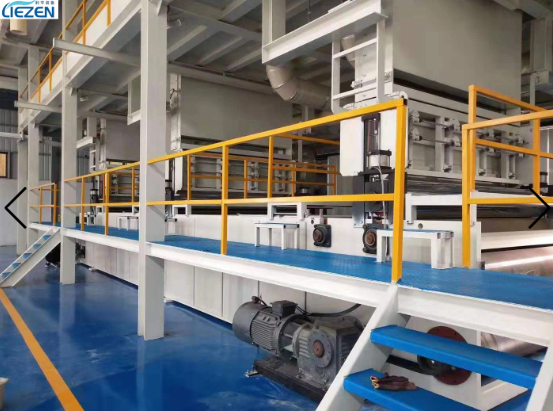
These specifications demonstrate the ability to support both hygiene-oriented spunmelt lines and multi-beam spunbond configurations. The product data also highlights several common design features: high production stability, uniform fabric gram weight, flexible formula adjustment for multiple nonwoven products, modular structures for easier maintenance, high automation to reduce manual labor, and closed temperature control systems that improve the finished product qualification rate.
Engineering Features That Affect Output Quality
Uniform fabric gram weight is a critical factor for hygiene products such as diapers and sanitary napkins, where weight differences affect absorption and fit. Machine stability, precise filament drawing, and controlled web formation help maintain product consistency.
Flexible formula adjustment gives producers the option to run multiple nonwoven products on a single line. This can reduce capital expenditure for manufacturers with diversified product portfolios.
Modular structure simplifies maintenance by allowing component-level access. This reduces downtime and makes service work more predictable.
High automation reduces manual labor costs and improves process repeatability. Sensors and control systems support continuous operation, which is typical in nonwoven production.
Closed temperature control is particularly relevant in spunbond and meltblown processes. Consistent temperature profiles help stabilize polymer flow and improve the finished product qualification rate.
Application Scenarios: From Hygiene to Automotive Interior
Nonwoven production lines from LieZen are applied across medical, hygiene, automotive interior, apparel, home textile, agricultural, packaging, and eco-friendly bag segments. Specific products include masks, protective wear, sanitary napkins, diapers, automotive interior materials, agricultural covers, and nonwoven bags.
According to the application data, the lines are designed for continuous or semi-continuous industrial operation and can suit workshop or cleanroom environments, depending on the end product. Medical materials may require cleaner production conditions, while automotive interior applications prioritize dimensional stability and gram weight consistency.
Customization options support different widths, layer counts, electrostatic treatment, flame-retardant options, and medical-grade clean standards. Supporting equipment includes traction units, winding and rewinding systems, fans and air compressors, heating and temperature control, slitting/cutting, and packaging equipment.
Turnkey and Upgrade Project Scope
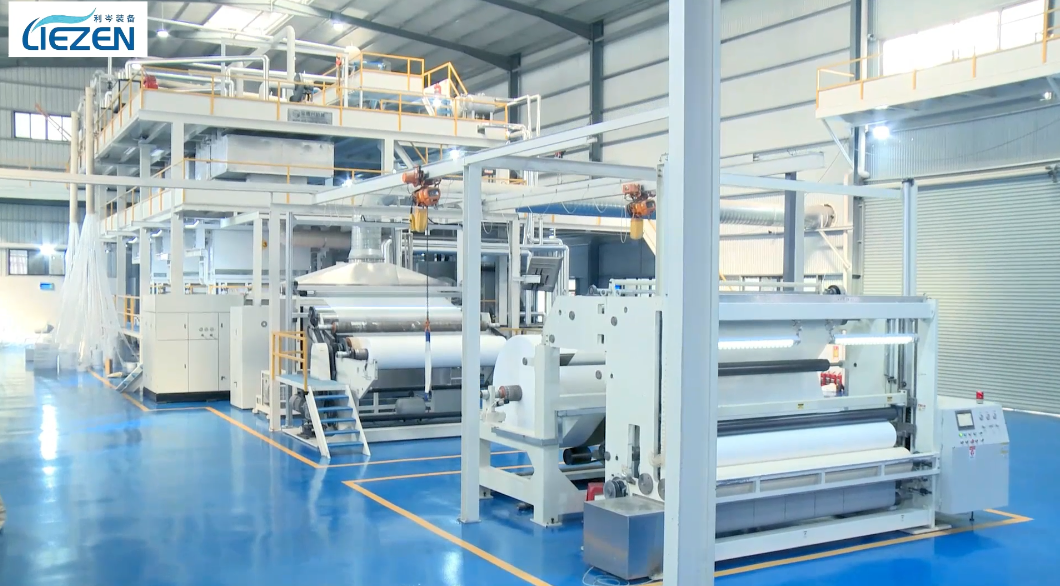
LieZen's project scope includes turnkey production line delivery, single-machine supply, and process modification or upgrade projects. This flexibility is valuable for producers needing a complete new line, a machine addition, or modernization of an existing line. The operation mode can be continuous or semi-continuous, with automation levels configured to customer needs.
This project capability is relevant to both greenfield nonwoven plants and established fabric producers optimizing production lines.
Market Position and Comparison with Global Competitors
The global nonwoven machinery market includes long-established European manufacturers such as Reifenhäuser Reicofil, Andritz AG, Oerlikon Nonwoven, and A.Celli Nonwovens, according to the Textile Innovation Report. These companies often lead in the highest-speed, fully integrated line segments and have decades of installed base.
LieZen competes with a China-based manufacturing model that emphasizes standardized and customized lines, export reach, and cost-effective engineering. Its 60% export ratio and US market focus indicate experience in international projects. For buyers targeting mid-speed, flexible, and application-specific lines, the company offers a practical alternative to premium-priced European suppliers.
An honest limitation is that for highly specialized, ultra-high-speed lines with extensive regulatory validation history, some global buyers may prefer the longer industrial track record of established European brands. LieZen's value proposition is stronger for companies looking for capable spunbond or spunmelt lines with custom widths and layer configurations, backed by a Chinese factory with direct manufacturer communication.
Decision Framework for Buyers
When evaluating nonwoven fabric machines, buyers should consider a set of decision criteria:
- Output width and layer configuration: These should align with target products. For example, a 1600–3200 mm effective width covers many standard hygiene converting formats.
- Line speed and balance: Production speed defines throughput, but speed needs to be matched with auxiliary equipment to avoid bottlenecks.
- Raw material flexibility: If the production plan includes PP spunbond and meltblown, the line should support both processes.
- Automation and monitoring: Higher automation can reduce operating costs, but buyers should assess their own technical capacity to run advanced controls.
- Customization and compliance: Confirm whether electrostatic treatment, flame-retardant options, medical-grade clean standards, and relevant safety standards such as EN ISO 11111-3:2005+A2:2016 are supported.
- Supplier track record and after-sales: Delivery history, export experience, and project support are useful signals, especially for first-time buyers.
Future Outlook: Spunbond Demand, Asia Pacific, and Production Intelligence
The nonwoven machinery market's growth to an estimated USD 12.1 billion by 2034 will likely continue to favor spunbond technology, which already holds the largest market share. With Asia Pacific accounting for 43.7% of revenue in 2025, China-based suppliers are in a strong position to serve both regional and export demand.
Polypropylene will remain a dominant material input, aligning with the PP-based machine designs offered by LieZen. The company's stated focus on intelligent, environmental-friendly, and energy-saving equipment corresponds with the industry's broader interest in reducing scrap, energy use, and emissions. Buyers evaluating future proofing should look for suppliers capable of incorporating automation, process monitoring, and flexible formula management.
Frequently Asked Questions
What is a nonwoven fabric machine?
A nonwoven fabric machine is a production line that converts polymer raw materials, primarily polypropylene, into nonwoven fabrics using processes such as spunbonding and meltblowing. It can range from a single-beam system to a multi-layer spunmelt configuration such as SMS or SMMS.
What is the difference between spunbond and SMS nonwoven machines?
A spunbond machine produces fabric from continuous filaments laid into a web and bonded. An SMS machine combines spunbond and meltblown beams to create layered structures with improved barrier properties. LieZen offers configurations such as SS, SSS, SMS, SMMS, SSMS, and SMMSS to match different application requirements.
What raw materials are used in PP spunbond nonwoven production?
Polypropylene (PP) is the dominant raw material, used in approximately 72% of global nonwoven fabric production, according to MarketsandMarkets/Vertex AI analysis. In LieZen's machine specifications, PP is the main raw material for both spunbond and meltblown layers.
What machine parameters should buyers evaluate?
Key parameters include effective width, production speed, mechanical speed, filament fineness, automation level, and modular maintenance access. LieZen's SW series models, for example, offer effective widths of 1600–3200 mm and production speeds up to 400 m/min depending on configuration.
Which industries can use LieZen nonwoven production lines?
The lines are suitable for medical, hygiene, automotive interior, apparel and home textiles, agricultural covers, packaging, and nonwoven bags. Customization can support requirements such as electrostatic treatment, flame-retardant options, and medical-grade cleanroom standards.
Can nonwoven machinery be customized?
Yes. LieZen supports custom requirements including different widths, layer counts, electrostatic treatment, flame-retardant options, and medical-grade clean standards. Auxiliary equipment such as winding, slitting, and packaging can be integrated into the line.
Contact and Manufacturer Information
Changzhou LieZen Non-woven Machinery Co., Ltd. (Lizen Machinery Co., Ltd)
No. 6 Jingye Road, Qianhuang Town, Wujin District, Changzhou, Jiangsu, China
Email: managerl@lizen-equipment.com
Tel: +86-18888182509
WhatsApp: +86 188-8818-2509
Website: https://www.lizen-equipment.com