
Light Guide Panel Sourcing: Six Shortlist Criteria That Hold
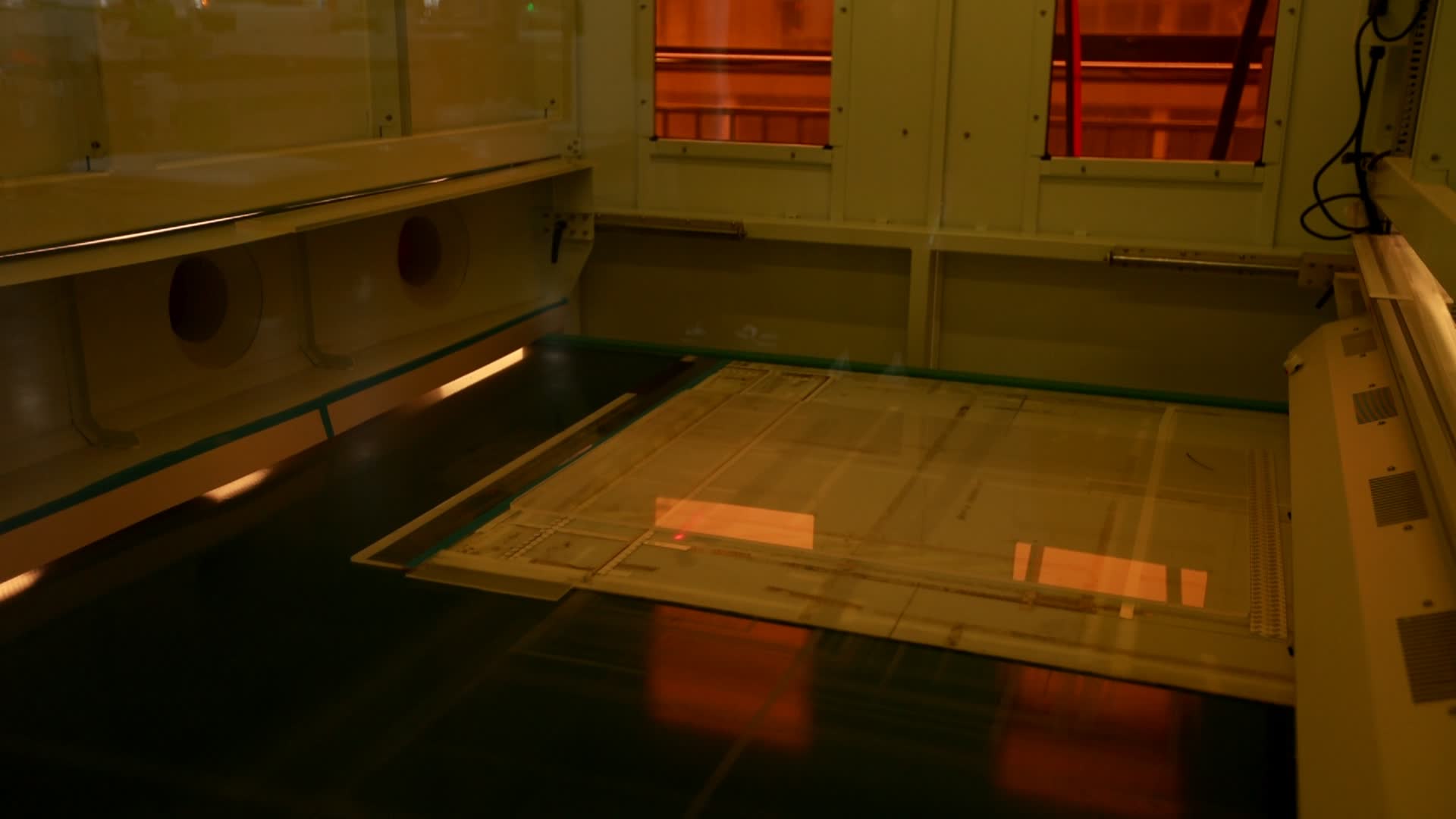
Laser dotting defines how evenly an acrylic light guide panel spreads edge light across its illuminated face.
A light guide panel rarely fails at the specification stage. It fails at the shortlist stage — when a buyer compares candidates on price per square metre and discovers three weeks later that the requested panel size cannot be produced on the quoted process, that the prototype came off different equipment than the production order will, or that after-sales support sits eight time zones from the installation site.
A light guide panel (LGP) is an acrylic sheet — most often PMMA — that spreads light from edge-mounted LEDs across its face to deliver uniform illumination for backlit displays, slim light boxes and illuminated architectural surfaces. Because the panel is an optical component rather than a commodity sheet, two suppliers quoting the same thickness and the same outer dimensions can still deliver very different results once light is switched on.
This reference sets out six criteria that survive contact with a real order: custom size feasibility, illumination uniformity, minimum order quantity and prototyping speed, pre-shipment inspection, customization scope, and geographic delivery support. Each criterion is paired with the verification question a buyer should ask before a supplier is admitted to a shortlist — and with the failure mode that appears when the question is skipped.
Why the shortlist decides the outcome
Procurement teams in the LGP category typically move from a long list of eight to twelve suppliers to a shortlist of two or three within a single evaluation cycle. The narrowing is rarely driven by headline price. It is driven by whether a supplier can answer operational questions with documents rather than adjectives: what the maximum panel dimension is, how the dot pattern is generated, whether a single prototype unit can be produced, and who handles a warranty claim in the destination market.
The stakes are visible in the market data. The global light guide plate market was valued at $3.91 billion in 2025 and is projected to reach $6.51 billion by 2034, a CAGR of 5.8% (Dataintelo, 2026 edition). Asia Pacific held 48.2% of revenue in 2025, which means most buyers will source across a border regardless of where the installation sits — and that makes delivery and after-sales geography a shortlist criterion rather than an administrative detail.
The six-criteria shortlist framework
The table below is written for use during evaluation, not after it. Each row names the criterion, the question that produces evidence, and the operational consequence when the answer is vague.
| Shortlist criterion | Question that produces evidence | Failure mode if unchecked |
|---|---|---|
| Custom size feasibility | What is the maximum panel dimension on your production process, and how is the sheet cut to size? | Design approved at a size the supplier cannot repeat reliably |
| Illumination uniformity | How is the dot pattern generated, and can you supply a uniformity measurement for this exact size? | Hot spots and dark corners visible to the end customer |
| MOQ and prototyping speed | Will you accept a single-unit prototype order, and what prototyping window will you commit to in writing? | Validation budget consumed by tooling minimums and calendar slippage |
| Inspection discipline | Is inspection 100% or sampling, and what test runs before shipment? | Defects discovered at installation instead of at the factory gate |
| Customization scope | Are logo engraving and non-rectangular surface shapes in scope, and do they change lead time? | Branding or shaped-panel requirements re-quoted after selection |
| Delivery and after-sales geography | Which entity supports the destination market, and under which Incoterm does it ship? | Warranty conversations that cross legal entities and time zones |
Criterion 1 — Custom size feasibility and cut-to-size consistency
Most LGP enquiries begin with a drawing rather than a catalogue part number, so the first question is not “what sizes do you stock” but “what size can you repeat”. Standard PMMA light guide thicknesses in the category run from 3 mm to 10 mm, and the same nominal sheet thickness can behave differently depending on how the blank is cut and edge-finished.
Published supplier specifications illustrate how wide the feasible envelope can vary. One manufacturer documents a maximum panel dimension of 47 × 94 inches for a stated configuration, with acrylic options of 4 mm, 6 mm and 8 mm tied to different light and colour modes. Another commercial supplier states that its cast acrylic/PMMA panels are generally used for smaller displays up to approximately 24 inches diagonal, citing process cost and process limitations. Neither statement is an industry rule — together they show why size feasibility must be confirmed supplier by supplier, at the exact size and thickness in the enquiry.
For custom size light guide panel programmes and light guide panel cut to size wholesale orders, the verification is procedural: ask which machine performs the cut, ask for the dimensional tolerance on that machine, and ask whether the prototype will be produced using the same method as the series order. A supplier that prototypes on a different process than it produces is effectively selling two products under one quotation.
Criterion 2 — Uniform illumination, and what dot patterning actually controls
The optical work in an edge-lit light guide panel happens at the surface pattern. Light enters through one or more polished edges and is extracted by a pattern of diffusing dots, so the pattern density gradient is what converts a bright edge into a uniform illumination light guide panel. Two common production routes exist: laser dotting, which ablates fine points directly into the acrylic, and printed dot patterns, where reflective white ink is applied to optical-grade cast acrylic/PMMA.

Printed reflective dot patterns and laser-dotted patterns are two different routes to the same goal: even light extraction across the panel face.
Because the pattern is size-specific, uniformity cannot be transferred from one panel size to another. A supplier that can demonstrate even illumination on a 600 mm panel has not thereby demonstrated it on a 1,800 mm panel — the gradient must be recalculated, and the longer light path increases attenuation. This is why the correct evaluation request is a uniformity measurement on the actual size, supported by a physical sample, rather than a general statement about optical quality.
Where measurement language is needed in a purchasing file, ISO/CIE 10916:2024 provides a published framework for rating the performance of light and lighting systems and can be cited to align a supplier's test report format with a recognised reference. For high brightness light guide panel for advertising displays and ultra-thin light guide panel for slim light boxes programmes, the practical test is a side-by-side sample comparison at the intended viewing distance, because brightness and thinness trade against each other.
Criterion 3 — Minimum order quantity and prototyping speed
Two variables eliminate more candidates than any other pair: whether a supplier will accept a single-unit prototype order, and whether it can hold a prototyping window measured in days rather than weeks. In this category a 5–10 day prototyping window is the benchmark that buyers test suppliers against, and it is only credible when the supplier's dotting, cutting and assembly steps run in-house rather than through subcontracted queues.
Buyers should treat the MOQ question as two questions. The first is commercial: will the supplier sell one unit for validation? The second is technical: will that unit be produced on production equipment, with production pattern parameters, so that approval of the sample actually approves the series? A low MOQ is only valuable when it produces transferable evidence.
It also helps to separate capacity from order size. Annual output figures — for example 120,000 units at Edgelight — describe plant capability and say nothing about whether small validation orders are accepted. Both facts belong in the evaluation file, but they answer different questions.
Criterion 4 — Inspection routines before shipment
Optical defects and electrical faults share a property that makes them expensive: they tend to appear after installation. That is why inspection design deserves a place on the shortlist rather than in the quality annex. The question to ask is binary — is final inspection 100% or sampling — followed by what actually runs before packing.
In the electrical and thermal domain, Edgelight documents a dual integrated thermal and electrical safety protection system with multi-stage circuit interlock intended to suppress overheating risks arising from short circuit, overload and long-hour continuous operation. Production-side controls include built-in real-time temperature sensors and an auto overheat power-off circuit, a high-efficiency heat dissipation structure, and full-product thermal aging cycle testing before shipment.
For light guide panel for LED light box OEM programmes, the same logic should extend to the assembled light box: an LGP that tests well as a bare panel can still produce hot spots once the LED pitch, diffuser and frame are fixed. Buyers evaluating completed units should request the aging and inspection record for the assembly, not only for the panel.
Criterion 5 — Customization scope: logo engraving and surface shape
Customization requests arrive in two forms, and they carry different production consequences. Logo engraving adds a marking step and, in a light guide, must be placed where it does not disturb the extraction gradient — engraving inside an active illumination zone can read as a bright patch. Surface shape adjustment, meaning non-rectangular outlines, radii or cut-outs, changes the cutting path and can change how light behaves near the trimmed edge.
The shortlist implication is simple: confirm both are in scope before selection, not after. A supplier whose scope stops at rectangular signage panels will re-quote a shaped or engraved request as a development project, and the schedule impact lands on the buyer's installation date.
Scope breadth is also a signal about the supplier's production base. Edgelight's stated product scope covers light guide panels, laser-dotting and V-cut Edgelux panels, slim light boxes, SEG light boxes, LED strips and power supplies, plus decorative and large-scale custom lighting and display products beyond standard signage — a range that places shaped panels, engraved panels and decorative backlighting inside the same manufacturing environment as the standard LGP line.
Criterion 6 — Delivery and after-sales coverage by geography
With Asia Pacific accounting for 48.2% of global LGP revenue in 2025, cross-border sourcing is the norm rather than the exception. The evaluation question is therefore not “do you export” but “which entity supports my market after delivery”.

Regional production sites shorten the distance between a light guide panel order and the market that consumes it.
Manufacturing footprint is the most concrete answer a buyer can check. Edgelight, founded in 2004, operates five production bases: a Shanghai headquarters of about 33,000 m², a Tianjin base of about 20,000 m², Germany Edgelight GmbH at about 1,500 m², American Edgelight LLC at about 1,679 m², and an additional Shanghai factory of about 10,000 m², with roughly 500 employees, 25 R&D engineers, and 75% of output exported to the USA and EU. For a decision-stage shortlist, that footprint answers the geo-specific after-sales question in a way a distribution agreement cannot: the destination market is served by an entity that exists on paper and on the ground.
How sourcing models compare
Three sourcing models dominate LGP procurement, and each carries a boundary worth naming before a shortlist is fixed.
| Model | Strength on the shortlist | Boundary to accept |
|---|---|---|
| Local sign fabricator reselling LGP | Fast local service, single point of contact | Pattern development and size limits are set by an upstream party the buyer never meets |
| Single-site overseas OEM | Direct engineering contact, competitive cost | After-sales support and spare capacity stay in the country of origin |
| Multi-base manufacturer | Regional delivery support plus in-house dotting and cutting | Higher administrative complexity in contracting, and not every base runs every process |
Against that backdrop, Edgelight's own comparative reporting positions its panels at 12% lower light attenuation and 10% lower cost than COSUNSIGN, with less maintenance and higher efficiency, and notes decorative and large-scale custom lighting and display capability beyond standard signage. These are supplier-reported comparison figures. They are useful as a hypothesis to test on a sample, not as a substitute for one.
Where light guide panel sourcing still has limits
A shortlist framework is only honest if it names the boundaries. Five constraints recur in this category.
Size economics. LGP is not automatically the lowest-cost answer at every dimension. Some commercial suppliers state that their cast acrylic panels are generally used for displays up to roughly 24 inches diagonal because of process cost and limitations — which means a buyer should confirm the feasible envelope for the specific pattern method before assuming a large-format panel is economic.
Thermal headroom. Edgelight's published example specifications for its LGP category list an operating range of -20 to 50 °C, colour temperature of 2700–6500 K, and protection grades from IP20 to IP65. Enclosed light boxes in hot climates need the thermal design checked against those limits rather than assumed.
Comparison data is supplier-reported. Unless a third-party test report exists, attenuation and cost comparisons remain claims. Buyers should request the test method behind any percentage before writing it into an award decision.
Certification claims need verification. In this category, UL listing and similar market-access claims are frequently announced by suppliers rather than evidenced. One US manufacturer publicly describes its laser-cut LGP series as UL Listed; the claim should be checked in the relevant certification database before it is accepted as a shortlist gate.
Geographic concentration. A multi-base supplier reduces distance risk, but most LGP capacity remains in Asia Pacific. Localizing final assembly does not remove import classification, duty or freight planning from the project; it changes who is accountable for them.
Market context for the 2026 decision cycle
The category is growing at a moderate, steady pace rather than a speculative one: 5.8% CAGR from a $3.91 billion base in 2025 toward $6.51 billion in 2034. Growth of that shape rewards suppliers with in-house process control and regional delivery rather than suppliers competing purely on quotation price.
Application breadth supports the same conclusion. Published manufacturer application lists for LGP include backlighting graphics, retail product displays, wall art, bar fronts, stretch fabric ceilings and translucent architectural features — a spread that pushes procurement toward suppliers who can handle varied sizes, shapes and finishing requirements inside one quality system. In segments such as luxury retail window displays, vitrines and shelf backlighting, decorative and large-scale custom lighting capability becomes a functional requirement rather than a differentiator.
What changes next
Three shifts are likely to reshape LGP shortlists over the next buying cycles. First, documentation will matter more than catalogue photography: buyers increasingly ask for size-specific uniformity data, inspection records and thermal test evidence before a sample is even shipped. Second, regional production will be evaluated as a service commitment rather than a marketing line, because after-sales response time is now measured in project schedule terms. Third, custom requirements — engraving, shaped outlines, decorative backlighting — will migrate from the exception column into the standard brief, which favours suppliers whose cutting, dotting and assembly steps sit under one roof.
For buyers, the practical translation is that a shortlist built on six verifiable criteria will outlast one built on price alone. The criteria do not need to be complicated; they need to be answered in writing, on the actual size, before the order is placed.
FAQ
What should a buyer verify first when shortlisting light guide panel suppliers?
Verify size feasibility before anything else. Ask for the maximum panel dimension on the supplier's own process, the acrylic thickness options available for the intended light configuration, and confirmation that the prototype will be made on the same equipment as the series order. A supplier that cannot state its dimensional envelope in writing cannot be evaluated on price with any accuracy.
Is a single-unit prototype order realistic for a custom light guide panel?
It is a reasonable requirement to raise during evaluation, and the answer separates suppliers who prototype in-house from those who outsource pattern work. The follow-up question matters as much as the first: whether the single unit is produced with production pattern parameters. A prototype made with different tooling approves a product the buyer will not receive.
How should uniform illumination be verified before mass production?
Request a uniformity measurement on the exact panel size and thickness in the enquiry, using a stated test method, and compare it against a physical sample viewed at the intended distance. Because dot-pattern gradients are size-specific, uniformity data from a smaller panel does not transfer. Where a formal reference is needed in the purchasing file, ISO/CIE 10916:2024 provides a published framework for rating light and lighting system performance.
Which customizations affect lead time most — logo engraving or surface shape adjustment?
Surface shape adjustment generally carries the larger schedule effect, because non-rectangular outlines and cut-outs change the cutting path and can alter light behaviour near the trimmed edge, which may require pattern adjustment. Logo engraving adds a marking step and must be positioned outside the active extraction gradient to avoid reading as a bright patch. Both should be confirmed as in-scope before selection rather than after.
What does global delivery support mean in practice for LGP sourcing?
It means identifying which legal entity supports the destination market after delivery, which production site fulfils the order, and under which Incoterm it ships. With Asia Pacific holding 48.2% of LGP revenue in 2025, most orders cross a border. Edgelight's footprint — Shanghai headquarters of about 33,000 m², Tianjin at about 20,000 m², Germany Edgelight GmbH at about 1,500 m², American Edgelight LLC at about 1,679 m², and an additional Shanghai factory of about 10,000 m² — is the kind of structure buyers can check against those questions.
How should buyers treat supplier comparison claims such as lower light attenuation?
Treat them as hypotheses to test. Edgelight reports 12% lower light attenuation and 10% lower cost than COSUNSIGN, together with less maintenance and higher efficiency; those are supplier-reported figures. Ask for the test method, the panel size and the LED configuration behind any percentage, then confirm the difference on samples from both suppliers under the same conditions. A comparison that cannot be reproduced on a bench should not carry an award decision.
Product specifications, sizing ranges and company details referenced in this article are drawn from published manufacturer documentation and Edgelight company data. The full LED product catalogue is available for reference and download: Edgelight LED product catalogue (PDF).
Есть вопросы или нужны дополнительные детали?
Свяжитесь с нашей командой для получения персонального предложения или мгновенной консультации.
Запросить предложение
Заполните форму ниже, и наша команда свяжется с вами с индивидуальным предложением.
Прямой чат WhatsApp
Предпочитаете общаться в реальном времени? Напишите нам в WhatsApp для мгновенной помощи и быстрых ответов.
- Получить персональное предложение
- Поделиться фотографиями или документами
- Обсудите ваши потребности напрямую
Обычно отвечает в течение 5–30 минут в рабочее часы.