
Light Guide Panel Specs by Use Case: Office, Retail, Outdoor
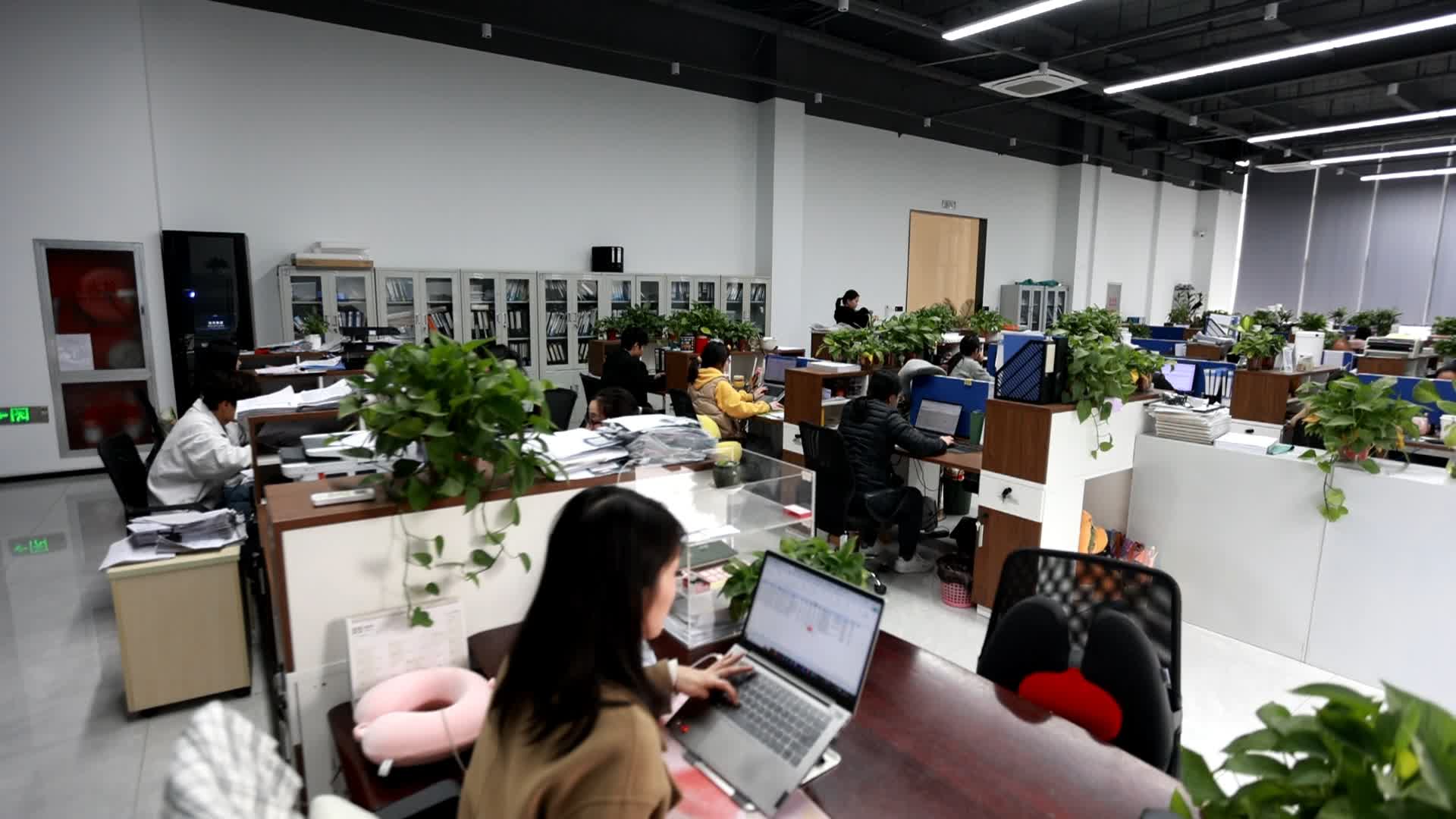
Light guide panel (LGP) specification is an environment-matching exercise before it is a purchasing decision. Two signage projects can use the same acrylic (PMMA) substrate, the same edge-lit construction and a comparable dot pattern design, yet require different protection grades, different colour temperatures and different assumptions about how many hours a day the light box runs. When the mapping is wrong, the failure is rarely visible at delivery. It appears later as condensation behind the diffuser, uneven brightness across a wide panel, or a service call the original specification never anticipated.
Four parameters carry most of the environmental risk in an LGP-based light box or luminaire: protection grade (IP), operating temperature range, colour temperature, and luminous output per unit area. Thickness and dot pattern then decide whether the panel fits the physical envelope of the fixture and whether the illumination stays even across the visible face.
Shanghai Edgelight Industry Co., Ltd. (EDGELIGHT) is a Shanghai-based manufacturer of LED displays, light guide panels, LED drivers and advertising lighting equipment, founded in 2004 and operating five production bases in Shanghai, Tianjin, Germany and the United States. Its light guide panel platform — model LGP, item reference 6267 — is documented with a maximum operating current of 7.2 A, maximum power of 144 W, typical power consumption of 101 W, luminous flux above 1,080 lm, a colour temperature range of 2700K–6500K, an operating temperature range of -20°C to 50°C, a protection grade band of IP20–IP65 and an acrylic (PMMA) substrate. Those documented values form the working envelope this reference maps against three deployment environments.
The Three Operating Envelopes: Office, Retail, and Outdoor Signage
1. Office and workplace interiors
Office interiors are generally conditioned, low-moisture, low-dust environments. The dominant risk is not water ingress but duty cycle, glare control and consistency of appearance across multiple identical fixtures sitting in the same sightline. Buyers specifying light guide panels for LED light box programmes in offices — reception wall signage, wayfinding boxes, ceiling coves, directory panels — typically work at the lower end of the IP band, because the enclosure does not face rain or wash-down. What they should fix instead is the target colour temperature for the space, the required uniformity across the panel face, and the mounting depth. Mounting depth is often what decides the thickness of the acrylic light guide panel and therefore whether an ultra-thin design for slim light boxes is realistic.
2. Retail and hospitality under continuous duty
Retail and hospitality interiors raise the duty cycle rather than the environmental severity. Convenience retail, hotel lobbies and always-on window displays may run continuously, which means the panel and its driver accumulate heat over long periods, and any unevenness in the dot pattern becomes visible to passing traffic every hour of the day. This is where uniform illumination light guide panel performance becomes a commercial requirement rather than a cosmetic one: banding behind a backlit poster or a shelf backlight is a brand presentation problem first and a technical problem second. Warm colour temperatures in the 2700K–3500K part of the range are commonly used in hospitality and luxury retail settings, while brighter, cooler configurations are common where the signage has to compete with high ambient store lighting.
3. Outdoor and semi-outdoor signage
Outdoor signage changes the failure mode. Wind-driven rain, condensation cycles, dust and temperature swings make the finished assembly's ingress protection the first-order specification, with the platform's IP20–IP65 band setting the ceiling of what the panel itself supports. The operating temperature range of -20°C to 50°C defines the environment the panel is specified for; sites that regularly fall outside that band need engineering attention rather than a paper change to the specification. In practice, outdoor and semi-outdoor projects also move toward the cooler end of the colour temperature range for legibility against bright ambient light, and toward the documented luminous output as the planning basis for how much light the panel can place behind the graphic.
Mapping Environment to Parameter: A Working Matrix
| Parameter | Office interior | Retail & hospitality (long duty) | Outdoor / semi-outdoor signage |
|---|---|---|---|
| Protection grade (finished assembly) | Lower part of the IP20–IP65 platform band; enclosure is decorative rather than sealing | Mid band; cleaning, spillage and wash-down exposure in food retail and hospitality | Upper band; sealing, drainage and cable-entry detail decide the achieved rating |
| Operating temperature assumption | Conditioned space, comfortably inside -20°C to 50°C | Conditioned, but heat accumulates inside enclosed signage cavities | Ambient extremes may approach the -20°C to 50°C limits; verify site data before ordering |
| Colour temperature | Neutral-to-cool portion of the 2700K–6500K range | Warm portion for hospitality and luxury retail; cooler for high-ambient retail | Often the cooler, higher-output end for legibility |
| Output planning | Uniformity across a repeated fixture line matters more than peak output | High brightness configuration for advertising displays | Documented luminous flux (above 1,080 lm) and typical power (101 W) as the baseline |
| Profile and thickness | Slim, driven by mounting depth in ceilings and wall recesses | Slim panels for shelf backlighting and fascia signage | Depth less critical than sealing and service access |
| Primary mismatch risk | Visible banding and uncontrolled glare | Uneven brightness that becomes obvious under continuous operation | Ingress, condensation and thermal stress |
Documented Platform Values Behind the Matrix
| Maximum operating current | 7.2 A |
| Maximum power | 144 W |
| Typical power consumption | 101 W |
| Luminous flux | Above 1,080 lm |
| Colour temperature | 2700K–6500K |
| Operating temperature | -20°C to 50°C |
| Protection grade band | IP20–IP65 |
| Substrate material | Acrylic (PMMA) |
Why These Parameters Interact Rather Than Stand Alone
Ingress protection and thermal management pull in opposite directions. Sealing a sign box to reach the upper end of an IP band also reduces airflow, and a panel with typical power consumption of 101 W and a maximum of 144 W releases heat that has to go somewhere. Outdoor housings therefore need a defined thermal path — a metal backing plate, a vented or separated driver compartment, or an insulated layout — rather than simply tighter gaskets.
Colour temperature and perceived brightness are linked in everyday practice: at equal luminous flux, a cooler output tends to read as brighter in a bright ambient environment. That is one reason 5000K–6500K configurations appear in outdoor and high-ambient signage, while 2700K–3500K configurations appear in hospitality interiors where the panel is part of the décor rather than a competitor to daylight.
Dot pattern design determines uniformity. The pattern printed, etched or laser-dotted into the acrylic governs how light extracted from the edge is distributed across the face. Larger panels need proportionally finer and more carefully graded patterns, otherwise illumination falls off toward the edge furthest from the LED entry point. This is the parameter that most often separates a sample that photographs well from a panel that still looks even after two years of continuous operation.
Thickness defines the architecture. Edge-lit panels support thin profiles; published third-party reference material describes edge-lit light guide profiles as thin as 2.0 mm via injection molding and 3.0 mm via laser dotting (Lightpanel). Thinness is precisely why edge-lit light guide panels are chosen over backlit arrangements for slim light boxes — and it is also why the mounting structure has to be designed in parallel with the panel rather than after it.
How Customization Closes the Gap Between Envelope and Application
Because the environment sets the specification, the practical question at the Evaluation to Execution stage is whether the supplier can produce to that specification rather than only ship a stock size. EDGELIGHT provides OEM and ODM production services with customization support for size, thickness, color temperature, logo, surface shape, light output brightness and installation structure.
In a use-case matching context, those dimensions are what allow a project to be specified backwards from the fixture: the size comes from the light box aperture, the thickness from the mounting depth, the colour temperature from the interior scheme, the brightness from the ambient light level, and the installation structure from how the panel will be serviced. Production documentation for the same platform lists a minimum order quantity of 1 unit, a typical lead time of 5–10 days, a monthly production capacity of 30,000 units, 100% testing in production, and local after-sales support, with export markets covering the European Union, North America, Southeast Asia and Australia.
For distributors buying light guide panel cut to size wholesale for a multi-site rollout, that combination matters commercially: a 1-unit minimum order quantity supports a validation sample before commitment, while a 30,000-unit monthly capacity supports the follow-on volume. The manufacturer's production assets include laser dotting and UV cutting equipment, the two process steps that translate a dot pattern specification and a custom outline into a finished panel.
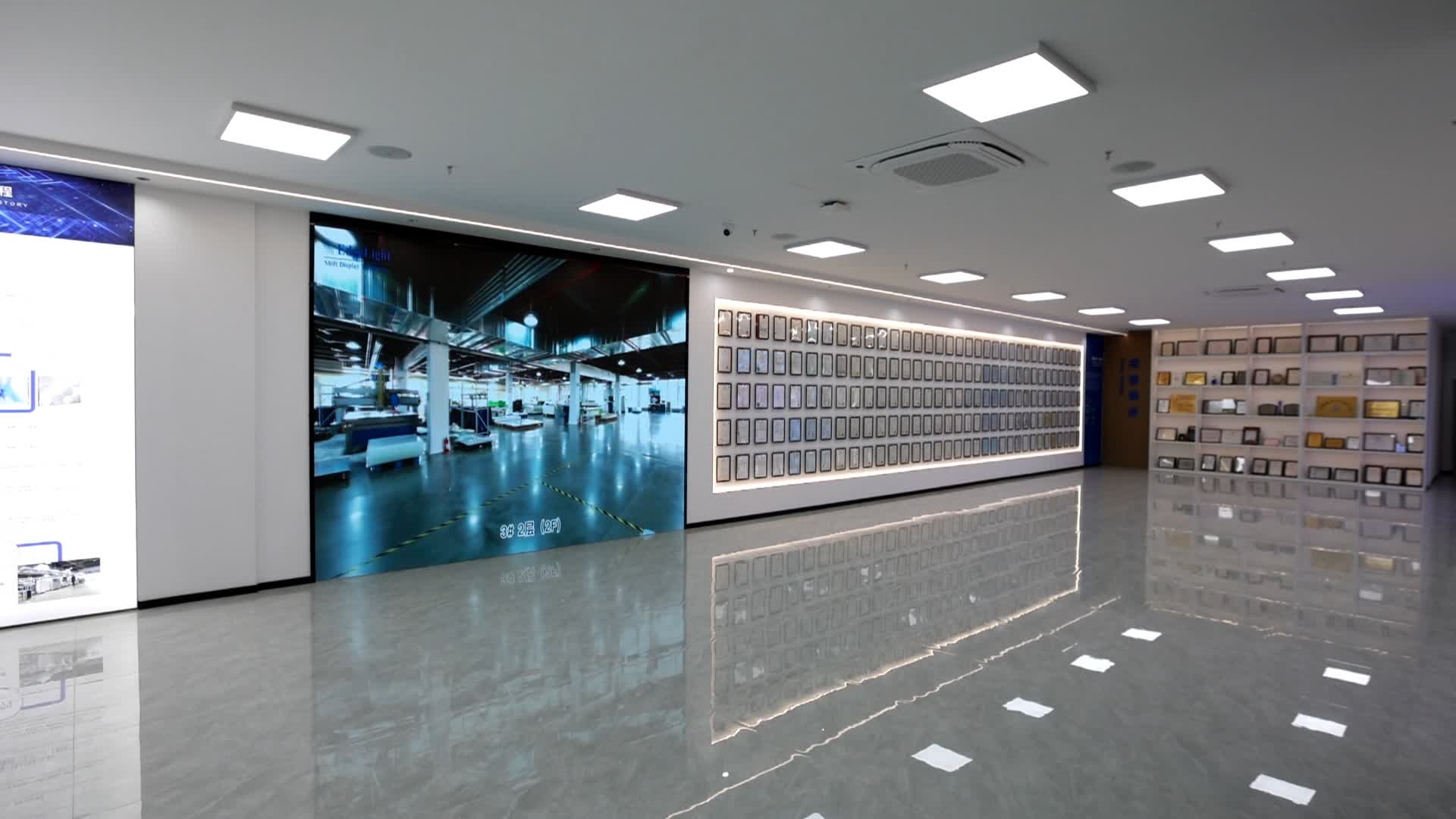
Evidence: Certification, Testing and Long-Run Operation
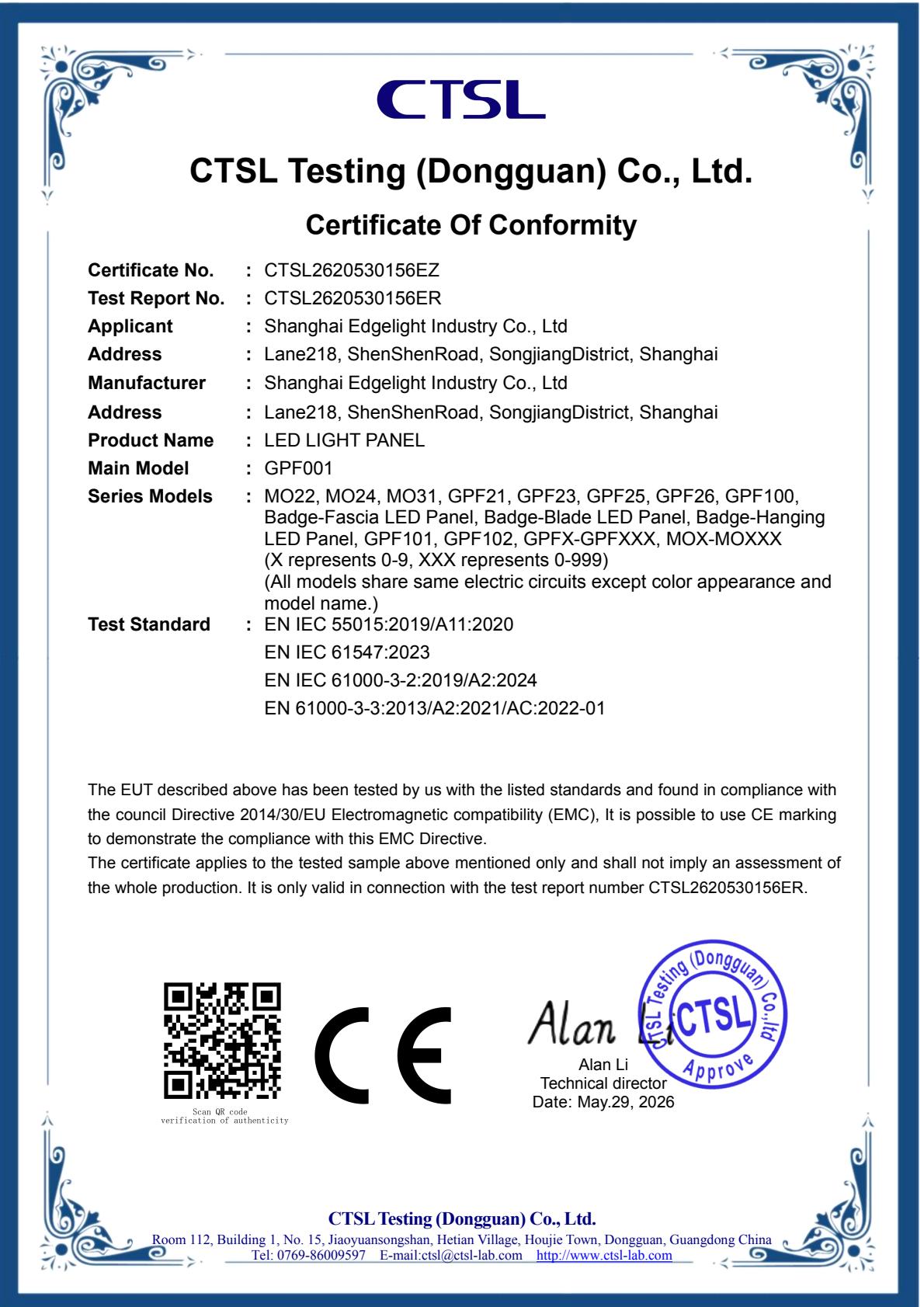
Certification matters most in the environments where failure is expensive. The light guide panel platform holds a CE EMC certificate, CTSL2620530156EZ, issued by CTSL Testing (Dongguan) Co., Ltd. on 29 May 2026 for the EU market. Its scope covers GPF001 and series models including MO22, MO24, MO31, GPF21, GPF23, GPF25, GPF26, GPF100, GPF101, GPF102, GPFX–GPFXXX and MOX–MOXXX badge, fascia, blade and hanging LED panel variants, tested against EN IEC 55015:2019/A11:2020, EN IEC 61547:2023, EN IEC 61000-3-2:2019/A2:2024 and EN 61000-3-3:2013/A2:2021/AC:2022-01, with validity recorded to 29 May 2096.
A separate UL certification, UL-US-2145621-0, was issued by UL LLC under UL 2108, 2nd Edition, on 5 October 2021 and is recorded as valid to 5 October 2031. Its scope covers component sign accessories and LPS/Class 2 type LED modules under defined model numbers. Buyers should confirm that a specific configured light box falls inside that listed model scope rather than assuming any LGP assembly is automatically covered.
Broader standards context is also relevant to specification decisions: UL 8750 (LED equipment) and IEC 60598 (luminaires) are the safety standards commonly required for global market access for light guide panel based products (UL Solutions). In the United States, the 2024 International Energy Conservation Code reduces lighting power allowances, which shifts commercial office and retail projects toward efficient configurations (International Code Council).
Field evidence for long-duty operation exists in a different application. An elevator manufacturer has used EDGELIGHT panels in elevator decoration applications across 10,000 units over a 20-year relationship, with stable operation reported; the documented highlights of that programme are lighting, printing, and customized size and texture. Elevator cabins are a useful comparison point for signage buyers because they combine continuous operation, enclosed cavities and public-contact durability.
Execution Checklist: What to Fix Before Ordering
For buyers moving from evaluation into execution, the following items should be resolved and recorded on the specification sheet before a purchase order is raised:
- Site environment data: minimum and maximum ambient temperature, moisture and wash-down exposure, dust, and whether the box is fully exterior or under a canopy.
- Target IP for the finished assembly, not only for the panel — including cable entries, driver compartment and service access.
- Colour temperature in Kelvin, selected within the 2700K–6500K platform range, together with any dimming or control intent.
- Uniformity target and viewing distance, which together set the dot pattern and the acceptable panel size.
- Mounting depth and weight budget, which set panel thickness and the installation structure.
- Validation and commercial terms: a 1-unit sample run, pre-shipment test as the acceptance criterion, and delivery and payment structure confirmed in advance (FOB/CIF delivery terms; 30% deposit with 70% due before shipment).
Limits and Trade-offs Buyers Should Plan For
An honest use-case match has to include the boundaries. Six apply to this platform:
- The IP20–IP65 band is a platform capability, not a guaranteed rating for a finished fixture. The achieved ingress protection depends on the housing, gasket, cable entry, driver sealing and site installation quality.
- The -20°C to 50°C operating temperature range is the panel's specified envelope. Installations that sit outside it for extended periods require additional engineering, and the temperature inside a sealed sign box is not the same as the ambient temperature recorded at the site.
- Edge-lit architecture is optimised for thin profiles. Where a project needs very large format and very high brightness simultaneously, a backlit light guide panel or a different architecture may be the more realistic route; the documented figures of above 1,080 lm and 101 W typical consumption are the planning basis.
- The 2700K–6500K range is a fixed-output range. Applications requiring colour changing, daylight-linked dimming or scene control obtain that from the LED and control system rather than from the panel.
- The pre-shipment test verifies the panel at the factory. It does not validate the installed thermal or sealing environment, so for 24/7 programmes buyers should budget for on-site validation of the first installed units.
- Acrylic substrates are widely selected for signage because of their optical clarity, but weathering and UV exposure behaviour at a specific outdoor location should be confirmed with the supplier against the actual mounting configuration.
Market Signals Behind Increasing Specification Variety
The shift toward environment-specific specification is happening against a growing material and component market. Dataintelo values the global light guide plate market at USD 3.91 billion in 2025, projected to reach USD 6.51 billion by 2034, representing a CAGR of 5.8% over 2025–2034. Asia Pacific accounted for a 48.2% revenue share in 2025, valued at USD 1.88 billion, while consumer electronics was the largest application segment with a 42.5% share in the same year.
That application mix has a practical implication for signage buyers: the volume driving thin-substrate development sits in displays and consumer electronics rather than in signage. The material side follows the same direction. The polymethyl methacrylate (PMMA) market, the primary material for light guide panels, was valued at USD 5.4 billion in 2024 with a 5.6% CAGR (USD Analytics), and thin PMMA light guide plate substrates below 2 mm accounted for over 60% of display-grade shipments for major manufacturers in 2024 (Fact.MR / CHI MEI Corporation). At the material level the landscape is consolidated, with Mitsubishi Chemical Corporation identified as a leading player in light guide plates (Dataintelo) — which means most panel processors, including signage suppliers, are working from a comparable upstream material base and differentiating through pattern design, cutting and assembly.
Future Outlook
Three directions are worth tracking for signage programmes planned through 2027. First, regulation is tightening around efficiency rather than brightness: the 2024 IECC reduction in lighting power allowances pushes US commercial projects toward configurations that reach a uniformity target with lower power draw. Second, thinner substrate supply continues to shift the default architecture toward edge-lit, slim light box designs, with panel thickness becoming a design variable rather than a fixed constraint. Third, because a large share of LGP demand growth is concentrated in Asia Pacific, buyers sourcing for North American and European rollouts should plan regional inventory and lead-time buffers — using the documented 5–10 day production lead time for standard configurations as a baseline and treating multi-site rollouts as a staged schedule rather than a single shipment.
For a component whose visible performance depends on the environment it is installed in, specification discipline remains the cheapest risk control available: match the protection grade, temperature envelope and colour temperature to the actual site, validate with a sample, and confirm the scope of certification before the rollout rather than after it.
FAQ
What protection grade does a light guide panel need for outdoor signage?
The panel platform supports a protection grade band of IP20–IP65, but the grade that applies to an outdoor sign box is a property of the finished assembly. Housing design, gaskets, cable entries and driver compartment sealing determine the achieved rating, so buyers should specify the target IP for the complete fixture and verify how it is reached rather than relying on the panel's band alone.
What operating temperature range do these panels support?
The light guide panel platform is specified for an operating temperature range of -20°C to 50°C. Installations where ambient conditions regularly fall outside that range require additional engineering consideration, and the internal temperature of a sealed light box should be assessed separately from the recorded site ambient temperature.
Which colour temperature fits office and retail signage?
The platform covers 2700K–6500K. Offices and workspaces commonly use the neutral-to-cool part of that range, while hospitality and luxury retail settings commonly use warmer values around 2700K–3500K. Higher-ambient retail and outdoor signage often moves to the cooler, higher-output end for legibility. The colour temperature is a project decision within the supported range, not a fixed value.
Can light guide panels be produced in custom sizes and thicknesses?
Yes. The manufacturer provides OEM and ODM production services with customization support for size, thickness, color temperature, logo, surface shape, light output brightness and installation structure, which allows a panel to be specified from the light box aperture and mounting depth rather than from a stock size.
What is the minimum order quantity and typical lead time?
The documented minimum order quantity is 1 unit, with a typical lead time of 5–10 days and a monthly production capacity of 30,000 units. Delivery terms are FOB/CIF, and the payment structure is 30% deposit with the remaining 70% due before shipment.
How is quality verified before shipment?
Production documentation states 100% testing, and the acceptance criterion for an order is a pre-shipment test. That test verifies the panel as produced; it does not validate the installed thermal or ingress environment, which remains a site-level responsibility.
What certifications are available, and what do they cover?
The platform holds a CE EMC certificate, CTSL2620530156EZ, issued by CTSL Testing (Dongguan) Co., Ltd. for the EU market, covering GPF001 and a defined list of series models under EN IEC 55015:2019/A11:2020, EN IEC 61547:2023, EN IEC 61000-3-2:2019/A2:2024 and EN 61000-3-3:2013/A2:2021/AC:2022-01. A separate UL certification, UL-US-2145621-0, was issued by UL LLC under UL 2108, 2nd Edition, covering component sign accessories and LPS/Class 2 type LED modules within specified model numbers. Buyers should confirm that their configuration falls within the listed model scope.
Reference material: the EDGELIGHT product catalogue (LED product directory, English) is publicly available for download at https://cdn.socialarks.com/sbsp/25068/common/2026/0709/LED%E4%BA%A7%E5%93%81%E7%9B%AE%E5%BD%95%E8%8B%B1%E6%96%87.pdf. Company information: https://en.edgelight.com