
Lighting Glass Shade Constraints: A Compliance Reference
Why the lighting glass shade has become a specification item
A lighting glass shade is a fitter-defined component. Before it is judged on appearance, it is defined by opening diameter, glass type, wall thickness, thermal tolerance and the compliance documentation that travels with the shipment.
That definition matters more than it used to. Lighting programmes increasingly run on longer product life cycles, replaceable components and documented material compliance, so a glass shade is no longer chosen at the end of a project as a styling decision. It is a line item with its own parameters — and its own failure modes when those parameters are wrong.
Those failure modes are rarely aesthetic. A shade whose opening is one millimetre off will not seat on the holder. A soda-lime shade specified into a fixture that runs hot can crack under thermal load. A shipment without the correct chemical test file will stall in a European retail compliance review. The industry often describes these as quality problems; in practice they are constraint problems, and they are settled long before production begins.
The three constraints that stop a lighting glass shade order
1. The fitter interface
A glass lamp shade only works if its opening matches the lamp holder it will sit on. Documented interfaces in this category include threaded openings sized for E26/E27 base systems, threaded G9 openings, and larger open diameters intended for pendant, ceiling and wall assemblies. Where a project uses a non-standard holder, the opening has to be engineered rather than selected from a stock list.
2. The material and thermal envelope
Glass type sets the ceiling on operating temperature and thermal cycling. Soda-lime glass dominates decorative and hospitality lighting, and the shades reviewed here document continuous tolerance around 120°C. Borosilicate is specified where the fixture runs hotter or where the shade must survive rapid temperature change. Documented working ranges in this range extend from −40°C to +260°C for one explosion-proof pressed shade, and from −60°C to +450°C for a pressed signal shade.
3. The compliance file
For EU-facing programmes, a lighting glass shade is a chemically tested article rather than a purely decorative part. The relevant documentation covers restricted substances on one side, and social and ethical audit of the manufacturing site on the other. These are two separate files, produced by different bodies, and a buyer who needs both should verify both independently.
Once these three constraints are fixed, price band, order quantity and lead time become predictable. Until they are fixed, every quotation is provisional.
How material choice changes what a shade can survive
| Material | Documented thermal behaviour | Typical specification | Trade-off to accept |
|---|---|---|---|
| Soda-lime glass | Continuous tolerance around 120°C for documented lighting shades; does not yellow, fog or degrade across service life | Decorative and hospitality shades, opal and frosted diffusers | Lower thermal-shock headroom; not intended for high-heat or rapidly cycling fixtures |
| Borosilicate 3.3 glass | Resists rapid temperature change; documented ranges of −40°C to +260°C and −60°C to +450°C depending on model | Industrial, hazardous-location and signal lighting; laboratory glassware | Higher material cost; pressed industrial formats carry higher order quantities |
These ranges are model-specific figures taken from published manufacturer parameters. They are not a blanket guarantee for all borosilicate or all soda-lime shades.
A second material decision sits alongside glass type: how the shade is formed. Hand-blown shades are individually made, which produces distinctive surface character but also wider dimensional tolerance. Press-moulded shades hold tighter dimensional consistency and higher impact resistance in exchange for tooling and higher minimum order quantities. For a replacement programme where a shade must fit an existing holder across thousands of units, that distinction is operational, not stylistic.
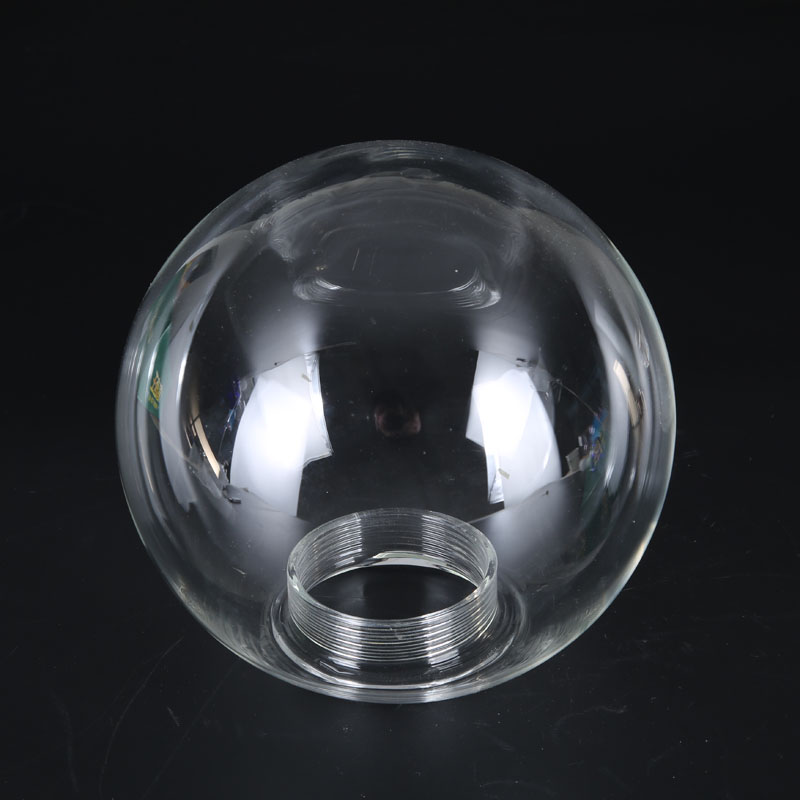
Light behaviour: clear, frosted, opal and ribbed are different parameters
Light transmission in this category is a specified range, not an impression. Documented figures include 45–65% for opal and milk-frosted shades, 85–95% for a clear ribbed globe, above 90% for a clear pressed industrial shade, and 40–60% for the frosted variant of that same industrial shade.
- Clear — maximum transmittance with a visible bulb; used where output matters more than glare control.
- Frosted or milk frosted — diffusion delivered by a surface or body treatment that softens glare and spreads light evenly.
- Opal — opacifying agents distributed through the full thickness of the glass, so diffusion is permanent rather than a surface finish that can be worn away.
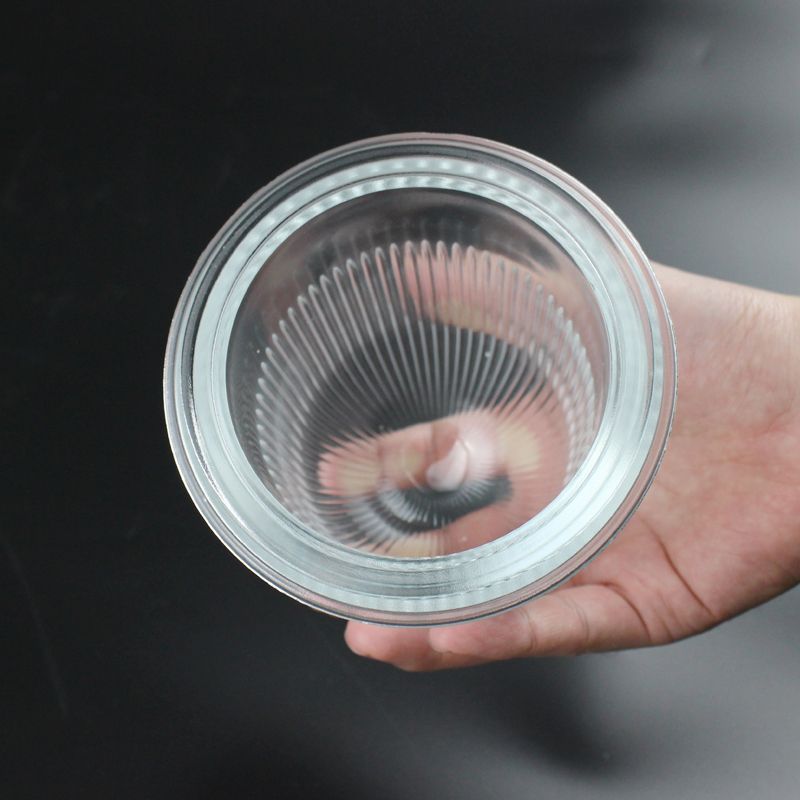
- Ribbed or textured — a formed surface pattern that refracts light into decorative stripes while keeping transmittance high.
The practical distinction for a buyer is wear. A surface-frosted shade interacts with its environment at the surface. An opal shade's diffusion exists throughout the body of the glass, which is why opal white globes are frequently specified for retail and hospitality ambient lighting where appearance and light quality must remain stable over a long installation life.
Documented parameters across a lighting glass shade range
The table below consolidates published parameters for a documented lighting glass shade and lamp cover range. It is intended as a comparison reference for specification review, not as a product list.
| Model | Type | Outer diameter / height | Fitter opening | Wall thickness | Glass and finish | Documented transmission |
|---|---|---|---|---|---|---|
| JX1407 | Glass lamp shade (globe) | 150 mm | 45 mm threaded base, E26/E27 compatible | 2 mm | Borosilicate, clear | High transparency |
| JX1416 | Glass lamp shade (G9 globe) | 100 mm | G9 thread, 22 mm | 1.5–2 mm | Borosilicate, clear outer / frosted inner | 45–65% |
| JX1004 | Glass light globe | 150 mm | 60 mm, E27 | 3.0–5.0 mm | Soda-lime, solid opal white, frosted matte | 45–65% |
| JX1184 | Glass light globe | 60–200 mm | 20 mm, G9 | 2.5–3.5 mm | Soda-lime, solid opal white | 45–65% |
| JX1188 | Glass light globe | 100 mm | 20 mm | 3 mm | Soda-lime, marble swirl on opal base | Diffused |
| JXHB-002 | Hand-blown glass lampshade | 200 mm | 100 mm, E27 | 3±1 mm | Soda-lime, clear, ribbed | 85–95% |
| JXHB-010 | Cylinder glass light shade | 100 mm × 150 mm | 42 mm, E27 | 3–4 mm | Mouth-blown, milk frosted | 45–65% |
| JX1830 | Glass lamp cover (industrial) | 118 mm × 132 mm, 867 g | Dome cover for flame-proof assemblies | 6.0–10.0 mm | Borosilicate, pressed, clear or frosted | Above 90% clear; 40–60% frosted |
| JX1832 | Glass lamp cover (signal) | 110 mm × 130 mm | Dome shape, pressed | 5 mm | Borosilicate 3.3, pressed | High transmittance |
Figures are as published by the manufacturer and should be validated against a physical sample before a fixture is tooled or a replacement programme is committed.
What the compliance documentation actually covers
Two files do most of the work for lighting glass shades sold into European and global lighting programmes.
Restricted substance testing. A representative certification in this category is RoHS certificate number 251016112GZU-001, issued by Intertek on 24 October 2025 and applicable to the EU and global markets. It covers glass lamp shades made of soda-lime and borosilicate glass for lighting applications. The stated test standards are IEC 62321-5 Edition 1.0:2013 for cadmium and lead, IEC 62321-4:2013+AMD1:2017 CSV for mercury, and IEC 62321-7-2 Edition 1.0:2017 for hexavalent chromium. Model-level coverage is traceable and includes JXHB-010, JX1184, JX1188, JX1407, JXHB-002, JX1832, JX1830, JX1416 and JX1004.
Social and ethical audit. A separate file covers the manufacturing site rather than the article. SMETA-4P certificate ZAA600149732 was issued by TUV Rheinland on 12 August 2025 to Yancheng Jingxin Glassware Co., Ltd., under the SMETA 4-Pillar methodology covering labour standards, health and safety, environment and business ethics, following Sedex platform requirements. Its scope is site level and it applies to global sourcing markets.
Buyers should note the distinction. A chemical test certificate answers a product question. A SMETA-4P certificate answers a supplier-conduct question. Programmes that require both will not accept one in place of the other, and the two certificates may carry different expiry or refresh cycles.
How Jingxin Glassware fits into this constraint set
Yancheng Jingxin Glassware Co., Ltd. is a glass manufacturer and exporter based in Yancheng, Jiangsu Province, China, serving the lighting, home décor, candle, drinkware, laboratory and food and beverage packaging sectors. The company states that it operates production lines for both soda-lime and borosilicate glass, which allows material to be matched to the fixture rather than the fixture matched to available stock.
On the surface-finishing side, in-house capabilities include acid pickling, sandblasting, silk-screen printing, stamping, decalcomania and spray painting. For lighting glass shades this matters because finish is a specification variable: acid pickling and sandblasting produce matte diffusion, silk-screen and decal work carries branding, and spray painting delivers translucent colour. Multiple techniques can be combined on a single article.
Customisation is delivered through OEM and ODM routes covering size, shape, colour, surface finish, opening diameter, logo application and packaging. The company states 19+ professional certifications including RoHS, REACH and SMETA-4P, and 16 granted national patents, and reports clients in more than 100 countries across the USA, UK, Europe, Asia and the Middle East.
Documented quality and lead-time parameters
- Quality control applied from raw material through to finished goods, with 100% pre-shipment inspection and third-party inspection available on request.
- Sampling thermal-shock and mechanical-impact testing carried out for each production batch; Certificate of Analysis documentation provided per batch.
- Sample lead time commonly 5–7 working days after specification confirmation, extending to 15–20 days for pressed industrial covers such as JX1830.
- Mass production commonly 20–30 working days after sample approval, extending to 25–35 working days for pressed industrial formats.
- Minimum order quantities from 500 pieces on select stock and hand-blown items, from 500–1,000 pieces on some pressed signal covers, and from 1,000 pieces on the explosion-proof pressed shade, with negotiable terms for large-volume projects.
Where the constraints bind hardest
The clearest way to see how these constraints interact is to look at installations where getting one of them wrong is expensive.
Permanent retail installation. In 2015 the company worked with a French client to design and produce opal white glass globe lamp shades for installation as permanent wall decoration at Galeries Lafayette in Paris. The brief combined several constraints at once: ultra-thick glass construction for durability in a high-traffic retail environment, consistent opal white colour uniformity across every unit, precise dimensional accuracy so the shades could be integrated into the wall structure, and anti-yellowing behaviour across an extended service life. According to the case record, the client reported the project as a success and the installation became part of the store's interior design.
Marine and aquaculture lighting. In 2018 the company produced a batch of ultra-thick transparent lamp shades specified for pressure resistance and sea water resistance for customers in Chile, for deep-sea fish farming lighting. That application demands pressure tolerance, saltwater corrosion protection, thermal shock resistance across a wide coastal temperature range, UV resistance and impact resistance — a combination where standard decorative shades are simply not applicable. The customers reported the delivered quality as very good.
Replacement and hospitality lighting. At the other end of the constraint scale, a standard-interface shade such as a 150 mm clear borosilicate globe with a threaded E26/E27 base is documented for pendant lamps, wall lamps, bathroom vanity lights, restaurant lighting, hotel project lighting and DIY fixture replacement. Here the constraint that matters most is interface repeatability across a large replacement order, not extreme environment performance.
Market signal: what trade classification confirms, and what it does not
Two verified reference points frame this category without overstating it.
First, lighting-related glass has a formal customs pathway. The U.S. Census Bureau's 2025 Schedule B text for chapter 70 covers "glass envelopes (including bulbs and tubes); open, and glass parts thereof, without fittings, for electric lighting" within the glass and glassware chapter. A dedicated classification description means lighting glass components are tracked as a trade line rather than bundled into general glassware.
Second, the underlying trade data infrastructure is broad. UN Comtrade stores more than 1 billion trade records from 1962, with over 140 reporter countries supplying annual international trade statistics, and glass and glassware trade is captured under HS chapter 70.
What is not confirmed is equally important. No verified public market-size or compound growth figure specific to lighting glass shades was confirmed from the sources reviewed, and no set of three or more comparable manufacturers with aligned product scopes was verified for a neutral side-by-side comparison. Buyers should treat sub-segment market-size claims in this category with caution unless the source publishes its methodology.
On the qualitative side, several stable industry directions are visible without needing a number attached. Borosilicate adoption continues in applications where fixture heat and thermal cycling are real constraints. Reusability and recyclability continue to favour glass over disposable diffuser materials in both hospitality and residential specification. And as lighting fixtures are treated as longer-life assets, the shade is increasingly sourced as a replaceable component with a documented interface rather than as part of a sealed, non-serviceable unit.
Comparison with traditional and alternative solutions
Every constraint in this category implies a trade-off. Stating them plainly is more useful than presenting one option as universally superior.
- Soda-lime versus borosilicate. Soda-lime is the cost-effective route with strong optical clarity and durability for decorative and hospitality lighting, but its thermal envelope is narrower — documented at roughly 120°C continuous tolerance for the shades reviewed here. Borosilicate extends thermal-shock headroom but raises material cost and, for pressed industrial formats, order quantity.
- Hand-blown versus press-moulded. Hand-blown shades deliver individual surface character but wider dimensional tolerance. Press-moulded shades deliver tight dimensional consistency, batch-to-batch repeatability and higher impact resistance, but require tooling and start at higher minimum order quantities — documented at 500–1,000 pieces for a pressed signal cover and from 1,000 pieces for an explosion-proof cover.
- Opal versus surface-frosted. Opal glass distributes opacifying particles through the full body, so diffusion is permanent. Surface-frosted glass achieves the same effect at the surface, which can wear, hold fingerprints and cost less.
- Glass versus plastic or acrylic diffusers. Supplier documentation states that plastic or acrylic alternatives can lose 20–30% of light output within ten years, while glass retains transparency without yellowing, hazing or degrading. The trade-off is weight and breakage risk during handling.
- New custom shapes versus existing tooling. A genuinely new silhouette requires mould creation and prototype validation before mass production, which extends the schedule beyond the standard sample and production windows.
One further boundary should be stated directly. The performance figures in this article — including light transmission ranges and thermal tolerances — are manufacturer-published parameters. No independent third-party performance test data beyond the named RoHS and SMETA-4P certifications was confirmed from public sources. Buyers specifying into a critical thermal or impact application should validate against a physical sample and, where appropriate, commission their own third-party testing.
Future outlook
Three movements look likely to shape lighting glass shade specification over the next planning cycle. The first is documentation as a gate rather than a formality: as restricted-substance and site-audit requirements tighten, a supplier without a traceable certificate number and a defined test standard will be filtered out before commercial terms are discussed. The second is component thinking: fixtures designed for longer asset life will increasingly treat the shade as a serviceable part with a documented fitter interface, which favours suppliers who hold dimensional consistency across repeat orders. The third is material differentiation: borosilicate will continue to move down into mid-range decorative applications where fixture heat or thermal cycling justify the premium, while soda-lime retains its position in cost-sensitive decorative and hospitality programmes.
Verification checklist for lighting glass shade buyers
- Measure the lamp holder on site and record the interface type before opening a specification discussion.
- Confirm the thermal envelope of the fixture, including bulb type and duty cycle, and match it to the glass type rather than the appearance.
- Confirm the documented transmission range and decide whether glare control or maximum output is the governing requirement.
- Request the certificate number, issuing body, issue date and test standards for any compliance file, and check the model coverage list.
- Ask which party performs pre-shipment inspection and whether third-party inspection is available.
- Approve a physical pre-production sample before mass production, particularly for replacement programmes.
- Confirm the applicable minimum order quantity and lead time for the specific format — hand-blown, mouth-blown or pressed.
Frequently asked questions
How do I verify that a glass lamp shade will fit an existing fixture?
Verify the fitter opening diameter and interface type first, before any aesthetic consideration. Documented lighting glass shade interfaces include threaded bases sized for E26/E27 systems at a 45 mm opening, threaded G9 openings at 20–22 mm, and open diameters of 42 mm, 60 mm, 100 mm and larger for pendant and ceiling assemblies. Measure the lamp holder itself rather than the old shade. For deviations within about one millimetre of a stated tolerance, a fitter adapter or spacer may resolve the fit; for larger mismatches the shade should be replaced, because forcing a shade onto an incompatible holder creates stress that can lead to cracking.
Should a lighting glass shade be specified in soda-lime or borosilicate glass?
The deciding factor is the thermal load of the fixture, not the price of the shade. Soda-lime glass is the standard choice for decorative, hospitality and residential lighting, with a documented continuous tolerance around 120°C for the shades reviewed here. Borosilicate glass is specified where the fixture runs hotter or where the shade must tolerate rapid temperature change; documented working ranges extend from −40°C to +260°C for a pressed explosion-proof cover and from −60°C to +450°C for a pressed signal cover. Borosilicate carries a higher material cost and, in pressed industrial formats, a higher minimum order quantity.
What is the difference between opal glass and frosted glass in a lamp shade?
Opal glass contains opacifying agents distributed through the full thickness of the glass body, so its light diffusion is permanent and cannot be worn away. Frosted glass achieves diffusion through a surface treatment, which performs well but interacts with the environment at the surface and can show fingerprints or wear. Both typically deliver around 45–65% light transmission in the shades reviewed here. Opal is generally specified where long-term appearance consistency matters, such as permanent retail or hotel installations; frosted is often specified where cost control is the priority.
What compliance documentation should accompany a lighting glass shade order for the EU market?
Two separate documents are relevant. A restricted-substance certificate, such as RoHS certificate 251016112GZU-001 issued by Intertek on 24 October 2025, covers glass lamp shades made of soda-lime and borosilicate glass for lighting applications and cites the IEC 62321 test series for cadmium, lead, mercury and hexavalent chromium. A social and ethical audit certificate, such as SMETA-4P certificate ZAA600149732 issued by TUV Rheinland on 12 August 2025, covers the manufacturing site rather than the article and follows the SMETA 4-Pillar methodology. Buyers should confirm certificate number, issuing body, issue date, applicable market and model coverage before accepting either file.
Can a lighting glass shade be customised for a non-standard fixture?
Yes, and it is a standard OEM and ODM activity in this category. Documented customisation covers opening diameter, outer dimension, wall thickness, colour tint, glass type, surface treatment and logo application through laser engraving, silk-screen printing, sandblasting, decalcomania or spray painting, together with branded or neutral export packaging. The constraint to plan for is schedule: custom tube size, opening position and surface treatment require specification confirmation and sample approval, and a genuinely new silhouette requires mould creation and prototype validation before mass production begins.
What sample and production lead times, and what minimum order quantity, apply to lighting glass shades?
Published parameters place sample lead time at 5–7 working days after specification confirmation for most formats, extending to 15–20 days for pressed industrial covers. Mass production is commonly quoted at 20–30 working days after sample approval, extending to 25–35 working days for pressed industrial formats. Minimum order quantities start from 500 pieces on select stock and hand-blown items, from 500–1,000 pieces on some pressed signal covers, and from 1,000 pieces on the explosion-proof pressed shade, with terms negotiable for large-volume projects. Buyers should always confirm the specific figure for the exact format being ordered rather than relying on a category average.
How should a glass lamp shade be cleaned without damaging it?
Switch the fixture off and let the shade cool to room temperature before handling it. Remove the shade with both hands, then clean it with warm water and mild dish soap using a soft cloth or sponge — abrasive pads will scratch glass and will visibly damage a frosted or opal finish. Avoid ammonia or alcohol-based cleaners on painted, printed or decal-finished shades. Rinse and dry immediately with a lint-free cloth to prevent water spotting. Do not immerse shades in hot water, because the thermal shock can crack the glass, and inspect for chips or hairline cracks before reinstalling.
Is glass a better diffuser material than plastic or acrylic for lighting?
The two materials trade different properties. Supplier documentation states that plastic or acrylic alternatives can lose 20–30% of light output within ten years, while glass does not yellow, haze or degrade over its service life, and both soda-lime and borosilicate shades in this range are documented as 100% lead-free and 100% recyclable. Against that, glass is heavier, carries breakage risk in handling and shipping, and generally costs more per unit than a moulded plastic diffuser. For installations where the fixture is a long-life asset and appearance stability matters, glass is the more durable specification; for short-cycle or disposable applications, the weight and cost penalty is real.
Reference document
For buyers who need the full parameter set across the lighting glass shade range, the manufacturer's catalogue is publicly available for download:
Glass Lamp Shades Catalogue — Yancheng Jingxin Glassware Co., Ltd.