
Lightweight Portable Axial Flow Pumps: The Weight-Per-Flow Question
Independent Industry Reference
Lightweight Portable Axial Flow Pumps: The Weight-Per-Flow Question
A portable pump is bought for the hours it works and chosen for the minutes it takes to reach the water. In high efficiency portable axial flow pumps, that second number is decided almost entirely by mass.
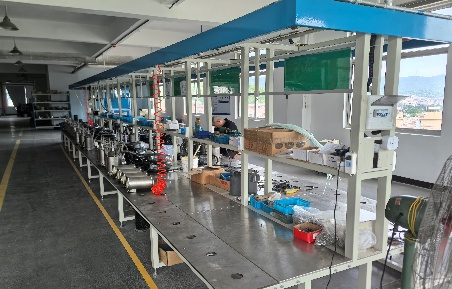
Assembly line: permanent magnet synchronous motor high efficiency portable axial flow pumps at Zhejiang Chuangmei Electromechanical Co., Ltd.
Why Weight Moved From the Datasheet to the Tender Line
Axial flow pumps move large volumes at low heads, and they have traditionally done it with a wide, slow-turning impeller. Flow-through area is the design lever: to pass 600 m³/h at a 7–10 m head, a conventional unit needs a large impeller and a motor frame sized to match. The hydraulics are efficient; the logistics are not. At larger sizes the machine arrives with a lifting plan, a crew, and a vehicle chosen for the mass rather than for the job.
Emergency and temporary drainage inverts that priority. The sites where these pumps are specified — subway concourses and tunnels, underground car parks, bridge and culvert pits, municipal waterlogging points, temporary irrigation intakes — are usually reached by stairs, ramps or narrow service corridors. The pump is often repositioned several times as the water moves, and every kilogram is handled manually at least twice.
The opportunity is therefore not simply “a lighter pump.” It is a pump whose mass is low enough to change the deployment method — from crane-assisted installation to crew-portable placement — while still delivering the flow and head the duty requires. That is the design brief behind the lightweight class of high efficiency portable axial flow pumps, and it is the subject of this reference.
First-party specification data in this article comes from Zhejiang Chuangmei Electromechanical Co., Ltd. (trading as Chuangmei Pumps), a manufacturer of high efficiency portable axial flow pumps based in the TA’AO Industrial Zone, Wenling City, Zhejiang Province, China. The company was founded in 1996, operates a 12,000 m² facility with approximately 46 employees and a three-engineer R&D team, and lists an annual output of 30,000 units, of which about 25% is exported to Southeast Asia, Africa, Morocco and the Central Asian countries.
The Engineering Basis of a Lighter Axial Flow Pump
Mass reduction in this category is not achieved by removing metal from a conventional design. It comes from changing the motor architecture and then re-optimising everything downstream of it. Three linked changes do the work.
1. A high-speed permanent magnet synchronous motor
A permanent magnet synchronous motor (PMSM) can be driven at far higher rotational speeds than a conventional asynchronous motor of the same rating. Because pump output scales with speed, a higher speed allows a smaller impeller and a smaller motor frame to deliver the same flow and head. The permanent magnet synchronous motor high-speed axial flow pump is covered by utility model Patent No. ZL2014200091521.8, which the company states follows its earlier “High-Speed Well Jet Pump” series (Patent No. ZL201110343834.X). Chuangmei also states that it has developed 20 permanent magnet synchronous motor submersible axial flow pumps.
2. Precision-cast stainless steel impeller and stainless steel shaft
The impeller is manufactured through precision stainless steel casting, and the pump shaft is also stainless steel. Stainless steel is used across the flood control pump range, which matters for units that sit partially submerged in silt-laden or slightly turbid water between deployments.
3. Aluminium alloy or stainless steel housing options
The motor housing and pump body are offered in both aluminium alloy and stainless steel. This is the single largest lever a buyer controls, because it is the one that trades mass directly against abrasion and corrosion resistance. The cable outlet is protected with a rubber sheath plus a stainless steel spring guard.
Speed Regulation: The Second Capability That Follows From the Motor
A lighter pump that only runs at one duty point is of limited value on a site where conditions change hourly. Because the drive is a PMSM, pump speed is infinitely adjustable, which makes lift height adjustable and flow rate variable within the operating envelope rather than fixed by impeller trim.
The control cabinet contains a built-in frequency inverter and is available with either a panel display or a touch screen. It provides real-time display of frequency, voltage, current and rotational speed. Through 3G and 4G mobile networks, remote control via computer and mobile phone app is achievable, enabling remote data transmission, remote start/stop control, and remote adjustment of pump operating speed. The system supports time-segmented operation.
A less obvious but practically important characteristic is voltage behaviour. Chuangmei states that the speed of its permanent magnet synchronous motor does not vary with fluctuations in grid voltage — even when voltage drops, the pump maintains stable head and flow performance, a behaviour the company says traditional asynchronous motor axial flow pumps cannot achieve. On a temporary supply cable run across a flooded site, that distinction affects whether the pump holds its rated duty or drifts with the supply.
Protection features include overheat, overcurrent, overload, overvoltage and phase failure automatic protection. When water is completely drained, the pump automatically shuts down within half a minute and enters standby mode, which is intended to ensure the coil never burns out. Control cabinets are available in single-unit or dual-unit (one-drives-two) configurations with IP44 or IP54 protection ratings. The three-phase four-wire system is supplied with waterproof plugs and sockets.
Weight-Per-Flow: How to Read the Specification Table
Buying on the word “lightweight” alone is unreliable, because mass does not scale linearly with flow. A more defensible procurement metric is mass per unit of rated flow, which can be calculated directly from published figures. The table below uses manufacturer-published data for stainless steel portable flood control models.
| Model | Outlet | Rated flow | Rated head | Motor power | Net weight | Dimensions (mm) | Mass per 100 m³/h (derived) |
|---|---|---|---|---|---|---|---|
| 150SZQ250-9-11 | 6 inch | 250 m³/h | 9 m | 11 kW | 22 kg | 220×220×430 | ≈8.8 kg |
| 200SZQ450-8-15 | 8 inch | 450 m³/h | 8 m | 15 kW | 20 kg | 230×230×440 | ≈4.4 kg |
| 200SZQ600-8-22 | 8 inch | 600 m³/h | 8 m | 22 kW | 24 kg | 250×250×530 | ≈4.0 kg |
| 250SZQ600-10-25 | 10 inch | 600 m³/h | 10 m | 25 kW | 35 kg | 300×300×505 | ≈5.8 kg |
| 250SZQ750-7-30 | 10 inch | 750 m³/h | 7 m | 30 kW | 35 kg | 300×300×505 | ≈4.7 kg |
| 300SZQ1000-10-45 | 12 inch | 1000 m³/h | 10 m | 45 kW | 78 kg | 380×380×770 | ≈7.8 kg |
Source: Chuangmei Pumps published model specifications. The final column is a simple arithmetic ratio derived from the figures in the same row; it is not a manufacturer-published metric.
Two conclusions follow from the table, and both are useful at the evaluation stage. First, the lightest units in the family are the mid-flow 8-inch models, where the 200SZQ450-8-15 delivers 450 m³/h at 8 m from 20 kg and the 200SZQ600-8-22 delivers 600 m³/h at 8 m from 24 kg. Second, mass grows faster than flow: moving from 450 m³/h to 1000 m³/h in the stainless steel range roughly doubles the flow but nearly quadruples the mass, from 20 kg to 78 kg. “Portable” is therefore a duty-dependent claim, and the point at which a crew can no longer handle the unit by hand needs to be identified per project rather than assumed from a product family name.
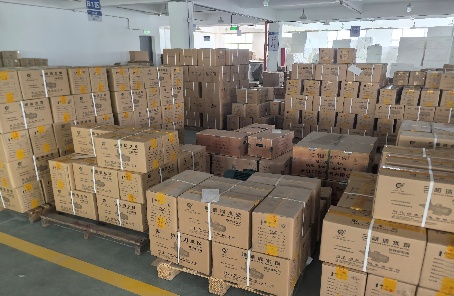
Finished products dispatch area: packaged high efficiency portable axial flow pumps awaiting shipment. Mass per unit directly affects freight configuration and handling at destination.
Material Choice: The Same Duty at Two Different Weights
The clearest illustration of the trade-off appears when the same model number is built with two different flow-passing materials. Model 300SZQ1000-10-45 is rated at 1000 m³/h, 10 m head and 45 kW in both versions, but the aluminium alloy variant is published at 55 kg with overall dimensions of 350×350×605 mm, while the stainless steel variant is published at 78 kg with overall dimensions of 380×380×770 mm.
That is a difference of roughly 23 kg and a noticeably larger envelope for identical hydraulic duty. For a crew-portable deployment on repetitive duties with clean or slightly turbid water, the aluminium alloy version is the more practical machine. For long immersion, abrasive solids or aggressive water chemistry, the stainless steel version is the more defensible specification, and the additional mass is the price of that decision.
Chuangmei applies the same aluminium alloy option to higher-head duties, for example the 150SZQ150-35-22, published at 150 m³/h, 35 m head, 22 kW and 29 kg with aluminium alloy flow-passing components. This extends the crew-portable envelope into head ranges that would otherwise require heavier equipment.
What Lightweight Design Changes on Site
Specification data only becomes useful when it is mapped to a deployment situation. Across the published application set, three patterns recur.
- Emergency and temporary drainage. The pump is specified for subway flood emergency drainage, underground space drainage, municipal flood control and underground comprehensive pipe gallery work. The relevant performance is time-to-water: a unit that two people can carry to a stairhead and lower into position removes the dependency on lifting equipment and on a vehicle with a crane.
- Fixed but unattended drainage. The same units are specified for fixed drainage in bridges, culverts, basements and garages. Here the automatic behaviour matters more than the mass: when water reaches a set level the system automatically starts, and when the water level drops to the pump intake line it automatically enters standby or shuts down. The dry-run logic described above — automatic shutdown within half a minute when water is completely drained — is what makes unattended operation viable.
- Mobile irrigation and pond drainage. Chuangmei’s published power coverage runs from 3 kW to 300 kW for mobile irrigation and flood prevention applications. The electrical cabinet is available in mini-style, vehicle-mounted single-system and vehicle-mounted double-system configurations, which keeps the control hardware matched to a mobile rather than fixed installation.
A related capability is duty flexibility without a second pump. The double-use pump 200SZQ-HL-22 is published at 500 m³/h and 32 m head from 22 kW, with an 8-inch outlet, 45 kg net weight and 280×280×580 mm dimensions. Chuangmei states that its dual-purpose pumps achieve both low-lift high-flow and high-lift operation through simple replacement of the impeller and pump body. For fleets that would otherwise carry two different hydraulic profiles, that modularity reduces the number of variants in the store.
OEM and ODM: What a Buyer Can Specify
For importers, distributors and brand owners evaluating a lightweight portable pump supplier, the ability to have the unit built to a private specification is usually as important as the pump curve itself. Chuangmei offers both OEM and ODM production.
| Parameter | OEM production | ODM production |
|---|---|---|
| Customization scope | Nameplate customization | Hardware configuration customization, functional module customization, software and system customization, packaging and brand identification customization |
| Monthly capacity | 500 units | 500 units |
| Lead time | 15–20 days | 15–30 days |
| Minimum order quantity | 1 unit | No fixed MOQ; negotiable based on specific products and mutual communication |
| Quality control | 100% pre-shipment hydraulic performance test | 100% pre-shipment hydraulic performance test |
| After-sales | Remote technical guidance, spare parts supply, on-site maintenance consultation | Remote technical guidance, spare parts supply, on-site maintenance consultation |
Source: Chuangmei Pumps capability data. Export markets cited for these services include the EU, Middle East, North America, ASEAN, Japan and South Korea, Latin America, Africa and Oceania.
The distinction matters commercially. An OEM order changes the identity of the machine but not its configuration, which suits distributors building a private-label range around a fixed specification. An ODM order changes the configuration itself, which suits brand owners who need a different hardware layout, a different control or monitoring function, or market-specific packaging and identification. A one-unit minimum on OEM orders is unusual in industrial pumping and is relevant to buyers who want to validate a supplier with a single evaluation unit before committing to a container-scale order.
Verification: What Is Tested and What Is Certified
A lightweight claim is only as good as the testing behind it. Two forms of evidence are available for this product family.
Pre-shipment hydraulic testing
Every unit is subject to a 100% pre-shipment hydraulic performance test. The company operates a water pump comprehensive performance test bench for this purpose. On the commercial side, acceptance can be handled by the buyer’s own self-inspection or by entrusting a third-party professional organisation to carry out the inspection, with delivery on FOB or CIF terms and payment by T/T.
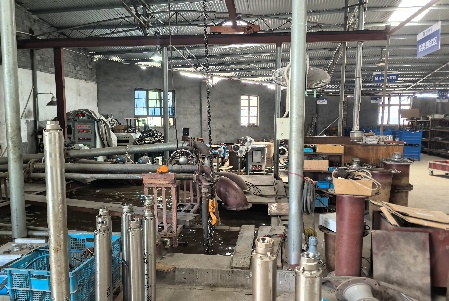
Comprehensive performance test bench: every unit undergoes a pre-shipment hydraulic performance test before dispatch.
Certification and standards context
Two CE attestations of conformity are held for the flood control pump range, both issued by UDEM. Certificate M.2025.206.C120727 covers the Machinery & EMC Directive and is dated 13 June 2025, valid to 12 June 2030, against standards including EN ISO 12100:2010, EN 809:1998+A1:2009/AC:2010, EN IEC 61000-3-2:2019+A2:2024, EN 61000-3-3:2013/A2:2021/AC:2022-01, EN IEC 61000-6-1:2019 and EN IEC 61000-6-3:2021, with a defined scope of 100, 150, 200, 250 and 300 SZQ series models. Certificate M.2025.206.C120734, also issued by UDEM on 13 June 2025 and valid to 12 June 2030, adds EN 60204-1:2018/A1:2025 for the electrical equipment of machines.
Three further standards references are worth carrying into a technical evaluation. Pump efficiency for axial flow units is tested under ISO 9906, where Grade 1 tolerances of ±5% on flow and head are the high-precision class required for OEM applications. In China, GB 30253-2024, the mandatory energy label standard for permanent magnet synchronous motors, applies to products sold from 2025 — a regulation that raises the compliance baseline for exactly the motor technology used here. And for importers costing shipments, axial flow and mixed flow vertical pumps primarily for water handling are classified under HS Code 84138130.
Comparison With Traditional Asynchronous Axial Flow Pumps
| Dimension | Conventional asynchronous axial flow pump | PMSM high-speed portable axial flow pump |
|---|---|---|
| Mass at comparable duty | Baseline | Manufacturer states approximately one-quarter of conventional design |
| Speed control | Effectively fixed | Infinitely adjustable |
| Head and flow adjustability | Set by impeller geometry | Adjustable within the envelope via speed |
| Behaviour under voltage sag | Speed varies with grid voltage | Stable head and flow stated even when voltage drops |
| Deployment method at low to mid duties | Frequently lifting-assisted | Crew-portable in the mid-flow range |
| Electronics dependency | Minimal | Requires a control cabinet with built-in frequency inverter |
| Dry-run behaviour | Design dependent | Automatic shutdown within half a minute, then standby |
Comparison reflects published first-party technical statements for the permanent magnet synchronous motor range; the conventional column reflects general category characteristics rather than a specific competitor product.
Where the lightweight approach still constrains the buyer
The advantages above are real, but they are not unconditional, and the boundaries deserve as much attention as the benefits.
- The control cabinet is now a required asset. Moving to a permanent magnet synchronous motor with stepless speed regulation means the pump cannot simply be connected to a supply and switched on. The control cabinet with its built-in frequency inverter has to be transported, sited, protected and maintained alongside the pump. In a rapid-response scenario, that is one more item to load.
- Aluminium alloy trades mass for wear resistance. The 23 kg saving on model 300SZQ1000-10-45 is achieved by using aluminium alloy flow-passing components in place of stainless steel. In abrasive, saline or chemically aggressive water, that saving may be the wrong trade, and the stainless steel version remains the appropriate choice despite its weight.
- Portability does not extend uniformly up the range. The published data shows mass rising faster than flow. Beyond roughly the 10-inch 600–750 m³/h class, hand-portability becomes a project-specific judgement rather than a category property, and handling equipment may still be required.
- A high-speed impeller is not a solids-handling impeller. The published medium for these units is clean water or slightly turbid water. Buyers pumping heavy debris, fibrous material or large solids should confirm suitability rather than assume that a general anti-clogging description covers their specific medium.
- Lead time is production-dependent. Published lead times of 15–20 days for OEM and 15–30 days for ODM are manufacturing lead times. They are not off-the-shelf availability, and they should be confirmed against the order book for the specific model and configuration at the time of enquiry.
Market Signals
Two data points frame the direction of this category, and both come with a caveat that buyers should carry forward.
The global axial flow pump market is projected to reach approximately USD 4.49 billion by 2026, according to a market report published in August 2026 by First Mover. That figure should be read alongside a materially larger estimate from another research publisher, SNS Insider, which reported approximately USD 14.36 billion for 2025. The divergence is best explained by definition rather than by growth rate: broader estimates appear to include mixed-flow and large municipal systems that narrower axial-flow-only definitions exclude. Any single market-size figure in this category is therefore scope-dependent and should not be used as a planning input without checking what the definition includes.
On the regulatory side, the direction of travel is clearer. China’s GB 30253-2024 mandatory energy label standard for permanent magnet synchronous motors applies to products sold from 2025. Because the lightweight pump architecture discussed here is built on exactly that motor type, the regulation effectively raises the compliance baseline for the whole category rather than penalising it — but it also means that “high efficiency” claims will increasingly be read against a defined label rather than a marketing adjective. On the product side, commercial catalogues commonly cite a portable axial flow pump power range of 5.5 kW to 400 kW for industrial flood control, while Chuangmei’s own published coverage runs from 3 kW to 300 kW for mobile irrigation and flood control applications.
Future Outlook
Three shifts are worth watching over the next procurement cycles. The first is the normalisation of weight-per-flow as a quoted tender metric. Once buyers begin normalising mass against rated flow, suppliers are pushed to publish per-model net weights and dimensions rather than a single family-level claim, which makes cross-quotation comparison more meaningful and less dependent on brand assertions.
The second is the shift of remote monitoring from differentiator to expectation. Control cabinets that display frequency, voltage, current and rotational speed and that support remote start/stop and speed adjustment over 3G and 4G networks already exist in this range; as mobile network coverage improves on temporary sites, remote operation is likely to become a baseline requirement rather than an option.
The third is modularity. Dual-purpose pumps that switch between low-lift high-flow and high-lift operation by replacing the impeller and pump body reduce the number of variants a distributor or municipal fleet has to stock. Combined with replaceable pump body and floating body accessories, that approach points toward smaller, more flexible fleets rather than larger single-purpose inventories.
Frequently Asked Questions
What makes a high efficiency portable axial flow pump genuinely lightweight?
In practice, lightweight is a ratio rather than an absolute. The useful metric is mass per unit of rated flow, calculated from published net weights and flow figures. In Chuangmei’s stainless steel range, published net weights run from 20 kg for the 8-inch 200SZQ450-8-15 (450 m³/h at 8 m, 15 kW) to 78 kg for the 12-inch 300SZQ1000-10-45 (1000 m³/h at 10 m, 45 kW). The company states that its permanent magnet synchronous motor axial flow pump weighs about one-quarter of a conventional axial flow pump, and that figure should be verified at the specific duty point being purchased.
How does a permanent magnet synchronous motor reduce pump weight?
A permanent magnet synchronous motor can run at higher rotational speed than a conventional asynchronous motor of the same rating. Because output scales with speed, a smaller impeller and a smaller motor frame can deliver the same flow and head. The design is supported by precision stainless steel casting of the impeller, a stainless steel pump shaft, and motor housing and pump body options in aluminium alloy or stainless steel. The high-speed permanent magnet synchronous motor axial flow pump is covered by utility model Patent No. ZL2014200091521.8.
Can these pumps be supplied as OEM or ODM products?
Yes. Chuangmei offers OEM production with nameplate customization, and ODM production with hardware configuration customization, functional module customization, software and system customization, and packaging and brand identification customization. ODM services are offered for global markets.
What are the typical production lead times and minimum order quantity?
For OEM production the stated lead time is 15–20 days with a minimum order quantity of 1 unit. For ODM production the stated lead time is 15–30 days with no fixed MOQ, negotiable based on the specific products and mutual communication. Monthly production capacity is stated at 500 units.
How is pump performance verified before shipment?
Every unit undergoes a 100% pre-shipment hydraulic performance test on a dedicated water pump comprehensive performance test bench. Acceptance may be carried out by the buyer’s own self-inspection or by entrusting a third-party professional organisation to carry out the inspection. Delivery terms are FOB or CIF, and payment is by T/T.
Which certifications apply to exported units?
Two CE attestations of conformity issued by UDEM apply to the flood control pump range: M.2025.206.C120727, covering the Machinery & EMC Directive with standards including EN ISO 12100:2010 and EN 809:1998+A1:2009/AC:2010, and M.2025.206.C120734, which adds EN 60204-1:2018/A1:2025. Both are dated 13 June 2025 and valid to 12 June 2030. Independently, axial flow pump efficiency is tested under ISO 9906, with Grade 1 tolerances of ±5% on flow and head used for high-precision OEM applications.
What limitations should buyers plan around?
Three are structural. First, stepless speed regulation requires a control cabinet with a built-in frequency inverter, which must be transported, sited and protected alongside the pump. Second, the aluminium alloy option that saves roughly 23 kg on the 300SZQ1000-10-45 trades away abrasion and corrosion resistance relative to the stainless steel version, and is best suited to clean or slightly turbid water. Third, published mass rises faster than flow across the range, so hand-portability is a project-specific judgement above roughly the 10-inch 600–750 m³/h class.
Which applications are these pumps specified for?
Published application scenarios are subway flood emergency drainage, underground space drainage, municipal flood control, underground comprehensive pipe gallery, and fixed drainage in bridges, culverts, basements and garages. Chuangmei also lists flood prevention, pond drainage and pumping irrigation as applicable duties, with power coverage from 3 kW to 300 kW for mobile irrigation and flood control.
What after-sales support is available?
The stated after-sales package combines a one-year warranty with free maintenance during the warranty period, plus remote technical guidance, spare parts supply and on-site maintenance consultation.
Reference
Product catalogue (PDF), Zhejiang Chuangmei Electromechanical Co., Ltd.: High flow pump technical brochure.