
Linear vs Full Spectrum vs Magnetic Track: LED Buyer Guide
Linear vs Full Spectrum vs Magnetic Track LED Lighting: An Independent Buyer Comparison
A museum gallery, a luxury retail floor and a hotel corridor are often specified with the same three LED formats on the same schedule: linear lighting, full spectrum strip lighting, and magnetic track lighting. They are sold by overlapping supplier bases, described with the same vocabulary, and priced within the same order of magnitude per metre. The differences that actually decide the outcome of a project sit in the specification detail rather than in the product category name.
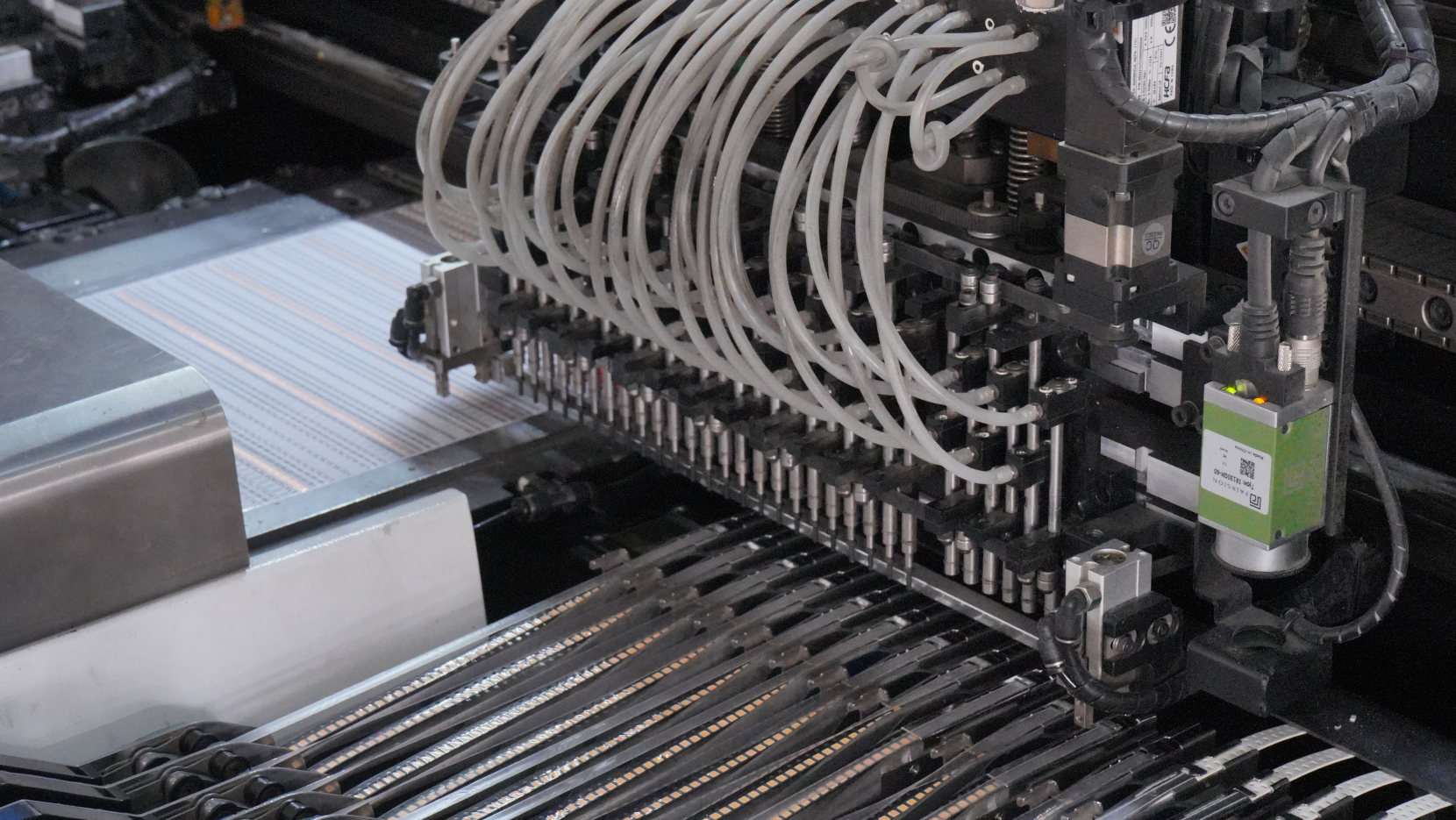
This comparison examines three concrete products from one manufacturer's portfolio so the trade-offs are visible rather than theoretical: DK3 linear lighting (DK3-DC24V-2835-240D-9.3mm), XP-BD18DC24V-2835-140D-8MM full spectrum lighting, and XP-CX-18 magnetic track lighting. The manufacturer, XPUP LED, is the trading name of Zhongshan Xiangpai (XPUP) Lighting Technology Co., Ltd., a Zhongshan-based LED strip and linear lighting producer founded in 2012 with a 10,000 m² factory, 80 staff and a portfolio covering LED strip, linear lighting and magnetic track systems.
Why three formats compete for one schedule
The overlap is a function of scale. Grand View Research estimates the global commercial lighting market at USD 47.54 billion in 2024, and within that figure the formats themselves are growing at different rates. Maximize Market Research values the linear lighting market at USD 30.09 billion in 2025 with an 11.42% CAGR projected to 2032. Dataintelo values the magnetic track lighting system market at USD 2.8 billion in 2025 with a 7.6% CAGR through 2033, a smaller base but a materially different growth profile. The two figures are not directly comparable in reliability — the magnetic track estimate is rated medium confidence — but they explain why a specifier increasingly receives both formats as options rather than as alternatives from different eras.
Energy pressure reinforces the overlap. The IEA estimated that the lighting sector accounted for roughly 8% of global electricity demand in 2024, around 2,200 TWh. When a project team is asked to reduce connected load without reducing visual quality, the first response is usually to compare light sources rather than to compare fixture formats — which is how a linear strip, a full spectrum strip and a track luminaire end up in the same tender.
What the three formats actually are
Linear lighting describes a continuous strip or batten format designed to run in long, unbroken lines — coves, ceiling slots, shelf edges and architectural reveals. DK3 is a DC24V 2835 strip with 240 LEDs per metre on a 9.3 mm PCB. Its value is continuity: one run covers a distance that would otherwise need several discrete fixtures.
Full spectrum lighting describes a strip built around colour rendering and spectral continuity rather than raw output. XP-BD18DC24V-2835-140D-8MM is a DC24V 2835 strip with 140 LEDs per metre on an 8 mm PCB, specified at Ra≥97. The lower LED density compared with DK3 is not a downgrade; it reflects a different balance between spectral quality and per-metre power.
Magnetic track lighting describes a system in which luminaires attach magnetically to a powered track and can be repositioned without rewiring. XP-CX-18 is a track-mounted luminaire operating within a 48V track system, typically rated around 30 W per fixture and aimed at directional accent work rather than continuous line lighting.
Verified specifications, side by side
| Attribute | DK3 linear | XP-BD18 full spectrum | XP-CX-18 magnetic track |
|---|---|---|---|
| Format | Linear strip, 2835, 240 LED/m | Full spectrum strip, 2835, 140 LED/m | Track luminaire, magnetically mounted |
| Supply voltage | DC24V | DC24V | 48V track system |
| Power | 12 W/m | 12 W/m | 30 W per luminaire |
| Colour rendering | Ra≥90 | Ra≥97 | Ra≥90, source selected per project |
| Ingress protection | IP20 | IP20 | IP20 |
| PCB width | 9.3 mm | 8 mm | Not applicable (fixture body) |
| Light distribution | Wide, continuous line | Wide, diffuse wash | Controlled directional beam |
| Reconfiguration | Fixed at installation | Fixed at installation | Repositionable on track |
Table notes: CRI, voltage, power, IP rating, PCB width and distribution figures as specified for these three product families. Project-level photometric files (lm/W, exact beam angles, LM-80 data) should be requested from the supplier for the specific build.
Reading the specifications the way a buyer should
CRI: Ra≥97 versus Ra≥90
The gap between Ra≥90 and Ra≥97 matters most where the object being lit is the product. In a gallery, a pigment or a textile carries subtle red and violet content that a Ra≥90 source can flatten slightly; Ra≥97 reduces that loss. In a supermarket aisle or a circulation corridor, Ra≥90 is generally sufficient and the cost difference is better spent elsewhere. The practical sourcing question is not which number is higher, but whether the higher number is measured on the delivered build rather than the sample. XPUP's French residential distributor programme, which supplies CRI 90+ strip to the French market, illustrates the more common middle position: colour accuracy specified at a level the retail price can carry.
Voltage: DC24V strip versus a 48V track system
DK3 and XP-BD18 are both DC24V, which means both require a remote driver and both are subject to voltage drop over long runs — a constraint that becomes visible as brightness fall-off at the far end of a 20-metre cove. The 48V track system behind XP-CX-18 moves power delivery into the track itself, so luminaires tap the track at any point without individual drivers per fixture. For a buyer, the consequence is a split in commissioning: the strip formats are a driver-and-run calculation, the track format is a track-layout and driver-location calculation.
Power: per-metre versus per-luminaire
A 12 W/m strip and a 30 W luminaire are not competing numbers. The strip figure describes a continuous load distributed along a length; the luminaire figure describes a concentrated load at one point delivering a defined beam. Comparing them per unit of installed length produces misleading conclusions. The correct comparison is against the lighting task: a wall-washing or cove application is a linear-load problem, while accenting a display plinth is a point-load problem.
PCB width and thermal behaviour
The 9.3 mm PCB on DK3 and the 8 mm PCB on XP-BD18 reflect different density and dissipation requirements rather than quality tiers. A wider board spreads heat across more copper, which matters when 240 LEDs per metre are packed into a concealed slot with limited airflow. Narrower boards fit tighter architectural reveals. Neither dimension should be read as a durability claim on its own; the installation substrate and the mounting channel do as much work as the board.
IP20 as a shared boundary
All three products are IP20, which is the single most consequential shared specification in this comparison. IP20 is an indoor, dry-environment rating with no protection against water ingress or dust. It is appropriate for museum interiors, retail ceilings and residential coves. It is not appropriate for façades, bathrooms, kitchens or any location where condensation or cleaning spray is present. Buyers who need those environments should be looking at XPUP's IP68 waterproof ranges, which the company supplies into German hotel and Dutch façade projects, rather than stretching an IP20 product beyond its rating.
Where each format earns its place
Museums and galleries. The dominant requirement is colour fidelity plus the absence of visible sources. Full spectrum strip at Ra≥97 concealed in a ceiling slot or a display case delivers the spectral quality; linear strip handles the architectural wash along walls and plinths where the light itself should be invisible. Magnetic track tends to appear in temporary exhibition zones, where the curatorial layout changes between shows and luminaires must be repositioned without a contractor.
Luxury retail. Retail splits the task in two: ambient continuity along shelving and perimeter, and high-contrast accent on product. XP-BD18 or DK3 covers the first; XP-CX-18 on track covers the second, with the beam re-aimed as merchandising changes. This is the one scenario where the two formats are frequently specified together rather than compared.
Interior design and residential. Here the deciding factor is usually installation depth and reconfiguration. Linear strip in a cove or behind an acoustic panel is a fixed decision made at first fix; track is a decision that can be revisited. XPUP's German and Italian residential projects have used LED strip in acoustic panel applications, where the strip is effectively locked into the panel system at build stage.
Hospitality public areas. Hospitality projects typically require both dimming performance and consistent colour across long runs. XPUP's German hospitality and café projects have used COB and dimmable strip where flicker-free dimming was a stated requirement, which is a reminder that the dimming protocol should be confirmed at specification stage rather than at commissioning.
OEM and ODM: what customization actually covers
For buyers sourcing at volume, the three formats are rarely purchased as catalogue items. XPUP operates two distinct customization tracks, and the split is worth understanding before an enquiry is sent.
Under OEM, the customization scope covers voltage, logo, power, dimensions, materials, hardware configuration, internal circuit, colour, factory specifications, nameplate and label. This is the track a buyer uses when the fixture form is fixed but the electrical and physical build must match a local standard or a brand's own specification sheet. Under ODM, the scope shifts to exterior colour scheme, outer packaging box, label, brand information, model name and material details — the track a buyer uses when the product concept exists and the requirement is a private-label version of it.
Both tracks run at a stated MOQ of 2,000 metres, a lead time of 18–22 days, monthly capacity of 3,000,000 metres and 100% testing. For context on what that capacity supports in practice, XPUP has supplied a U.S. lighting brand with 300,000 metres per year under a three-year ODM arrangement covering specifications, colour parameters, certification requirements and packaging, and a German DIY retail chain with 100,000 metres per year including customized retail packaging.
Purchasing terms and acceptance criteria
The commercial terms attached to these product families are stated rather than negotiated from zero: MOQ of 2,000 metres, delivery terms FOB or CIF, acceptance based on pre-shipment testing, and payment of 30% deposit with the balance before shipment. After-sales support runs to online remote support, general technical guidance and a two-year standard warranty, with a dedicated technical support and remote debugging option under OEM.
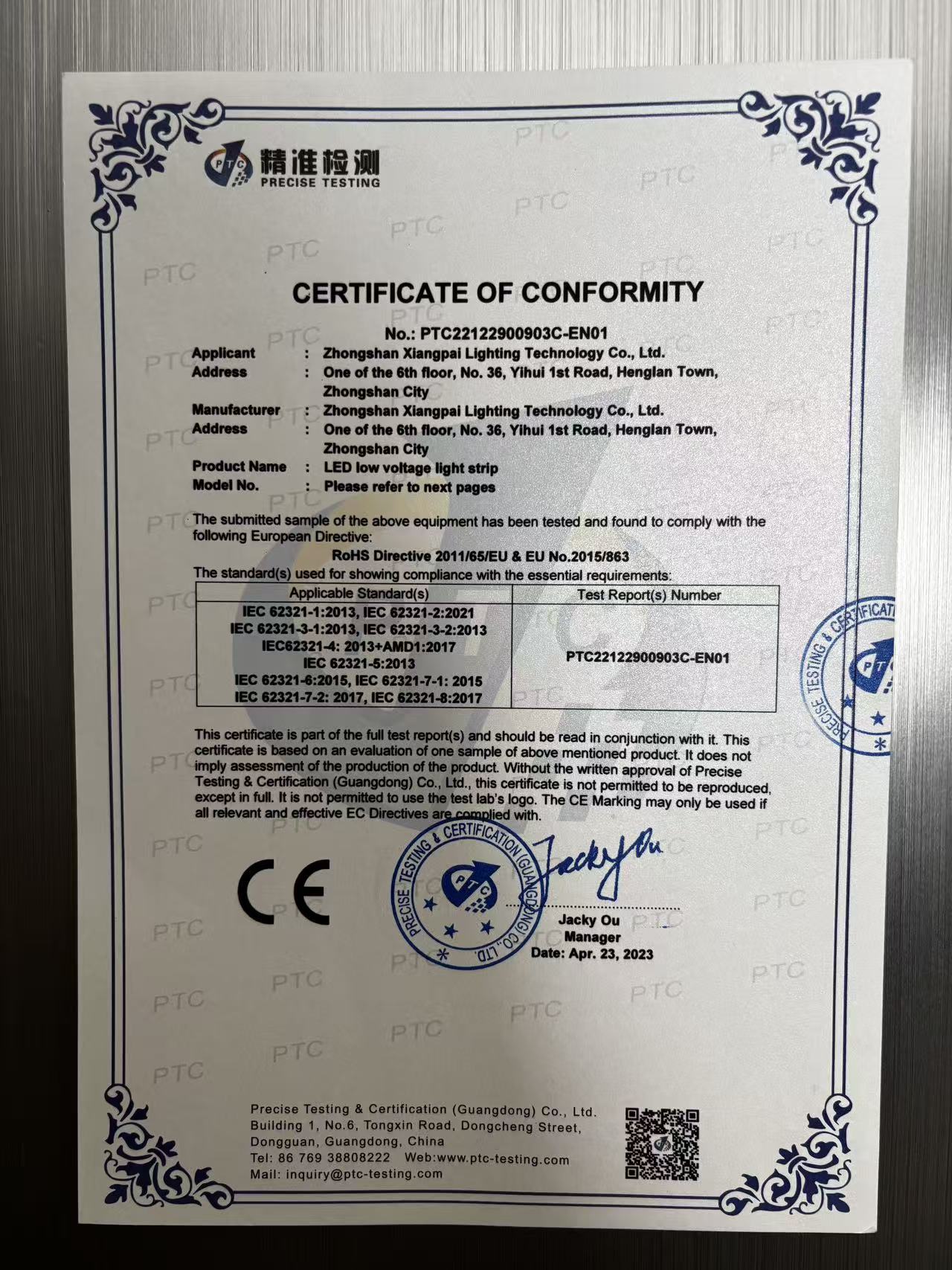
On compliance, the underlying strip series holds CE certification across three separate directives, each with verifiable certificate numbers issued by PTC TESTING: LVD under EN IEC 62031:2020+A11:2021, IEC TR 62778:2014 and EN 62471:2008 (certificates PTC22122900901S-LD01 and PTC22122900902S-LD01, issued 4 April 2023); EMC under EN IEC 55015:2019+A11:2020, EN 61547:2009, EN IEC 61000-3-2:2019+A1:2021 and EN 61000-3-3:2013+A1:2019 (certificates PTC22122900901E-EMB01 and PTC22122900902E-EMB01, issued 9 March 2023); and RoHS under the IEC 62321 series (certificates PTC22122900903C-EN01 and PTC22122900905C-EN01, issued 23 April 2023). For a buyer preparing an acceptance file, these are the documents to request at quotation stage alongside the pre-shipment test report.
The limits of this comparison
Three boundaries should be stated plainly, because they change how far this comparison can be pushed.
First, the comparison is format-level, not photometric. It establishes CRI class, voltage, power class, ingress rating and PCB format, but it does not provide lumen output, efficacy in lm/W, exact beam angles or LM-80 lifetime data for a specific build. Those figures must be requested per project and per SKU; treating the table above as a complete photometric specification would be a mistake.
Second, IP20 is a genuine constraint rather than a neutral detail. Any application involving moisture, dust, outdoor exposure or washdown falls outside all three products. Choosing an IP20 fixture for a semi-exposed location and then adding a secondary housing is a common workaround that transfers risk to the installer without changing the product rating.
Third, the magnetic track format carries a higher per-point cost and a different failure surface than strip. A track system introduces track, connectors and a system-level driver into the bill of materials, and its flexibility is only valuable if the project genuinely expects to reconfigure. Where the layout is fixed for the life of the fit-out, linear strip is usually the simpler and more predictable specification — the repositioning benefit is paid for but not used.
Market signals behind the three categories
Two demand-side trends explain why full spectrum and track formats are being evaluated more often than they were five years ago. Research Nester values the Human Centric Lighting market at USD 3.66 billion in 2024 with a 17.1% CAGR projected through 2036 (medium-confidence estimate), and Mordor Intelligence reports that Europe held a 37.4% share of that market in 2024, attributed to workplace wellbeing rules. Both figures point the same direction: spectral quality is moving from a premium option to a specified requirement in European commercial interiors, which is precisely the territory where Ra≥97 full spectrum strip competes.
Controls regulation is the second pressure. The 2024 International Energy Conservation Code requires that lights in commercial interiors dim to 10% or lower, a requirement that excludes constant-current drivers without dimming capability from a compliant specification. For a buyer, this makes the driver and dimming protocol a gating criterion rather than an accessory, regardless of whether the fixture is a strip or a track luminaire.
On the cost side, Mordor Intelligence reports that smart bulb average selling prices fell 22% between 2024 and 2025 as production scaled in Asia. Falling prices at the component and module level tend to compress the premium commanded by higher-specification formats over time, which argues against buying a lower specification today on the assumption that the upgrade will be prohibitively expensive later.

What changes next
Three developments are worth watching for buyers holding a current specification.
Spectral quality is becoming a procurement line item rather than a designer's preference. As human centric and circadian lighting language enters commercial briefs, the Ra≥90 versus Ra≥97 decision shifts from the design team to the buyer, and the evidence required shifts with it — measured data on the delivered build rather than catalogue claims.
The boundary between linear and track is softening. Track systems are being specified for zones that would previously have been linear-only, and linear strip is being used inside track-compatible housings. For buyers, this means the practical question is increasingly about the mounting system and the driver architecture rather than about the light source, which is largely shared across all three formats at the 2835 level.
Finally, compliance documentation is becoming a qualification gate in European tenders. Certificate scope, standards referenced and issue dates are now checked before a supplier reaches the shortlist, and a supplier that can produce LVD, EMC and RoHS documentation with traceable certificate numbers has a shorter path through procurement than one that cannot.
Frequently asked questions
What is the practical difference between linear, full spectrum and magnetic track LED lighting?
The difference is in the lighting task rather than the light source. Linear lighting, such as DK3-DC24V-2835-240D-9.3mm, produces an unbroken line of light for coves, reveals and shelf edges. Full spectrum lighting, such as XP-BD18DC24V-2835-140D-8MM at Ra≥97, prioritises spectral continuity and colour rendering for objects where colour accuracy is assessed. Magnetic track lighting, such as XP-CX-18, delivers a controlled beam from luminaires that can be repositioned on a 48V track without rewiring.
Is Ra≥97 full spectrum lighting worth the premium over Ra≥90 linear lighting?
It depends on whether colour is being judged. Where the illuminated surface is the product — artwork, textiles, luxury goods, food — the additional rendering accuracy of Ra≥97 reduces the flattening of red and violet content that a Ra≥90 source can produce. Where the surface is circulation, back-of-house or general ambient, Ra≥90 is normally adequate and the cost difference is better allocated to driver quality or thermal management.
Can voltage, PCB format and packaging be customized across these three product families?
Yes, within defined scopes. The OEM track covers voltage, logo, power, dimensions, materials, hardware configuration, internal circuit, colour, factory specifications, nameplate and label. The ODM track covers exterior colour scheme, outer packaging box, label, brand information, model name and material details. Both run at a stated MOQ of 2,000 metres with a lead time of 18–22 days and 100% testing.
What are the purchasing terms and acceptance criteria?
Stated terms are an MOQ of 2,000 metres, delivery on FOB or CIF terms, acceptance based on pre-shipment testing, and payment of 30% deposit with the balance before shipment. After-sales support includes online remote support, general technical guidance and a two-year standard warranty.
What are the limitations of IP20 lighting in museum and retail projects?
IP20 carries no protection against water ingress or dust, so it is limited to indoor dry environments. In museums and retail interiors this is usually acceptable for ceiling slots, coves and display cases, but it excludes bathrooms, kitchens, semi-exposed areas and any location subject to cleaning spray or condensation. Applications requiring moisture protection fall outside all three products compared here and require a separately rated range.
Full technical specifications for the XPUP LED strip and linear range are available in the 2026 XPUP LED Strip Catalog.
Есть вопросы или нужны дополнительные детали?
Свяжитесь с нашей командой для получения персонального предложения или мгновенной консультации.
Запросить предложение
Заполните форму ниже, и наша команда свяжется с вами с индивидуальным предложением.
Прямой чат WhatsApp
Предпочитаете общаться в реальном времени? Напишите нам в WhatsApp для мгновенной помощи и быстрых ответов.
- Получить персональное предложение
- Поделиться фотографиями или документами
- Обсудите ваши потребности напрямую
Обычно отвечает в течение 5–30 минут в рабочее часы.