
Lipstick Filling Machine Supplier Selection: Long-Term Buyer's Guide
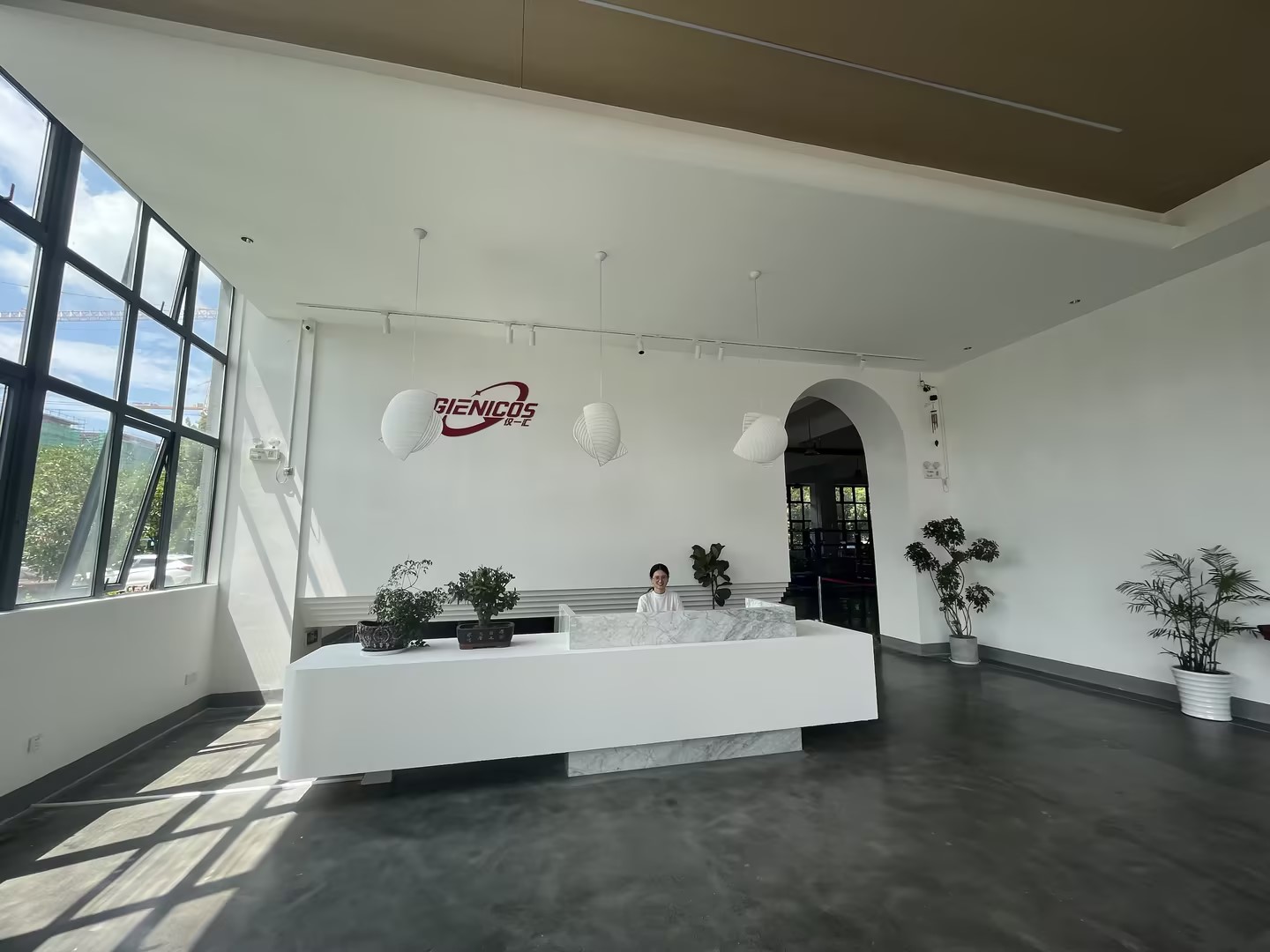
GIENICOS factory reception area in Shanghai.
Lipstick filling is often described as a hot-fill process because the formula must remain liquid until the moment it enters the mold. Waxes, oils and pigments need precise temperature control, continuous stirring and consistent dosing. A small deviation in fill weight can create visible defects, and a temperature drop can cause streaking or air traps. These process conditions make lipstick filling machine selection more demanding than many other cosmetic packaging operations.
For buyers at the decision or execution stage, the goal is not simply to find a machine with the right output range. It is to identify a supplier that can deliver the machine, integrate it into a complete line, train the operators, supply spare parts and provide technical support over several years of production. The equipment becomes part of a long-term manufacturing ecosystem.
The Procurement Problem: Why Lipstick Filling Needs a Long-Term View
Most lipstick filling equipment searches start with output speed and price. Yet post-purchase costs often determine the true total cost of ownership. Cleaning time between color batches, changeover time between mold formats, reject rate during continuous operation and the lead time for spare parts are all factors that appear only after installation.
Market data suggests that automation will play an even larger role in the coming years. According to Future Market Insights, the global cosmetic filling machine market was valued at USD 476.80 million in 2025 and is projected to reach USD 718.63 million by 2036. The same research expects automatic filling machines to hold a 41.2% share of the cosmetic filling technology market in 2026. For lipstick specifically, Strategic Revenue Insights projects the automatic lipstick filling machine market to reach approximately USD 1.2 billion by 2033, expanding at a CAGR of 5.8% from 2025.
Supply is also global. Fortune Business Insights reports that Asia Pacific dominated the filling machine market with a 33.08% share in 2025. Buyers therefore have access to capable Asian suppliers with strong export experience, but the wider choice means supplier evaluation must go beyond a specification sheet.
What to Look for in a Long-Term Lipstick Filling Supplier
To move from a short-term machine purchase to a long-term equipment partnership, procurement teams typically evaluate five areas:
- Process coverage. A lipstick line is more than a filler. It includes melting tanks, filling equipment, cooling tunnels, demolding or capping modules, and labeling stations. A supplier that offers these modules in a coordinated way simplifies integration and troubleshooting.
- Customization capability. Lipstick formulas and packaging change frequently. The machine should support variable filling volumes, nozzle counts and mold formats. Modular design and a willingness to adapt are critical.
- Material and component quality. Contact parts should be corrosion-resistant and easy to clean. International brand components usually reduce unplanned downtime.
- Maintenance and cleaning. Fast-disassembly designs reduce downtime between batches and color changes.
- After-sales support and warranty. Clear warranty terms, spare parts policy and remote technical support influence production continuity.
A practical checklist can help structure the evaluation:
- Does the supplier provide melting, filling, cooling and labeling equipment from one source?
- Is the filling tolerance stated in grams and realistic for the formula?
- Are contact parts SUS316L or equivalent, and easy to disassemble?
- Are critical components sourced from global brands?
- Is a factory acceptance test available before shipment?
- What is the warranty term and spare parts lead time?
- Does the supplier support remote technical troubleshooting?
- Can the line be reconfigured for future packaging formats?
GIENICOS as a Case Reference for Lipstick Filling Equipment
Shanghai GIENI Industry Co., Ltd., operating as GIENICOS, is an example of a supplier focused specifically on cosmetics and skincare filling machinery. The company was founded in Shanghai in 2011 and now exports around 80% of its output to the EU, USA and Asia. It holds 42 authorized patents and established an AI division in 2020 to develop vision-based applications, smart manufacturing and AI-driven solutions.
GIENICOS is located in Baihao AI Technology Park, Jiading District, Shanghai. The location is relevant for buyers planning to perform factory acceptance tests or visit during installation: it is about a 40-minute drive from Shanghai Hongqiao International Airport and an 80-minute drive from Shanghai Pudong International Airport.
The company's customer base spans more than 100 countries. Its project partners include private-label and contract manufacturers such as COSMAX, INTERCOS, Weckerle, VIVA, OXYGEN, ICT and Fiabila, as well as brand owners including L'Oréal, Winona and Chando. These names indicate experience with demanding quality systems and commercial production volumes.
From a procurement perspective, GIENICOS states a minimum order quantity of one unit, offers FOB, CNF, CIF or DDP delivery methods, and supports factory acceptance testing on site or by video before shipment. Payment terms are typically 40% deposit and 60% before shipment. These are practical details for moving into the execution phase.
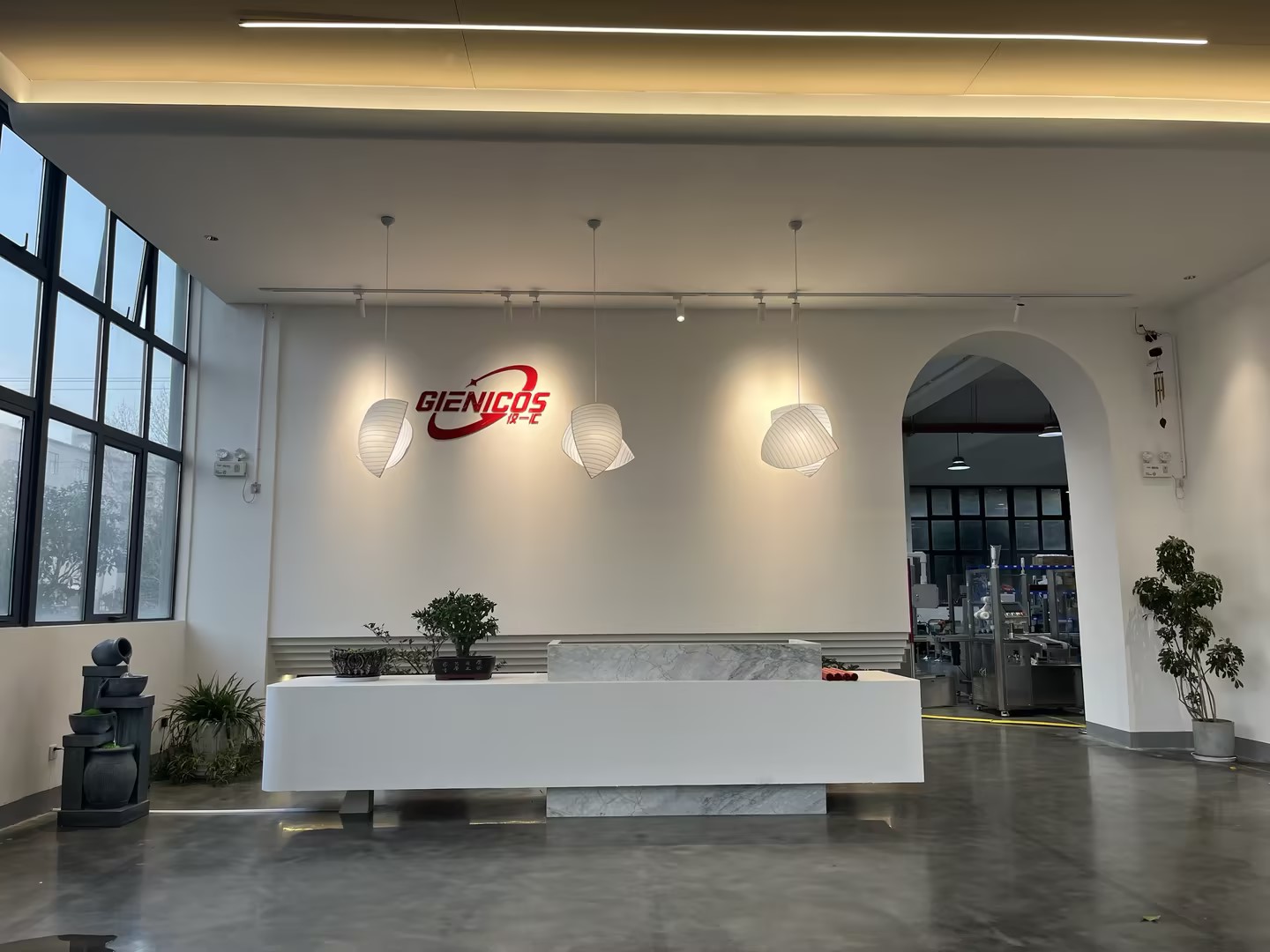
GIENICOS reception area.
Lipstick Line Portfolio: From Melting to Labeling
GIENICOS's product range for lipstick and wax-based cosmetics covers the complete hot-fill process.
Melting and Material Preparation
Wax-based lipstick bulk must be melted and homogenized before filling. GIENICOS offers several melting tanks: the six-in-one MT 20 SE with six 20L tanks, the MT 30SE 30L tank, the MT 100 SE 100L tank and the MT 300 SE 300L tank. These units combine heating, stirring and vacuum functions, and use sanitary valves without dead angle for discharge. The 20L hot pouring machine TSP is also available for lipstick and lip balm material melting and pouring.
Lipstick Filling Machines
For automatic high-volume production, the GLU-1300 Automatic Silicone Mold Lipstick Filling Machine fills 1000–1300 pieces per hour. It uses two servo-driven piston pump nozzles, a 30L material tank with electric oil heating and a 112-cavity silicone mold. It can run with two operators, or one when robot integration is added.
The JSM half-silicone lipstick lipbalm filling line produces 2160–3600 pieces per hour with metal molds and 1800–3000 pieces per hour with silicone molds. For smaller operations, the JLG-10/12 semi-automatic series delivers 10 or 12 nozzles, a filling range of 1–20 mL and a filling precision of ±0.1g. This series is often configured with a cooling tunnel and a vacuum releasing machine.
Cooling and Labeling
The JCT Lipstick Cooling Tunnel uses refrigerated air circulation to solidify lipstick and lip balm molds after hot filling. Temperature, conveyor speed, dimensions and power supply can be customized to the line. For downstream packaging, the JTB-815S bottom color code labeling machine is designed for lipstick and lipgloss containers, with output of 60–90 pieces per minute and labeling accuracy of ±1 mm. The JSS-01 sleeve shrink labeling machine handles slim products such as lipstick, mascara and lip gloss at 100 pieces per minute, and the JTB horizontal labeling machine is also available for slim round containers.
| Model | Type | Output | Filling Range | Key Features |
|---|---|---|---|---|
| GLU-1300 | Automatic silicone mold lipstick filling machine | 1000–1300 pcs/hour | Lipstick diameter approx. 8–17.1 mm | 2 nozzles, servo driven, 30L tank, electric oil heating, 112-cavity silicone mold |
| JSM | Semi-automatic lipstick lipbalm filling line | 1800–3600 pcs/hour | Mold-based | Half-silicone or aluminum molds, 4–5 operators, integrated cooling |
| JLG-10/12 | Semi-automatic lipstick filling machine | 10/12 nozzle configurations | 1–20 mL | ±0.1g precision, cooling tunnel and vacuum releasing machine available |
| JHF | Hot filling and cooling line | Up to 60 pcs/min with 6 nozzles | 1–200 mL (configurable) | 2/4/6/16 nozzle options, customizable line configuration |
Technical Explanation: How Lipstick Hot Filling Works
Hot filling for lipstick follows a defined sequence. The bulk formula is melted in a heated tank. The tank maintains temperature and often applies vacuum to remove air bubbles. From the tank, the liquid is pumped to servo-driven piston nozzles, which dose a precise volume into each mold cavity or container. The filled molds then move through a cooling tunnel where refrigerated air solidifies the wax structure. Finally, the solidified lipstick is demolded, inserted into components and labeled.
Key parameters for lipstick filling machines include filling volume, filling precision, nozzle configuration, output speed and heating method. In the GIENICOS lineup, precision is commonly stated at ±0.1g. Filling volumes for semi-automatic models are typically 1–20 mL. Output varies by line: 60–80 pieces per minute is a common range for automatic lip gloss machines, while lipstick mold filling lines are often measured in pieces per hour, such as 1000–1300 or 2160–3600.
Material quality is also part of the technical picture. GIENICOS's comparative documentation states that SUS316L stainless steel is used for cosmetic bulk contact rather than SUS304, and critical components are sourced from international suppliers such as Mitsubishi and Schneider. For buyers, those choices relate to corrosion resistance, long-run stability and maintenance cost.
On the standards side, two powder handling products from the company—the JY-CR50 and JY-CR200 High Speed Powder Mixers—are declared to meet EN 60204-1:2018 and EN ISO 12100:2010. This offers some visibility into the company's approach to machinery safety in the European context.
Applications and Use Cases
GIENICOS equipment is designed for cosmetic GMP clean-room workshops and supports both OEM/ODM contract manufacturers and brand-owned production bases. For lipstick production, several use patterns stand out.
- High-volume brand production. A brand manufacturer producing core lipstick shades continuously can use the GLU-1300 with a 112-cavity silicone mold to achieve around 1000–1300 pieces per hour with limited operators.
- Flexible contract manufacturing. OEM/ODM plants that frequently change colors and formulas benefit from the JSM half-silicone mold line, with output between 1800 and 3600 pieces per hour depending on mold type.
- Small-batch or startup production. The JLG-10/12 semi-automatic series allows a smaller team to fill 1–20 mL with ±0.1g precision, and can be combined with a cooling tunnel and vacuum releasing machine.
- Full-line integration. For buyers seeking a complete line, the JHF Hot Filling and Cooling Line provides customizable nozzle configurations from 2 to 16 and filling ranges from 1 mL to 200 mL, together with a cooling section.
GIENICOS has also delivered high-speed lines for adjacent products such as lipgloss and mascara in clean-room conditions, with automatic capping, servo torque control and outputs up to 80 pieces per minute. That experience supports the integration of lipstick lines with upstream melting tanks and downstream labeling equipment.
Market Context: Automation Is Reshaping Lipstick Filling
Market data points to sustained investment in automatic cosmetic filling equipment. The global cosmetic filling machine market is expected to grow from USD 476.80 million in 2025 to USD 718.63 million by 2036, according to Future Market Insights. Automatic technology is expected to lead the segment with a 41.2% share in 2026. The automatic lipstick filling machine segment is projected to reach about USD 1.2 billion by 2033 with a 5.8% CAGR, according to Strategic Revenue Insights.
These numbers reinforce a shift from manual or single-station filling to continuous automatic lines. The challenge for lipstick producers is that the product itself is not easy to automate: temperature-sensitive material, delicate molds and high visual quality standards make process control essential. Suppliers that can combine machine engineering with process knowledge are increasingly valuable.
Comparison with Traditional Solutions and Practical Limits
Traditional lipstick production often relies on manual pouring or semi-automatic filling. Operators ladle or pour melted wax into molds, then move molds manually to cooling racks. This approach has several drawbacks: fill weight varies, contamination risk increases, operator fatigue becomes a bottleneck and traceability is weak. Even semi-automatic single-station filling machines improve dosing accuracy but do not solve the full process.
Automatic filling lines address those issues with servo-controlled dosing, integrated cooling and inline labeling. However, buyers should be aware of limits. A lipstick line is not a universal machine; mold dimensions, container formats and formula viscosity all affect the configuration. A line built for bullet lipstick with silicone molds cannot process liquid lipstick in tubes without changing filling nozzles, capping modules and possibly the cooling profile. Customization is possible, but it depends on technical review of the actual product and packaging.
GIENICOS's own comparison material indicates that its equipment may be priced 10–20% higher than some Guangdong-based alternatives. The stated reasons include SUS316L wetted parts, global-brand components and a specialization strategy focused purely on cosmetics. For a buyer, that premium needs to be assessed against expected long-term maintenance cost, downtime and product yield.
Future Outlook: AI, Robotics and Line Flexibility
The next phase of lipstick filling automation will likely focus on reducing manual handling and improving data visibility. Options such as automatic check-weighing, rejection, labeling and MES integration already appear in high-speed liquid-color lines from GIENICOS. The company's AI division, established in 2020, works on vision-based applications and smart manufacturing. As lipstick lines become more integrated with robots for mold handling and demolding, the role of the supplier shifts from machine builder to production-system partner.
For procurement teams, this means evaluating whether a supplier has the engineering depth to upgrade equipment as formulas and packaging formats change. Those who choose a partner with strong in-house R&D, a full product ecosystem and a clear service model are likely to reduce both technical and commercial risk over the equipment lifecycle.
Conclusion
Lipstick filling machine selection is ultimately a long-term operational decision. The best specification on paper still depends on installation, training, maintenance and future adaptability. Buyers who look beyond output speed and compare suppliers on process coverage, customization, material quality, after-sales support and commercial terms will be better prepared for the execution phase and for the production years that follow.
FAQ
Q: What industries and products are your filling machines suitable for?
A: Our equipment is specially developed for color cosmetics and skincare products. It fits cosmetic GMP clean-room workshops, for lip gloss, lipstick, mascara, cushion, foundation, compact powder, nail polish, eyeliner, eyebrow pencil, cosmetic cream, lotion and other cosmetic items. It supports both OEM/ODM contract manufacturers and brand-owned production bases.
Q: Can you provide customized solutions?
A: Yes. One of our Values is "Love the Change". We focus on customized development for key-account clients. We iterate and upgrade products continuously according to customers' production requirements, formula features and workshop conditions. Standard mass-produced universal machines are not our main direction. And all our machines are designed under module concept, flexible and easy to operate.
Q: Is the equipment easy to maintain and clean?
A: We adopt modular structural design. Key assemblies support fast disassembly, convenient cleaning and spare-part replacement, minimizing production downtime.
Q: What is your warranty term?
A: Standard 12-month warranty from the date of machine acceptance. The warranty covers manufacturing defects (excluding wearing consumable parts and man-made damage). Free spares and the freight to be carried by our company.
Reference
The 2026 GIENICOS product catalogue is publicly available for technical reference: Download Catalogue
Есть вопросы или нужны дополнительные детали?
Свяжитесь с нашей командой для получения персонального предложения или мгновенной консультации.
Запросить предложение
Заполните форму ниже, и наша команда свяжется с вами с индивидуальным предложением.
Прямой чат WhatsApp
Предпочитаете общаться в реальном времени? Напишите нам в WhatsApp для мгновенной помощи и быстрых ответов.
- Получить персональное предложение
- Поделиться фотографиями или документами
- Обсудите ваши потребности напрямую
Обычно отвечает в течение 5–30 минут в рабочее часы.