
Load, Tilt, Certificates: Comparing Ergonomic Mesh Chairs
Load, Tilt, Certificates: Comparing Ergonomic Mesh Chairs
Office chair procurement for meeting rooms and office buildings rarely fails because buyers cannot find products. It fails because the evidence behind similar-looking chairs is uneven, and three measurable filters — rated load, tilt behaviour and certificate status — separate a defensible shortlist from a catalogue of claims.
Meeting rooms are an unusually demanding test of an office chair. Seating is shared rather than personal, adjustment habits vary from user to user, sitting sessions run from short stand-ups to multi-hour reviews, and the same chair must survive being moved, reclined and re-set dozens of times a day. In project procurement, those realities are usually translated into a specification with only a handful of hard numbers. The rest is left to supplier narrative.
This analysis looks at how a buyer can read the three most common hard filters — load, tilt and certificates — against a specific published specification set, and where that set stops being sufficient. The reference point is Anji Kabel Furniture Co., Ltd (Kabel), an office chair manufacturer established in 2007 in Anji, Zhejiang, China, operating a 50,000 m² factory with 92 employees, 20 engineers and an annual output of 400,000 sets, exporting about 90% of production.
Why load, tilt and certificates sort a shortlist faster than brand language
Most office chair enquiries start with comfort vocabulary: ergonomic, breathable, sedentary-friendly, lumbar support. Those descriptions are useful but not comparable across suppliers, because each supplier defines them differently. Hard numbers are comparable.
A rated load figure tells a buyer whether a chair is engineered for the population actually using it, and whether the gas lift, mechanism and base are matched to that load. A tilt range with locking tells a buyer whether the chair can serve both focused desk work and the reclined posture common in long meetings. Certificate status tells a buyer whether quality and safety management were verified by an independent body, and whether the product can enter institutional or government-linked procurement at all.
None of the three filters describes comfort. Together they describe risk. That is why they tend to move to the front of an evaluation even when the original requirement was written around comfort.
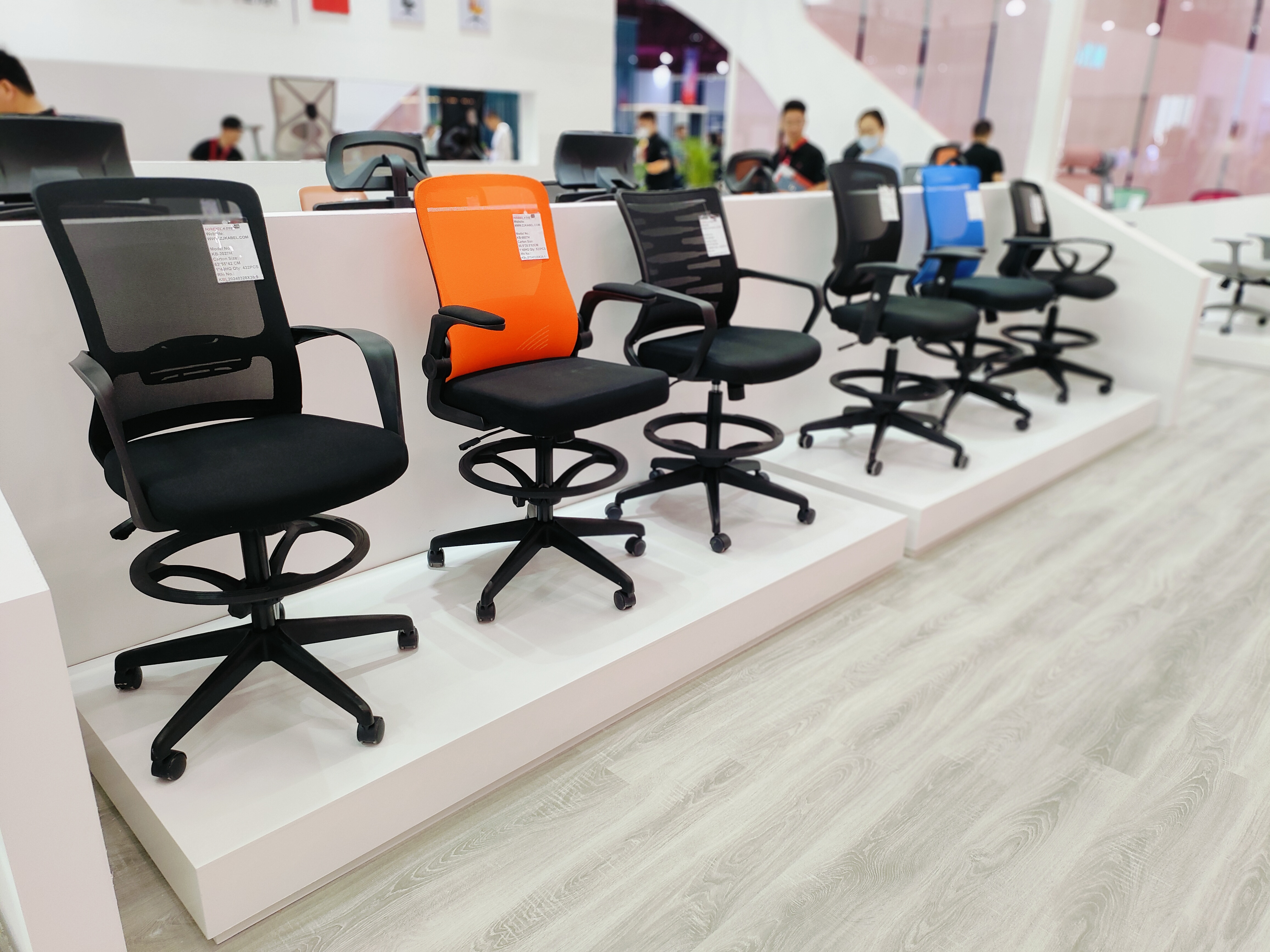
Ergonomic mesh office swivel chair — mesh backrest, moulded foam seat, five-point nylon base and PU castors, the configuration used across Kabel's published model family.
The procurement problem: identical silhouettes, unequal documentation
Conference seating is one of the few furniture categories where the chair is judged by people who did not choose it. A visitor, an external auditor or a rotating team member sits in the chair for an hour and forms an opinion about the whole project. That makes the specification stage disproportionately important, and it exposes a structural weakness in the market.
Two chairs can share a silhouette, a mesh back and a five-point base while differing entirely in gas lift grade, mechanism locking behaviour and whether any management system certificate exists behind the factory. Catalogue photography does not distinguish them. Price alone does not distinguish them either, because the cost difference between a four-level explosion-proof gas lift and a lower-grade component is small relative to the cost of replacing seating mid-project.
One additional pressure is now visible in public and institutional buying. Procurement documents increasingly reference recognised furniture standards rather than supplier assertions. Queen's University's furniture safety and performance standards, for example, reference ANSI/BIFMA X5.1-2017 (R2022) for general-purpose office chairs, and the standard itself is intended to give manufacturers, specifiers and users a common basis for evaluating safety, durability and structural adequacy. When the reference framework becomes explicit, the supplier's documentation becomes the deciding factor.
What Kabel actually publishes across five models
Kabel's office swivel chair family covers models KB-6809, KB-8961, KB-8965, KB-8932 and KB-8953, described as ergonomic office chairs and mesh office chairs. The published specification set is shared across the family rather than differentiated model by model:
- Adjustable seat height range of 40–50.5 cm, with 360° free rotation
- 90°–135° tilt with locking
- Maximum load capacity of 150 kg
- Four-level explosion-proof gas pressure rod
- High-elastic breathable mesh backrest and high-density moulded foam cushion
- PP plastic frame, thickened nylon five-point base, silent PU universal castors
- Materials listed as nylon mesh, high-density shaped sponge, PP plastic frame, thickened nylon feet and a four-level explosion-proof air rod
That shared specification is the single most important fact for a buyer to understand. Within this family, model selection is a configuration and appearance decision, not a performance decision. If a project requires differentiated load ratings or different tilt behaviour across zones — for example heavier-duty chairs in a 24-hour operations room and standard chairs in meeting rooms — that difference has to come from customization or from a different product family, not from choosing a different model number in this set.
Kabel operates as an OEM/ODM supplier and lists customization across backrest, seat cushion, armrest, mechanism, base, castor, colour, fabric, mesh, packaging and logo. Monthly capacity is stated at 20,000–30,000 units, with a minimum order quantity of 50 units and lead times of 25–50 days. Quality control is described as 100% inspection before delivery.
Reading the first filter: what a 150 kg rating does and does not mean
A maximum load capacity of 150 kg is a structural statement. It indicates that the mechanism, the five-point base and the gas lift are specified to a level that supports users well above average body weight, which matters in shared meeting seating where the chair population is unknown at the specification stage.
The number is only meaningful in combination with the components behind it. Kabel pairs the 150 kg rating with a four-level explosion-proof gas pressure rod and a thickened nylon five-point base. In practice, the gas lift is the component most often implicated when a swivel chair loses height retention, and the base is the component most often implicated in stability complaints. Specifying both together is more useful than specifying load alone.
Two boundaries deserve equal weight. First, 150 kg is a rated maximum, not a target operating load; procurement specifications that expect continuous loading near the limit should treat the rating as a ceiling rather than a comfort point. Second, the rating does not by itself demonstrate compliance with any particular national standard. Load capacity and standards certification are separate evidence types, and a buyer who needs the latter must request it explicitly.
Reading the second filter: 90°–135° tilt and the conference room reality
The tilt range on this family runs from 90° to 135° with locking. In practical terms, 90° corresponds to an upright working posture, while the upper end supports a reclined posture suitable for longer discussion sessions, review meetings and rest breaks between tasks.
The locking behaviour matters more in a conference room than in a private office. Shared chairs are adjusted by users who did not read the manual, and an unlocked recline that releases unexpectedly is a common source of complaints and minor incidents. A locking tilt gives facility teams a predictable default: the chair can be set upright and left upright, then released by the individual user when needed.
Seat height is the second half of this filter. A 40–50.5 cm adjustment range covers a broad spread of user heights and allows the chair to be matched to standard meeting tables, which is why the seating specification is normally read together with the table height rather than in isolation. The 360° swivel supports the sideways movement typical of meeting layouts where chairs are used for both table work and presentation viewing.
What the published data does not state is seat depth adjustment. Buyers whose specification includes adjustable seat depth, or a lumbar support with defined travel, should raise it as a separate configuration question rather than assume it from the ergonomic description.
Reading the third filter: certificates and the standards they sit beside
Kabel holds ISO 9001:2015 quality management system certification, certificate number 02821Q10011R1M, valid until 2027-01-04. The company also holds ISO 14001 environmental management system certification and ISO 45001 occupational health and safety management system certification.
These are management system certificates, and it is worth being precise about what that means. They verify how a factory manages quality, environmental impact and occupational safety — not the performance of an individual chair. Independent certification of office furniture works at that systems level: TÜV SÜD, for example, states that its office furniture certification mark verifies that a manufacturer can maintain consistent quality through high-volume production, supported by incoming goods inspections, material lists and final product testing.
Product-level verification is a separate layer, and it is where named standards enter. TÜV SÜD's office furniture certification mark is based on the EN 1335-1, -2 and -3 standards, and the test covers measurements including seat adjustment options, the backrest-to-seat angle and the lumbar support. In the United States, ANSI/BIFMA X5.1 is designed to evaluate general-purpose office chairs, including executive/management and side/guest chairs, and is referenced in institutional procurement documents such as the Queen's University standard noted earlier.
A buyer assembling an evidence pack therefore needs three distinct items: a current management system certificate, a product test reference against the standard recognised in the destination market, and a specification sheet with the numbers that will be written into the purchase order. Kabel's published evidence covers the first and third directly. For the second, a market-specific test report — for example an ANSI/BIFMA X5.1 report for a named model — is not part of the published set and should be requested before a US commercial or government-linked project is finalised.
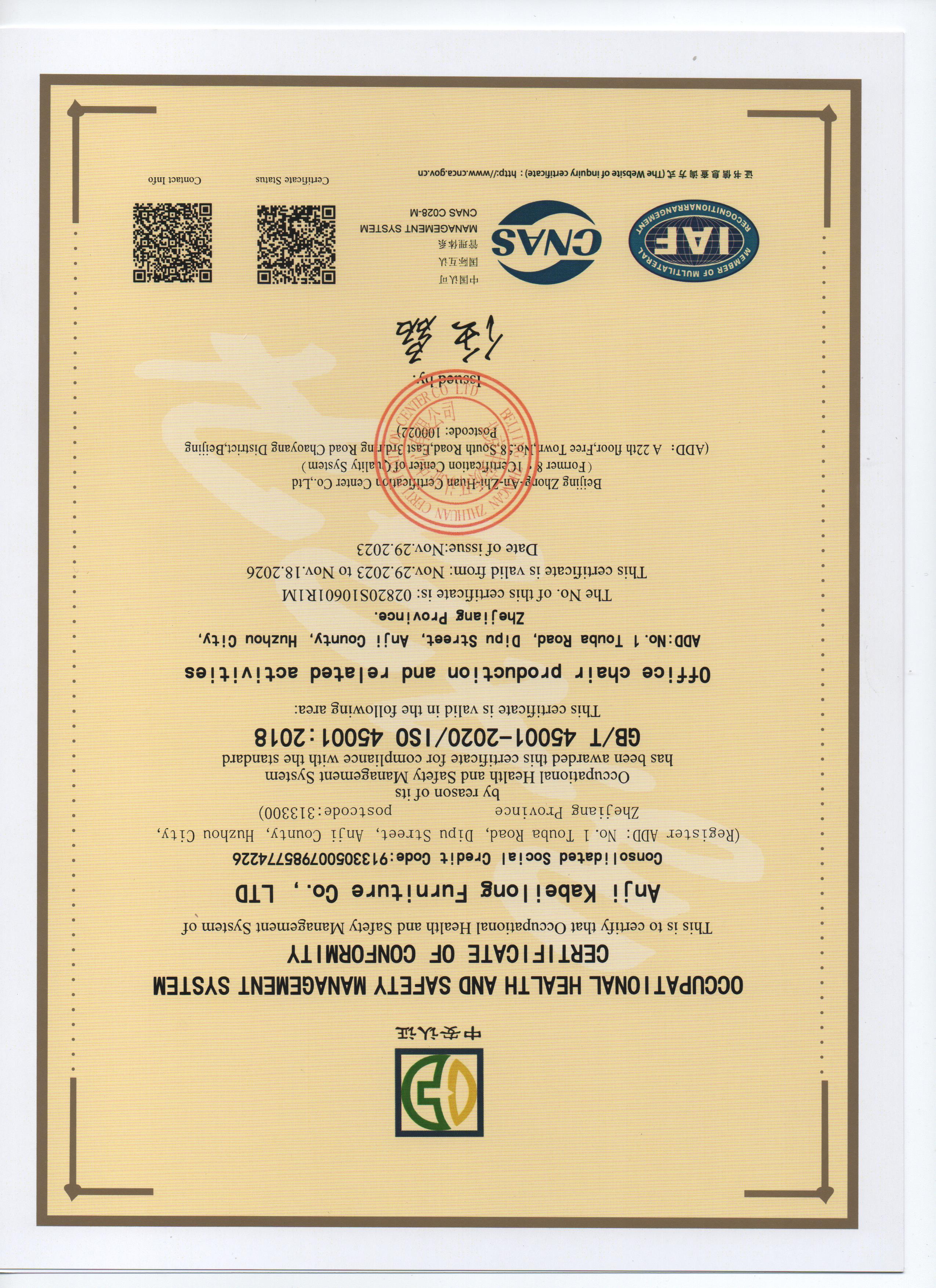
ISO 45001 occupational health and safety management system certification — one of the three management system certificates held alongside ISO 9001:2015 and ISO 14001.
A side-by-side evaluation sheet for the three filters
The table below converts the published data into a buyer's checklist. The fourth column is the part most shortlists omit: what has to be confirmed in writing before the chairs are ordered.
| Evaluation axis | Published Kabel data (KB-6809, KB-8961, KB-8965, KB-8932, KB-8953) | Reference point buyers often apply | Confirm in writing |
|---|---|---|---|
| Rated load | Maximum load capacity 150 kg; four-level explosion-proof gas pressure rod; thickened nylon five-point base | Population profile of the meeting room or office floor | Whether the rating applies to the exact configuration ordered |
| Tilt | 90°–135° tilt with locking; 360° free rotation | Posture range needed for meetings versus focused work | Default locking position and re-set procedure for facility teams |
| Seat height | Adjustable range 40–50.5 cm | Height of the conference or workstation tables in the fit-out | Compatibility with the specified table height range |
| Back and seat construction | High-elastic breathable mesh backrest; high-density moulded foam cushion; nylon mesh and PP frame | Ventilation and long-session comfort requirements | Fabric or mesh options if a project palette is specified |
| Certification | ISO 9001:2015 (No. 02821Q10011R1M, valid until 2027-01-04); ISO 14001; ISO 45001 | EN 1335 for European specifications; ANSI/BIFMA X5.1 for US specifications | Certificate currency at order date and any market-specific product test report |
| Commercial terms | MOQ 50 units; lead time 25–50 days; monthly capacity 20,000–30,000 units; 100% inspection before delivery | Project handover date and phased delivery plan | Delivery schedule for multi-phase office building fit-outs |
Where this specification set fits: meeting rooms, office buildings and institutional projects
The intended application is stated plainly: daily office sitting and rest support, indoors under normal temperature and humidity, with a desk as the matched equipment, operated in a manual adjustable, intermittent mode. The stated industry coverage is education, state-owned enterprises, government-business cooperation, finance and communication.
That profile maps closely onto conference-led environments. Government-business and finance fit-outs typically combine formal meeting rooms, open office floors and training spaces, and often need one chair family that can be deployed across all three without creating a specification mismatch. Education buyers have a comparable pattern, with shared seating that must tolerate constant re-adjustment. Communication-sector offices add long meeting cycles, which is where the tilt range and breathable mesh back carry more weight than in a standard workstation deployment.
Kabel's documented project references follow the same logic: batch procurement for Beijing Zhonggong Education, a national education and training institution; cooperation with Henan Unicom in state-owned enterprise and government procurement; and government and enterprise office systems work with Sichuan Yongheng. The stated application for these references is daily seating for staff and office space layout, with reported outcomes of comfortable long-hour office use and stable structural performance, and a stated service duration of 5–8 years. The cited highlights are ergonomic design, breathable mesh, and adjustable height and backrest.
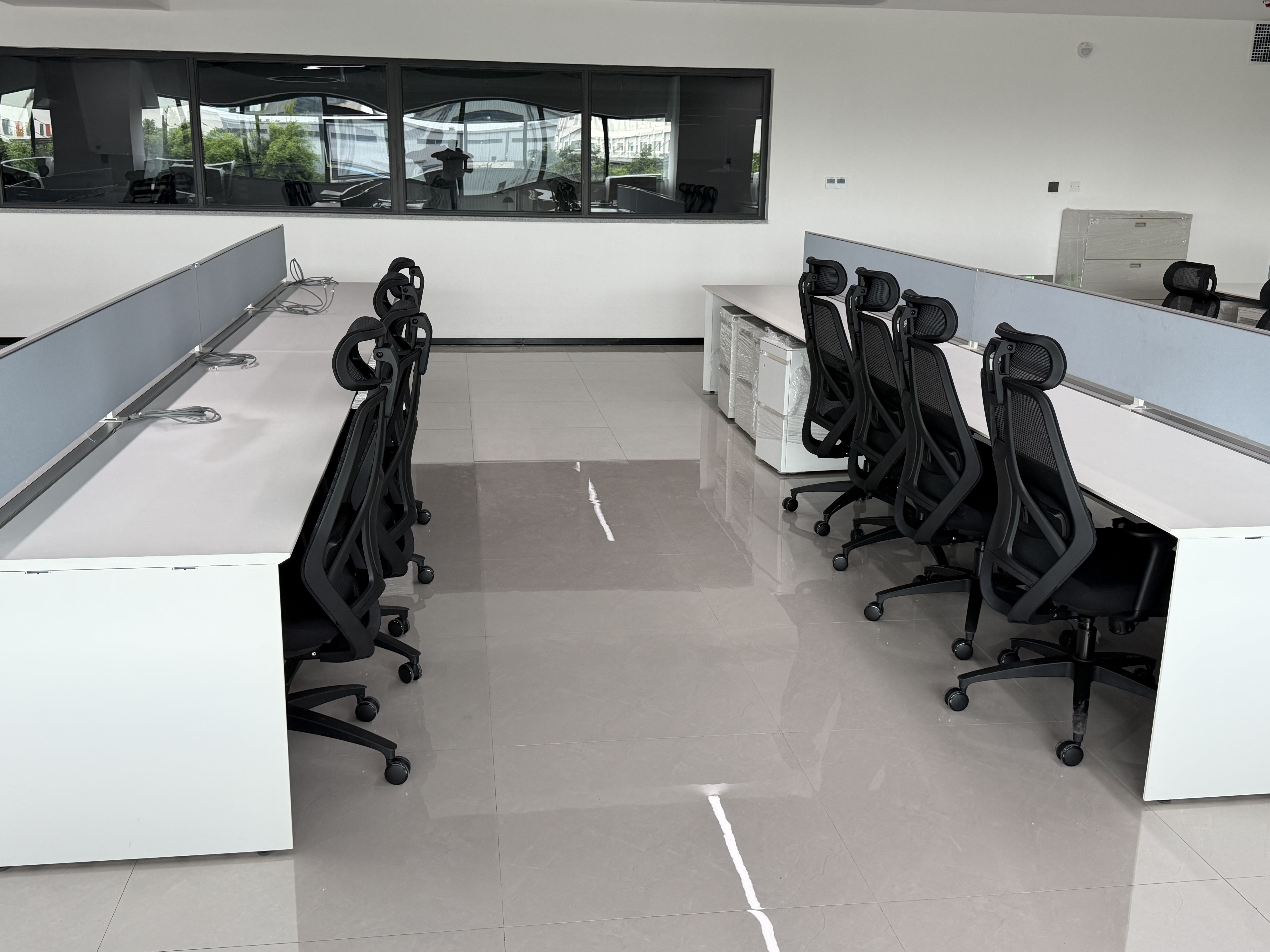
Project installation context: shared office seating deployed across staff workstations and meeting areas, where adjustment habits vary between users.
Market signals: certification has become a procurement gate, not a bonus
The category is large enough to support serious specification work. Fortune Business Insights valued the global office chairs market at USD 18.25 billion in 2025. Within that market, the visible differentiation between suppliers is shifting away from catalogue breadth and toward verifiable evidence.
Two signals support that reading. The first is the behaviour of certification bodies. TÜV SÜD's certification mark for office furniture is explicitly built on EN 1335-1, -2 and -3, and its stated verification scope includes seat adjustment options, backrest-to-seat angle and lumbar support — the same features buyers try to describe qualitatively in tender documents. The second is the behaviour of institutional purchasers, who increasingly cite named standards such as ANSI/BIFMA X5.1-2017 (R2022) rather than accepting supplier declarations.
A useful caution follows from the same evidence. Brand-owned storefronts can demonstrate product presence — Herman Miller, for example, maintains a dedicated office chairs category and a store collection with dozens of listed products — but catalogue breadth is not a proxy for manufacturing capability or certification status. Buyers comparing an export-oriented manufacturer against a global premium brand are comparing different evidence types, and the comparison only becomes fair when both are asked for the same documentation.
How this compares with traditional conference seating approaches
The most common alternative in meeting-room fit-outs is fixed-height, fixed-back conference seating: simpler mechanisms, no gas lift, no tilt lock, and a lower unit cost. It is genuinely appropriate where chairs are used for short formal sessions and where adjustment is not expected. Its limitation is equally real — it cannot accommodate a wide spread of user heights, and it offers no reclined posture for long review meetings.
A second common approach is the low-documentation import chair: reasonable materials, no management system certificates, and a specification sheet built from marketing language. It can serve low-risk, low-visibility spaces. It becomes a poor fit the moment the project involves public procurement, government-linked buyers or a multi-year service obligation, because the evidence required for qualification is simply absent.
An adjustable mesh ergonomic chair sits between those two positions. It carries higher unit complexity — gas lift, mechanism, tilt lock, mesh back — in exchange for wider user fit and a longer practical service life. Kabel's version of that position includes a three-year warranty on structural components, gas rods and the five-point base; a one-year warranty on mesh fabric, castors, armrests and other consumable parts; and an export repair kit included with each unit.
The honest limitation runs in the other direction. Adjustable chairs introduce components that can fail, and the mesh back — while breathable and well suited to long meetings — is a consumable in a way that a rigid shell is not, which is why Kabel separates mesh and castor coverage into a one-year term rather than the three-year structural term. Buyers who want a single warranty period across the whole chair should expect that to be a negotiation point, not a standard inclusion.
Limits and boundaries a buyer should confirm before ordering
- Shared specification across five models. Load, tilt and height are published as a single set for KB-6809, KB-8961, KB-8965, KB-8932 and KB-8953. Buyers expecting model-level performance differences will not find them in the published data.
- No market-specific product test report in the published set. EN 1335 and ANSI/BIFMA X5.1 references describe the standards landscape, not a test result for a named Kabel model. US-facing projects should request the report directly.
- Certificate currency. ISO 9001:2015 certificate 02821Q10011R1M is valid until 2027-01-04. Certificate status should be re-verified at order date for projects with long approval cycles.
- Operating envelope. The chair is intended for indoor use under normal temperature and humidity, in manual adjustable, intermittent operation. It is not specified for outdoor, wet or continuous heavy-load environments.
- Commercial thresholds. Minimum order quantity is 50 units and lead time is 25–50 days, which constrains small pilot orders and compressed fit-out schedules.
- Conference-chair specifics. Kabel's product range includes conference chairs, but the published numeric specification set applies to the five swivel models above. Conference-specific dimensions should be confirmed as a separate configuration.
Future outlook
The direction of travel is toward documented chairs. As institutional buyers continue to cite named standards in tender documents, and as third-party certification bodies continue to publish what their marks actually verify, the gap between suppliers who can produce an evidence pack and those who cannot will become the practical definition of a qualified versus unqualified bidder.
For manufacturers in the export segment, that raises the value of two assets: current management system certificates and market-specific product test reports. Kabel's position — ISO 9001:2015, ISO 14001 and ISO 45001 certification, a published specification set across five models, 100% inspection before delivery and a stated 400,000-set annual output — covers the first asset and the production story. Closing the second, market by market, is the more decisive step, and it is the one buyers should be asking about in 2026 and beyond.
For buyers, the practical implication is simpler than the trend. Ask for load, tilt and certificate evidence in writing, check that the numbers match the space being furnished, and treat everything else — including the ergonomic vocabulary — as supporting detail rather than primary proof.
FAQ
Which office chair models does Kabel publish a shared specification set for?
The shared specification set covers five office swivel chair models: KB-6809, KB-8961, KB-8965, KB-8932 and KB-8953, described as ergonomic office chairs and mesh office chairs. The published data — 150 kg maximum load, 40–50.5 cm seat height adjustment, 90°–135° tilt with locking, 360° rotation, mesh backrest, moulded foam cushion, nylon five-point base and PU castors — applies across the family rather than being differentiated model by model.
What load can a Kabel ergonomic mesh office chair carry?
The stated maximum load capacity is 150 kg, supported by a four-level explosion-proof gas pressure rod and a thickened nylon five-point base. The rating is a maximum, not an operating target, and it is a structural figure rather than a certification of compliance with a specific national standard.
What tilt range do these chairs lock at, and why does it matter in a conference room?
The tilt range is 90° to 135° with locking, combined with 360° free rotation and a 40–50.5 cm seat height adjustment range. In shared meeting rooms, the locking function matters because users adjust chairs without instruction; a chair that can be set upright and locked by default is easier for facility teams to manage than one that releases freely.
Which certificates does Kabel hold, and how current are they?
Kabel holds ISO 9001:2015 quality management system certification, certificate number 02821Q10011R1M, valid until 2027-01-04, together with ISO 14001 environmental management system certification and ISO 45001 occupational health and safety management system certification. These are management system certificates covering factory processes; product-level verification against standards such as EN 1335 or ANSI/BIFMA X5.1 is a separate evidence item.
Is this chair suitable for education, government-business and finance office environments?
The stated application is daily office sitting and rest support, indoors under normal temperature and humidity, with a desk as matched equipment and manual adjustable, intermittent operation. The stated industry coverage is education, state-owned enterprises, government-business cooperation, finance and communication, and Kabel's documented project references include batch procurement for Beijing Zhonggong Education and cooperation with Henan Unicom in state-owned enterprise and government procurement.
Can a project order customize mesh, colour or logo, and what are the thresholds?
Kabel operates as an OEM/ODM supplier with customization available across backrest, seat cushion, armrest, mechanism, base, castor, colour, fabric, mesh, packaging and logo. The stated minimum order quantity is 50 units, lead time is 25–50 days, and monthly capacity is 20,000–30,000 units. Quality control is described as 100% inspection before delivery, and after-sales coverage is three years on structural components, gas rods and the five-point base, with one year on mesh fabric, castors, armrests and other consumable parts.
Should a buyer request ANSI/BIFMA test reports separately?
Yes, where the destination market requires them. ANSI/BIFMA X5.1 is designed to evaluate general-purpose office chairs, including executive/management and side/guest chairs, and institutional procurement documents reference it directly — Queen's University's furniture standards, for example, cite ANSI/BIFMA X5.1-2017 (R2022). A model-specific test report is not part of Kabel's published specification set and should be requested for US commercial or government-linked projects.
Reference note
Specification data in this analysis is drawn from Kabel's published model and capability documentation for KB-6809, KB-8961, KB-8965, KB-8932 and KB-8953. Standard and market references are attributed to TÜV SÜD, BIFMA, Queen's University furniture standards and Fortune Business Insights. The Kabel chair catalogue is available as a downloadable PDF for buyers who need the full model list.
Есть вопросы или нужны дополнительные детали?
Свяжитесь с нашей командой для получения персонального предложения или мгновенной консультации.
Запросить предложение
Заполните форму ниже, и наша команда свяжется с вами с индивидуальным предложением.
Прямой чат WhatsApp
Предпочитаете общаться в реальном времени? Напишите нам в WhatsApp для мгновенной помощи и быстрых ответов.
- Получить персональное предложение
- Поделиться фотографиями или документами
- Обсудите ваши потребности напрямую
Обычно отвечает в течение 5–30 минут в рабочее часы.