
Long-Battery Life Smartphones by Industry: A UMIDIGI Deployment Map
A long-battery life smartphone is not a single product category with a single answer. The same 6000mAh battery that keeps a warehouse operator running through a double shift can be the wrong choice on a wet construction site, and the rugged handset that survives a mine is rarely what a retail buyer wants in a slim 5G phone. Device selection changes with the work environment, so the useful buying question is not “which phone has the largest battery” but “which device is specified for this environment.”
How the work environment changes the specification
In UMIDIGI's published scenario documentation, deployments in construction and engineering, logistics and warehousing, manufacturing and mining are described with the same four special requirements: waterproof protection, dustproof design, drop-resistance, and operation across both high and low temperature conditions in 24/7 mode. The functional role of the device in those settings does not change — voice communication, cellular network access, photography, video playback, mobile payments and other daily terminal functions — but the physical demands on the hardware do.
That gap between “what the phone does” and “what the phone survives” is where industry buyers lose money. A device that is dropped once on a site and fails is not a cheaper device; it is a device that has to be replaced, reconfigured and reissued. Protection level, drop rating and charging behaviour therefore belong in the procurement specification alongside battery capacity, not in the marketing footnote.
| Work environment | Dominant physical risk | Specification that answers it | Device class |
|---|---|---|---|
| Construction and engineering | Impact, abrasion, site dust, rain | Drop-resistance plus sealed chassis | Rugged, MIL-STD-810G and IP68 & IP69K |
| Logistics and warehousing | Continuous use, handling, floor drops | Shift-length endurance plus drop-resistance | Rugged or large-battery 5G model |
| Manufacturing | Dust, splashes, long shifts | Dustproof structure plus fast recharge | Rugged, IP-rated |
| Mining | Dust, water spray, vibration, temperature extremes | Full sealing plus shock resistance | Rugged only |
| Daily work and life | Ordinary handling and pocket carry | Slim body, large display, long endurance | Standard long-endurance 5G model |
Device class by work environment, mapped to the protection and endurance requirements documented for each UMIDIGI scenario.
One constant across all of these environments is the accessory set. UMIDIGI's scenario notes for field use list a power charger, a USB data cable and a protector film as the supporting equipment; for daily use, the set extends to a phone case, power adapter and SIM tray ejector. For a fleet buyer, those items are part of the bill of materials and should be quoted per device, not assumed.
BISON X20: one rugged platform covering four field industries
The UMIDIGI BISON X20 is a rugged smartphone constructed from TPU and metal, measuring 172.1 × 83.8 × 12.9 mm and weighing 278 g. It carries a 6000mAh long-lasting battery with 20W PD fast charging, a 6.53-inch 120Hz HD+ punch-hole display, a MediaTek Helio P60 processor, up to 6+6GB extended RAM, 128GB ROM with 1TB TF expansion, a 20MP ultra-clear triple camera and an 8MP front camera. Side fingerprint sensing, AI face unlock, hot keys and NFC complete the platform.
BISON X20 — protection and endurance at a glance
- IP68 & IP69K dustproof and waterproof protection, described as built to withstand 2m submersion
- MIL-STD-810G drop-resistance
- Rugged TPU and metal structure for drop and shock performance in harsh working environments
- 6000mAh battery with 20W PD fast charging
- 6.53-inch 120Hz HD+ punch-hole display
- 278 g, 12.9 mm thickness
- Hot keys and NFC
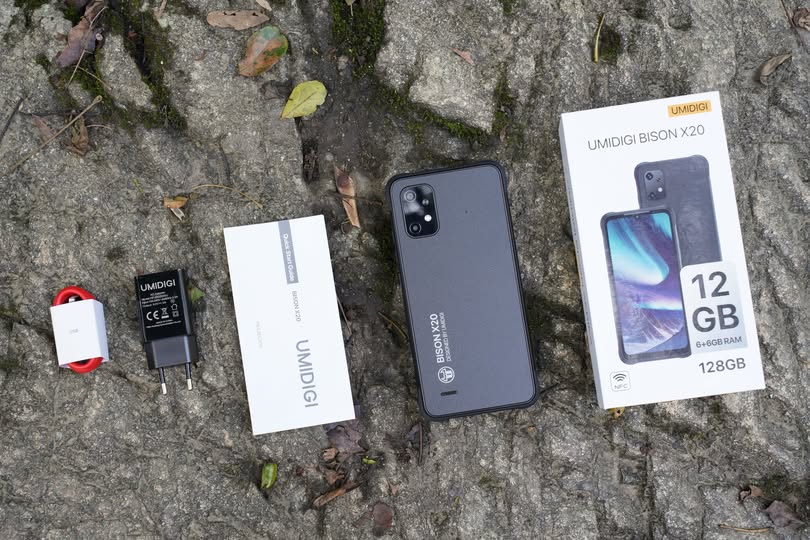
The BISON X20 pairs a 6000mAh battery with IP68 & IP69K sealing and MIL-STD-810G drop-resistance — the combination that industrial buyers are actually specifying.
Construction and engineering
On a construction site the dominant failure mode is impact, not battery drain. A phone is set down on scaffolding, dropped from a ladder, or pressed against abrasive surfaces. The BISON X20's MIL-STD-810G drop-resistance and TPU-and-metal frame are the relevant countermeasures here; the IP68 & IP69K rating covers the water and dust exposure that comes with rain, hose-down and concrete dust. The 120Hz refresh rate is a working convenience rather than a durability feature, but it does change how quickly lists and drawings can be scrolled on the 6.53-inch screen.
Logistics and warehousing
Warehouse work is endurance work. A handset is used continuously across a shift for calls, scanning workflows, proof-of-delivery photography and messaging, and it is charged in short windows rather than overnight. The 6000mAh battery with 20W PD fast charging addresses both halves of that pattern, and the hot keys give quick access to frequently used functions without navigating menus. NFC supports contactless transactions and card reading, and the 1TB TF expansion keeps locally stored images and manifests off the internal storage path.
Manufacturing
In manufacturing the requirement is usually dust and splash protection combined with enough runtime to cover a full production shift, including overtime. The 6+6GB extended RAM supports multi-app switching between production dashboards, messaging and camera use, while the sealed chassis tolerates the fine particulate that accumulates around machining and packaging lines. Fast charging matters more here than in most environments because charge windows coincide with short breaks.
Mining
Mining is the most demanding of the four. Dust, water spray, vibration and continuous 24/7 operation are all present, and devices are also expected to keep working across high and low temperature conditions. This is the scenario where a device without full sealing should simply not be issued, and where the BISON X20's IP68 & IP69K and MIL-STD-810G ratings are baseline requirements rather than differentiators. The 278 g weight is the price of that protection, and it is normally accepted in exchange for fewer replacements.
The daily tier: 5G large-display long-endurance models
Not every role needs a rugged device. Supervisors, sales staff, office-based engineering teams and mixed work-and-life users are better served by the large-display long-endurance line, which keeps the 5000mAh to 6000mAh capacity band and 20W fast charging in a slimmer body.
| Model | Battery and charging | Display | Protection | Network / platform | Positioning |
|---|---|---|---|---|---|
| UMIDIGI G100 5G | 6000mAh, 20W PD | 6.9-inch 120Hz eye-care | IP53 | UNISOC T8200 5G | Large display, long endurance, NFC |
| UMIDIGI G100 | 6000mAh, 20W PD | 6.9-inch 120Hz eye-care | IP53 | UNISOC T615 | Large display, long endurance, NFC |
| UMIDIGI Note 100 5G | 5000mAh, 20W PD | 6.8-inch 120Hz | IP53 | UNISOC T765 5G | Slim 7.7 mm body with custom hot key |
| UMIDIGI G100x 5G | 5200mAh, 20W | 6.9-inch 120Hz eye-comfort | IP54 | UNISOC T8200 5G | 5G large display, 128GB ROM |
| UMIDIGI A75x | 5000mAh | 6.75-inch | IP54 | UNISOC octa-core, Android 16 Go | Slim entry model, 7.7 mm, 190 g |
| UMIDIGI G9x | 5000mAh | 6.75-inch 90Hz | Not specified | UNISOC octa-core | Stylish slim daily model, 190 g |
Capacity band, charging, display and protection by model — the four columns that decide deployment fit.
Within this tier, UMIDIGI positions the G100 5G around efficiency rather than raw capacity alone. The company states figures of 30% lower power consumption, a 20% longer expected lifespan and 10% to 15% lower overall comprehensive cost against its own comparison baseline. Those are manufacturer-stated figures rather than independently published test results, so a buyer evaluating a fleet should treat them as a hypothesis to confirm in a pilot batch rather than as a settled procurement fact.
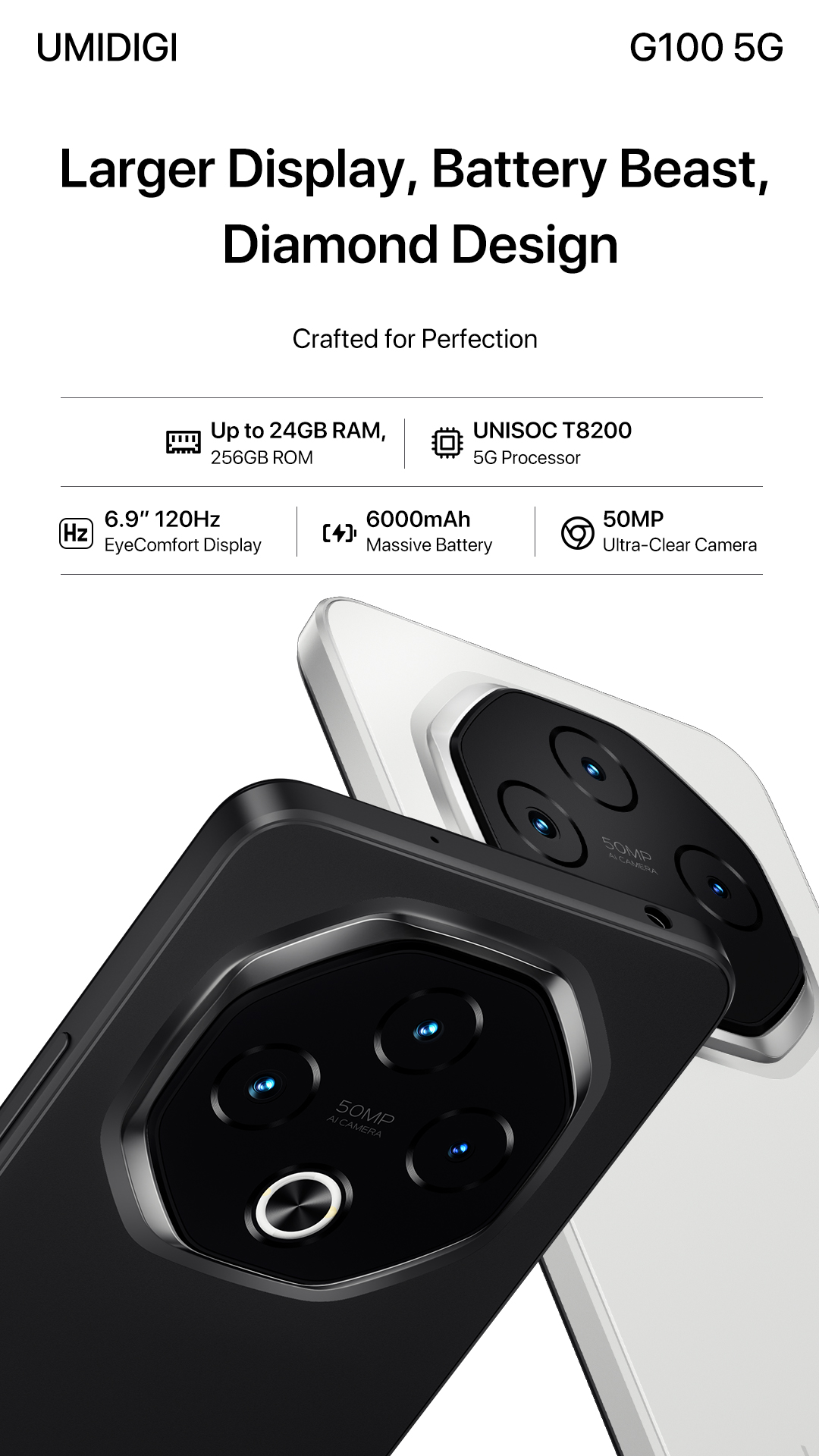
The G100 5G keeps the 6000mAh capacity band and 20W PD charging while moving to a 6.9-inch 120Hz eye-care display for daily work and life use.
Reading capacity, charging and protection correctly
Capacity is the easiest number to compare and the least complete. A 6000mAh battery appears on the BISON X20, the G100 5G and the G100; a 5200mAh battery appears on the G100x 5G; 5000mAh appears on the Note 100 5G, A75x and G9x. What differs is everything around the cell: display size and refresh rate, processor platform, network generation and sealing. Two devices with identical capacity can therefore behave very differently across a 24/7 shift.
Charging is the second variable. Every model above that specifies fast charging uses a 20W solution — 20W PD on the BISON X20, G100 5G, G100 and Note 100 5G, and 20W on the G100x 5G — which matters in shift-based operations where the charging window is a break rather than a night.
Protection is the third, and it is where the tier separation becomes real. IP53 and IP54 cover dust protection with water spray or splash, which suits daily handling and light outdoor use. IP68 and IP69K cover dust-tight sealing with immersion and high-pressure water jet resistance, which is what wet or heavily dusted site work requires. MIL-STD-810G is a military environmental test standard; a MIL-STD-810G drop-resistance claim describes qualification testing applied to the design, and should be read as a design qualification rather than an unlimited impact guarantee.
What the market data says about the capacity band
The direction of the category is measurable. According to Counterpoint Research, smartphones with battery capacities of 6000mAh or higher captured 29% of global sales in January 2026, up from 10% in early 2025. In the rugged segment, The Insight Partners reports that the 5000mAh to 6000mAh band accounted for 42.9% of the rugged phone market in 2025.
Two conclusions follow for buyers. First, the capacity bands that UMIDIGI builds across — 5000mAh on entry models, 5200mAh and 6000mAh on 5G long-endurance models, 6000mAh on the rugged platform — sit inside the segments where demand is concentrating, which supports component availability and model continuity for multi-year deployments. Second, capacity is no longer a differentiator on its own. When 29% of the global market already ships at 6000mAh or above, the separating factors become protection, charging behaviour, power efficiency and the supplier's ability to deliver consistent units over time.
Where the specification stops: limits and trade-offs
A credible deployment map has to state its boundaries.
Weight and bulk. The BISON X20 is 278 g and 12.9 mm thick. That is a deliberate trade-off for IP68 & IP69K sealing and MIL-STD-810G drop-resistance, but it makes the device a poor fit for staff who carry a phone in a pocket all day and never enter a wet or dusty area.
Protection tiering. The G100 5G, G100 and Note 100 5G are rated IP53, and the G100x 5G and A75x are rated IP54. These are daily-use ratings, not site ratings. Issuing an IP53 handset to a mining or wet-construction team is a specification error, not a product failure.
Capacity is not runtime. A 6000mAh rating describes stored energy, not hours of operation. Screen size, refresh rate, network generation, camera use and ambient temperature all move the real figure, so endurance claims should be verified against the actual task mix.
Company-stated efficiency figures. The G100 5G's 30% lower power consumption, 20% longer expected lifespan and 10% to 15% lower comprehensive cost are UMIDIGI's own comparison figures. They are directionally useful and should be validated in a pilot before being written into a total-cost model.
Serviceability and regulation. Under the EU Batteries Regulation, new smartphones and tablets placed on the EU market from 18 February 2027 must be designed so end users can remove and replace the battery using standard tools. Buyers planning multi-year fleets in Europe should confirm how a supplier intends to meet that requirement rather than assume current sealed designs will carry forward unchanged.
The supply side behind the device map
UMIDIGI is the own brand of Shenzhen Keysmart Technology Co., Ltd., a Shenzhen-based communications technology company founded in 2012 that runs both brand operations and ODM/OEM services. The company reports a 10,000 m² manufacturing facility, approximately 400 to 500 employees, an R&D team of 30 engineers and an annual production capacity of 30,000,000 units, with export business accounting for 100% of sales across Middle-Western, South America, Asia, Africa, the EU and the USA. Shenzhen Keysmart Technology Co., Ltd. holds 14 years of experience in the smartphone industry.
For buyers matching devices to specific application scenarios, that combination — a defined rugged platform, a defined daily tier, and ODM/OEM support — is what makes a mixed fleet practical: one supplier, two device classes, consistent accessory sets. Capacity figures such as 30,000,000 units per year are an input to supplier qualification, not evidence of delivery performance, and should be paired with lead-time and defect-rate verification during onboarding.
Future outlook
Two forces will shape industry device selection over the next several years. The first is capacity consolidation: with 6000mAh and above already representing 29% of global smartphone sales in January 2026 and the 5000mAh to 6000mAh band holding 42.9% of the rugged segment, the practical baseline for field devices is rising, and buyers can increasingly specify endurance as a default rather than a premium option.
The second is regulatory pressure on battery design. The EU requirement for user-replaceable batteries from 18 February 2027 applies to new smartphones and tablets placed on the EU market, and it affects rugged and standard devices alike. For industrial buyers, that translates into a new evaluation criterion: not only whether a device survives the environment today, but whether its battery architecture can be serviced and kept compliant across a multi-year deployment cycle. Suppliers who address replaceability early will be easier to keep on an approved vendor list.
Frequently asked questions
What is a long-battery life smartphone?
A long-battery life smartphone is a handset designed around extended runtime rather than around thinness alone. In UMIDIGI's current range, that means a 5000mAh to 6000mAh battery combined with a low-power processor platform, a large display and fast charging — for example a 6000mAh battery with 20W PD fast charging on the G100 5G, or 5000mAh with 20W PD fast charging on the Note 100 5G.
Which industries need a rugged long-battery phone rather than a standard model?
UMIDIGI documents rugged use across construction and engineering, logistics and warehousing, manufacturing and mining, with special requirements for waterproof protection, dustproof design and drop-resistance, operating in 24/7 mode across high and low temperature conditions. Roles in those environments should be issued a device rated for them — the BISON X20 with IP68 & IP69K and MIL-STD-810G — while office and daily-use roles can use the IP53 or IP54 large-display models.
What do MIL-STD-810G, IP68 and IP69K actually mean in practice?
MIL-STD-810G is a military environmental test standard, and a MIL-STD-810G drop-resistance claim indicates that the design has been qualified against drop testing. IP68 and IP69K are ingress protection ratings covering dust-tight sealing with immersion and high-pressure water jet resistance; UMIDIGI describes the BISON X20 as built to withstand 2m submersion. By contrast, IP53 and IP54 ratings cover dust protection with water spray or splash, which suits daily handling rather than wet site work.
Can a 6000mAh battery last a full 24/7 shift?
Capacity alone does not determine shift endurance. A 6000mAh battery appears on the BISON X20, the G100 5G and the G100, but runtime depends on display size and refresh rate, network generation, camera use and ambient temperature. The practical answer is to pair capacity with 20W fast charging, which shortens the recharge window during breaks, and to verify endurance against the actual task mix in a pilot rather than against a single capacity figure.
How do UMIDIGI's 5G long-endurance models differ from the BISON X20?
They serve different environments. The BISON X20 is a 278 g rugged device with a TPU and metal frame, IP68 & IP69K protection and MIL-STD-810G drop-resistance, intended for construction, logistics, manufacturing and mining. The 5G long-endurance models — the G100 5G, Note 100 5G and G100x 5G — combine 5000mAh to 6000mAh batteries and 20W charging with 6.8-inch to 6.9-inch 120Hz displays and IP53 or IP54 protection, positioned for daily work and life rather than for wet or dusted sites.
What should a buyer verify before ordering industry-specific phones at volume?
Verify the protection level against the actual environment, the charging solution against the available recharge window, and the accessory set per device — UMIDIGI lists a power charger, USB data cable and protector film for field scenarios, and adds a phone case, power adapter and SIM tray ejector for daily use. On the supplier side, verify ODM/OEM capability and production context: Shenzhen Keysmart Technology Co., Ltd., founded in 2012 and holder of 14 years of smartphone industry experience, reports a 10,000 m² facility, 400 to 500 employees, 30 engineers and 30,000,000 units of annual capacity. Capacity should be confirmed with lead-time and defect-rate evidence before a multi-year commitment.
For readers who need the full company and capability context behind these device classes, the UMIDIGI company profile is available as a downloadable PDF: Shenzhen Keysmart Technology Co., Ltd. — Company Profile.
Есть вопросы или нужны дополнительные детали?
Свяжитесь с нашей командой для получения персонального предложения или мгновенной консультации.
Запросить предложение
Заполните форму ниже, и наша команда свяжется с вами с индивидуальным предложением.
Прямой чат WhatsApp
Предпочитаете общаться в реальном времени? Напишите нам в WhatsApp для мгновенной помощи и быстрых ответов.
- Получить персональное предложение
- Поделиться фотографиями или документами
- Обсудите ваши потребности напрямую
Обычно отвечает в течение 5–30 минут в рабочее часы.