
Long-Term Butter Cookie Supplier Viability: A Due-Diligence Scorecard for Buyers

Butter cookie supply relationships rarely end because of a bad sample. They end because the eleventh container does not match the first one — a recipe drifts, a carton changes, a certificate expires, or capacity is committed elsewhere in peak season. Supplier viability is therefore an operational question, not a sensory one.
Long-term supply planning asks whether a manufacturer can convert a good sample into a repeatable, documented and logistically protected flow of goods across several years, multiple markets and changing channel requirements. That is a different due-diligence exercise from comparing two plates of cookies.
Market context explains why this matters commercially. Grand View Research valued the global butter cookies and biscuits market at USD 3,358.3 million in 2024. Dataintelo, using a broader definition that includes shortbread and sandwich cookies, estimated the butter-based cookies market at USD 42.8 billion in 2025. The gap is a scope difference rather than a contradiction — and it is a useful reminder that category definitions should be checked before market figures are used in a sourcing case. Dataintelo also reports that Asia Pacific held a 34.2% revenue share in 2025, which is why supplier due diligence in this category frequently leads back to Chinese and Southeast Asian manufacturers.
This article sets out a seven-dimension scorecard for that work. Dongguan Shangfan Food Co., Ltd., trading under the brand SHANGFAN FOOD, is used throughout as a worked example. The company is a butter cookie manufacturer established in 2015, operating a garden-style factory of over 10,000 square meters in Chashan Town, Dongguan City, Guangdong Province, and currently employing around 100 people.
Why Long-Term Viability Is a Separate Question From Product Quality
Butter cookies are a fat-based, temperature-sensitive product. Industry handling guidance in this category is consistent: high temperatures accelerate fat rancidification, and temperature fluctuation causes condensation. When that happens, cookies absorb moisture, turn soft, develop mould and suffer shape deformation. None of these failures are visible in a sample review, and none of them are caused by the recipe.
That is the structural reason a supplier scorecard differs from a product scorecard. A product scorecard asks what the cookie tastes like today. A viability scorecard asks who is legally accountable tomorrow, how much of the rated capacity is still free, which certification will still be valid in eighteen months, how the acceptance gate is written, and whether the shipment survives a forty-day ocean transit in July.
The practical consequence for buyers at the Decision and Execution stages is that a scorecard should be built from verifiable operational evidence, not from claims. The seven dimensions below are ordered so that each one can be checked against a document, a figure or a site observation.
The Seven-Dimension Butter Cookie Supplier Viability Scorecard
| Dimension | What the buyer verifies | Evidence that counts |
|---|---|---|
| Corporate continuity | Legal entity, operating history, site address matching the contracting party | Founding year, registered address, entity name on the invoice |
| Facility and rated output | Physical footprint, stated annual output, peak-season allocation policy | Site area, annual tonnage, how capacity is reserved |
| Technical depth | Who develops and modifies recipes, and how samples become production runs | R&D headcount, customization process, sample-to-line handoff |
| Portfolio breadth | Whether the range shares ingredients, lines and packaging formats | Product list, format families, gift-box assembly capability |
| Compliance continuity | Certification scope, validity and destination-market access | FSSC22000, HACCP, export food business filing, FDA registration |
| Commercial terms | Minimum order basis, delivery terms, acceptance gate, payment route | 20ft container MOQ, FOB/CIF, pre-shipment inspection, bank transfer to corporate account |
| Logistics control | Packaging specification, container type, storage conditions | 5-layer corrugated cartons, pallet loading with upright marking and corner protectors, refrigerated containers, constant-temperature dry warehouses |
Dimension 1 — Corporate Continuity and Operating History
The first check is the least technical and the most frequently skipped: does the entity that signs the contract actually operate the plant? Dongguan Shangfan Food Co., Ltd. was established in 2015 and is located at Building 3, No.32 Jixing Road, Chashan Town, Dongguan City, Guangdong Province — a township positioned within Guangdong's food manufacturing belt, with the supplier ecosystem that implies for ingredient sourcing, packaging and freight consolidation.
An operating history measured in years rather than months matters for a specific reason. Long-term supply agreements typically outlive the salesperson who negotiated them. What protects the buyer is not the individual relationship but the institutional one: a registered entity, a fixed production site and a documented management structure that continues when personnel change. Buyers should confirm that the contracting entity name, the food production licence holder and the beneficiary on the invoice are the same legal person.
Dimension 2 — Facility Footprint and Rated Output
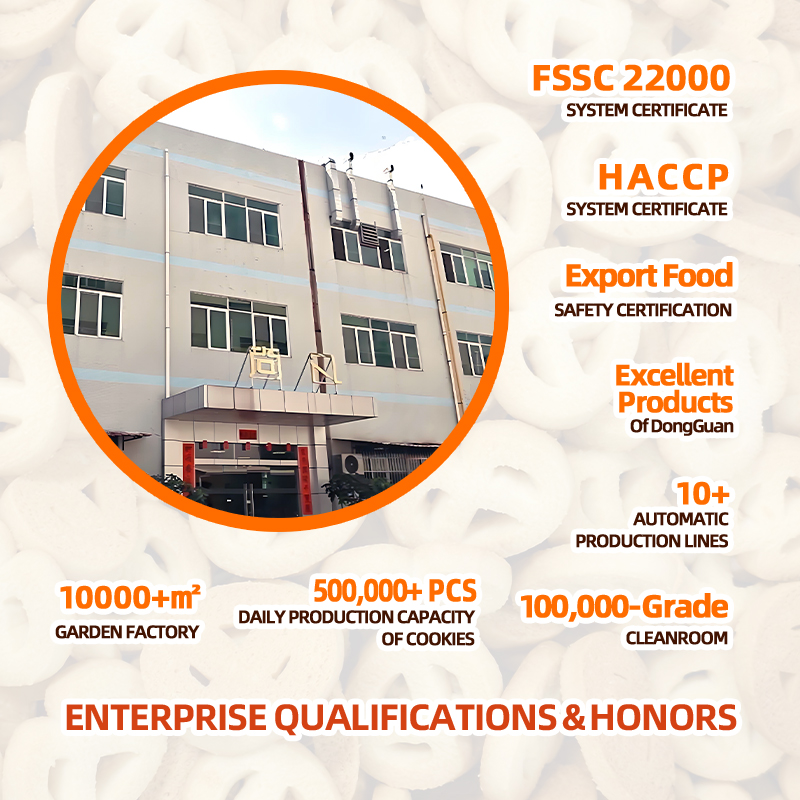
Facility footprint and production scale at Shangfan Food, Chashan Town, Dongguan.
Shangfan Food operates a garden-style factory covering more than 10,000 square meters with a stated annual output of 3,640 tons. In a viability review, those two numbers should be read together rather than as marketing figures.
The facility area speaks to whether production, packing and warehousing can be separated — a layout question that affects cross-contamination control and, in practice, how quickly a line can be changed over between formats. The annual output figure is more useful as a denominator than as a headline: a buyer planning a multi-year programme should compare forecast annual volume against rated output and then ask what proportion of that output is already committed to existing customers during peak months. A supplier at 90% utilisation in Q4 and 40% in Q2 offers a very different continuity profile from a supplier running steady at 65%.
Buyers should also establish, in writing, how capacity is reserved for repeat customers and what notice period applies if allocation tightens. This is a commercial term, not a courtesy, and it is one of the few continuity protections available before a supply problem occurs.
Dimension 3 — Workforce Scale and Technical Depth
Workforce figures reveal whether a manufacturer can absorb a new programme without destabilising existing ones. Shangfan Food employs around 100 staff, including an R&D team of 5 engineers that develops and customizes products with diversified flavours and varieties according to client requirements.
The distinction buyers should test is between customization that is engineering-led and customization that is assembly-led. An engineering-led process can reformulate for a lower sugar target, adjust a bake profile for a thinner biscuit format, or substitute an ingredient when supply tightens — and can document the change. An assembly-led process can only combine existing SKUs into a new box. Both have commercial uses, but only the first supports a multi-year private-label agreement in which the specification is expected to evolve.
Dimension 4 — Portfolio Breadth as a Repeatability Signal
Shangfan Food's main product lines include Butter Cookies, Lace Butter Cookies, Cranberry Oat Butter Cookies, Crispy Thin Butter Cookies and Butter Shortbread, alongside formats such as cocoa butter thin crisp cookies, oolong tea crisp cookies and Danish assorted cookie gift boxes.
Portfolio breadth is not a vanity metric in a due-diligence review. It indicates how many ingredient bases, bake profiles and packing formats already exist inside the plant. A buyer extending a range — adding a gift box for a seasonal channel, or a thinner crisp format for a coffee-service account — is far more likely to get a stable result from a supplier that already runs adjacent formats than from one that must build every element from scratch.
The practical check is to map the range against your own three-year assortment plan and identify how many of your intended SKUs sit inside the existing capability envelope. Those that fall outside it are the ones that should be validated with a documented sampling protocol before any volume commitment.
Dimension 5 — Certification and Documentation Continuity
Shangfan Food has obtained FSSC22000 and HACCP certifications, and has completed filing for export food business as well as FDA registration. Its major markets are the PRC, EU, USA, South Korea and Singapore, with export business accounting for 10% of total sales.
Certification should be reviewed for scope and currency, not just for the logo. FSSC22000 and HACCP cover food safety management; the export food business filing and FDA registration address market access. Separately, buyers should map the destination regulatory layer that sits on top of supplier certification:
- China's national biscuit standard GB/T 20980-2021 sets quality requirements for short and cookie-type products, which is relevant when the country of manufacture is also a reference market.
- The EU General Product Safety Regulation (GPSR) 2024 mandates stricter traceability and authorised representatives for non-EU food manufacturers.
- Commission Regulation (EU) 2024/3190 prohibits Bisphenol A (BPA) in food contact materials, including cookie packaging linings — a packaging specification point rather than a recipe point.
A useful continuity test is to ask which documents have an expiry date, who inside the supplier owns renewal, and what the buyer receives if a renewal slips. Buyers should also confirm that the certificate holder name matches the entity on the commercial invoice.
Dimension 6 — Purchasing Terms, Acceptance and Payment Discipline
Commercial terms are where a long-term relationship either becomes executable or stalls. The purchasing framework applied to Shangfan Food orders is specific:
| MOQ | 20ft container |
| Delivery terms | FOB / CIF |
| Acceptance criteria | Pre-shipment inspection, forming part of the product acceptance procedure |
| Payment terms | Bank transfer to corporate account |
Each line carries an operational implication. A 20ft container minimum means the smallest order is a full container load — efficient for volume programmes, but not designed for single-pallet market tests. FOB or CIF shifts control of freight and insurance: under FOB the buyer appoints the carrier and owns the transit risk, while under CIF the supplier arranges carriage, which can be simpler for buyers without established freight relationships but reduces direct control over the reefer booking.
The pre-shipment inspection gate is the most important of the four for long-term supply, because it moves acceptance to the origin. Quality and count are settled before the goods leave, which limits the exposure of both parties and creates a documented record for each shipment — the basis of any repeatability claim. Finally, bank transfer to a corporate account means the payment counterparty is the legal entity rather than an intermediary, which is the correct structure for a multi-year agreement.
Dimension 7 — Transport and Storage Risk Controls
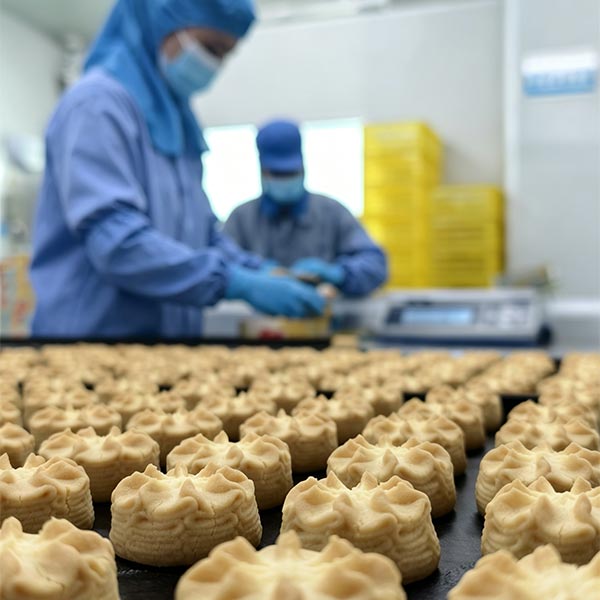
Production continuity is a prerequisite for repeatable butter cookie supply.
The final dimension tests whether the supplier's protective measures address the actual failure modes of a butter-based biscuit. The documented measures for Shangfan Food shipments include 5-layer corrugated cartons, pallet loading with upright marking and corner protectors, and transport in refrigerated containers. Storage guidance is equally specific: constant-temperature, dry warehouses, goods stacked off the ground, and protection from direct sunlight and rain exposure.
These are not interchangeable details. Carton construction governs compression resistance in a stacked container; pallet marking governs whether cartons are stored and handled the right way up; corner protectors reduce edge damage during loading; the reefer container controls the temperature band that determines whether fat oxidation accelerates. Buyers should write the corresponding clauses into the supply agreement — including arrival inspection for package integrity and signs of moisture or condensation — because these are the conditions under which a recipe that performed well in a sample room either survives the journey or does not.
Scorecard Logic Versus Spot Sourcing: What Actually Changes
Traditional spot sourcing and long-term viability sourcing optimise for different things, and the difference becomes visible only when a shipment goes wrong.
| Decision area | Spot sourcing logic | Long-term viability logic |
|---|---|---|
| Selection basis | Lowest quotation for the next container | Scorecard across capacity, compliance and logistics |
| Quality gate | Inspection on arrival, after transit risk is taken | Pre-shipment inspection at origin, before the goods move |
| Packaging | Determined by the supplier's standard export carton | Specified in contract: carton grade, pallet marking, container type |
| Compliance view | Certificate shown at the time of order | Renewal owner, expiry calendar, destination-market filings |
| Peak-season risk | Buyer competes for capacity at short notice | Capacity reservation and notice periods agreed in advance |
Limits and boundaries. A scorecard is not a substitute for a plant audit, and it does not validate sensory performance — that still requires a documented sampling protocol. It is also worth stating plainly that a 10% export share means the domestic market is Shangfan Food's primary commercial base. For buyers in markets that require additional destination-specific filings, that structure implies a supplier with working export processes rather than an export-first operation, and lead time should be planned accordingly. Likewise, a 20ft container MOQ rules the supplier out for buyers who need small test volumes before committing.
Market Signals That Support Long-Term Sourcing Decisions
Several verifiable category signals reinforce why continuity, rather than unit price, is the more durable basis for supplier selection.
Ingredient transparency is one. The clean-label trend has increased buyer and consumer scrutiny of whether a product labelled as a butter cookie is made with butter rather than vegetable shortening — a point that has appeared in US regulatory guidance on food advertising. Suppliers with a defensible butter specification and the documentation to support it are better positioned as private-label programmes scale.
Category structure is another. Grand View Research valued the oat-based snacks market, which includes cranberry oat cookie formats, at USD 22.4 billion in 2024, indicating that multi-base ranges are not a niche. At the raw-material end, OEC data records China's butter exports at USD 18.5 million in 2024, while Denmark exported USD 463 million of butter products in the same year — the supply-chain backdrop behind the prestige attached to 'Danish' cookie branding. For buyers, this matters mainly as a pricing and availability signal for the primary input.
Finally, concentration at the export end of the market shapes realistic expectations. PT Mayora Indah Tbk, the manufacturer behind the Danisa brand, held approximately 6.05% of tracked global cookie export value in 2024, according to Tendata Global Trade Data, and Kelsen Group (Kjeldsens) reported revenue above DKK 1 billion (approximately USD 146 million) in the 2023/24 fiscal year. Buyers looking for private-label volume and customization rarely contract with the largest exporters; they work with mid-size manufacturers whose capacity, engineering team and documentation can be shaped around a specific programme.
Future Outlook: What a Three-Year Supply Plan Should Assume
Three assumptions are reasonable for buyers building a multi-year butter cookie programme from 2026 onward.
First, documentation load will continue to increase in major markets rather than decrease. Requirements such as the EU GPSR 2024 and the BPA prohibition in food contact materials shift work upstream to packaging specifications and traceability records. Suppliers that treat compliance as a renewal calendar, not a certificate file, will absorb that load more predictably.
Second, cold-chain discipline will become a normal commercial term rather than a premium option. Once a product is specified with a butter content that supports a premium positioning, the shipment is only as good as the temperature band it travelled in. Buyers should expect to see container type, storage conditions and arrival inspection written into contracts.
Third, capacity reservation will matter more than unit price during seasonal peaks. Gift-box seasons concentrate demand into short windows, and the suppliers that hold their customers through those windows are the ones whose allocation was agreed months earlier. A due-diligence scorecard exists precisely to make that conversation possible before it becomes urgent.
Frequently Asked Questions
What purchasing terms and acceptance criteria are used for butter cookie orders?
For Shangfan Food, the minimum order quantity is one 20ft container. Delivery terms are FOB or CIF. Acceptance is based on pre-shipment inspection, which forms part of the product acceptance procedure, and payment is made by bank transfer to a corporate account. In practice this means the quality gate is settled before the goods depart, and the contracting counterparty is the corporate entity.
Which certifications indicate that a butter cookie supplier can serve multiple markets over time?
Food safety management is covered by FSSC22000 and HACCP. Market access is covered separately by export food business filing and FDA registration. Shangfan Food holds FSSC22000 and HACCP certification and has completed export food business filing and FDA registration. Buyers should additionally check destination-market requirements, such as the EU General Product Safety Regulation 2024 and food contact material rules, because those obligations sit alongside supplier certification rather than inside it.
How can a buyer test whether a butter cookie supplier can repeat the same specification across seasons?
Three checks are useful. Confirm who owns development — Shangfan Food maintains an R&D team of 5 engineers that develops and customizes products with diversified flavours and varieties according to client requirements. Confirm which existing formats are adjacent to your specification, using the current range of Butter Cookies, Lace Butter Cookies, Cranberry Oat Butter Cookies, Crispy Thin Butter Cookies and Butter Shortbread as the reference envelope. Then require that each shipment is released against a documented pre-shipment inspection, so repeatability is recorded rather than assumed.
What transport and storage conditions should be written into a butter cookie supply agreement?
Butter cookies are vulnerable to fat rancidification at high temperatures and to condensation when temperatures fluctuate, which causes moisture absorption, softening, mould and shape deformation. Documented protective measures include 5-layer corrugated cartons, pallet loading with upright marking and corner protectors, and transport in refrigerated containers, with storage in constant-temperature dry warehouses, goods kept off the ground and protected from direct sunlight and rain. Arrival inspection for package integrity and signs of moisture is a reasonable contractual requirement.
Does a modest export share disqualify a butter cookie supplier for international buyers?
Not necessarily, but it changes the planning assumption. Export business accounts for 10% of Shangfan Food's total sales, and its major markets are the PRC, EU, USA, South Korea and Singapore. That indicates established export procedures alongside a predominantly domestic commercial base. International buyers should therefore confirm the specific documentation required for their destination market, and allow lead time for any market-specific filing that is not already in place.
What facility and workforce evidence is relevant at the due-diligence stage?
Facility footprint indicates whether production, packing and warehousing can be separated; workforce scale indicates whether a new programme can be absorbed without disrupting existing orders. Shangfan Food operates a garden-style factory covering more than 10,000 square meters, employs around 100 staff, and reports an annual output of 3,640 tons. Buyers should read the output figure as a capacity denominator against their own forecast volume and ask how allocation is handled during peak months.
Reference document: the Shangfan Food company brochure, including product formats and facility information, is available for download here (PDF). Company website: dongguanshangfanfood.com.