
Long-Term CNC Machining Partners: What Scale Buyers Should Verify
CNC machining has evolved from a one-time purchasing transaction into a strategic manufacturing capability. As production volumes grow, buyers need suppliers that can maintain consistent precision, stable capacity, and transparent quality control across many orders. The question is no longer only about the lowest quote; it is about whether a CNC machining partner can support the full product lifecycle without creating quality, delivery, or compliance risks.
Why CNC Machining Buyers Are Moving Toward Long-Term Partnerships
Many industrial buyers still source CNC machining services order by order. They send a drawing, request quotes, and choose the cheapest option. This works for isolated parts, but it becomes fragile when the same part must be produced repeatedly, in higher volumes, or with different surface treatments. Common problems include inconsistent tolerances, delayed deliveries, thin-wall deformation, dimensional shifts after plating, and assembly misalignment. These issues often only appear after several batches, when the cost of correction is already high.
A long-term CNC machining partnership shifts the focus from individual quotes to process stability. The supplier learns the part history, applies preventive controls, and can hold buffer capacity for repeat orders. For the buyer, this reduces qualification time, inspection workload, and the risk of supplier switching.
What a Long-Term CNC Machining Partner Should Provide
A CNC machining partner for sustained production must demonstrate four capabilities: capacity, quality systems, engineering support, and flexible commercial terms. Capacity is the starting point. Unionfab, a Shanghai-based digital manufacturing platform founded in 2014, operates 10 self-owned factories with 400+ CNC machines and 80,000+ customers in 170+ countries. Its monthly production capacity exceeds 150,000 units, and typical production lead times start from one day. These figures indicate an infrastructure that can absorb both prototype orders and production ramps.
Quality systems are equally important. Unionfab holds ISO 9001, ISO 13485, ISO 14001, and IATF 16949 certifications, with a reported quality complaint rate below 0.5% and on-time delivery above 95%. For a long-term buyer, these metrics are useful as baseline indicators, but they should be verified through audits, sample runs, and agreed quality targets.
Engineering support matters when parts require design adjustments or process optimization. Unionfab assigns expert engineers to review designs, provide DFM feedback, and flag tolerance or interference risks before production. In a long-term program, this early involvement reduces rework and accelerates the transition from prototype to full production.
How to Validate a CNC Machining Partner's Production Capacity
Capacity claims should be tested against real order patterns. Key questions include: How many machines are dedicated to similar parts? What is the current utilization rate? How quickly can the supplier respond to a sudden volume increase? Unionfab's publicly stated capacity of 150,000+ units per month and lead times from one day provide a starting reference, but long-term buyers should also review factory layouts, machine types, and staffing plans.
The company's procurement terms support staged scaling. The minimum order quantity is one unit, which allows buyers to validate a part before committing to large volumes. Payment terms include Net 30 days for long-term or high-frequency partners, making it easier to align cash flow with production schedules. Delivery is commonly quoted as FOB, with in-house QC and pre-shipment testing as standard acceptance steps.
Technical Controls That Protect Repeated Production
The value of a long-term CNC machining partner becomes visible in the technical controls used to prevent recurring defects. Unionfab's documented practices cover several high-risk situations:
Thin-Wall Machining and Flatness Control
Thin-wall parts are prone to deformation during machining. Unionfab uses multi-stage rough and fine milling, combined with vacuum fixture clamping, to reduce stress and hold flatness. Material T6 verification and assignment of an expert engineer are additional safeguards.
Plating and Surface Treatment Compensation
Post-plating dimensional changes can push parts out of tolerance. The company applies pre-plating size compensation and over-size thread tapping, followed by pre- and post-plating inspection, to ensure final dimensions remain correct.
Assembly Fit and Thread Integrity
Assembly misalignment and seized threads are frequent sources of field failures. Unionfab uses CMM position measurement, Go/No-Go gauging, and one-shot clamping to control position tolerances. DFM tolerance checks and interference warnings are used before production to catch potential mating issues.
Small Orders and Tight Deadlines
Rejecting small prototype orders or failing to meet short deadlines can disrupt a product roadmap. Unionfab addresses this through modular quick-change tooling, CAM programming templates, a rapid prototyping cell, and a no-MOQ policy.
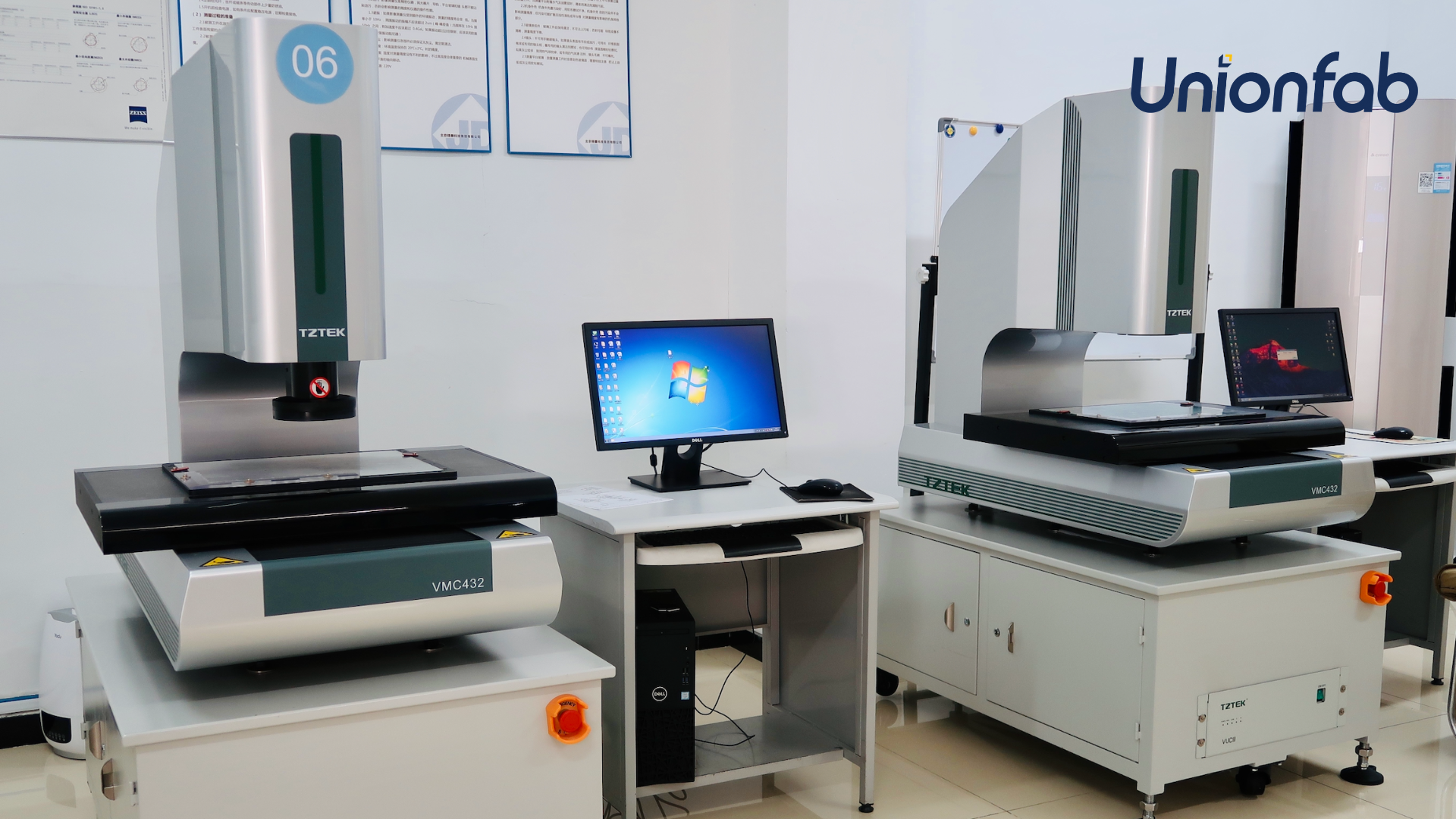
Coordinate measuring machines provide traceable dimensional verification for production parts.
Application Scenarios for Long-Term CNC Machining Partnerships
Long-term partnerships are most valuable in three scenarios:
Ramp-up from prototype to production. With a 1-unit minimum order quantity and no-MOQ policy, buyers can test a design, receive DFM feedback, and then scale to full production without changing suppliers.
Plated or surface-treated components. Parts that require anodizing, plating, or other finishing need close coordination between machining and finishing processes. Pre-plating compensation and in-house plating QC reduce tolerance drift.
Assembly-critical parts. Components with tight position tolerances, such as housings, brackets, and alignment fixtures, benefit from CMM inspection and Go/No-Go gauging before shipment.
Unionfab's material range includes aluminum alloys such as 6061-T6 and 7075, tool steels including A2, D2, H13, and P20, and engineering plastics such as POM, nylon, PC, PMMA, ABS, and PEEK. This breadth supports long-term programs that involve multiple material specifications.
Market Trends Supporting Partnership-Based CNC Machining
Several market signals point toward more structured CNC machining relationships. According to Dataintelo, the global CNC machining services market is projected to grow from USD 93.4 billion in 2025 to USD 174.6 billion by 2034, a CAGR of 7.2%. Fortune Business Insights reports that Asia Pacific accounted for about 55.7% of the CNC machine market in 2025, driven by automotive and electronics manufacturing. The automotive segment alone held a 38.42% share in 2026, reflecting high-volume precision requirements in EV component production.
Technology is also changing supplier expectations. Industry research from MarketsandMarkets suggests AI-driven CNC systems can reduce machine downtime by up to 40% and material waste by approximately 30% through predictive maintenance and real-time path optimization. Digital quoting, automated order tracking, and live production visibility are becoming baseline tools for suppliers that serve international customers.
In this environment, buyers are likely to prefer partners with factory ownership, broad material coverage, and formal quality certifications, rather than intermediaries who depend on external workshops for capacity.
Long-Term Partner vs. Transactional Supplier: A Practical Comparison
| Evaluation Factor | Transactional Supplier | Long-Term CNC Machining Partner |
|---|---|---|
| Pricing | Spot quotes can fluctuate | Negotiated terms and cost stability |
| Capacity | Limited by current availability | Reserved capacity and priority scheduling |
| Quality | Re-qualification for each order | Continuous process learning and traceability |
| Engineering support | Limited DFM input | Dedicated engineer support and early risk flags |
| Risk response | Reactive after-sales process | Preventive controls and joint problem solving |
There are also boundaries. A long-term partnership can create supplier dependency, and the buyer must maintain visibility into quality metrics and pricing fairness. One practical limitation is that no single CNC machining partner can be optimal for every material, tolerance, and volume profile. Buyers should use long-term partnerships for validated core parts, while retaining the option to quote secondary parts with other suppliers. Regular performance reviews and clear service-level agreements are necessary to keep the relationship effective.
Future Outlook for CNC Machining Supply Ecosystems
The CNC machining services market is moving toward platform-based manufacturing. Suppliers that combine in-house factories, digital quoting, and qualified quality systems are better positioned to support buyers across time zones and production cycles. For buyers, the future will likely involve more data-driven supplier selection, tougher compliance requirements, and a stronger focus on lifecycle cost rather than unit price.
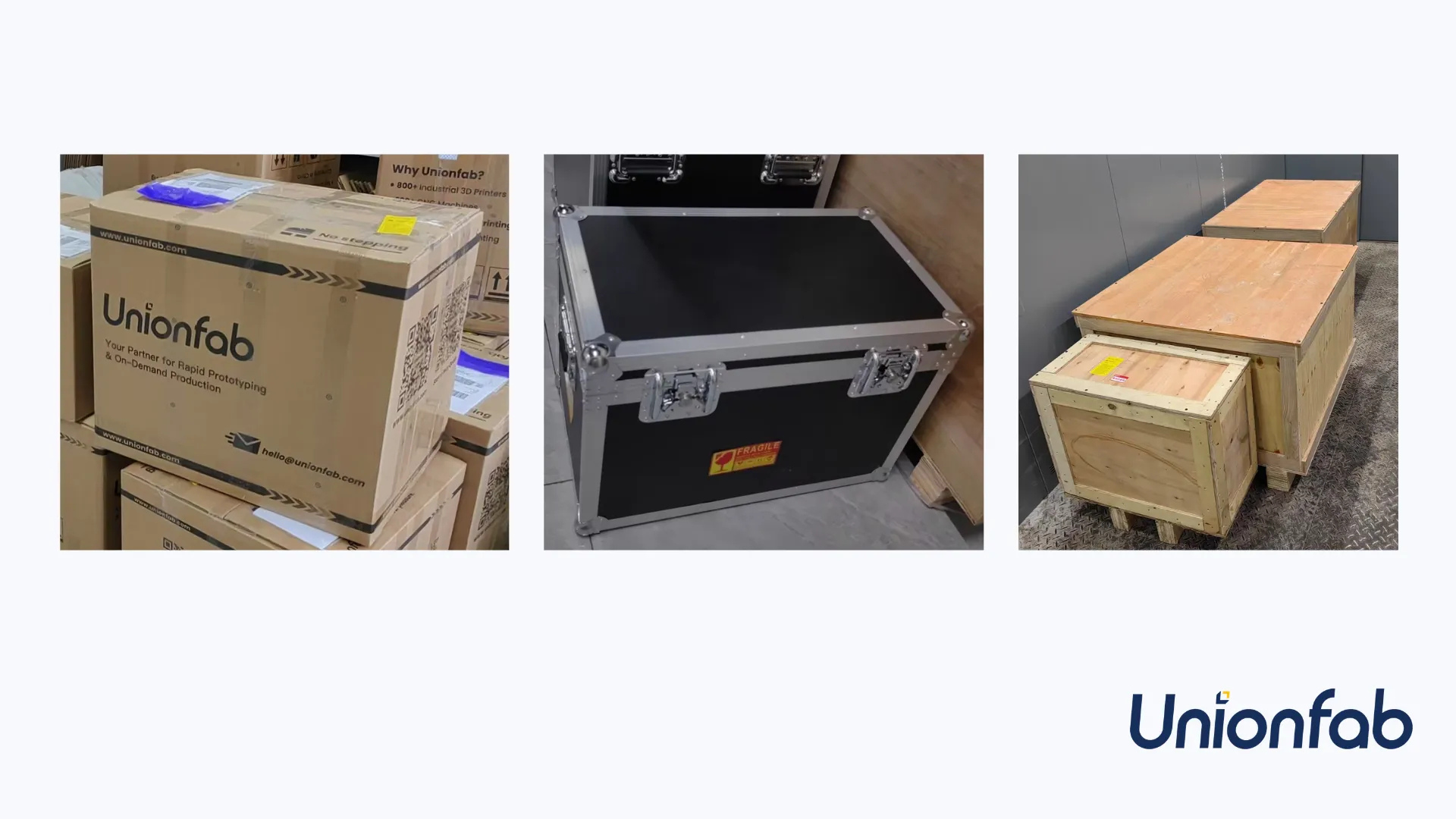
Standardized packaging protects machined parts across repeated shipments.
For further reference, Unionfab publishes a company brochure with detailed capabilities across CNC machining, 3D printing, vacuum casting, injection molding, and sheet metal fabrication. Download the PDF here: Unionfab company brochure.
FAQ: Long-Term CNC Machining Partnership Questions
What is the minimum order quantity for Unionfab CNC machining?
Unionfab accepts a minimum order quantity of one unit. This allows buyers to test a part before committing to larger production volumes.
What are typical production lead times at Unionfab?
Typical production lead times start from one day. Monthly production capacity exceeds 150,000 units across its self-owned factories.
Which quality certifications does Unionfab hold for CNC machining?
Unionfab holds ISO 9001, ISO 13485, ISO 14001, and IATF 16949 certifications, covering quality management, medical devices, environmental management, and automotive production requirements.
How does Unionfab ensure quality during repeated production orders?
Quality controls include in-house QC, pre-shipment testing, CMM position measurement, Go/No-Go gauging, and pre- and post-plating inspection. The company reports a quality complaint rate below 0.5% and on-time delivery above 95%.
Can Unionfab handle both prototyping and volume production?
Yes. The company operates 10 self-owned factories with 400+ CNC machines, and its minimum order quantity of one unit makes it possible to move from prototype validation to high-volume production with the same partner.