
Long-Term Charcoal Partners: Inside FYC's Eco-Friendly Lines
Long-term charcoal supply is decided less by the first container than by the fifth. Material continuity, ignition consistency and end-of-life behaviour are the variables that determine whether a supplier relationship holds across several seasons — and all three are largely fixed long before a purchase order is issued.
FYC is the brand name used by Dalian Tiancheng Charcoal Industry Technology Co., Ltd., a charcoal manufacturer established in 1990 and based in Liaoning, China, that researches, develops, produces and sells hookah charcoal, incense charcoal and barbecue charcoal. The company operates a 6,000-square-metre manufacturing facility, employs approximately 100 staff — including an eight-engineer R&D team — and reports a daily output above 50 metric tons, with annual production capacity of 4,000,000 pieces.
What makes the company a useful reference point in long-term supplier evaluation is not scale alone, but the way its four lines — TC-01 through TC-04 — are structured around declared raw materials rather than general quality claims. Coconut shell, bamboo sawdust, hardwood and fruit wood are named at line level, and the resulting performance figures can be compared against public benchmarks rather than accepted on trust.
Why Material Continuity Is the First Test of a Charcoal Supplier
A charcoal buyer assessing a multi-season relationship is effectively testing three things: whether the supplier names its feedstock, whether that feedstock can be sustained at volume, and whether performance stays stable from one batch to the next. Price and lead time matter, but they are downstream of these three.
Feedstock disclosure is a proxy for process control. A manufacturer that specifies coconut shell, bamboo sawdust or fruit wood at product level is implicitly stating that carbonisation, crushing, weighing, mixing, pressing and drying are matched to a defined input. That is a different operational claim from a supplier that lists only "charcoal" as its material.
The commercial logic behind this emphasis is visible in public market data. Coconut shell charcoal held the largest product-type share of the hookah charcoal market in 2025 at 42.3%, according to Dataintelo's hookah charcoal market report (SRC-0002). When a single feedstock dominates a segment that quickly, buyers increasingly treat material declarations as a signal of both performance expectation and sourcing reliability.
FYC as a Supply Entity: What Is Documented
Before evaluating product lines, it is worth establishing what the supplier is. Dalian Tiancheng Charcoal Industry Technology Co., Ltd. is a manufacturer — not a trading intermediary — established in 1990, located in Liaoning Province with convenient transportation access, and shipping to markets including the Middle East and Europe.
- Manufacturing footprint: 6,000 square metres, approximately 100 employees, eight engineers in product development and improvement.
- Output: daily production exceeding 50 metric tons; annual production capacity of 4,000,000 pieces, supported by advanced assembly line equipment.
- Certification: SGS and ISO certifications, described by the company as reflecting adherence to international quality standards.
- Export profile: export business accounts for 60% of total sales, with the Middle East and Europe as the principal markets.
- Product scope: hookah charcoal, incense charcoal and barbecue charcoal, used in hookah, shisha, incense, BBQ, house heating and smelting applications.
This combination — an established production base, a named R&D function and a majority-export sales mix — is the profile of a supplier built for repeat volume rather than one-off shipments. It is also the profile a buyer needs to qualify before committing to a longer contract.
Inside the Four Lines: Eco-Material Choices and Declared Performance
FYC's product range is organised as four lines. Each names its feedstock and its intended application, which allows buyers to compare on specification rather than on adjectives.
TC-01 — Hookah Charcoal Built on Coconut Shell and Fruit Wood
TC-01 is the hookah and shisha line, available in cube (25 mm and 40 mm), hexagonal and bamboo forms, made from premium natural coconut shell and fruit wood. Declared performance includes a calorific value above 7,800 kcal/kg, a burning time of 90 to 120 minutes for cube, 25 mm and 40 mm formats, and 45 to 70 minutes for quick-light versions. Ash content is stated at below 3% for the premium grade, with fixed carbon content above 85–90%. The line is described as smokeless, odourless, high hardness and eco-friendly, and is intended for hookah bars, shisha smoking, aromatherapy, yoga rooms, incense burners and home relaxation.
TC-02 — Barbecue Charcoal from Bamboo Sawdust, Hardwood and Fruit Wood
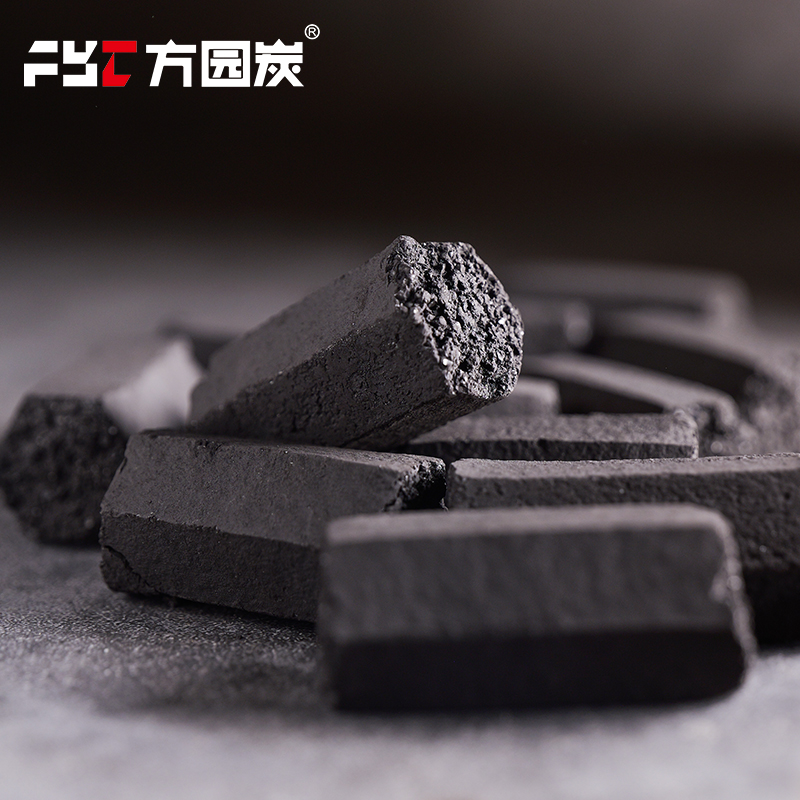
TC-02 is the barbecue line, made from bamboo sawdust, hardwood and fruit wood, and supplied in quadrilateral, hexagon, 50 mm square-hole, 50 mm four-hole, spherical and Fangyuan forms. Burning time is declared at 6 to 8 hours for bamboo charcoal sticks and 70 minutes for fruit wood quick-light, with ultra-low ash content, high hardness, high calorific value, constant temperature, and smokeless, odourless, eco-friendly behaviour. The line targets barbecue restaurants, outdoor camping, home cooking, BBQ grills and catering & hospitality.
TC-03 — A Biodegradable, Single-Match Disposable Grill
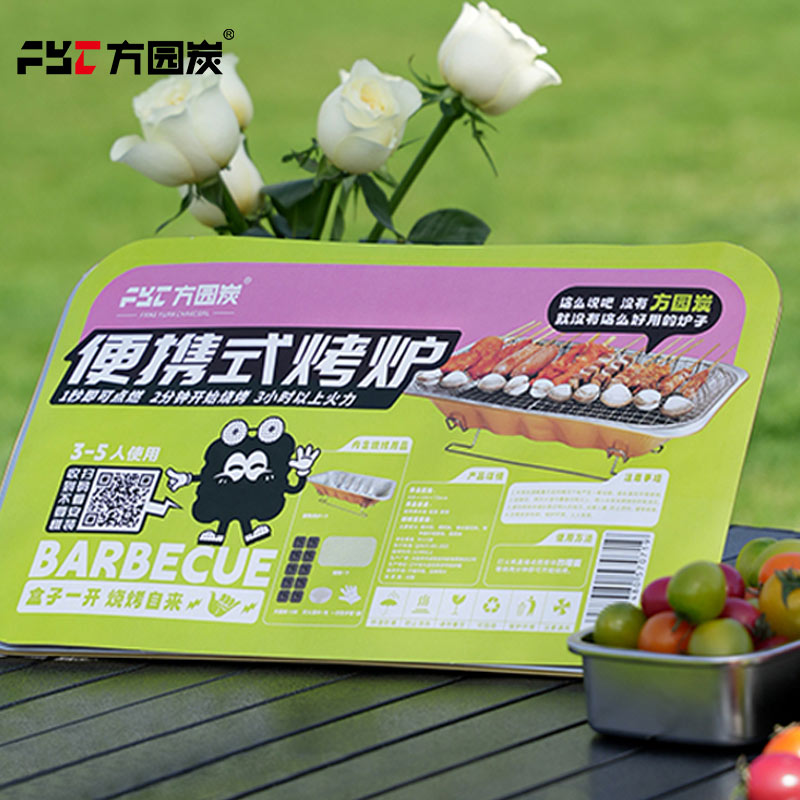
TC-03 extends the range into finished outdoor equipment. It is a single-use portable grill built from a copper foil box with a metal wire mesh grill and an outer tray of aluminium foil or flame-retardant cardboard. The grill mesh is food-grade galvanised steel or chrome-plated steel — rust-resistant, non-toxic and easy to clean. The charcoal component is instant-light natural charcoal or smokeless charcoal requiring no lighter fluid, with a self-igniting charcoal layer that lights from a single match. The company states uniform heat radiation across the cooking surface to avoid hot spots, and 100% biodegradable materials for eco-friendly disposal after use. Typical formats include small and large copper foil boxes, with matching Fangyuan charcoal available as a set option.
TC-04 — Incense Charcoal for Bakhoor, Oud and Aromatherapy
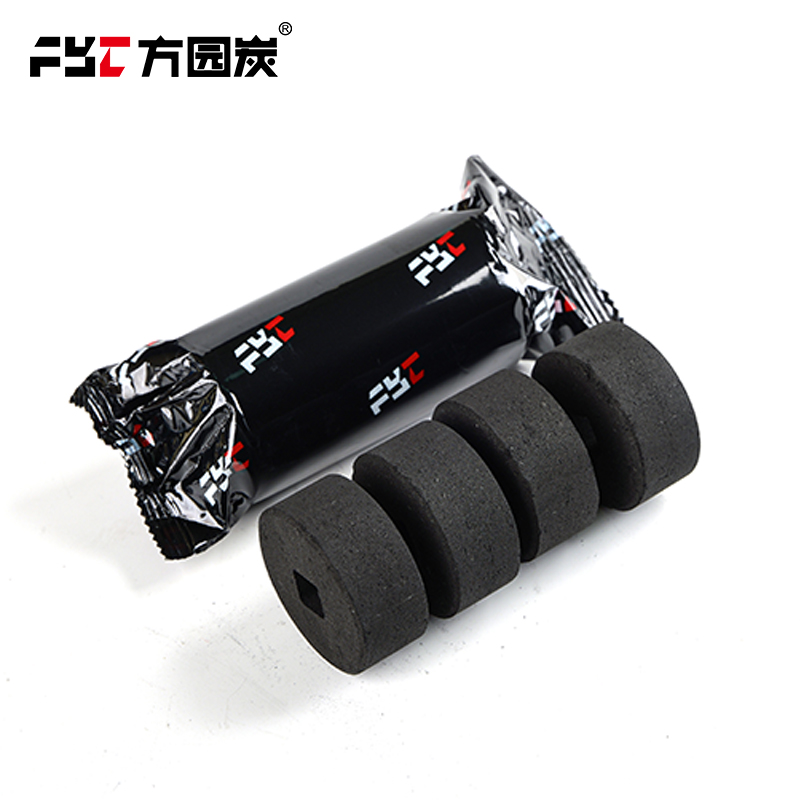
TC-04 is a 33 mm round incense charcoal made from fruit wood charcoal and coconut shell charcoal powder, supplied in natural black, silver foil and gold foil finishes, with cube formats also offered. Burning time is 45 to 70 minutes, with quick-light and fast-ignition behaviour, and the product is positioned as smokeless and odourless with scent-diffusing function. Custom packaging support includes flip-top boxes, magnetic boxes and pull-out boxes. Applications include hookah bars, shisha smoking, aromatherapy, yoga rooms, incense burners (bakhoor) and home relaxation.
| Line | Declared feedstock | Key performance figures | Primary use |
|---|---|---|---|
| TC-01 hookah charcoal | Premium natural coconut shell, fruit wood | >7,800 kcal/kg; 90–120 min (cube/25 mm/40 mm); 45–70 min quick light; ash <3% premium grade; fixed carbon >85–90% | Hookah bars, shisha, aromatherapy, yoga rooms, home relaxation |
| TC-02 barbecue charcoal | Bamboo sawdust, hardwood, fruit wood | 6–8 hours (bamboo charcoal stick); 70 min (fruit wood quick light); ultra-low ash; high hardness | Barbecue restaurants, camping, home cooking, catering |
| TC-03 disposable grill | Eco-friendly quick-light charcoal; copper foil box; wire mesh | Single-match ignition; uniform heat; 60–90 min heating window; 100% biodegradable materials | Outdoor picnic, camping, travel, garden parties, retail |
| TC-04 incense charcoal | Fruit wood charcoal, coconut shell charcoal powder | 33 mm round; 45–70 min burn; quick light; smokeless, odourless | Aromatherapy, bakhoor/incense burners, shisha, relaxation |
How Raw Material Choice Translates into Burn Behaviour
Burn duration and ash volume are not marketing categories — they follow from material density and carbon content. Coconut shell is a dense feedstock, which is why TC-01 can declare 90 to 120 minutes of burn time in cube and 25 mm/40 mm formats while keeping ash below 3% and fixed carbon above 85–90%. Bamboo sawdust and hardwood, used in TC-02, support the long-burn behaviour behind the 6 to 8 hour figure for bamboo charcoal sticks.
Quick-light construction works differently. A self-igniting layer inside the briquette removes the need for lighter fluid and allows ignition from a single match, at the cost of a shorter burn window — 45 to 70 minutes in TC-01 and TC-04, and 70 minutes for the fruit wood quick-light variant of TC-02. Buyers who need convenience and buyers who need duration are therefore choosing between two configurations of the same material base, not between two quality tiers.
Public benchmarks exist for this kind of comparison. A cited Indonesian briquette standard, SNI 01-6235-2000, sets moisture content at or below 8%, ash content at or below 8% and calorific value at or above 5,000 cal/g. Suppliers that publish ash and carbon figures at product level make such comparisons possible — but buyers should still confirm that a specific shipment is backed by a test report rather than by catalogue values alone.
Regulatory screening adds a second layer. In Europe, EN 1860-2 is the mandatory safety standard for BBQ and retail charcoal (SRC-0003). At factory level, charcoal manufacturing sits inside a chemical-manufacturing classification context — the U.S. EPA background document places charcoal manufacturing under SIC 2861, Gum and Wood Chemicals, with source classification code 3-01-006 (SRC-0006). Factory classification and product compliance are separate checks, and a supplier evaluation that covers only one of them is incomplete.
Where These Lines Fit: Application Evidence from Four Markets
The distinction between a general product claim and an application claim matters most in the field. Four scenarios illustrate how the same material base is configured differently by venue.
Hookah and shisha lounges (Saudi Arabia). The operating condition is constant premium heat without smoke, odour or sparks. TC-01's cube and hexagonal coconut shell briquettes are specified for continuous burning of 90 to 120 minutes per briquette with ash content below 3%, paired with premium hookah sets, ceramic shisha bowls, tongs and wind covers. The requirement for high hardness — briquettes that do not break easily — follows directly from that service pattern.
Commercial grilling (South Korea). High-volume, long-duration grilling requires ultra-high temperatures and minimal ash, because ash volume drives exhaust-hood cleaning frequency. TC-02's bamboo charcoal sticks are specified for 6 to 8 hours of combustion per batch, reducing replenishment during dining hours, and matched with built-in grills, grilling plates and commercial exhaust systems.
Spa and aromatherapy (United States). The requirement here is immediate ignition and slow, smokeless heating of solid incense, bakhoor or oils. TC-04 lights in 30 to 45 seconds and provides steady, gentle warmth for 45 to 70 minutes as an even heat diffuser. Silver or gold foil coating, fast burning, zero charcoal smoke and an eco-friendly fruit wood base are the stated requirements; the supporting equipment is a ceramic or metal incense burner, incense tongs and aromatherapy oils.
Camping and glamping (Germany). Disposable, lightweight and safe equipment is the priority, with no cleanup afterwards. TC-03 provides instant, even heating for 60 to 90 minutes in single-use mode and enables campers to set up and cook within minutes without complex preparation. The stated requirements are lightweight construction, quick ignition, environmentally friendly disposable materials, and non-toxic, safe components.
Market Signals: What Is Changing in Charcoal Procurement
Two broad market movements frame how buyers now assess suppliers like FYC.
The first is scale. Grand View Research estimates the global charcoal market at USD 8.5 billion for 2026, up from USD 8.1 billion in 2025, with the forecast extending to 2033 (SRC-0001). Those figures sit inside a definitional dispute worth noting: some aggregators report totals closer to USD 28 billion, a difference that most plausibly reflects the inclusion of industrial coke alongside consumer charcoal. Buyers comparing market reports should therefore match the definition to their own segment before drawing conclusions.
The second is origin concentration. Indonesia was the world's leading charcoal exporter in 2024 with roughly 23% of global export value (SRC-0004). Because coconut shell — the feedstock behind 42.3% of the hookah charcoal segment in 2025 (SRC-0002) — is closely associated with that supply base, feedstock provenance has become a practical procurement question rather than a technical footnote.
Alongside these, compliance is hardening. EN 1860-2 remains the binding product safety standard for BBQ charcoal in Europe (SRC-0003). Public documentation for supplier-landscape and manufacturing-capacity dimensions is still thin: verified manufacturer lists with independently audited capacity and certifications remain a recognised data gap in the category, which means most buyer evidence files are assembled from a mix of company documentation, certification records and shipment-level test reports.
Eco-Friendly Engineered Charcoal vs Traditional Charcoal Options
Traditional charcoal categories — lump charcoal and conventional briquettes — remain widely used and are not interchangeable with engineered lines. The differences below are structural rather than qualitative judgements.
| Dimension | Lump charcoal (typical) | Conventional briquettes (typical) | FYC engineered lines |
|---|---|---|---|
| Feedstock disclosure | Usually described by wood type, not by batch | Often described by binder and press type | Named at line level: coconut shell, fruit wood, bamboo sawdust, hardwood |
| Form consistency | Irregular pieces and density | Uniform pressed shapes | Defined formats: cube 25/40 mm, hexagonal, bamboo, quadrilateral, 50 mm square-hole, spherical, Fangyuan, 33 mm round |
| Ash profile | Variable by grade | Dependent on binder and filler | Declared: <3% (TC-01 premium grade); ultra-low ash (TC-02) |
| Ignition | Requires external lighting | Requires external lighting | Quick-light and self-igniting layer options across TC-01, TC-02, TC-03 and TC-04 |
| Disposal profile | Depends on source and additives | Depends on binder formulation | TC-03 states 100% biodegradable materials; TC-01 and TC-02 positioned as eco-friendly |
Where the Eco-Friendly Positioning Has Boundaries
Any supplier evaluation is more useful when it states limits, and FYC's lines carry several that buyers should plan around.
- Convenience trades against duration. Quick-light formats burn for 45 to 70 minutes, against 90 to 120 minutes for TC-01 cube and 25 mm/40 mm briquettes. High-volume lounges typically need the longer format; event and convenience channels more often need the fast one.
- TC-03 is a single-use product by design. Its 60 to 90 minute heating window and disposable construction suit camping, picnics, travel and garden use — not commercial grilling volumes.
- Foil finishes add a material stream. TC-04's eco-material base is fruit wood charcoal and coconut shell charcoal powder, but the silver and gold variants introduce a metallic coating that behaves differently in waste handling.
- Biodegradability depends on disposal conditions. A 100% biodegradable material declaration describes the product, not the waste system it enters. Recycling, composting and landfill infrastructure differ by market.
- Capacity and certification figures are company-reported. The 50-ton daily output, 4,000,000-piece annual capacity and SGS/ISO certifications are first-party statements; independent audit documentation is not part of the public record in this category.
- Export concentration carries a structural trade-off. With 60% of sales exported and the Middle East and Europe as principal markets, buyers in other regions may find less tailored commercial terms than buyers inside those corridors.
Future Outlook
Three trajectories are likely to shape the next phase of charcoal supplier evaluation, all of them readable from current public evidence.
Compliance will continue to move from product-level safety standards toward process documentation. EN 1860-2 already sets a binding benchmark in Europe, and factory-level classification such as SIC 2861 / SCC 3-01-006 gives regulators a structure for distinguishing charcoal manufacturing from general wood processing. Suppliers that can present both layers — product test data and factory classification — will be easier to qualify.
Feedstock provenance will move closer to the centre of sourcing decisions. With coconut shell accounting for 42.3% of the hookah charcoal segment and Indonesia holding roughly 23% of global charcoal export value, buyers will increasingly ask not just what the feedstock is, but where it originates and how consistently it can be secured.
Finally, buyers should expect to build their own evidence files for some time yet. Independent, factory-level verified manufacturer lists and audited capacity figures remain a documented gap across the category. Against that backdrop, a supplier with a defined product architecture — named materials, published burn and ash figures, and formats mapped to specific venues — offers something more practical than a claim: a specification that can be tested on arrival.
FAQ
What kind of company is FYC?
FYC is the brand used by Dalian Tiancheng Charcoal Industry Technology Co., Ltd., a charcoal manufacturer established in 1990 and based in Liaoning, China. The company researches, develops, produces and sells hookah charcoal, incense charcoal and barbecue charcoal, operates a 6,000-square-metre facility with approximately 100 employees, and holds SGS and ISO certifications. Exports account for 60% of total sales, with the Middle East and Europe as the main markets.
Which raw materials does each FYC line use?
TC-01 hookah charcoal uses premium natural coconut shell and fruit wood. TC-02 barbecue charcoal uses bamboo sawdust, hardwood and fruit wood. TC-04 incense charcoal uses fruit wood charcoal and coconut shell charcoal powder. TC-03 is a disposable grill whose charcoal component is instant-light natural charcoal or smokeless charcoal, housed in a copper foil box with a metal wire mesh grill.
What burn times and ash levels do the lines declare?
TC-01 declares 90 to 120 minutes for cube, 25 mm and 40 mm formats and 45 to 70 minutes for quick-light versions, with ash below 3% for the premium grade and fixed carbon above 85–90%. TC-02 declares 6 to 8 hours for bamboo charcoal sticks and 70 minutes for fruit wood quick-light, with ultra-low ash content. TC-04 declares 45 to 70 minutes. TC-03 provides an even heating window of 60 to 90 minutes in single-use mode.
Which applications are these lines designed for?
TC-01 and TC-04 are intended for hookah bars, shisha smoking, aromatherapy, yoga rooms, incense burners and home relaxation. TC-02 is intended for barbecue restaurants, outdoor camping, home cooking, BBQ grills and catering & hospitality. TC-03 is intended for outdoor picnics, camping, travel, home garden parties and retail or wholesale channels. In practice, venue requirements differ: lounges prioritise 90 to 120 minute burn with ash below 3%, while commercial grills prioritise 6 to 8 hour batches with minimal ash.
What can a buyer verify before committing to a long-term contract?
Documented first-party facts include the founding year of 1990, a 6,000-square-metre manufacturing facility, approximately 100 employees, an eight-engineer R&D team, daily output above 50 metric tons, annual capacity of 4,000,000 pieces, SGS and ISO certifications, and a 60% export share. Public third-party reference points include EN 1860-2 for BBQ charcoal in Europe, the SNI 01-6235-2000 briquette parameters (moisture ≤8%, ash ≤8%, calorific value ≥5,000 cal/g), and the EPA classification of charcoal manufacturing under SIC 2861 with source classification code 3-01-006. Capacity and certification figures remain company-reported unless supported by an independent audit.
What are the limitations of FYC's eco-friendly lines?
Quick-light formats burn for 45 to 70 minutes rather than the 90 to 120 minutes available in TC-01's cube and 25 mm/40 mm formats. TC-03 is single-use and suited to outdoor and convenience use rather than commercial volume. TC-04's silver and gold variants add a metallic foil coating to an otherwise fruit wood and coconut shell base. The 100% biodegradable declaration describes the material set, not local waste infrastructure. And with 60% of sales exported to the Middle East and Europe, buyers outside those corridors may see less tailored commercial terms.
For buyers who want the full line specification — formats, performance figures, packaging options and application mapping — FYC publishes a downloadable product brochure: FYC Charcoal Product Brochure (PDF).