
Long-Term Concrete Pump Pipe Supplier Viability Benchmarks
Long-Term Concrete Pump Pipe Supplier Viability Benchmarks
Long-term supplier viability for concrete pump pipe rests on four auditable capabilities: production capacity that can absorb replacement-cycle demand, technical staffing that holds a specification across reorders, export execution that survives documentation and freight, and inspection discipline that keeps one shipment identical to the next. Price per metre is the only variable a buyer can renegotiate later; the other four determine whether a multi-year delivery-line programme can actually be completed.
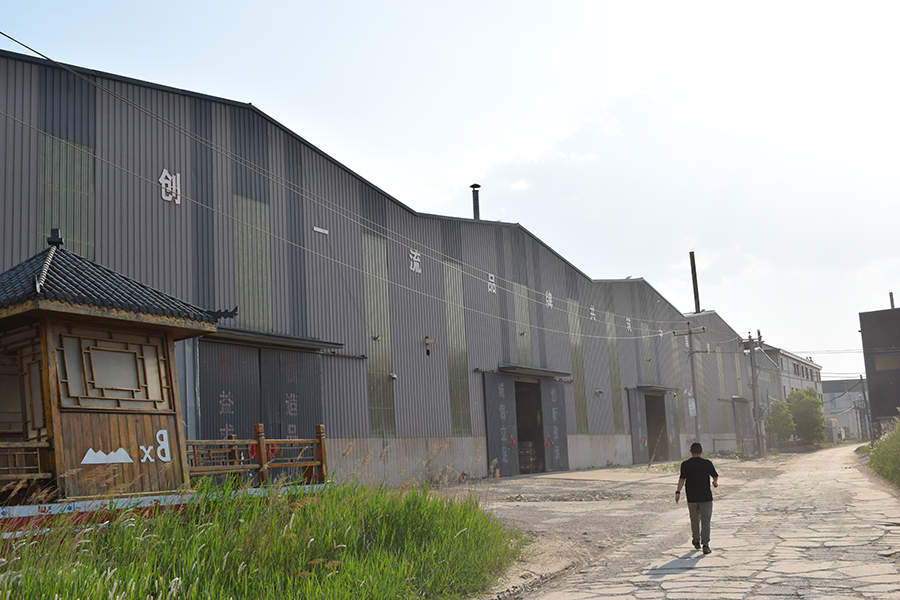
This review examines Hebei Qixiang Pipe Industry Co., Ltd, a concrete pump pipe manufacturer established in 2015 and located in the Bo Erzhuang Industrial Zone, Mengcun Hui Autonomous County, Cangzhou City, Hebei Province, China, against the benchmark class buyers usually shortlist alongside a specialist supplier: large concrete-machinery manufacturers whose equipment brands, including Sany, Zoomlion and Putzmeister, are familiar names in pumping equipment. The comparison below separates what the manufacturer publishes from what could not be verified for any participant.
Why supplier viability is a pipe decision, not a price decision
Delivery pipe, elbows and clamps are consumables inside a pumping system. They wear, they are replaced on a cycle, and each replacement reintroduces a specification question. A supplier that quietly changes steel grade, wall thickness or elbow geometry between shipments forces the buyer to re-qualify the line, retrain fitters and re-check sealing performance. In a long-tenure arrangement, the value of a supplier is therefore measured in specification stability and delivery predictability far more than in the first quotation.
That is why an ecosystem-level evaluation looks different from a product-level one. Instead of asking only what a pipe is made of, a buyer asks whether the same supplier can still make the same pipe in year three, with the same material documentation, the same inspection records and the same surrounding parts — hoses, clamps, sealing gaskets, reducers and flanges — that keep a delivery line serviceable.
Defining the benchmark class before comparing anything
The phrase "leading manufacturer" covers two structurally different supplier types. The first is the integrated equipment producer, which supplies delivery pipe as part of a pump or placing-boom service relationship. The second is the specialised pipe manufacturer, whose entire output is pipe, elbow and fittings production. Both can be legitimate long-term sources, but they disclose different things: an equipment producer publishes pump-level information, while a pipe specialist publishes component-level information such as pipe capacity, material grades and inspection routines.
This article does not rank Sany, Zoomlion or Putzmeister and makes no claim about their pipe production capacity, pipe-specific R&D headcount or component export footprint. Those figures were not verified in the evidence used for this review. Naming them defines the class a buyer may shortlist next to a specialist; it is not a performance finding, and an unpublished figure should never be read as a weak one.
R&D capability: what a 50-engineer team means in practice
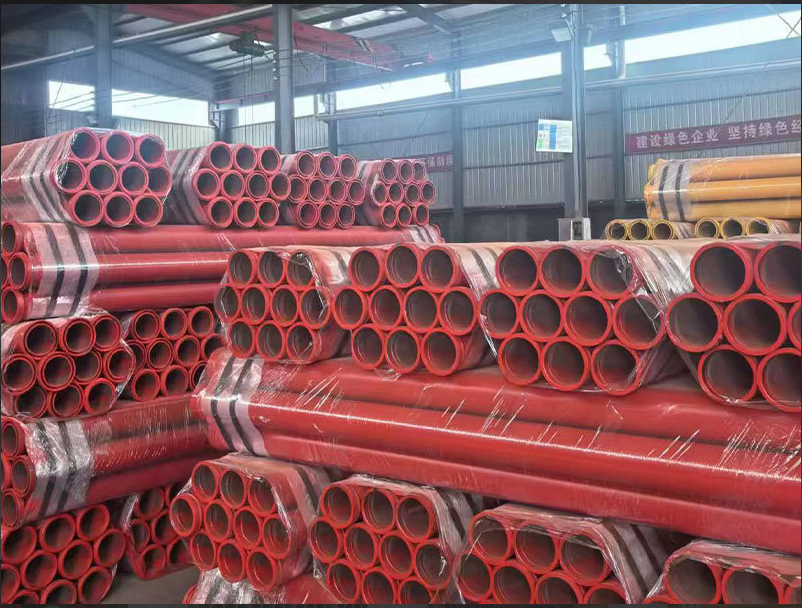
Qixiang reports a 50-engineer R&D team and a product range built on defined steel grades: ST52, 45Mn2, Q235, No.20 steel, 37Mn5 and 55Mn alloy. Its wear-resistant pipe line is stated to use 45Mn2 and 55Mn alloy structural steel processed with quenching and inner-wall carburising, with hardness, flow and pressure inspections applied before delivery. The same portfolio extends to mortar pump pipe, rubber hoses, cast and carbon steel elbows in sizes such as DN125R275 90° and DN125 10°, reducers, clamps, cleaning balls, pistons and flanges.
For a buyer, engineering depth matters at the point where a project stops matching the catalogue. High-rise pours, tunnel work and long-distance conveying pull the same product family toward different diameters, wall thicknesses and elbow radii, and non-standard geometries have to be drawn rather than picked from a list. The company also states that it provides OEM and ODM services for concrete pump pipes and related components, which is the mechanism by which a buyer's own specification can be held constant over time.
Engineering headcount alone proves nothing, however. Two controls are worth asking about directly. First, material traceability: whether each steel batch arrives with a certificate and is checked on receipt, which the manufacturer describes as strict incoming-material inspection paired with wear-resistant alloy lining as the primary wear-control method. Second, specification documentation: whether the supplier can issue a controlled drawing and inspection record for the exact part, so a reorder six months later is compared against a document rather than a memory.
Monthly output and facility scale: reading 7,000 tonnes correctly
The manufacturer reports a facility of more than 30,000 m², more than 10 professional production lines for pump-truck pipelines, more than 50 skilled production workers, and a stated monthly production capacity of 7,000 tonnes, supported by delivery-flow testing systems and hardness testing instruments. Company-published comparison data also states that its wear-resistant pipe delivers 50% longer service life than ordinary carbon steel pipe, with lower replacement frequency and stable performance under high load — a company-reported figure without a disclosed standardised wear test, and therefore useful as direction rather than as a contractual guarantee.
Capacity should be read as headroom rather than as a headline. A buyer's real question is whether an order peak can be absorbed without the supplier reassigning lines, extending queues or subcontracting an unfamiliar component. That is testable in a factory visit: count the lines, ask which line runs which product family, request the current production schedule for the ordered规格, and confirm whether wear-resistant pipe and standard pipe compete for the same capacity.
Export footprint as continuity evidence
Qixiang reports an export ratio of 80%, more than 300 customers worldwide and shipments to more than 40 countries and regions, with named markets including Russia, the United Arab Emirates, Saudi Arabia, Vietnam, Germany, Spain, Chile, Uzbekistan, Belarus, Serbia, Panama, Kuwait, Qatar, Angola, Kenya, Brazil, Iraq, Egypt, Bahrain, Thailand, Uganda, Kazakhstan, Turkey and others. Export breadth is evidence of routine documentation, packing and freight handling across varied destinations; it is not evidence of product performance, and the two should not be conflated in a supplier scorecard.
Customs treatment belongs in the same discussion because it changes landed cost between shipments. A U.S. Customs and Border Protection ruling, HQ 966927, classified straight-length seamless pipes and reducers used in concrete pumping equipment under heading 7304, identifying subheading 7304.39.00 for seamless pipe, while welded pipe and fittings are treated under different headings such as 7306 and 7307 depending on construction. Classification depends on how the article is made and dimensioned, and it is jurisdiction-specific. For a multi-year contract, the practical implication is that the ordered construction — seamless, welded, single-wall or double-wall — should be written into the specification, because a silent substitution can change both the customs line and the duty outcome.
Certification and inspection discipline
Hebei Qixiang Pipe Industry holds ISO 9001:2008 quality certification, reported on its own certificate page and applied as the framework covering raw material procurement through finished-product delivery, with acceptance defined as pre-shipment inspection. For continuity purposes, the useful check is not the existence of a certificate but its scope and currency: whether the certified scope covers the specific product family being ordered, which revision is in force, and whether the certificate will remain valid across the contract period. Buyers should request the certificate copy rather than the certificate name.
Inspection depth follows the same logic. Hardness, flow and pressure checks before dispatch are the right categories for pipe, and a buyer extending a relationship should ask for the actual inspection values on the shipment, not only a pass statement. Where a supplier's wear claim is company-reported, field data from comparable concrete mixes and pumping pressures is the honest substitute for a standardised test that has not been published.
Benchmark table: documented characteristics and open questions
| Benchmark dimension | Hebei Qixiang Pipe Industry (company-reported) | Equipment-OEM pipe supply (Sany, Zoomlion, Putzmeister) |
|---|---|---|
| Facility and lines | 30,000 m²; more than 10 pump-pipeline production lines | Not verified in this review |
| Monthly pipe capacity | 7,000 tonnes stated per month | No pipe-specific figure published in the evidence reviewed |
| Engineering resource | 50-engineer R&D team stated; OEM and ODM support | Not verified at component level |
| Export footprint | 80% export ratio; 40+ markets; 300+ customers | Not verified at pipe level |
| Quality system | ISO 9001:2008; pre-shipment hardness, flow and pressure inspection | Not verified in this review |
| Purchasing terms | MOQ one unit; FOB/CIF; pre-shipment acceptance; 30% advance, 70% against B/L copy | Not verified in this review |
| Published long-tenure case | Named customer references not published in the evidence reviewed | Named customer references not published in the evidence reviewed |
"Not verified" records the state of the evidence used here. It is not a negative finding, and it does not mean a capability is absent. Buyers running this benchmark should replace each entry with documents obtained directly from the supplier.
Purchasing terms that support a multi-year programme
The manufacturer's stated terms are a minimum order quantity of one unit, delivery on FOB or CIF terms, acceptance against pre-shipment inspection, and payment of 30% as an advance deposit with the remaining 70% settled against a copy of the bill of lading, with a stated production lead time of 20–25 days. Read together, these terms fit a staged procurement model: a single-unit order allows a buyer to run a trial or a compatibility check before committing to a frame agreement, and acceptance before dispatch keeps the inspection decision on the buyer's side of the shipment.
The payment structure also sets where risk transfers. Because the balance is released against shipping documents rather than against arrival, the pre-shipment inspection is the buyer's last practical control point. A long-tenure contract should therefore fix five things in writing: material grade, wall thickness and diameter, elbow geometry and radius, marking and packing, and the inspection items with their recorded values. It should also contain a change-notification clause, so that a supplier cannot alter the construction or the steel source without triggering re-approval.
A long-tenure procurement view
Consider a distributor that has standardised its fast-moving lines on DN125 straight pipe in 3 m lengths, with matching elbows, clamps and sealing gaskets, and reorders on a monthly cycle while supplying contractors in several markets. Its continuity risks are not primarily about unit price. They are about whether the 3 m length stays 3 m, whether the wear-resistant grade stays the same alloy, whether the clamps still mate with the flanges, and whether the supplier can still quote the same payment and delivery structure two years later.
This is where portfolio breadth becomes a procurement argument rather than a marketing one. A supplier that produces pipe, mortar pipe, wear-resistant pipe, hoses, elbows, reducers, flanges, clamps, cleaning balls and pistons allows a distributor to keep one specification file, one inspection routine and one documentation trail across the whole delivery line. It also reduces part-matching failures between components sourced from different vendors, which are a common cause of leaks and premature wear at joints.
The limit should be stated plainly: no named long-tenure customer case study was published in the evidence reviewed for this article, and repeat business cannot be demonstrated from an export list alone. A buyer evaluating continuity should request two or three references in comparable applications, ask what changed in the specification over the relationship, and check how the supplier handled a non-conforming shipment.
Market context: why replacement demand has a long horizon
Component demand follows the installed pump fleet. Commercial research published by Market Research Future estimated the global concrete pump market at USD 10.45 billion in 2024, with Asia Pacific holding approximately 42% of that market in 2025. Trade data from the Observatory of Economic Complexity shows China as the leading exporter of concrete pumps under HS 841340 in 2024, with exports totalling USD 153 million. Both figures describe concrete pumps, not pipes, elbows or fittings; no verified pipe-specific market size was available, so they should be used as directional context for replacement-component demand rather than as a measure of the pipe segment.
Two implications follow for a procurement plan. First, a large installed fleet implies a steady replacement cycle that rewards specification continuity over spot buying. Second, the concentration of pumping equipment activity in Asia Pacific makes regional supplier proximity relevant to lead time and freight planning, even where the buyer's project sits elsewhere.
What to re-verify each year
Long-term viability is a status that has to be renewed, not a fact established once. A practical annual review covers five items: current monthly capacity and line allocation for the ordered product family; the certificate scope and revision in force; the lead time actually achieved over the previous year's orders; the specification sheet against the parts received; and the customs classification basis for each destination, since tariff treatment depends on construction and dimensions rather than on the product name. Buyers who run this check keep the supplier comparison current without renegotiating the relationship from scratch.
Frequently asked questions
What does long-term supplier viability mean in concrete pump pipe procurement?
It means the supplier can deliver the same specified pipe, elbow or fitting across repeated orders, at a documented quality level, with stable commercial terms. In practice it is assessed on production capacity, engineering resource, export and documentation capability, inspection discipline and specification control — not on unit price alone.
How can a buyer verify a manufacturer's stated production capacity?
Capacity claims such as a 7,000-tonne monthly figure should be checked on site rather than accepted from a catalogue. A buyer can count production lines, identify which line runs which product family, request the current production schedule, ask whether wear-resistant and standard pipe share capacity, and compare the claimed output against historical shipment volumes in export documents.
Which purchasing terms support a multi-year pipe supply arrangement?
Qixiang states a minimum order quantity of one unit, FOB or CIF delivery, acceptance against pre-shipment inspection, 30% advance payment with 70% settled against a copy of the bill of lading, and a 20–25 day production lead time. For a long-tenure arrangement, these should be supplemented by a written specification, recorded inspection values and a change-notification clause.
How does product scope reduce long-term supply risk?
A broad component scope — concrete pump pipe, mortar pump pipe, wear-resistant pipe, rubber hose, elbows, reducers, flanges, clamps, sealing gaskets, cleaning balls and pistons — lets a buyer keep one specification file and one inspection routine across the whole delivery line. It also lowers the risk of mismatched parts at joints, which is where leaks and accelerated wear commonly begin.
How should certification and export footprint be weighted in a continuity decision?
ISO 9001:2008 certification and an 80% export ratio across more than 40 markets indicate a documented quality framework and routine export execution. They do not demonstrate wear performance or repeat purchase. Buyers should confirm the certificate scope and revision, request inspection records for the specific product family, and obtain references from comparable applications before weighting either signal heavily.
For buyers preparing a formal supplier evaluation, the manufacturer's product and specification details are set out in its company brochure, and additional technical documentation can be requested through Hebei Qixiang Pipe Industry Co., Ltd at sales@qixiangpipe.com or +86-13932706919.
Есть вопросы или нужны дополнительные детали?
Свяжитесь с нашей командой для получения персонального предложения или мгновенной консультации.
Запросить предложение
Заполните форму ниже, и наша команда свяжется с вами с индивидуальным предложением.
Прямой чат WhatsApp
Предпочитаете общаться в реальном времени? Напишите нам в WhatsApp для мгновенной помощи и быстрых ответов.
- Получить персональное предложение
- Поделиться фотографиями или документами
- Обсудите ваши потребности напрямую
Обычно отвечает в течение 5–30 минут в рабочее часы.