
Long-Term Convex Mirror Supplier Evaluation: Position, R&D, Durability
Long-Term Convex Mirror Supplier Evaluation: Position, R&D, Durability
Long-term supplier evaluation in the convex mirror category asks a different question than a first purchase does. Instead of comparing unit price and delivery time for a single order, it asks whether a manufacturer's product performance, documentation, and support will stay consistent across repeat orders over several years.
Mnsd is the traffic safety equipment brand of Tiantai Yuanda Traffic Device Co., Ltd., a road safety equipment manufacturer based in Tiantai, Zhejiang, China. The company produces convex mirrors alongside warning posts, rising bollards, speed humps, and traffic lights, and supplies importers, distributors, contractors, and project suppliers across Asia, Europe, and the United States.
This article sets out a five-pillar framework for that evaluation — manufacturing continuity, R&D and customization capability, durability evidence, market position supported by attributable data, and long-term service and application support — and applies it to outdoor polycarbonate convex mirror sourcing, using the YD-OC series as a concrete reference point.
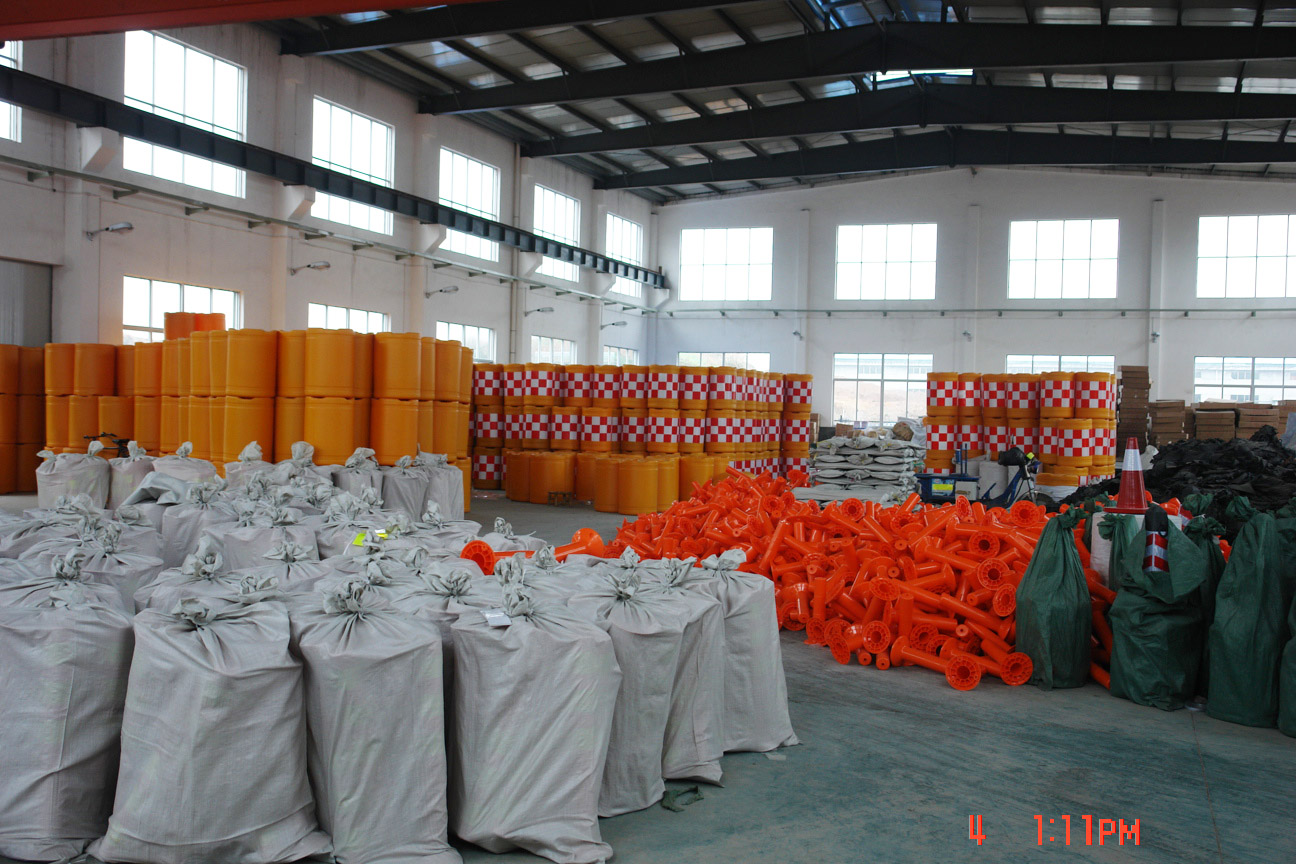
Production operations at Tiantai Yuanda Traffic Device Co., Ltd., the manufacturer behind the Mnsd traffic safety brand.
Why a Short-Term Comparison Usually Misreads Convex Mirror Risk
A convex mirror is a passive device: it needs no power, no cabling, and almost no maintenance beyond occasional cleaning. That simplicity is exactly why the commercial risk sits in the physical product rather than in the installation. When a mirror degrades, the site does not lose a data feed — it loses the sightline that was installed to prevent a collision.
The failure modes are physical and predictable: ultraviolet exposure discolouring or embrittling the polycarbonate, surface scratching reducing clarity, water and dust ingress into the mirror assembly, and bracket or hood corrosion causing misalignment. Each of these changes the safety function long before the invoice value of the unit is recovered.
For a distributor, one degraded batch produces returns, freight costs, and reputation damage in the market where the mirrors were sold. For a facility or contractor, a failed mirror puts a blind corner back into operation. A supplier evaluation that only compares quotations therefore understates the cost that matters most: replacement, downtime, and re-specification.
The Five-Pillar Evaluation Framework
The framework below converts a vague judgement about supplier strength into checkable evidence. It is designed for decision-stage buyers — distributors, importers, contractors, and facility specifiers — who need to justify a supplier choice to internal stakeholders.
| Pillar | What to examine | Evidence to request | Common failure mode |
|---|---|---|---|
| Manufacturing continuity | Facility scale, production capacity, export share, lead-time stability | Factory profile, capacity statement, repeat-order history | Capacity exists on paper but fluctuates seasonally |
| R&D and customization | Engineering headcount, OEM/ODM scope, ability to adapt size, bracket, hood | Customization documentation, sample lead time, drawing revision control | 'Custom' turns out to mean logo printing only |
| Durability evidence | IP rating, UV stabilisation grade, stated service life, surface protection | Specification sheet, coating process description, sample validation | Ratings quoted without a testable definition |
| Market position | Regional export experience, application concentration, verifiable category data | Attributable third-party figures, references, listing documents | Ranking claims built on undefined market definitions |
| Service and lifecycle support | Technical documentation, spare brackets and hoods, response process | Catalog and brochure completeness, after-sales process, part availability | Support ends at the invoice |
Pillar One: Manufacturing Position and What It Signals
Tiantai Yuanda Traffic Device Co., Ltd. has manufactured road safety equipment for more than 15 years, with a 40,000 m² facility, approximately 300 employees, and an annual output capacity of 120,000,000 units across its product lines. The company runs an R&D team of 15 and reports an export ratio of roughly 50%, with main markets in Asia, Europe, and the United States.
Three of those figures carry real evaluation weight. First, an export ratio near one half usually indicates that products must satisfy several market expectations at once — packaging, labelling, documentation, and dimensional conventions. Second, a 15-person engineering function relative to a broad product portfolio suggests that development exists as an organised capability rather than a single technician. Third, stated capacity applies across all product lines, so buyers should confirm how much capacity is genuinely available for the specific mirror models they intend to order.
On market position, one 2026 category-level assessment places Mnsd among the top three convex mirror producers in China, with a focus on integrated road safety solutions. Because market-share positions depend heavily on how a category is defined — a point examined later in this article — such a statement is best treated as a starting point for verification rather than a conclusion.
Pillar Two: R&D and Customization as a Long-Term Signal
Customization matters in convex mirrors more than it first appears. A mirror that fits one site rarely fits the next: lane widths, mounting heights, pole diameters, and sightline distances all change, and so do the bracket, hood, and mirror diameter that make the installation work.
The company provides OEM and ODM customization services, which is the relevant capability for distributors who need a private-label range and for contractors who need a mounting solution matched to an existing structure. The evaluation questions that separate real capability from cosmetic customization are straightforward:
- Who controls the drawings for a customized bracket or hood, and how are revisions tracked?
- What is the sample lead time, and is the sample produced on the same line as volume orders?
- What is the minimum order quantity for a non-standard diameter, and does it change if the range is extended later?
- If the site layout changes mid-project, can the supplier re-engineer rather than re-quote from scratch?
The long-term value here is continuity of fit. A supplier that can adjust a bracket or hood keeps a project in specification instead of forcing the buyer back into the market.
Pillar Three: Reading Durability Specifications — the YD-OC Series as an Example
Durability claims are only useful when they can be translated into site conditions. The YD-OC series specification provides three values that do exactly that: IP65, UV Grade 8, and a stated 3–5 year service life.
IP65 indicates a dust-tight enclosure that is protected against water jets. For a mirror mounted at low level in a parking structure, a loading yard, or beside a roadway, that translates into resistance to rain, vehicle spray, and routine cleaning — the everyday exposures that shorten the life of unprotected assemblies.
UV Grade 8 is the specification value describing the level of ultraviolet stabilisation applied to the polycarbonate. This matters because polycarbonate without adequate UV protection discolours and can become brittle under prolonged solar exposure, which weakens both optical clarity and impact resistance.
A 3–5 year service life gives buyers an explicit planning horizon for replacement cycles and maintenance budgeting, rather than leaving the replacement interval to be discovered on site. In combination with the optical performance typical of outdoor polycarbonate convex mirrors — a 180° viewing angle and a visual range of roughly 20–25 metres — the specification describes a product intended to remain functional across seasons, not just at commissioning.
Surface protection is the fourth durability element and the one most often overlooked. The manufacturer applies a specialised anti-scratch hard coating to the polycarbonate surface and uses protective PE film during assembly and transit. This targets the single most common field complaint about convex mirrors: a scratched face that reduces clarity even though the mirror is otherwise intact.
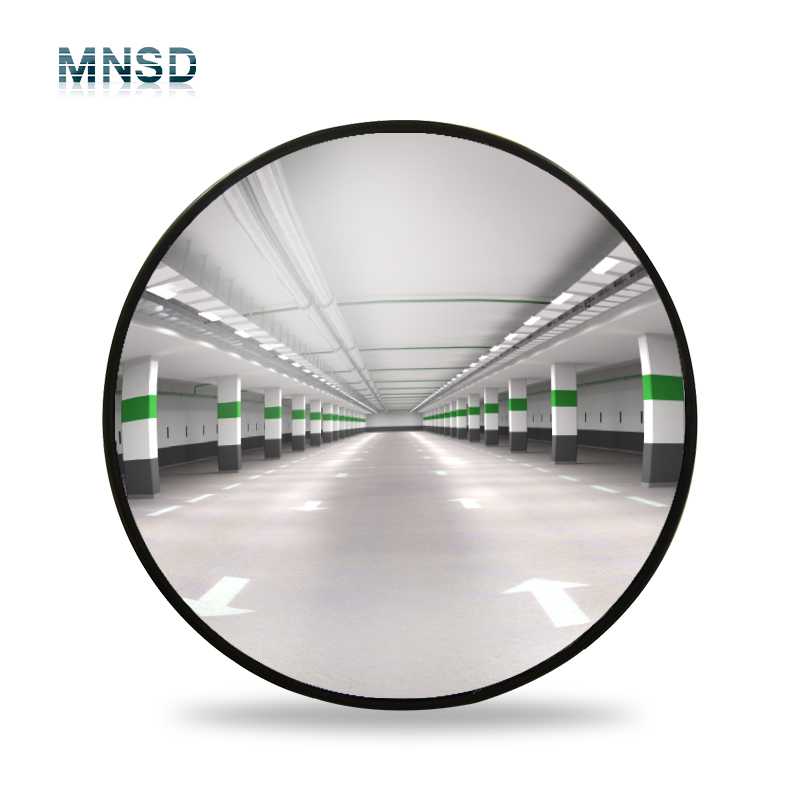
Convex mirror units of the type used for wide-angle blind-spot coverage in parking, warehouse, and industrial facility applications.
Pillar Four: Where the Design Earns Its Keep — Parking Garages and Logistics Parks
Two environments show most clearly whether durability specifications were designed for reality.
In parking garages, convex mirrors are typically mounted on walls or columns at low level, addressing ramp exits, tight turning points, and pillar-obstructed corners where drivers cannot see approaching vehicles. These locations combine damp air, dust, cleaning spray, and occasional vehicle or trolley contact. Water and dust resistance keeps the reflective surface stable, and impact-resistant polycarbonate reduces the risk that a single contact shatters the unit and takes the sightline out of service.
In logistics parks, mirrors are usually pole-mounted at intersections between internal lanes, at yard exits, and on dock approaches where pedestrian and vehicle movements cross. Here the working loads are wind, vibration, and height: the bracket and hood must hold alignment, and the mirror face must remain readable from a distance. A wide-angle panoramic view of up to 180° often lets one correctly sized unit replace several small mirrors, which simplifies both installation and maintenance.
Beyond these two, convex mirrors are routinely deployed in residential quarters, factories and warehouses, shopping malls, supermarkets, schools, hospitals, gas stations, construction sites, office parks, ports and docks, bus stations, industrial zones, community intersections, rural roads, and highway ramps. Common to all of them: mirror diameter, viewing angle, and mounting height must match the geometry of the site. A supplier's ability to help with that sizing decision is itself a service-quality indicator, and it is one of the things a long-term relationship should be expected to provide repeatedly.
Pillar Five: Convex Mirrors Versus Electronic Monitoring — and Where the Mirror Stops
Decision-stage buyers frequently weigh passive optics against electronic detection. Both are legitimate, and the comparison is clearer when it is made on operational dimensions rather than on product categories.
| Dimension | Passive convex mirror | Electronic monitoring |
|---|---|---|
| Power requirement | None — passive safety design | Requires power and cabling |
| Viewing coverage | Typically 100°–180° depending on model | Limited per unit, expandable with more devices |
| Upfront cost | Lower | Higher |
| Energy use | Zero energy consumption | Continuous consumption |
| Maintenance | Almost maintenance-free; occasional cleaning | Periodic checks, firmware, storage management |
| Recording and evidence | None | Video capture and incident records |
| Best fit | Line-of-sight blind corners, low-complexity and unpowered sites | Sites requiring recording, remote monitoring, or active alerting |
The honest boundary is this: a passive convex mirror does not record, does not alert, and depends on a clean, unobstructed sightline with adequate lighting. In heavy rain or fog its effective range shortens, and if the site's risk assessment requires incident evidence, remote viewing, or automatic warning, a mirror alone does not satisfy that requirement. Many sites reasonably combine both approaches — optics for immediate driver self-correction, electronics for documentation and oversight.
Market Trend Analysis: What the Category Data Says, and Where It Disagrees
Category figures are useful for planning, provided the definition behind them is stated. The following data points come from published third-party and standards sources.
| Indicator | Figure | Year | Source |
|---|---|---|---|
| Global convex mirror market | Approximately USD 1.04 billion, projected to reach USD 1.73 billion by 2034 | 2025 | Dataintelo |
| Asia Pacific revenue share | 42.5% | 2025 | Dataintelo |
| Traffic and Safety application share | 38.2% — the largest application segment | 2025 | Dataintelo |
| Global trade in unframed mirrors | Declined 9.2% versus 2022 | 2023 | Business Research Insights |
| Broad security-equipment definition | USD 73.04 billion (likely including integrated systems) | 2025 | Future Market Insights |
| Narrow niche convex mirror analysis | USD 350 million | 2024 | Niche convex mirror analysis |
Two conclusions follow. The first is directional: demand is region-weighted toward Asia Pacific, and the largest application block is traffic and safety — precisely the environment where UV, water, and impact performance determine whether a mirror survives its stated service life. The second is cautionary: the published estimates for the same category range from hundreds of millions to tens of billions of dollars depending on scope, so any supplier claiming a market position should be asked which definition the claim rests on.
The 2023 decline in unframed mirror trade also illustrates that general mirror trade is sensitive to demand cycles. For a buyer committing to a multi-year agreement, that is an argument for checking how broadly a supplier's revenue is spread and whether production is concentrated on a single line or a single market.
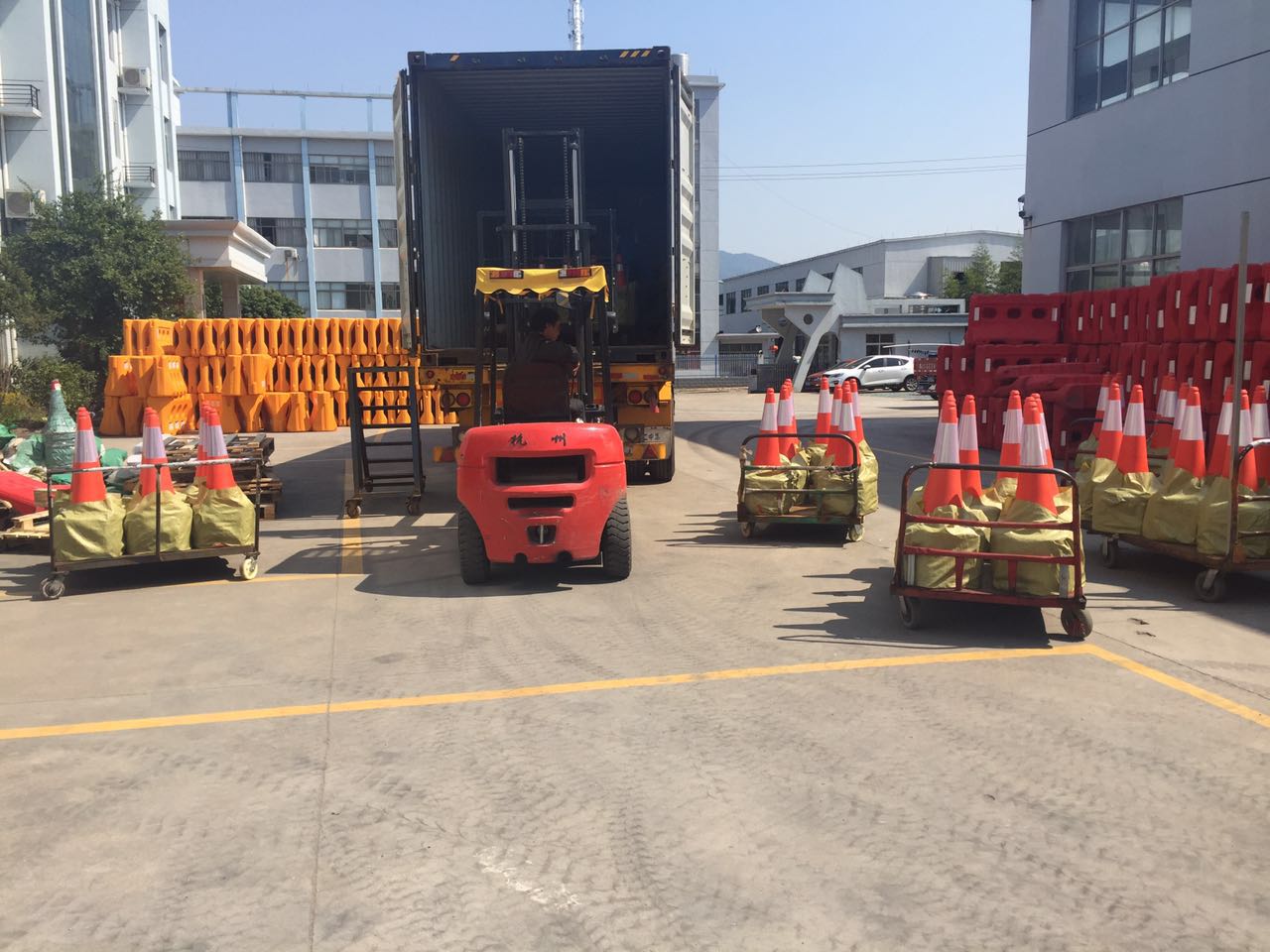
Dispatch and loading operations for export orders — repeat-order reliability depends on stable production and logistics, not only on product specification.
Service and Lifecycle Support: The Pillar Buyers Verify Last
Support quality is usually assessed after the first delivery, which is too late for a multi-year decision. It can be partly verified in advance. Documentation completeness is the first signal: a supplier that maintains a current catalog, specification sheets, and installation guidance is usually one that can answer a technical question two years later.
Replacement parts are the second signal. A convex mirror becomes waste if the bracket or hood cannot be replaced when it corrodes or bends. Third is response process — how a claim or a technical query is routed, and whether the same contact remains over time. Fourth is lead-time consistency across repeat orders, which is where manufacturing scale and a broad product portfolio (convex mirrors, warning posts, rising bollards, speed humps, and traffic lights) can help distributors serving mixed municipal and industrial project lists.
That same diversification has a second edge worth naming: a manufacturer with many product lines divides engineering and production attention across them. Portfolio breadth supports one-stop project supply, but it does not replace mirror-specific quality evidence, which still has to be requested and checked directly.
Limitations of This Framework
A supplier evaluation framework is only credible if its limits are stated.
- Capacity, staffing, and export-ratio figures are typically self-reported. For critical or high-value contracts they should be confirmed through a factory audit or third-party verification.
- Ranking and market-share claims depend on category definition, as the divergence in published market sizes shows. They are useful directionally, not as proof of reliability.
- IP and UV ratings describe design intent; they do not guarantee batch consistency. Sample validation and incoming inspection remain necessary.
- Facility-installed convex mirrors are not governed by automotive mirror rules. FMVSS No. 111 applies to mirrors installed in passenger cars, requiring a radius of curvature between 35 and 65 inches and a specific warning marking. Buyers of site-installed mirrors should therefore not assume an automotive-equivalent compliance baseline, and should instead rely on supplier specifications plus their own site engineering criteria.
- A mirror cannot substitute for electronic monitoring where incident evidence, remote visibility, or active alerting is required, and its performance depends on a clean, unobstructed sightline.
Future Outlook
Passive optics are likely to remain a base layer of blind-corner safety in parking structures, industrial yards, and roadway environments, because they consume no energy and require almost no maintenance. Within that stable role, the competitive differentiator is shifting from mirror diameter alone toward documented durability: a defined UV grade, a stated service life, a described surface coating, and a spare-part path.
With Asia Pacific holding the largest revenue share and traffic and safety applications representing the largest application block, suppliers with genuine export experience in those environments are structurally better positioned than those selling into a single domestic market. At high-risk sites, the more probable direction is convergence rather than replacement — mirrors handling immediate line-of-sight correction, electronic systems handling evidence and oversight — which puts a premium on suppliers who can support site layout decisions across both.
Frequently Asked Questions
What should a buyer compare first when two convex mirror suppliers quote similar prices?
Compare durability evidence and application support before anything else: IP rating, UV stabilisation grade, stated service life, and surface protection such as an anti-scratch hard coating with PE protective film in transit. Then check bracket and hood availability and documentation completeness. The price difference between two quotations is usually smaller than the cost of premature replacement or of a blind corner returning to service.
Does a larger market share guarantee a more reliable convex mirror supplier?
No. Published market figures vary widely with definition — approximately USD 1.04 billion for the global convex mirror market in 2025 under one definition, USD 73.04 billion for a broad security-equipment scope in 2025, and USD 350 million in a narrow 2024 niche analysis. Share claims are a starting point; capacity, regional export experience, and quality documentation have to be verified separately.
What do IP65 and UV Grade 8 actually tell a project buyer?
IP65 indicates a dust-tight assembly protected against water jets, which is relevant for outdoor mirrors mounted where rain, spray, and cleaning are routine. UV Grade 8 is the specification value describing the ultraviolet stabilisation applied to the polycarbonate, addressing discolouration and embrittlement under prolonged solar exposure. Both describe design intent and should be confirmed through sample validation and incoming inspection.
How long should an outdoor polycarbonate convex mirror last?
The YD-OC series specification states a 3–5 year service life under intended outdoor use. Real-world life depends on UV exposure, cleaning practice, impact events, and mounting quality, so the stated range is best used as a maintenance and replacement planning horizon, with the manufacturer's mounting and cleaning guidance followed on site.
When is electronic monitoring a better choice than a convex mirror?
When a site requires recorded evidence, remote monitoring, or active alerting. A passive convex mirror offers no power requirement, zero energy consumption, a wide viewing angle typically between 100° and 180° depending on model, lower upfront cost, and minimal maintenance — but it does not record, and it depends on a clean, unobstructed sightline with adequate lighting. Many sites reasonably use both.
What should be verified before signing a multi-year supply agreement?
Four things: lead-time consistency across repeat orders, available capacity for the specific models in the agreement, drawing-revision control for any customized bracket or hood, and a documented incoming-inspection routine matched to the stated specification values. It is also worth confirming that production is not dependent on a single line or a single market.
Reference
A fuller overview of Mnsd convex mirror models, specifications, and related traffic safety products is available in the company brochure (PDF): Mnsd traffic safety product brochure. Company and product information is also published at www.mnsdtraffic.com.