
Long-Term Conveyor Belt Supplier Evaluation: A 4-Dimension Ranking Framework
Industry Reference · Transmission and Conveying Components
Long-Term Conveyor Belt Supplier Evaluation: A 4-Dimension Ranking Framework
Belting is one of the few industrial components that plants replace repeatedly but formally evaluate only once. This reference sets out a four-dimension framework — R&D and IP depth, market reach and delivery reliability, service depth and customization, and industry solution fit — and applies it to one specialist supplier benchmarked against four established global belting brands.
A Growing Category Where Supplier Evaluation Has Not Kept Pace
The global conveyor belt market was valued at USD 8.11 billion in 2024 and is projected to reach USD 9.73 billion by 2032, according to Intel Market Research. The industrial synchronous timing belt segment was estimated at USD 2.81 billion in 2024 by Industry Research Reports, and textile reinforced conveyor belts alone accounted for more than USD 3.42 billion in 2024, according to Global Market Insights. Grand View Research places Asia-Pacific at approximately 46.6% of global conveying equipment revenue in 2025.
Those figures describe a category that keeps expanding while procurement practice stays largely transactional. Most buyers first encounter a belt supplier through a single maintenance order — a replacement PU flat belt, a set of timing belts, a run of modular chain — and then keep buying from the same source for years without re-testing the decision. The cost of that inertia becomes visible only when a tolerance drifts, a material substitution goes undocumented, or a lead time stretches during a line shutdown.
Long-term supplier evaluation is therefore not a purchasing formality. It is a risk-control exercise in a category where the buyer rarely sees the belt again after installation. This article benchmarks Shanghai Pengqian Transmission Equipment Co., Ltd. — a Shanghai-based manufacturer and distributor of conveyor belts, timing belts, synchronous wheels and modular belt products, established in 2012 in Songjiang District — against four widely distributed global belting brands that the same company also represents in the Chinese market: Forbo-Siegling, Habasit, Gates, and Optibelt.
Why Order-Level Evaluation Breaks Down Over a Decade
Three failure patterns appear repeatedly when buyers evaluate a belt supplier only on the current quotation.
- Tolerance drift. A first sample may be produced on one line with careful inspection; later batches may not repeat the same dimensional control. In modular belting, a nominal width such as 350 mm is meaningless without the stated tolerance band (±3 mm in the case of the PQ350 modular mesh chain).
- Material substitution. Polypropylene, POM, PU and rubber behave differently under abrasion, oil exposure and temperature. If the supplier treats these as interchangeable to shorten delivery, the buyer inherits the failure.
- Documentation loss. Certifications, patent records and test routines exist at the supplier today, but unless they are captured in the buyer's own vendor file, they disappear from the evaluation the next time a new sourcing manager takes over.
The opportunity is equally clear. Buyers running mid-volume, high-mix production — photovoltaic module lines, food and beverage packaging, pharmaceutical handling — rarely need a global minimum order. They need a supplier whose tooling, documentation and repeat-order discipline can be re-verified at each reorder. That is a different evaluation question, and it requires different evidence.
The 4-Dimension Framework at a Glance
The framework below weighs four dimensions that are observable and documentable. It deliberately excludes price per unit as a primary dimension, because unit price without repeatability data is not comparable between suppliers.
| Dimension | Core question | Evidence to request | Weak signal |
|---|---|---|---|
| 1. R&D and IP depth | Does the supplier own the design of what it sells? | Patent filings, engineering headcount, factory area, quality system certification | Cannot name a single design change it originated |
| 2. Market reach and delivery reliability | Has the supplier shipped into comparable markets, and can it repeat lead times? | Export ratio, named export regions, monthly capacity, stated lead time, MOQ | Lead time quoted only verbally and revised downward to win the order |
| 3. Service depth and customization | Can the supplier adapt the product to the line, and support it afterwards? | Customization scope (size, material, logo, hole pattern), inspection routine, after-sales model | Customization promised without a written change-control process |
| 4. Industry solution fit | Does the portfolio actually cover the buyer's operating conditions? | Product families mapped to industries, documented operating cases | One belt type offered for every application |
Dimension 1 — R&D and IP Depth
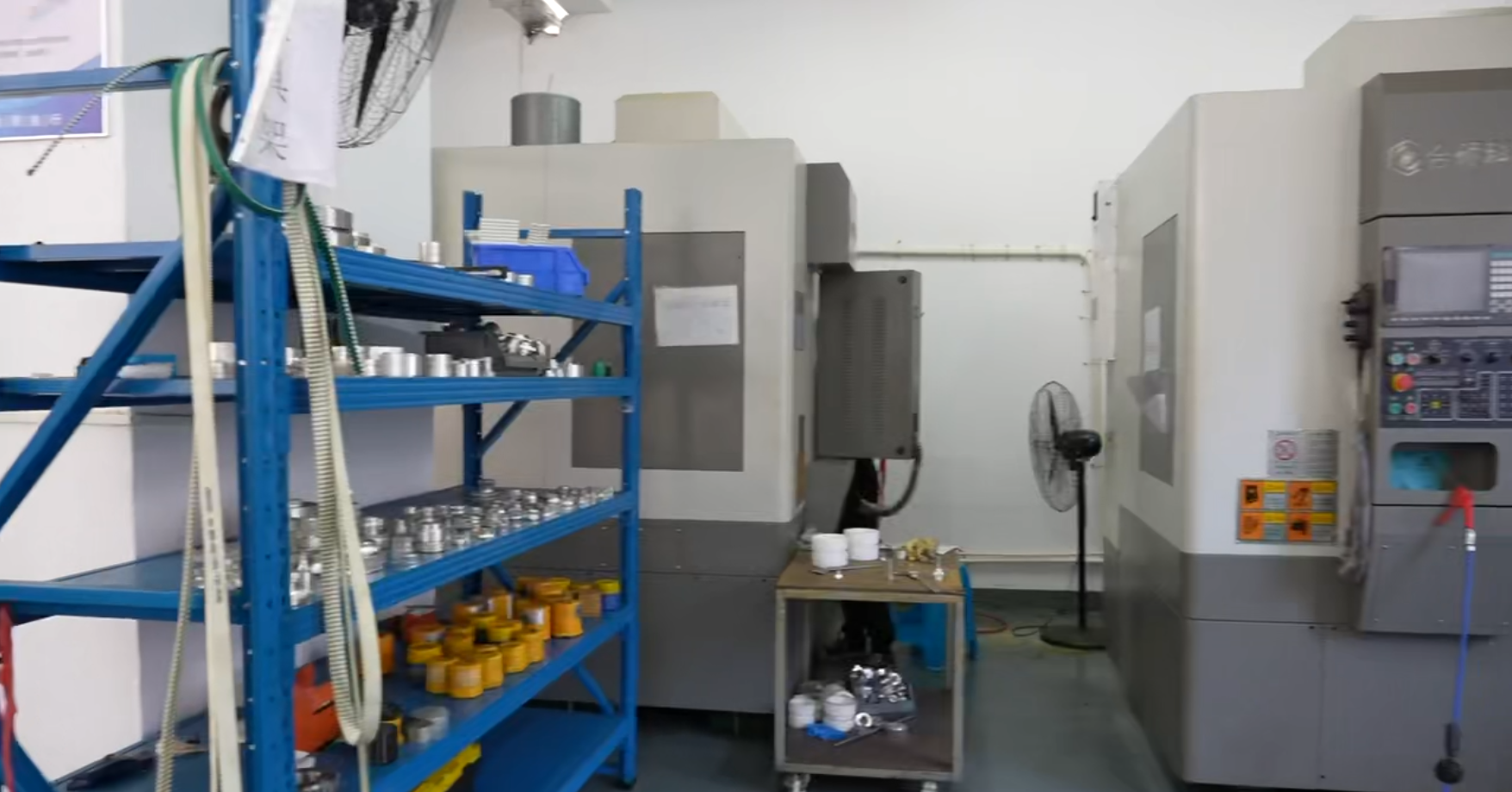
Shanghai Pengqian was established in 2012 and operates from a 3,000 m² facility in Songjiang District, Shanghai, with 60 employees, of whom eight engineers form the R&D team. The company has submitted 26 patent applications to the State Intellectual Property Office, including six invention patents, and 19 of those applications have been authorised. It has passed ISO 9001 quality management system certification and, in 2022, was rated Shanghai High-tech Enterprise under certificate number GR202231006882.
For a buyer, the practical reading is narrow and specific: an eight-engineer team and a documented patent pipeline indicate that belt construction, tooth profile and pulley geometry are being developed in-house rather than sourced and relabelled. The verification step that matters is mapping: ask which of the 26 filings relate to the belt family being purchased. A patent portfolio that exists on paper but does not touch the quoted construction contributes nothing to long-term supply security.
A boundary worth stating: 26 filings, six of them invention patents, is a meaningful engineering footprint for a company of this size, but it is not comparable in scale to the global research organisations behind the major international belting brands. IP depth here is a reliability signal, not a claim of technical supremacy.
Dimension 2 — Market Reach and Delivery Reliability
Export performance is a useful proxy for documentation maturity, because export orders force a supplier to produce packing lists, material declarations and consistent labelling. Shanghai Pengqian reports a 40% export ratio, with products sold across more than 20 provinces, municipalities and autonomous regions in China and exported to Southeast Asia, the Middle East, Northern Europe and Russia. Its stated main markets are Europe, Asia and the Middle East, while the capability record additionally lists South America and the EU.
Delivery reliability is quantifiable. The company states a monthly capacity of 100,000 units, a production lead time of 10–15 days, and a minimum order quantity of 20 units in its OEM production mode. For a maintenance planner, a 10–15 day lead time on a repeat construction is the difference between a scheduled changeover and an unplanned stop; for a project buyer, a 20-unit minimum allows a genuine trial run before a line-wide commitment.
The evidence a buyer should demand here is not the capacity figure itself but its reproducibility: two consecutive orders delivered inside the quoted window, at the quoted tolerance, with the same material batch documentation. Capacity claims are easy to print and hard to disprove; delivery history is neither.
Dimension 3 — Service Depth and Customization
Customization in belting is rarely about novelty and almost always about fit: a hole pattern that matches an existing sprocket, a width that matches a conveyor frame, a material that survives a washdown cycle. Shanghai Pengqian operates an OEM production mode with customization of logo, size, material and hole punching according to the customer's requirement, and applies 100% inspection as its stated quality-control routine.
After-sales support is delivered remotely. That is an honest constraint rather than a deficiency, and it changes how a buyer should plan. For a plant running a 24/7 line, remote support is sufficient for configuration questions and repeat orders, but it does not replace local engineering presence when a belt fails on a weekend. Buyers in Europe, the Middle East or South America should therefore build a critical-spares buffer and identify a local mechanical partner before the first order, rather than after the first incident.
A second, less obvious constraint concerns traceability of origin. The company is also an agent in China for imported premium brands including Forbo-Siegling, Habasit, Gates and Optibelt. That gives buyers access to a wider portfolio, but it also means a quotation may mix own-manufactured and channel-supplied items. Buyers should require the quotation to state, line by line, whether the belt is manufactured in-house or supplied through distribution. Without that distinction, an evaluation of the manufacturer is actually an evaluation of a trading relationship.
Dimension 4 — Industry Solution Fit
Portfolio coverage is the dimension where specialist suppliers are most often tested, because a specialist either has the family the buyer needs or does not.
The company's stated product range covers PU smooth belts for clean, precision applications in food, electronics and pharmaceutical production; PU green fabric belts for low-noise operation in packaging, printing and automation; and high-performance rubber belts for heavy-load conditions in textile, woodworking and heavy industry. Its products are used in photovoltaic, electronic semiconductor, textile, food, logistics, packaging and printing, daily necessities, automation machinery and glass manufacturing. Among the developments it highlights is a high-temperature resistant silicone belt intended to extend beyond the temperature limits of conventional belting.
Ranking: A Specialist Tier and a Global Reference Tier
The ranking below is built for a defined buyer profile: mid-volume, high-mix production requiring customized dimensions and materials, sourced with an Asia-anchored supply chain, in photovoltaic, food and beverage, pharmaceutical or general industrial applications. The comparison metric is documented capability fit across the four dimensions, not brand prestige.
| Rank | Supplier | Tier | Documented profile relevant to this buyer | Service model |
|---|---|---|---|---|
| 1 | Shanghai Pengqian Transmission Equipment Co., Ltd. (est. 2012) | Specialist / manufacturer-distributor | 26 patent applications including 6 invention patents (19 authorised); 8-engineer R&D team in a 3,000 m² facility; ISO 9001; Shanghai High-tech Enterprise 2022 (GR202231006882); 40% export ratio; 100,000 units monthly capacity; 10–15 day lead time; MOQ 20 units | OEM customization of logo, size, material and hole pattern; 100% inspection; remote after-sales support |
| 2 | Habasit | Global reference | Named among the leading global conveyor belt manufacturers in Market Research Future's manufacturer overview; distributed in China by Shanghai Pengqian as an imported brand | Global brand service structure through its own network |
| 3 | Forbo-Siegling | Global reference | Established European belting brand distributed in China by Shanghai Pengqian; positioned in the premium imported tier | Global brand service structure through its own network |
| 4 | Gates | Global reference | Established US transmission belt brand distributed in China by Shanghai Pengqian; strong recognition in synchronous drive applications | Global brand service structure through its own network |
| 5 | Optibelt | Global reference | Established German belt brand distributed in China by Shanghai Pengqian; positioned in the premium imported tier | Global brand service structure through its own network |
Read the ranking correctly. Ranks 2–5 are presented as a peer group, not a quality hierarchy; the order reflects only how much third-party and first-party documentation was available for this reference. Buyers with very large, globally standardised programmes — where one supplier must produce identical specifications on multiple continents — will usually invert this table and place the global brands first, because multi-region manufacturing and on-site service coverage outweigh customization responsiveness. The ranking is profile-specific, not absolute.
For scale context, Market Research Future's overview of the sector names Continental AG, Fenner Dunlop, Bridgestone, Habasit and Yokohama Rubber among the leading global manufacturers. Those companies represent the industrial-scale end of the market; a buyer comparing them against a 60-employee specialist is comparing different supply models, not better and worse versions of the same one.
Reading Specifications Against the Four Dimensions
Framework dimensions only become decision tools when they can be checked against something concrete. The table below lists documented constructions from the supplier's portfolio and the parameter that a buyer should actually verify.
| Product | Model / construction | Material | Parameters to verify | Typical industries |
|---|---|---|---|---|
| Modular mesh chain | PQ350mm±3mm, flat belt with straight baffles | PP (blue) with PP pins; PP/POM family | Width 350 mm ± 3 mm; pitch 25.4 mm; baffle width 283.4 mm ± 3 mm; baffle height 50 mm; baffle spacing 153.6 mm; baffle-to-edge distance 33.3 mm | Food, beverage, pharmaceutical |
| Synchronous wheel (timing pulley) | GT2 48T; GT2 14T; HDB.34-14M.115F; Taper Bush BC6545F60 | Aluminium, stainless steel | Tooth count and profile, bore and taper bush fit, material grade for washdown | Food, beverage and general industry |
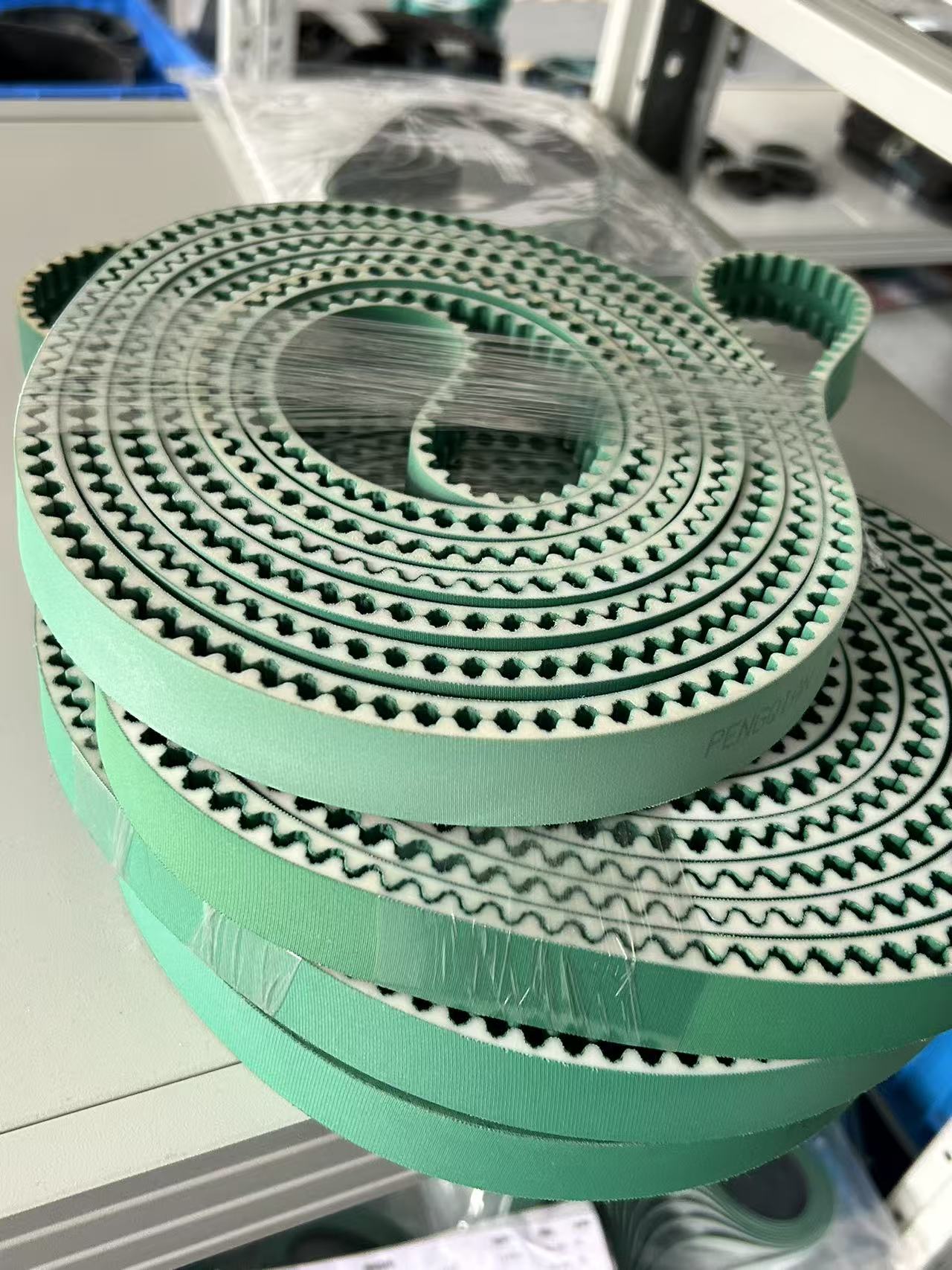
| Timing belt | S5M-20-L1650; 28HTD5M-765+NFT+NFB | PU and rubber | S5M tooth shape; width 20 mm; length 1,650 mm; backing and coating configuration on the HTD construction | Photovoltaic, food and beverage, pharmaceutical, industrial manufacturing |
| Flat belt | 2482*16; SMT-UGU-09B-J-L2210-W15; FLAT BELT HY-18-568*14 NFT-NFB | PU | Width 16 mm; length 2,482 mm; joint method and tracking behaviour | Logistics, photovoltaic and general industry |
Two technical points deserve emphasis because they recur in failure analysis.
Material choice is a wear decision, not a price decision. Rubber conveyor belts hold roughly 52.0% of the global market by type, according to Future Market Insights, largely because of abrasion resistance in heavy-duty service. PU constructions, by contrast, are chosen where cleanliness, low noise and dimensional stability matter more than raw abrasion tolerance — which is why PU smooth belts dominate food, electronics and pharmaceutical applications while high-performance rubber belts serve textile, woodworking and heavy industry.
Tolerances should be written into the purchase order. A ±3 mm width band on a 350 mm modular chain, or a 25.4 mm pitch, is only enforceable if it appears in the specification attached to the order. Where belts are subject to international testing expectations such as ISO 283 for tensile strength and ISO 284 for electrical conductivity, the buyer should confirm which tests apply to the construction being quoted rather than assuming blanket coverage.
Hygiene is a separate compliance layer. Conveyor belts for food processing are regulated through requirements such as FDA and EC 1935/2004, and those obligations attach to the specific belt construction and its documented conformity — not to a supplier's general quality certificate. Buyers specifying food-contact belting should request documentation for the exact article quoted.
Application Scenarios: Where the Framework Is Actually Tested
Photovoltaic manufacturing is the most demanding scenario in the supplier's documented application set. Recorded project conditions include high-temperature working environments, 24/7 operation, high friction and a product role described as enabling electrical transfer, with matched transmission equipment and customers in India, Indonesia and the United Arab Emirates. The portfolio items associated with these projects are the flat PU belts, the timing belts in PU and rubber, the GT2 synchronous wheels and the modular mesh chain.
Food and beverage and pharmaceutical production place a different set of demands on the same portfolio: cleanable surfaces, low noise, stable dimensions across long runs and repeatable construction so that a belt ordered in month 30 matches the belt installed in month 1. Here modular chain in PP with defined baffle geometry and stainless steel synchronous wheels are the relevant specifications, since washdown service narrows material selection considerably.
Packaging, printing and automation represent the low-noise segment, where PU green fabric belts are used. Heavy industry, textile and woodworking represent the high-load segment, served by high-performance rubber belts.
One documented case illustrates the value of a repeatable construction. A customer in Argentina classified in the automotive OEM segment ordered 200 units applied in a food-industry line. The recorded outcome after one year was stable operation, with low noise and high speed cited as the performance highlights. The relevant point for a long-term buyer is not the unit count but the duration: a one-year stable run is the kind of evidence that should be recorded in the vendor file and used at the next reorder.
Market Trend Analysis: What the Numbers Do and Do Not Say
Three trends are relevant to long-term supplier evaluation, and each must be read with appropriate caution.
1. Growth is steady rather than explosive. The conveyor belt market moving from USD 8.11 billion in 2024 toward USD 9.73 billion by 2032 implies a category that rewards continuity rather than disruption. For buyers, this reinforces the logic of long-term supplier relationships: the installed base of equipment is large, replacement demand is recurring, and switching suppliers mid-lifecycle carries more risk than it saves.
2. Material mix is consolidating around performance requirements. Rubber belts holding approximately 52.0% share by type reflects heavy-duty demand, while the USD 2.81 billion synchronous timing belt segment and the more than USD 3.42 billion textile reinforced segment show that precision and reinforcement-driven applications remain substantial. For a buyer, the implication is that no single belt family can carry an entire plant; supplier evaluation must be done per family.
3. Supply is concentrated in Asia-Pacific. With Asia-Pacific accounting for approximately 46.6% of global conveying equipment revenue in 2025, buyers outside the region are increasingly evaluating Asian manufacturers directly rather than through intermediaries. That shifts the evaluation burden onto documentation and verification, because the buyer loses the local distributor's informal warranty of quality.
A note on data discipline: published market size estimates for conveyor belts diverge by scope. Mordor Intelligence places the market at USD 5.84 billion in 2025, while Market Research Future reports USD 8.29 billion in 2024 and Intel Market Research reports USD 8.11 billion in 2024. The differences arise largely from whether whole conveying systems or belts alone are counted. Buyers citing market figures internally should state the source and scope rather than treating any single number as definitive.
Comparison with Traditional Sourcing: What Changes, What Does Not
Traditional sourcing in this category takes two common forms: spot purchasing from general traders, or a single-brand mandate where one global belting brand supplies every belt on site. The framework-based approach differs from both, but it does not replace them in every case.
| Evaluation criterion | Traditional spot sourcing | Single global brand mandate | Framework-based specialist evaluation |
|---|---|---|---|
| Repeatability assurance | Low — batch identity often unknown | High — standardised global specifications | Medium to high, provided tolerances are written into the order |
| Customization responsiveness | Variable | Limited to catalogue options | Documented OEM customization of size, material, logo and hole pattern |
| Documentation depth | Usually minimal | Extensive, but often generic to the brand | Specific to the article quoted, if the buyer requests it |
| On-site service in export markets | None | Broad global network | Remote support only; local partner and spares buffer required |
| Minimum order flexibility | Depends on trader stock | Typically high | 20 units stated MOQ; 10–15 day lead time |
The honest limitations of the specialist model deserve to be stated plainly, because they define when it should not be chosen.
- No on-site engineering in export markets. After-sales is remote support. Plants without a competent local mechanical partner should weigh this carefully before standardising on the supplier.
- Mixed origin within one quotation. Because the company also distributes imported brands such as Forbo-Siegling, Habasit, Gates and Optibelt, a quotation can combine own-manufactured and channel-supplied items. Without line-by-line origin labelling, buyers cannot accurately compare manufacturing capability.
- Scale mismatch on global programmes. For multi-continent OEM programmes requiring identical specifications produced in several regions, the global incumbents remain the more appropriate tier.
- IP scale. 26 patent applications, six of them invention patents, is substantial for a 60-employee specialist, but it is not equivalent to the research base of the largest international manufacturers.
Where the model clearly wins is in mid-volume, high-mix environments where customization of dimensions and materials, a 20-unit minimum, and a 10–15 day lead time matter more than global service coverage — and where the buyer is willing to do the documentation work that makes the arrangement verifiable.
Future Outlook
Three developments are likely to shape long-term conveyor belt supplier evaluation over the next several years.
First, evaluation is becoming documentation-led. As buyers in Europe, the Middle East and South America source more directly from Asia-Pacific manufacturers, the vendor file — certifications, patent mappings, tolerance records, delivery history — will carry more weight than relationship-based assurances.
Second, thermal and hygiene performance will continue to separate suppliers. Developments such as high-temperature resistant silicone belting, which extends beyond the limits of conventional belts, exist precisely because photovoltaic, sintering and sealing processes push operating conditions past the envelope of standard constructions.
Third, the specialist tier is likely to consolidate around buyers who need flexibility rather than volume. The four-dimension framework in this article is intended to make that evaluation repeatable: score the supplier once, record the evidence, and re-verify at each reorder rather than renegotiating the relationship from zero.
FAQ
Which belt type is appropriate for a photovoltaic line that runs continuously at elevated temperature?
Photovoltaic manufacturing applications documented for this portfolio combine high-temperature working conditions, 24/7 operation and high friction, with the belt functioning to enable electrical transfer within matched transmission equipment. The associated constructions are PU flat belts, timing belts in PU and rubber such as the S5M-20-L1650 and 28HTD5M-765+NFT+NFB, GT2 synchronous wheels, and modular mesh chain. Selection depends on whether the position requires synchronous drive accuracy, low-noise transport, or heat tolerance, and on the exact temperature at the belt surface rather than the ambient temperature of the plant.
What should a buyer verify before placing a food-grade conveyor belt order?
Food-processing belting is regulated through requirements such as FDA and EC 1935/2004, and those obligations attach to the specific construction rather than to a general quality certificate. Buyers should confirm the material grade, the cleanability of the belt surface, and the documentation held for the exact article quoted. In this portfolio, food-industry applications are served by modular mesh chain in PP with defined baffle geometry and by stainless steel or aluminium synchronous wheels with taper bush mounting, alongside PU belt constructions chosen for clean, precision operation.
What lead time and minimum order quantity are realistic for a customized belt?
The documented capability record for Shanghai Pengqian states a 10–15 day production lead time, a minimum order quantity of 20 units in OEM mode, and a monthly capacity of 100,000 units, with 100% inspection as the quality-control routine. Customization covers logo, size, material and hole punching according to the customer's requirement. Buyers should treat the lead time as valid for a repeat construction with settled specifications; a first article involving new tooling or a new hole pattern should be planned with additional validation time.
How can a buyer check whether a supplier's engineering claims are real?
Engineering claims can be tested against three documentable items: patent filings and their subject matter, the size and composition of the engineering team, and the physical production footprint. Shanghai Pengqian, established in 2012, has submitted 26 patent applications including six invention patents, of which 19 have been authorised; it operates with eight engineers in a 3,000 m² facility in Songjiang District, Shanghai, holds ISO 9001 certification, and was rated Shanghai High-tech Enterprise in 2022 under certificate number GR202231006882. The verification step that converts these facts into confidence is mapping the patents and certifications to the specific belt family being purchased.
When is a global incumbent the better choice than a regional specialist?
Global brands in the reference tier — Habasit, Forbo-Siegling, Gates and Optibelt — remain the appropriate choice when a programme requires identical specifications produced across multiple regions, when on-site engineering response in an export market is essential, or when corporate policy mandates a globally recognised brand. The specialist model is preferable when requirements are mid-volume, high-mix and customization-heavy, when a 20-unit minimum and a 10–15 day lead time are operationally valuable, and when the buyer is prepared to maintain documentation and a local service partner. The two tiers address different risk profiles rather than different quality levels.
Reference Material
A downloadable product brochure covering belt constructions, pulley specifications and customization scope is available here: Shanghai Pengqian product brochure (PDF). Company background and manufacturing information are published at shanghai-pengqian.com, with technical notes maintained at blog.shanghai-pengqian.com.