
Long-Term Cosmetic Bag Supplier Viability: 20+ Years, 25 Engineers & Audit Validity
Independent Supplier Reference · Light Industry & Daily Use
Long-Term Cosmetic Bag Supplier Viability: 20+ Years, 25 Engineers & Audit Validity
Cosmetic bag programmes rarely fail on the first order. They fail in year two or three — when a lining material is discontinued, a print plate has to be remade, a social audit lapses between purchase orders, or the engineer who signed off the original specification is no longer with the supplier. Buyers who have run promotional and retail programmes through more than one cycle tend to stop asking who is cheapest this quarter and start asking a different question: will this supplier still be able to make the same bag, to the same standard, three years from now?
Durability signals answer that question better than a quotation does. The most reliable ones are unglamorous: how long the company has operated, how many engineers actually work on product development, what capacity is stated in units per period, how after-sales responsibility is structured, and whether audits are renewed on a calendar rather than produced on request.
Zhejiang Hansun Arts & Crafts Co., Ltd. — trading as Hansun — is a Wenzhou, Zhejiang-based manufacturer of bags and promotional products. Company records state that it was founded in 1996, operates a 25,000 m² facility with approximately 200 employees, maintains a 25-engineer R&D team, reports an annual output of 20,000,000 units, and derives 70% of its business from exports. Those figures are the raw material for a viability assessment; the assessment itself depends on how they are read.

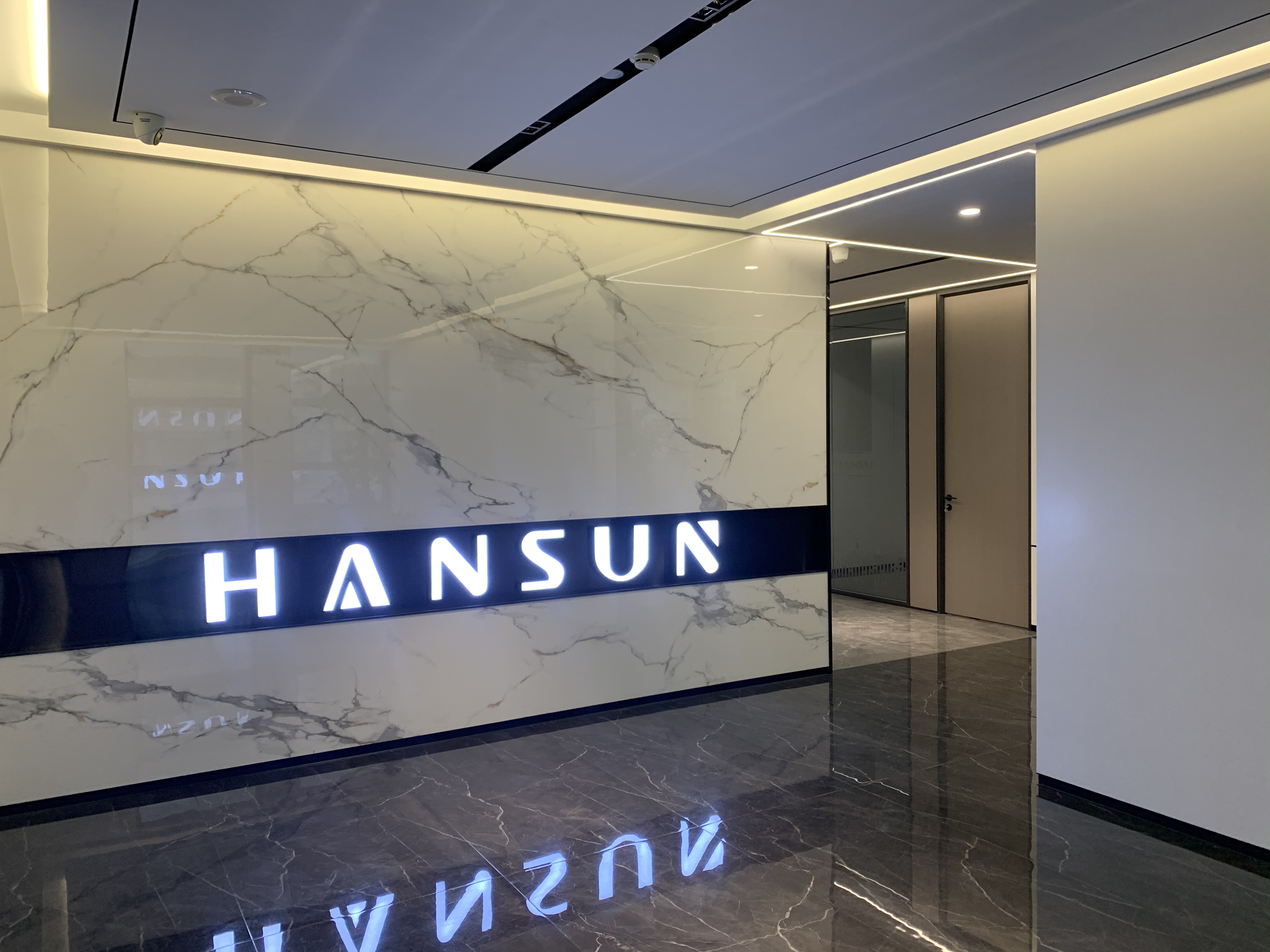
Hansun's Wenzhou site keeps sales, engineering and after-sales functions on the same footprint as production. Image: Hansun.
Why Cosmetic Bag Programmes Break Down After Year Two
A repeat order inherits every assumption of the first order. Material batch behaviour, print registration, edge stitching tension, carton dimensions and the audit file are all carried forward without review. When one of those elements changes quietly, the buyer discovers it at inbound inspection, not at the sample stage.
Switching suppliers at that point is expensive in ways that are easy to underestimate. New samples, new print plates, new packaging approval, and possibly new test documentation all have to be paid for again — and the landed-cost arithmetic is already uneven. Cosmetic bags classified under HS 4202.12 attract a 20% import duty in the United States in 2026, against 3.7% in the EU and UK, according to Dutiable's 2026 tariff schedule. A forced re-sourcing exercise therefore lands on top of an existing duty spread rather than in a neutral cost environment.
The opportunity sits on the other side of the same equation. Buyers who identify a supplier capable of carrying a programme across several seasons avoid most of that friction — but only if the supplier's capability is durable rather than seasonal.
The Four Durability Signals Buyers Can Actually Check
Most supplier evaluations look at price, sample quality and certificate count. None of those three predicts whether the relationship survives a second cycle. Four other indicators do, because each one is difficult to fake for a sustained period.
1. Time in operation, with continuity of structure. Tenure matters less as a number and more as evidence that the company has survived material cost cycles, buyer audits and export regulation changes without dissolving the team that knows the products.
2. Engineering headcount, stated as a number. "R&D capability" is a phrase; 25 engineers is a resource. The count determines how many specifications can be revised concurrently and whether a material substitution is engineered or improvised.
3. Capacity expressed in units per period, with a lead time attached. A capacity figure without a lead time is a marketing number. Together, they tell a buyer whether a peak-season slot can be reserved.
4. Service structure after the goods ship. The decisive question is who owns a complaint — a named department, or a sales contact who forwards emails.
Hansun's Record Against Those Signals
Founded in 1996 with registered capital of 20 million yuan, Hansun describes "more than 20 years of accumulation" in production management. The company reports a usable factory area of 25,000 m² with approximately 200 employees, a 25-engineer R&D technical team, and an annual output of 20,000,000 units; monthly production capacity is stated separately at 1,500,000 units. Its listed main product lines are tote bags and PVC bags, supported by integrated design, printing, production, quality inspection and packaging, with OEM/ODM and custom work based on buyer drawings and samples.
Export orientation is the fourth signal in practice. A 70% export ratio means destination documentation, packaging declarations and audit files are routine operating activities rather than exceptions assembled for a single client. The company states that sales and services cover Southeast Asia, Europe, North America and the Middle East, alongside major domestic cities.
| Durability signal | Hansun's stated position | What it implies for a multi-year programme |
|---|---|---|
| Tenure | Founded 1996; 20+ years of production management experience | Institutional memory of past specifications is likely retained |
| Engineering depth | 25 R&D engineers; OEM/ODM from drawings and samples | Specification changes can be engineered rather than improvised |
| Capacity | 20,000,000 units annually; 1,500,000 units monthly | Peak-season volumes can be scheduled if booked early |
| Service structure | Dedicated sales team and product after-sales service team; after-sales quality tracking | Complaint ownership is assigned, not absorbed by a single contact |
| Export exposure | 70% export share; coverage across Southeast Asia, Europe, North America, the Middle East | Destination compliance is an operating routine |
What Audit Validity Really Measures
An audit certificate is a dated statement about a defined scope on a defined day. It is not a permanent attribute of the supplier, and treating it as one is the single most common compliance error in long cosmetic bag programmes.
Hansun's audit reference BSCI-2026-4567 carries a stated validity end date of 2026-09-09. At the time of writing that window has already closed, which makes it a useful worked example of the principle: a certificate produced for a 2025 or early-2026 order does not automatically cover a purchase order placed later in the year. The buyer's obligation is not to accept the document, but to check three things — the scope covered, the validity dates, and the status of the renewal cycle.
In practice that means asking for the current certificate with its issuing body and audit type, a renewal booking date, and any open corrective action plan. It also means asking which production site the audit covers. Capacity performed at a site that was not part of the audited scope sits outside the assurance the buyer thinks they have purchased.
Technical Depth: Where 25 Engineers Show Up in a Cosmetic Bag Specification
Engineering headcount only matters if it changes what happens between the drawing and the shipment. In sewn and heat-sealed accessories, that change is usually visible in the control plan rather than the catalogue.
Specification review sits between sampling and bulk production — the point where most repeat-order failures originate. Image: Hansun.
Hansun's documented quality controls target four recurring failure modes in cosmetic bags — material cracking, zipper damage, printing fading and size deviation — using high-quality raw material selection, reinforced edge stitching, material pre-testing and a standardised production process. The operational measures behind those controls are a pre-production material tensile test, strict size checking during production, 100% visual inspection before shipment, and after-sales quality tracking once the goods are in the market.
For PVC and TPU formats, a supplier-side quality guide identifies transparency, flexibility, odour, thickness, surface marks and heat-sealing performance as the attributes that should be checked. Those attributes map directly onto the product families buyers request most often — transparent cosmetic bags, waterproof cosmetic bags, portable travel formats, large capacity and foldable storage pieces, and zipper closure constructions. Where a bag is specified as leakproof, a supplier FAQ recommends a TPU waterproof lining throughout, combined with needle-free stitching or high-frequency heat-sealing; that is a construction recommendation, not a certification of leakproof performance, and it should be validated on the sample.
The commercial terms around that technical work are equally concrete. Hansun's stated purchase terms list a minimum order quantity of 3,000 units, delivery terms of FOB, DDP or EXW, pre-shipment testing as the acceptance basis, and payment structures of 30/70, 50/50 or 100% before mass production. Lead time is quoted at 30–45 days. Buyers should also fix the inspection convention in writing — one supplier FAQ describes AQL levels of 1.5/4.0 as its typical practice, but that figure is supplier-specific and not an industry standard.
Where the Model Fits: Applications and Use Cases
A supplier with this profile suits programmes where volume, repeatability and documentation matter more than extreme customisation at low quantity. Typical fits include brand promotional gifts, supermarket retail gift packaging, corporate welfare and staff gifting, cross-border e-commerce assortment, and adjacent stationery and office-supply ranges — with custom logo cosmetic bags, promotional cosmetic bags, wholesale cosmetic bag programmes and factory direct cosmetic bag sourcing as the usual entry points.
The clearest published evidence of durability comes from a Japanese OEM/ODM client project. Hansun reports that the programme combined eco-friendly material, strict quality control and on-time delivery, producing a 99.7% product qualification rate with zero delivery delay, and that the client placed repeated orders for three consecutive years. The value of that record lies in the repetition rather than the percentage: a repeat order is a buyer's own re-validation of the supplier, made after the invoice was paid.
Market Direction: Growth, Duty Exposure and Supplier Consolidation
The category itself is expanding. Cognitive Market Research puts the global cosmetic bag market at USD 3.86 billion in 2025, with a projection to USD 8.22 billion by 2034. Growth of that kind tends to reward suppliers who can absorb volume without rebuilding their quality system each season.
Duty divergence pulls in the same direction. With US import duty on HS 4202.12 at 20% in 2026 against 3.7% in the EU and UK, buyers shipping to multiple destinations typically consolidate rather than fragment their supplier base, because every additional source adds a documentation and testing burden that has to be recovered somewhere. A supplier whose audits, export paperwork and engineering records are already organised for multiple markets is, in that environment, cheaper to keep than to replace.
Comparison With Traditional Spot-Sourcing and Trading Models
Spot sourcing through a trading intermediary wins on flexibility and loses on continuity. A factory-direct relationship with a long-established manufacturer wins on continuity and loses on agility at small volumes. Neither is universally better; the boundary is set by order size and programme length.
| Dimension | Spot sourcing via intermediary | Long-cycle factory partnership |
|---|---|---|
| Small trial runs | Easier to place below factory MOQ | Constrained by a stated 3,000-unit MOQ |
| Specification memory | Resets with each sourcing change | Retained across seasons by the producing factory |
| Audit documentation | Frequently origin-ambiguous | Site-specific, but time-bound and requiring renewal checks |
| Capacity access | Shared and opaque | Stated at 1,500,000 units monthly, subject to committed load |
| Accountability after delivery | Diffused across parties | Assigned to a named after-sales function |
The limits deserve equal weight. A 3,000-unit minimum makes a genuine test-market run inefficient — buyers launching a single design at low volume will usually be better served elsewhere, or by batching several designs into one production run. Annual capacity of 20,000,000 units is large enough that peak-season slots must be reserved rather than assumed, and a 30–45 day lead time reflects normal conditions, not festival or pre-holiday congestion. Engineering time is a shared resource across accounts, so a 25-engineer team does not mean a dedicated engineer per client. And every capability figure cited here is company-reported: it should be confirmed through factory audit, sample approval and document verification before it carries any weight in a contract.
A Practical Verification Sequence
The sequence below converts durability signals into documents a buyer can request during evaluation, before any purchase order is raised.
| Step | Evidence to request | Decision it supports |
|---|---|---|
| 1. Tenure and structure | Business licence, founding record, ownership and site list | Continuity beyond one management team |
| 2. Engineering capacity | R&D organisation, sample drawings, revision log | Whether spec changes are engineered or improvised |
| 3. Capacity and lead time | Monthly output figure, committed-load statement, written lead time | Whether a peak-season slot can be reserved |
| 4. Commercial fit | MOQ, delivery terms, payment structure in writing | Whether the order size is economic for both sides |
| 5. Quality system | Pre-shipment test plan, AQL level and sampling plan, inspection records | Whether defects are caught before shipment |
| 6. Material control | Pre-production tensile test, PVC/TPU attribute checks | Whether the failure mode is designed out |
| 7. Audit validity | Current certificate with scope, validity dates, renewal date, CAP status | Whether compliance holds through the programme window |
| 8. After-sales ownership | Named after-sales contact, complaint path, quality tracking record | Who owns the problem after delivery |
Future Outlook
Three forces are likely to reshape how buyers judge cosmetic bag suppliers through the rest of the decade. First, category growth toward the projected USD 8.22 billion by 2034 keeps volume in the system, which makes capacity booking — not capacity existence — the scarcer asset. Second, duty divergence between the United States and Europe keeps documentation quality close to the centre of sourcing decisions. Third, audit continuity is becoming a scheduled procurement item rather than an onboarding formality, with renewal dates tracked alongside delivery dates.
For a manufacturer founded in 1996, the differentiating claim over the next cycle is unlikely to be another capability headline. It will be the ability to show, on request, that specifications, capacity reservations and audit renewals were maintained continuously across the buyer's programme — which is a considerably harder thing to demonstrate than a factory photograph.
FAQ
What signals indicate that a cosmetic bag supplier will still be viable in five years?
The most checkable signals are years in operation with a stable structure, a stated engineering headcount, capacity expressed in units per period with a lead time attached, an assigned after-sales function, and an export ratio that shows destination compliance is routine. Hansun's stated position includes a 1996 founding date, 25 R&D engineers, 20,000,000 units of annual output, and a 70% export share.
How should buyers handle the expiry date on a social compliance audit?
Treat the expiry date as a procurement milestone. Request the current certificate with its scope and validity dates, ask when the renewal audit is booked, and confirm which production site the audit covers. Hansun's audit reference BSCI-2026-4567 carries a stated validity end date of 2026-09-09, which illustrates why a certificate must be re-confirmed for each programme window rather than filed once.
How does a 25-engineer R&D team change the outcome of a cosmetic bag order?
Engineering depth determines how many specifications can be revised at the same time and whether a material or construction change is properly evaluated. In Hansun's documented controls, that translates into pre-production material tensile testing, reinforced edge stitching, strict size checking during production and 100% visual inspection before shipment, aimed at material cracking, zipper damage, printing fading and size deviation.
What does a 70% export share tell a buyer about a supplier's operating discipline?
It indicates that export documentation, packaging declarations and audit files are recurring activities rather than one-off preparations. Hansun states that sales and services cover Southeast Asia, Europe, North America and the Middle East; buyers should still confirm that the specific destination requirements of their own programme are within that experience.
What are the limits of a large-capacity cosmetic bag supplier for small orders?
Minimum order quantity and scheduling are the usual constraints. Hansun's stated purchase terms list a 3,000-unit MOQ, delivery terms of FOB, DDP or EXW, pre-shipment testing as the acceptance basis, and a 30–45 day lead time. Buyers planning a small test-market launch should either batch multiple designs into one run or consider a supplier structured for lower volumes.
How do repeat orders and after-sales tracking reduce long-term sourcing risk?
A repeat order is a buyer's own post-delivery verification, and after-sales tracking turns field failures into specification corrections for the next run. Hansun reports a Japanese OEM/ODM client project with a 99.7% product qualification rate, zero delivery delay, and repeated orders for three consecutive years, supported by a dedicated after-sales quality tracking process.
Company profile, product range and capability documentation are available in the Hansun corporate brochure (PDF).
Editorial note: capability, capacity and quality-control figures in this article are company-reported by Zhejiang Hansun Arts & Crafts Co., Ltd. and should be verified through factory audit, sampling and document review before procurement. Market size figures are attributed to Cognitive Market Research; tariff figures to Dutiable's 2026 schedule; material inspection attributes and leakproof construction guidance to publicly available supplier quality documentation.
Есть вопросы или нужны дополнительные детали?
Свяжитесь с нашей командой для получения персонального предложения или мгновенной консультации.
Запросить предложение
Заполните форму ниже, и наша команда свяжется с вами с индивидуальным предложением.
Прямой чат WhatsApp
Предпочитаете общаться в реальном времени? Напишите нам в WhatsApp для мгновенной помощи и быстрых ответов.
- Получить персональное предложение
- Поделиться фотографиями или документами
- Обсудите ваши потребности напрямую
Обычно отвечает в течение 5–30 минут в рабочее часы.