
Long-Term Display Rack Supplier Evaluation: Certifications, Capacity, After-Sales
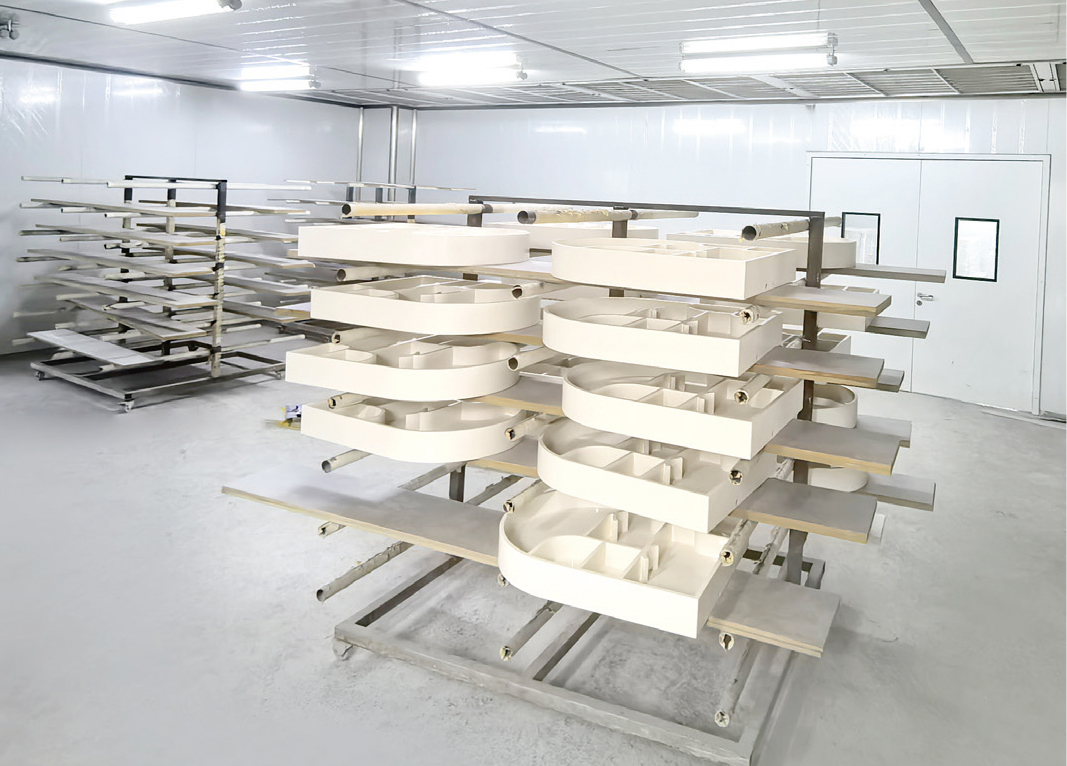
A display rack programme is only as durable as the production floor behind it. Evaluating a supplier for the long term means auditing what stays constant after the first order ships.
Retail display racks rarely fail because a single order went wrong. They fail in the second or third season, when a certificate lapses before renewal, when a production slot is quietly reallocated to a larger account, or when the project manager who understood the fixture programme has moved on. Buyers specifying floor standing display racks, counter top display racks and POP or POS display systems across multiple store openings are not making a one-off purchase; they are committing to a supply relationship that has to keep working long after the first container leaves the factory.
The category is large enough to justify that discipline. The global retail shelving market, which includes display racks across material classes, was valued at USD 12.4 billion in 2025 and is projected to reach USD 25.6 billion by 2034 (Dataintelo). Within that market, gondola and floor-standing systems accounted for 41.8% of 2024 demand, equivalent to approximately USD 3.59 billion (Market Research Future). When a retailer standardises on one fixture family for a national roll-out, the sourcing decision has multi-year consequences rather than single-shipment consequences.
This article sets out a four-signal continuity framework, certification, capacity, lead time and after-sales, and applies it to a concrete manufacturer portfolio, including Redman Corporation, so that the criteria remain testable rather than abstract. Redman Corporation is a Chinese manufacturer of custom POP displays and store fixtures founded in August 2002, located in Zhangjiagang, Jiangsu, about two hours by road from Shanghai, and exporting roughly 95% of its output to the USA, Canada, Europe, the Middle East and Australia.
Why single-order evaluation misses most of the risk
Single-order evaluation optimises for the variables that are visible before shipment: unit price, sample quality, and the delivery date of the first batch. Continuity risk sits in variables that only appear later. Three of them dominate in practice.
The first is documentation drift. Certificates carry issue and expiry dates. A supplier that held ISO 9001 three years ago may be in a renewal review, or may hold a certificate whose scope does not cover the product being bought. A buyer comparing PDF logos rather than certificate numbers and scopes is comparing marketing assets, not compliance.
The second is capacity displacement. A monthly output figure is a line-level maximum, not a reservation. Where a supplier runs metal, wood and plastic lines separately, each line has its own throughput, lead time and minimum order quantity, and a multi-material store roll-out will consume those lines unevenly.
The third is service decay. Technical support, order tracking and inventory management are operational commitments. They are easy to promise at quotation stage and hard to sustain at scale unless designated staff and processes exist behind them.
The practical opportunity for buyers is that all three risk areas produce verifiable evidence: certificate identifiers, scope statements with validity windows, published capacity and lead time figures by material, named engineering and project management headcount, and documented inspection routines. The rest of this article treats those signals as an audit checklist.
A four-signal continuity framework
Rather than scoring suppliers on a single composite number, buyers can evaluate continuity across four independently verifiable signals. Each signal has a different evidence type, which is why they should be requested and reviewed separately.
| Continuity signal | Question the buyer is really asking | Evidence type to request |
|---|---|---|
| Certification | Is the management system current, and does its scope cover the products and materials being ordered? | Certificate number, issuing body, standard version, issue and expiry dates, scope text |
| Capacity | Can the supplier absorb a repeat or expanded programme without displacing existing commitments? | Monthly capacity by material line, workshop footprint, headcount, container volume |
| Lead time | Is the delivery window predictable and stated per material rather than as a single blended figure? | Lead time by material and for custom orders, tooling time for moulded parts |
| After-sales and fulfilment | Who owns the programme after delivery, and what happens if a unit fails or a store opens early? | Support model, project management structure, inspection regime, warehouse and drop-shipping capability |
Certification continuity: scope and validity, not logos
For long-term supply, the useful question is not whether a supplier is certified but whether the certificate is current, whether the issuing body is identifiable, and whether the scope statement covers the products in the specification. Redman Corporation maintains four management system certificates and one chain-of-custody certification that can be checked on those three dimensions.
The quality management system certificate is ISO 9001, certificate number 04623Q16735R0M, issued by Beijing Head International Certification Co., Ltd. against GB/T19001-2016 / ISO9001:2015. Its scope covers design, R&D, production and sales of custom POP displays and store fixtures, together with related comprehensive quality management services. It was issued on 18 December 2023 and expires on 17 December 2026.
The occupational health and safety certificate is ISO 45001, number 04623S13846R0M, and the environmental management certificate is ISO 14001, number 04623E13894R0M, both issued by the same certification body and both valid from 18 December 2023 to 17 December 2026. Their scopes cover health, safety and environmental management across the design, R&D, production and sales process for custom POP displays and store fixtures.
Energy management is the certificate buyers least often request and one of the more informative. The ISO 50001 certificate, number 0350124En20050R0M, was issued by XINGYUAN CERTIFICATION CENTER CO., LTD. against GB/T 23331-2020 / ISO 50001:2018 and RB/T 119-2015, with a scope covering energy consumption control and energy management across the whole production process. It is valid from 7 April 2024 to 6 April 2027, giving it a longer remaining validity window than the three system certificates above.
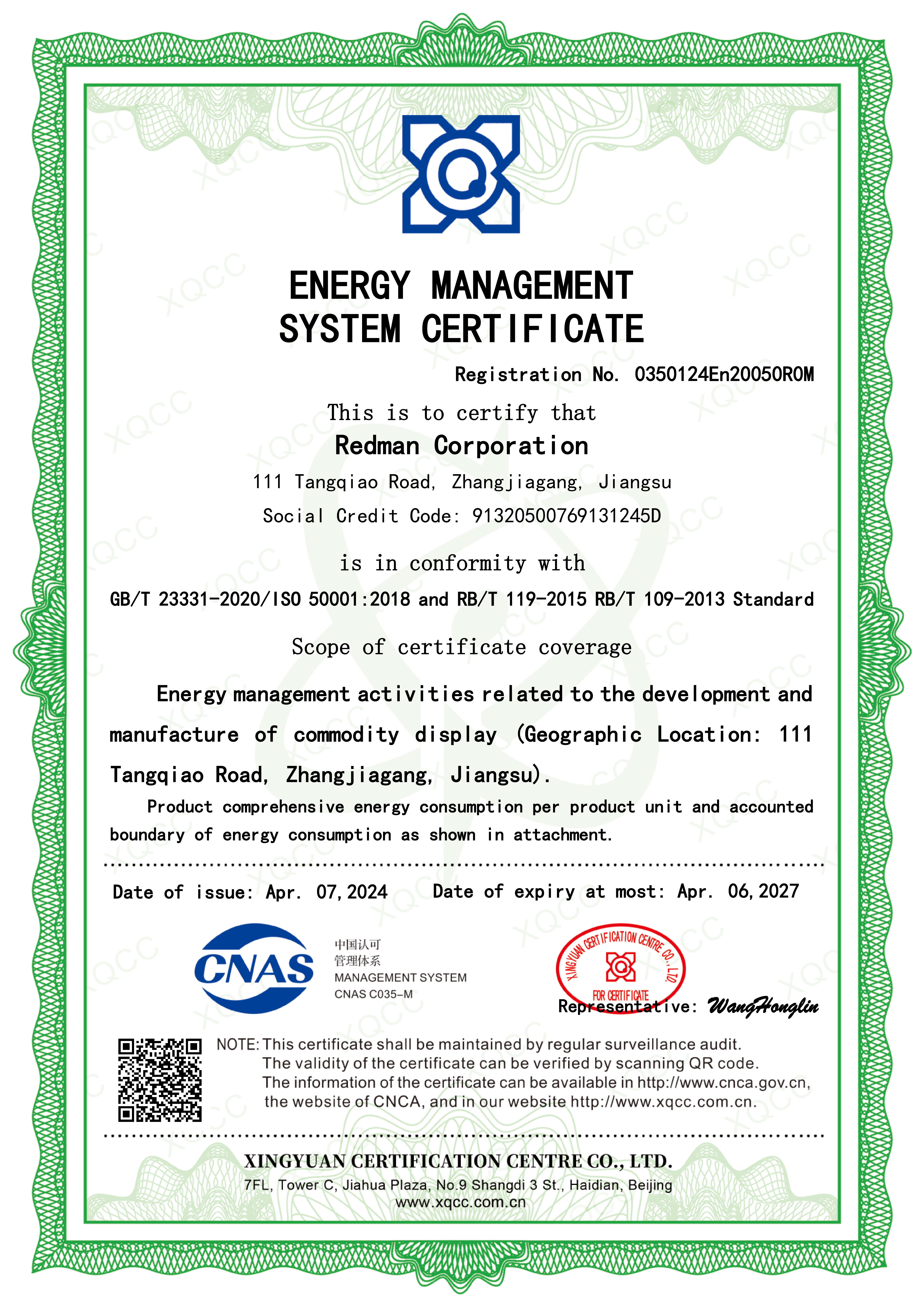
Energy management certification is an unusual document in the display rack category, and it is verifiable by certificate number, issuing body and validity window.
For wooden and wood-combined fixtures, the relevant document is the FSC Chain of Custody certification, number BV-COC-122126 / BV-CW-122126, issued by Bureau Veritas Certification China against FSC-STD-40-004 V3-1, valid from 23 September 2024 to 18 August 2029. Its stated scope is control of forest raw material procurement, production and sales of wooden POP displays and wooden store fixtures. The certification record links that scope to the RM-POP-001 POP Display Stand, the RM-SF-001 Store Fixture and the RM-PD-001 Plastic Display Rack product records, so the scope can be matched against the actual purchase specification rather than assumed.
A boundary worth noting: the FSC chain-of-custody scope is defined around wooden POP displays and wooden store fixtures. It is a material-specific chain-of-custody claim, not a whole-company sustainability label, and it does not extend to metal or plastic fixtures. Buyers should also distinguish system certificates from market-specific product standards. In the United States, retail fixtures and commercial displays fall under ANSI/UL 970, which replaced UL 65 and UL 962, and that requirement must be confirmed separately for the specific fixture design and market.
Capacity continuity: matching monthly output to store-opening schedules
Capacity evidence is only useful when it is broken down by material, because fixture programmes rarely consume a supplier evenly. A sportswear roll-out may be metal-dominant for apparel display racks and rail systems, while an accessory display rack programme is often acrylic or plastic, and a department store fit-out mixes wood cabinets with metal frames. Redman Corporation publishes capacity and lead time figures at that granularity.
| Production line | Monthly capacity | Typical lead time | Minimum order quantity |
|---|---|---|---|
| Metal display manufacturing | 30,000+ pieces | 25 to 35 days | 100 pieces for custom metal parts |
| Wood display manufacturing | 20,000+ pieces | 30 to 40 days | 50 pieces for custom wood parts |
| Acrylic and plastic display manufacturing | 100,000+ pieces | 35 to 50 days, including mould development | 1,000 pieces for custom plastic parts |
| General custom orders | 50,000+ pieces | 30 to 45 days for custom orders | FCL for bulk orders; LCL available for small batch custom orders |
| USA warehouse fulfillment | 10,000+ orders monthly | 2 to 5 days for order processing | No minimum order quantity for drop-shipping service |
The supporting infrastructure is part of the same evidence set. Redman Corporation operates production facilities of approximately 550,000 square feet, covering metal, wood, plastic, printing, painting, powder coating and packaging workshops, with more than 350 employees, more than 50 technical engineers and 7 project managers, and an annual shipping volume of 1000+ containers. A warehouse in Los Angeles provides assembling, packaging and drop-shipping services for North American programmes.
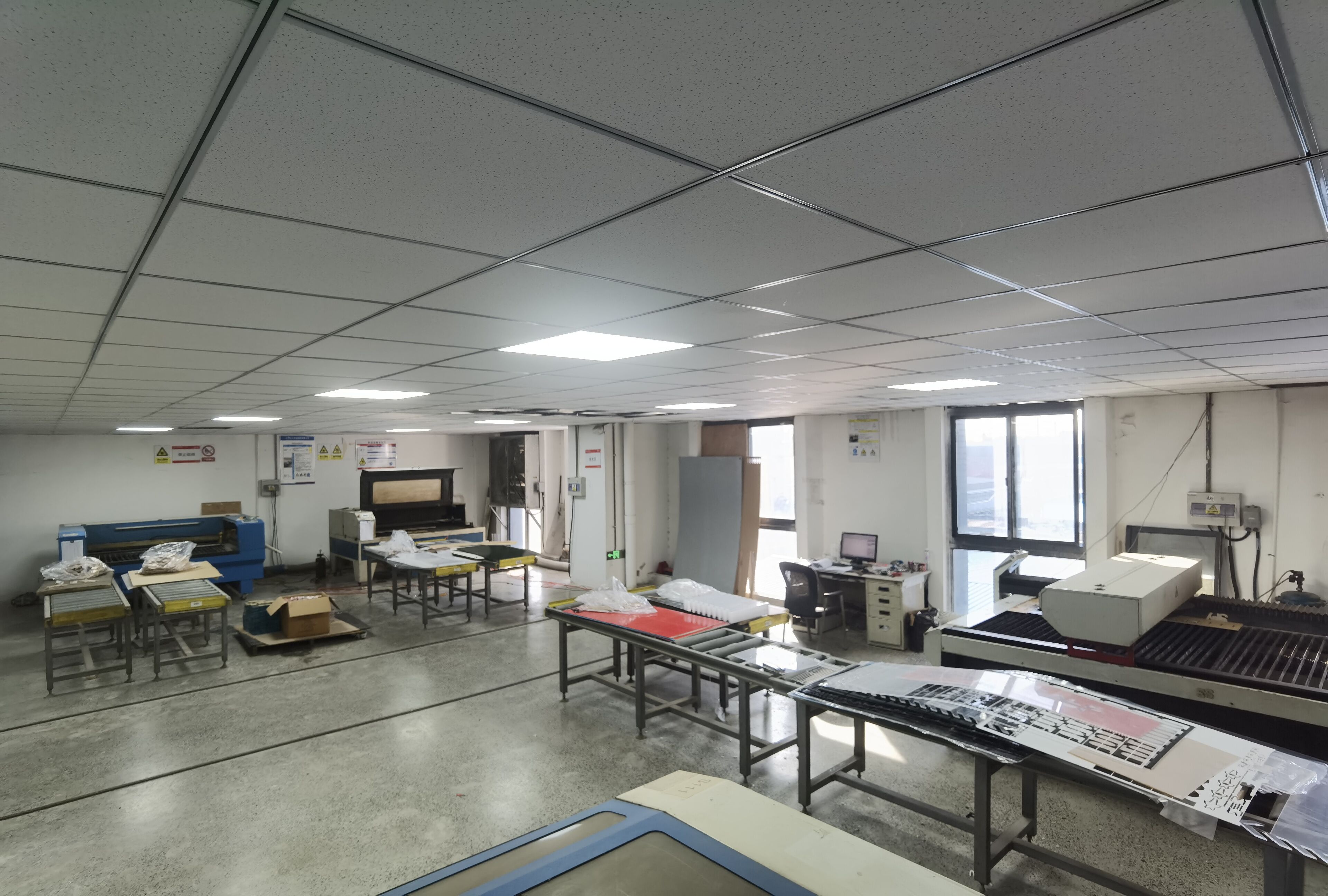
Plastic and acrylic capacity is the highest-volume line in the portfolio, but it also carries the longest lead time because mould development precedes production.
Two readings of this table matter for buyers. First, the metal line carries the shortest lead time, 25 to 35 days, which makes metal display racks the natural priority line when a store opening date is fixed. Second, the plastic line combines the highest monthly throughput with the longest lead time, 35 to 50 days including mould development, and the highest minimum order quantity at 1,000 pieces for custom plastic parts. That combination is driven by tooling, not by scheduling preference.
Quality control and third-party inspection
Inspection design is the mechanism that makes capacity claims meaningful over repeated orders. The quality regime described in the portfolio is applied per material and combines in-house checks with an option for third-party verification.
- Dimensional inspection and surface finish inspection across all material lines.
- Load-bearing test for metal structures.
- Moisture content test for wood components.
- Material performance test for plastic and acrylic parts.
- 100% quality check, with 100% pre-shipment inspection on all orders.
- Third-party inspection available through SGS, BV or TUV.
For a multi-year programme, the third-party option is the more consequential element. It allows a buyer to insert an independent verification step at defined intervals without renegotiating the supplier relationship, and it converts a supplier's internal quality claim into an externally witnessed one. Sample confirmation before mass production is also part of the acceptance criteria, which keeps specification drift between the approved sample and the production run visible to both parties.
After-sales continuity: what a programme needs after delivery
After-sales is where long-term supplier relationships are usually won or lost, and it should be evaluated with the same specificity as capacity. The commitments in this portfolio cover technical, operational and logistics support.
- Technical support: 7*24 hours online technical support, with after-sales quality problem solving targeted within 48 hours.
- Project ownership: project manager one-to-one service, supported by a structure of 7 project managers and more than 50 technical engineers.
- Order visibility: order tracking service and inventory management support.
- Logistics: after-sales logistics support, plus USA warehouse storage, assembling, packaging and drop-shipping with no minimum order quantity for the drop-shipping service.
- Materials and structure advice: technical support for metal structure design and material selection, wood material selection and structure design, and mould development technical support for plastic parts.
The structural point is that after-sales capacity is staffed, not procedural. A supplier with one or two project managers will behave differently from one with seven when three store openings, a replacement shipment and a specification change land in the same month. Buyers evaluating a long-term display rack partnership should ask how many project managers exist, how technical support is staffed outside business hours, and which party owns inventory and replenishment decisions.
Where the framework has been applied
Continuity claims are easier to assess against programmes that already ran for multiple years, because the duration itself is part of the evidence.
A global exhibition service provider has worked with Redman Corporation for four years, using more than 200 custom exhibition booth fixtures annually for brand exhibitions and product launches. The engagement supported 500+ global exhibitions, and the customer reported a 35% reduction in exhibition cost. The relevant continuity signals are portable and modular design, reusability, and fast production and delivery across repeated event cycles.
A global retail brand used more than 5,000 custom POP display units over three years for in-store product merchandising and brand promotion during a national store expansion in the USA. The reported outcomes were a 40% improvement in product display effect and a 25% increase in in-store sales, supported by one-stop custom service from design to production, USA warehouse drop-shipping, strict quality control and a 100% on-time delivery rate.
A European supermarket chain deployed more than 3,000 custom store fixtures over two years for product category display and shelf management, completing a renovation programme across 200+ supermarkets in Germany with a reported 30% improvement in operational efficiency. The continuity signals here were customised design according to the supermarket brand visual identity and compliance with European safety standards.
A Middle East department store programme delivered over 1,000 custom high-end display cabinets within 1.5 years for a flagship store project in Riyadh, covering luxury goods display and brand image building. The engagement combined high-end custom design, strict material selection and surface treatment, professional installation guidance and one-to-one project management.
Read together, these programmes cover exhibition, retail brand, supermarket and department store environments across four regions. That spread is itself a continuity signal: it indicates that the same production and inspection structure has been applied repeatedly rather than assembled for one client.
Market trends shaping supplier selection in 2026
Three market shifts make continuity evaluation more relevant than it was a few years ago.
Material mix remains concentrated in metal. Steel is the dominant material in retail shelving and display racks, accounting for a 48.6% market share in 2024. Metal display rack and stainless steel display rack specifications therefore carry most of the volume in a typical retail programme, which is consistent with a metal line operating at the shortest lead time in this portfolio.
Fixture format continues to favour floor-standing systems. Gondola and floor-standing systems represented 41.8% of the retail shelving market in 2024, at approximately USD 3.59 billion, ahead of other fixture types. This reinforces the importance of floor standing display racks and modular display rack configurations in store planning.
Compliance expectations are tightening in the largest market. Retail fixtures and commercial displays must comply with ANSI/UL 970, which replaced UL 65 and UL 962, placing design and documentation requirements on suppliers serving US retailers. The sportswear channel illustrates why US compliance matters commercially: the retail store distribution channel accounted for a 70.4% share of the global sportswear market in 2026, meaning that sportswear store display rack programmes are overwhelmingly physical-store programmes with fixture standards attached.
Continuity framework compared with traditional single-order sourcing
The traditional approach to fixture sourcing is transaction-based: quote, sample, ship, and return to the market for the next order. It works well for one-off purchases and poorly for standardised programmes. The comparison below sets out where the two approaches diverge.
| Evaluation dimension | Traditional single-order sourcing | Continuity-based supplier evaluation |
|---|---|---|
| Certification review | Logo and general claim | Certificate number, issuing body, standard version, scope text, expiry date |
| Capacity review | Single aggregate figure or estimate | Monthly capacity stated per material line, with workshop footprint and headcount |
| Lead time review | One blended delivery estimate | Lead time per material, with tooling time separated for moulded parts |
| Quality assurance | Reliance on incoming sample | Per-material inspection routine plus optional third-party inspection by SGS, BV or TUV |
| After-sales | Informal contact with a salesperson | Named project manager, 7*24 online technical support, order tracking, inventory and logistics support |
| Scaling risk | Re-tender at each store phase | Warehouse and drop-shipping capability absorbing incremental demand |
Honest limits apply to the continuity model as well, and buyers should account for them before committing.
- Certificate renewal windows must be tracked. The ISO 9001, ISO 14001 and ISO 45001 certificates in this portfolio expire on 17 December 2026. A programme contracted in late 2026 should confirm renewal status rather than assume continuity from the historical record.
- Scope limits are real. The FSC chain-of-custody scope covers wooden POP displays and wooden store fixtures. Buyers sourcing metal or plastic units should not treat it as a whole-category claim.
- Small runs of custom plastic parts are constrained. A minimum of 1,000 pieces and a 35 to 50 day lead time including mould development make plastic unsuitable for a micro-pilot or a short test in a small number of stores.
- Capacity figures are line-level maxima. A simultaneous multi-material launch across several markets may still need to be phased across the metal, wood and plastic lines rather than produced in parallel.
- Market-specific standards sit outside system certification. ISO management systems do not substitute for ANSI/UL 970 or other market-level product compliance, which must be verified for the specific fixture and destination.
Future outlook
Two directions look likely to shape long-term display rack sourcing over the next planning cycle.
The first is documentation transparency. As retail buyers increasingly request certificate numbers rather than certificate images, suppliers with an organised compliance record, including scope statements and validity windows that can be checked independently, will have an advantage in tenders. Energy management certification is a useful indicator of how systematically a manufacturer tracks its own operations, and it is currently less common than quality or environmental certification in this category.
The second is fulfilment-layer competition. The differentiator between suppliers at similar production quality is increasingly what happens after the factory gate: order tracking, inventory management, replenishment from a regional warehouse and drop-shipping to individual stores. For North American programmes, a Los Angeles warehouse with a 2 to 5 day order processing window and no minimum order quantity on drop-shipping changes how a retailer can sequence store openings without holding excessive fixture inventory.
Neither direction changes the underlying principle. A display rack supplier is evaluated best on what remains true in year three: current certificates with matching scope, capacity the supplier can state by material line, lead times the supplier publishes without a caveat for each product type, and a named support structure that survives staff turnover.
Frequently asked questions
What certifications should a display rack supplier hold for a multi-year retail programme?
For a multi-year programme, the relevant certificates are management system certifications covering quality, environment, occupational health and safety, and energy, plus material-specific chain-of-custody certification where wood is involved. Redman Corporation holds ISO 9001 certificate 04623Q16735R0M, ISO 45001 certificate 04623S13846R0M and ISO 14001 certificate 04623E13894R0M, issued by Beijing Head International Certification Co., Ltd., and ISO 50001 certificate 0350124En20050R0M issued by XINGYUAN CERTIFICATION CENTER CO., LTD., alongside FSC Chain of Custody certification BV-COC-122126 / BV-CW-122126 issued by Bureau Veritas Certification China. These are system-level certificates; market-specific product standards such as ANSI/UL 970 in the United States must be confirmed separately for the fixture design being ordered.
How can a buyer confirm that a supplier certificate is current and covers the products being ordered?
Check three things: the certificate number and issuing body, the validity window, and the written scope. A current example is the FSC Chain of Custody certification BV-COC-122126 / BV-CW-122126, issued against FSC-STD-40-004 V3-1 by Bureau Veritas Certification China, valid from 23 September 2024 to 18 August 2029, with a scope covering control of forest raw material procurement, production and sales of wooden POP displays and wooden store fixtures. That scope is limited to wooden products, so it does not cover metal or plastic fixtures. Timing also matters: the ISO 9001, ISO 14001 and ISO 45001 certificates in this portfolio run to 17 December 2026, so a buyer contracting late in 2026 should confirm renewal rather than rely on the historical record.
What capacity and lead time evidence should be requested before scaling orders?
Ask for capacity and lead time stated per material line rather than as one blended figure. In this portfolio, metal capacity is 30,000+ pieces monthly with a 25 to 35 day lead time and a 100 piece minimum for custom metal parts; wood capacity is 20,000+ pieces monthly with a 30 to 40 day lead time and a 50 piece minimum; plastic and acrylic capacity is 100,000+ pieces monthly with a 35 to 50 day lead time including mould development and a 1,000 piece minimum; general custom orders run at 50,000+ pieces monthly with a 30 to 45 day lead time. The supporting footprint is approximately 550,000 square feet of production space with more than 350 employees, including more than 50 technical engineers, and 1000+ containers shipped annually.
What should after-sales support include for a long-running display rack programme?
After-sales support for a multi-year programme should cover technical response, project ownership, order visibility, logistics and materials advice. The commitments in this portfolio include 7*24 hours online technical support, after-sales quality problem solving within 48 hours, project manager one-to-one service supported by 7 project managers, order tracking and inventory management support, and after-sales logistics support. Technical support also covers metal structure design and material selection, wood material selection and structure design, and mould development guidance for plastic parts. For North American programmes, a Los Angeles warehouse adds storage, assembling, packaging and drop-shipping, with a 2 to 5 day order processing window and no minimum order quantity for the drop-shipping service.
What are typical minimum order quantities and order terms for custom display racks?
Minimum order quantities vary by material: 100 pieces for custom metal parts, 50 pieces for custom wood parts, and 1,000 pieces for custom plastic parts. For general custom orders, FCL is standard for bulk orders and LCL is available for small batch custom orders, while no minimum order quantity applies to the USA warehouse drop-shipping service. Delivery terms include EXW, FOB Shanghai, CIF, DDU, DDP and USA warehouse drop-shipping. Acceptance criteria combine 100% pre-shipment inspection, optional third-party inspection by SGS, BV or TUV, and sample confirmation before mass production. Payment terms are typically 30% T/T deposit with 70% T/T against copy of B/L, with 30% deposit and 70% net 30 available for long-term cooperative customers, and credit insurance available for qualified customers.
Can a single supplier deliver metal, wood and plastic display racks within one programme?
Yes, provided the supplier runs separate production lines with stated capacity for each material. In this portfolio, the RM-POP-001 POP Display Stand is a custom metal POP display made from cold-rolled steel or stainless steel with powder coating or painting finishes and a load capacity of 50 to 200 kg; the RM-SF-001 Store Fixture is a custom wood fixture using MDF, solid wood or plywood with melamine, veneer or painted finishes; and the RM-PD-001 Plastic Display Rack is a custom plastic POP display in ABS, PS or acrylic produced by injection moulding or vacuum forming. One constraint to plan around is that mould development pushes the plastic line lead time to 35 to 50 days, and the FSC chain-of-custody scope applies only to the wooden items in the programme.
For readers who want the full specification and certification record in one document, the manufacturer reference catalogue is available here: Redman Corporation product catalogue. Additional company information is published at www.redmanretail.com.