
Long-Term Durian Supply for Dairy: An Evaluation Framework
Independent industry reference · Dairy and frozen dessert ingredient sourcing
Durian has stopped being a promotional experiment in dairy. Ice cream, gelato, yogurt and frozen dessert portfolios now carry durian as a recurring flavor, and in some cases as a standalone sub-brand rather than a single seasonal SKU. That shift changes the sourcing question. Buyers are no longer asking whether a durian flavor can be produced; they are asking whether the ingredient behind it can be supplied consistently, season after season, on the equipment already installed in the plant.
This reference sets out how dairy and frozen dessert buyers commonly assess long-term supply of freeze-dried durian ingredients. It uses UrSnacks — the core freeze-dried fruit brand of FUJIAN YOULINGYOUSHI TECHNOLOGY CO., LTD., a freeze-dried fruit manufacturer headquartered in Jinjiang, Quanzhou, Fujian, China — as a documented example, and it separates what can be verified from what remains a buyer's own commercial judgement.
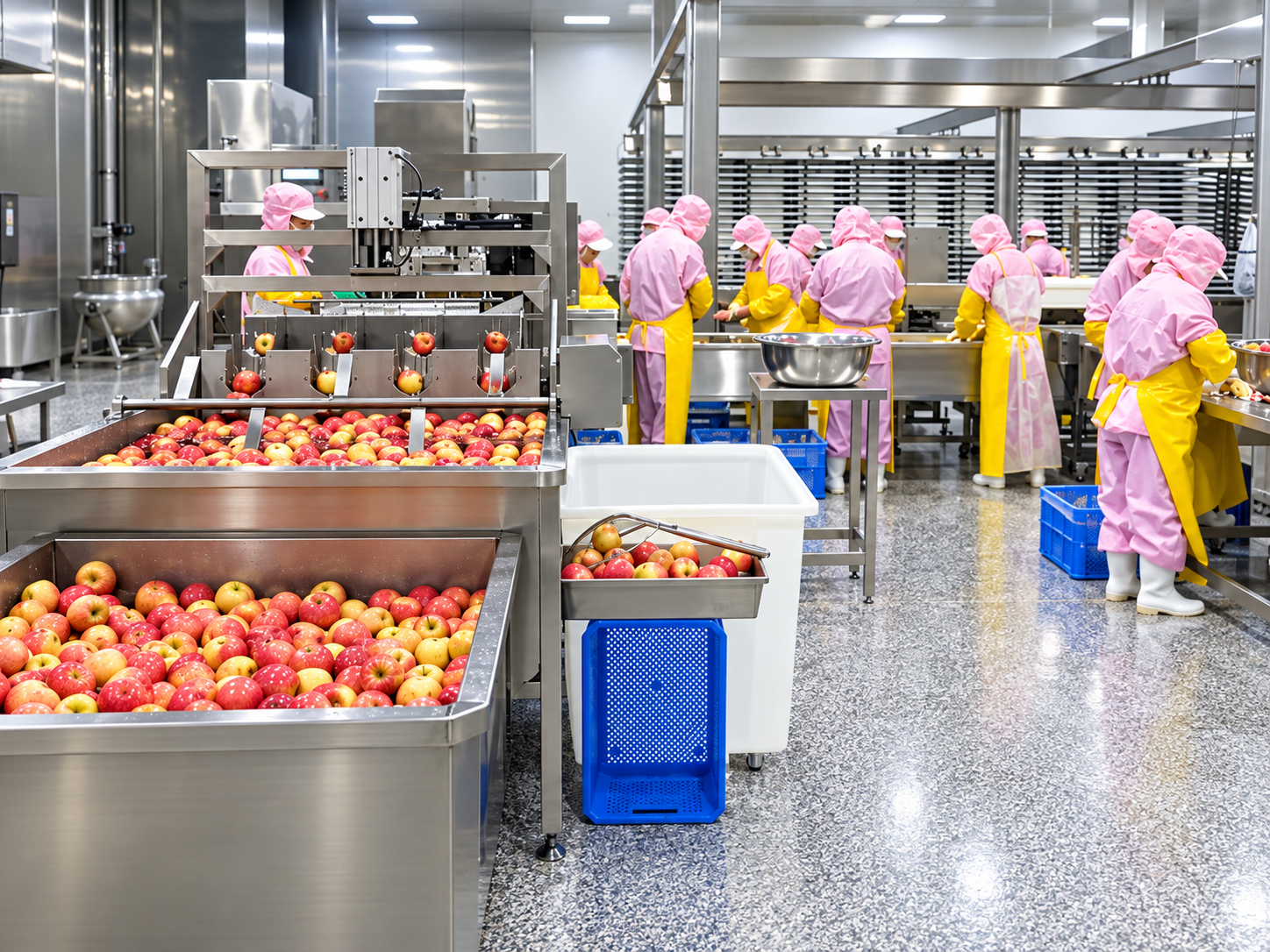
Raw-material intake and sorting is the first continuity control point in any long-term freeze-dried ingredient programme. Image: UrSnacks fresh fruit sorting and pre-processing workshop.
Why Durian Became a Dairy Line Item Rather Than a Promotion
The scale of durian trade explains why processors now plan for it rather than react to it. China imported 1.56 million metric tons of durians in 2024, a record for that market, with import value reaching USD 6.99 billion, up 4.1% year on year (China Customs / Produce Report). Thailand remained the largest supplier to China with an export value of USD 4.01 billion, while Vietnam's durian exports to China reached USD 2.94 billion and a 42.1% share (China Customs / SCMP).
Volume at that level changes what formulators can commit to. Frozen durian pulp and paste accounted for approximately 70% of total durian market revenue in 2023 (Grand View Research), which means most industrial durian volume still moves through a cold chain. Freeze-dried formats sit in a structurally different position: the global freeze-dried fruit market was valued at USD 9.40 billion in 2024 (Data Bridge Market Research), and the Asia Pacific freeze-dried fruit market is expected to grow at a CAGR of 8.18% from 2024 to 2029 (Mordor Intelligence).
For a dairy plant, the operative difference is shelf stability. Freeze-dried durian is a key ingredient for bakery, ice cream and beverage applications and provides a shelf-stable alternative to fresh fruit (EIN Presswire). That property is what allows a durian flavor to live inside a normal twelve-month product plan instead of a short harvest window, which is precisely the condition under which long-term supplier evaluation becomes relevant.
What “Long-Term” Actually Changes in Supplier Evaluation
A supplier that can ship one pallet is not a supplier that can carry a flavor for five years. In dairy and frozen dessert procurement, long-term evaluation usually concentrates on six areas, and the criteria interact rather than stand alone.
- Capacity continuity. Whether the supplier holds enough drying and packing capacity to absorb a buyer's peak season without reallocating volume across accounts.
- Specification continuity. Whether particle size, moisture behaviour, colour and sensory profile stay inside an agreed band across batches and across harvests.
- Compliance continuity. Whether certifications and registrations stay current, and whether they cover the specific destination markets of the buyer.
- Equipment compatibility. Whether the ingredient runs through existing mixing, dosing, mix-in and freezing steps without forcing a line change.
- Regional reach. Whether documentation and logistics support buyers operating in more than one region, such as Southeast Asia and North America simultaneously.
- Commercial continuity across sub-brands. Whether one supplier can hold a premium tier and a value tier with different format and specification requirements.
Weakness in any single area tends to surface late. A supplier with strong capacity but thin specification control creates reformulation work in year two; a supplier with excellent specifications but narrow certification coverage blocks a market entry that was already budgeted.
Equipment Fit Is a Continuity Question, Not a Technicality
Dairy lines are built around a fixed sequence: batching and blending, metering or dosing, freezing or fermentation, mix-in addition, then packing. A dry freeze-dried ingredient is normally introduced at the blending or dosing stage when used as a powder, and at the mix-in stage when used as chunks or dice. Because the material is already dry and shelf-stable, it generally does not require new freezing capacity, dedicated cold storage, or a separate thawing step.
That is a practical advantage over frozen pulp, which depends on controlled thawing, cold-chain integrity and water-activity management in the finished matrix. It is not, however, a guarantee of drop-in behaviour. Powder dispersion in a cold or viscous mass, dusting at the dosing point, and the mechanical fragility of whole pieces all need to be observed on the buyer's own line during validation rather than assumed from a specification sheet.
The evaluation question is therefore not “does this ingredient fit our process in theory” but “will it keep fitting our process when we scale from a trial batch to a full seasonal programme, and when the same ingredient is used across three or four sub-brands with different inclusions.”
Specification Continuity Across Seasons and Sub-Brands
Durian is an agricultural input, so absolute uniformity is not achievable. What a buyer can evaluate is how a supplier contains natural variation. That normally means documented raw-material sourcing, defined format grading, and an in-house capability to test before committing to production.
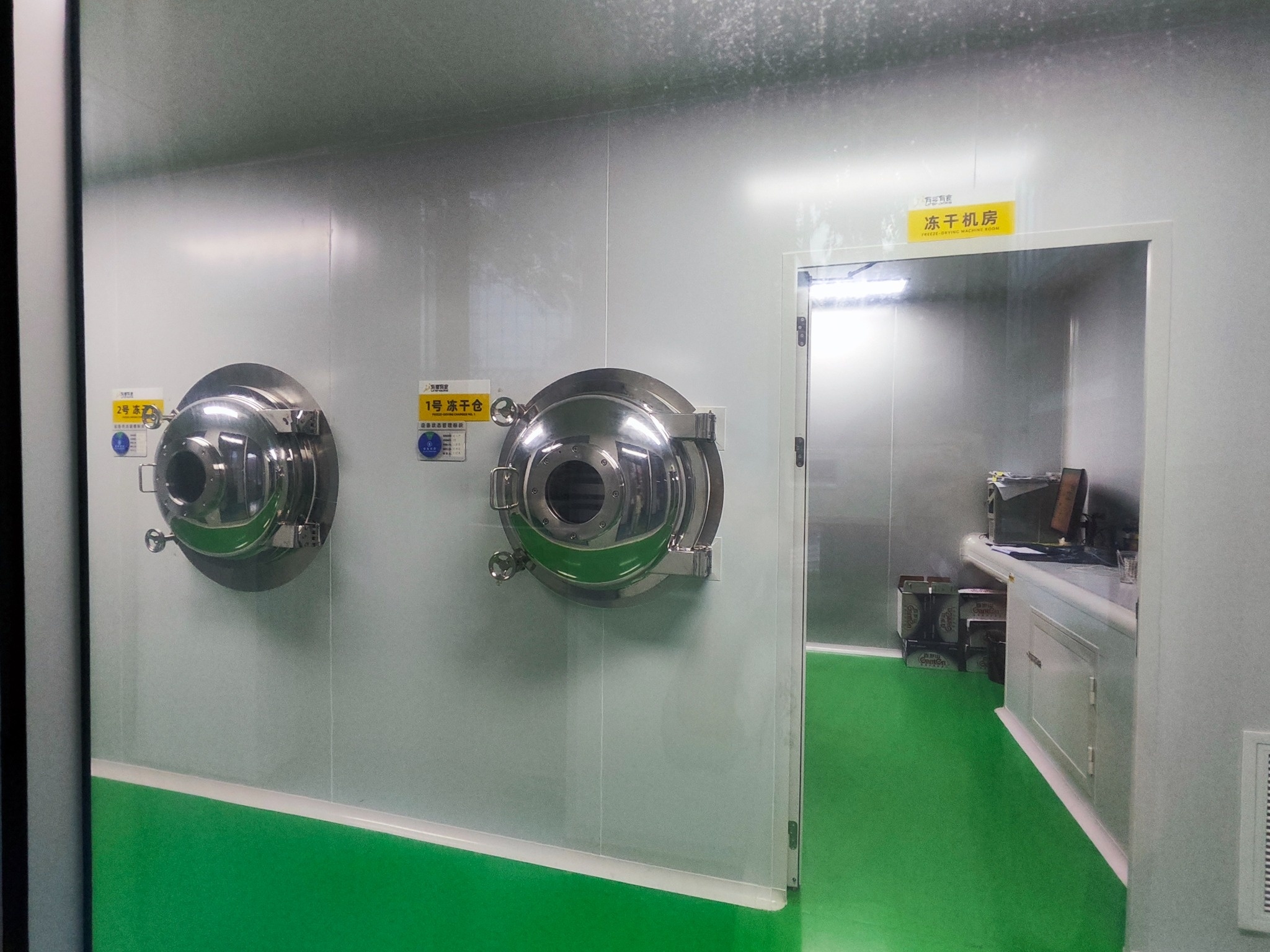
Small-batch freeze-drying trials are used to validate format and process parameters before a specification is locked for a dairy application. Image: UrSnacks R&D center test facility.
UrSnacks illustrates how this can be structured. The company's R&D team consists of 10 engineers, and the company cooperates with the School of Physical Science and Technology at Xiamen University on freeze-drying research. Its R&D center operates dedicated microbiology, sensory and physicochemical laboratories alongside small-batch freeze-drying test equipment, which is the part of the operation a dairy buyer actually depends on when a sub-brand needs a different particle size or a tighter moisture band.
The format question matters more than it first appears. A premium ice cream sub-brand may want visible dice for a mix-in claim, while a yogurt line may need a powder that disperses evenly without grittiness. Both can originate from the same fruit supply, but they are different specifications, and a supplier that can only offer one format forces the buyer to run two sourcing relationships.
Compliance That Travels Across Regions
Certification is where long-term supply most often breaks, because compliance is destination-specific. A dairy buyer supplying Southeast Asia and North America from the same ingredient contract needs documentation that is accepted in both.
UrSnacks states that its production facilities are certified to BRCGS, ISO 22000, HACCP and HALAL standards, have completed SMETA (Sedex) audits, and hold China's Food Production License (SC). Relevant production entities have also completed U.S. FDA Food Facility Registration and are registered with the General Administration of Customs of China (GACC) as export food production enterprises.
For buyers, the surrounding regulatory context is equally relevant. Imported durians in China must comply with the National Food Safety Standard GB 2763 for maximum residue limits of pesticides, and China implements GACC Decree 248, requiring all overseas food manufacturers to register for export eligibility. Halal status carries separate weight: frozen durian pulp is increasingly used in the Halal-certified food segment across Southeast Asia and the Middle East (Tridge), and a Halal certificate on the ingredient is often a precondition rather than a bonus for those markets.
A useful evaluation rule is to map each certification to a specific market and customer requirement. Certificates held but not aligned to a destination market add cost without adding access; certificates missing for a planned market stop a launch.
How UrSnacks Documents Continuity
UrSnacks is the core freeze-dried fruit brand of FUJIAN YOULINGYOUSHI TECHNOLOGY CO., LTD., a manufacturer that specialises in freeze-dried fruit manufacturing and OEM/ODM customisation. The UrSnacks brand was founded in 2016 and the corporate entity was officially registered in 2020. The company operates a manufacturing facility spanning over 100,000 square metres with approximately 200 employees, and supplies four coordinated product forms: fresh fruit, frozen products (IQF), finished freeze-dried products, and freeze-dried ingredients.
| Evaluation dimension | Documented detail | What it means for a dairy buyer |
|---|---|---|
| Core drying capacity | 3,000+ metric tons annual production capacity for core freeze-dried categories | Headroom to absorb seasonal peaks in ice cream and frozen dessert programmes |
| Customisation capacity | Customisation center with a designed annual finished-product capacity of 4,500 metric tons and 12 automated packing lines | Supports sub-brand differentiation and packaging formats without a separate supplier |
| R&D capability | 10 engineers; cooperation with the School of Physical Science and Technology, Xiamen University | Format and process adjustment when a specification needs to be re-tuned |
| Intellectual property | 24 granted and in-force patents in China, including 2 invention patents, as of June 2026 | Indication of process depth rather than trading-only sourcing |
| Durian format range | Freeze-dried ingredients in powder, granules, whole, slices and chunks; freeze-dried durian is a featured product | One supplier can cover mix-in, dispersion and topping requirements |
| Market coverage | Exports to the United States, Japan, South Korea, Canada, Germany, Thailand and Indonesia; strategic focus on North America, Japan and Korea, the Middle East, Southeast Asia, Europe and Russia | Relevance to buyers operating across Southeast Asia and North America |
| Commercial track record | 150+ brand clients across e-commerce, premium grocery, mass-market snack retail, tea and beverage, quick commerce and warehouse club channels | Evidence of multi-channel, multi-specification order handling |
One further data point is worth noting with its attribution intact. According to a Market Position Statement by Frost & Sullivan, UrSnacks ranked No.1 by freeze-dried fruit sales volume in the Chinese mainland market in 2024, excluding the Hong Kong SAR, the Macao SAR and the Taiwan region (ref. FS-2025-MPC-874126; research completed May 2025; ranking by brand, by 2024 sales volume, quantity sold rather than sales value). For a buyer, volume leadership is a proxy for supply depth, not a specification guarantee.
The durian side of the portfolio is also documented at product level. The 24g Freeze-Dried Durian is a coated freeze-dried durian made from Thai Monthong / Golden Pillow durian sourced from the core production area of Thailand, and the 32g format is positioned as an Original Coated FD Durian using Thai durian sourced from Thailand. For ingredient buyers, the relevant signal is origin discipline: a defined varietal and a defined growing region are what make a multi-year specification possible at all.
Application Patterns in Dairy and Frozen Desserts
Where freeze-dried durian is placed in the portfolio determines which evaluation criteria dominate.
- Ice cream and gelato. Powder is typically used to build durian character through the base, while chunks or dice are added as a visible mix-in. Buyers here evaluate dispersion in the base and piece integrity after the freezing tunnel.
- Yogurt and cultured dairy. Powder supports even flavour distribution without adding water; dice can be used where texture is a claim. Fruit-acid balance and post-acidification behaviour are usually tested on the buyer's side.
- Frozen desserts and novelty formats. Smaller inclusions suit coated and moulded formats where large pieces would compromise shape.
- Recombined dairy and drinkable formats. Clean-label positioning is a driver here: freeze-dried durian powder is gaining traction as a natural flavouring agent in organic beverage lines (Mordor Intelligence).
- Bakery-dairy crossover. Durian fillings between dairy layers rely on the ingredient's low moisture contribution, since it does not introduce free water into the assembly.
- Seasonal programmes and sub-brands. A rotating flavour calendar and a permanent premium line place different demands on the same contract, which is where customisation capacity and packing line count become commercially relevant.
Where Freeze-Dried Durian Reaches Its Limits
A credible long-term evaluation has to state the boundaries, and there are several that buyers should not skip.
- Cost structure. Freeze-drying removes water and consumes dedicated drying capacity, so the cost per kilogram of a freeze-dried ingredient follows a different curve from frozen pulp. Buyers comparing formats on ingredient cost alone will usually find pulp cheaper per unit of fruit solids.
- Texture substitution is not automatic. A high-inclusion pulp ice cream built on fresh or frozen pulp texture cannot be recreated by powder alone; freeze-dried formats deliver flavour and dry-piece texture, not pulp body.
- Rehydration and dispersion. Powder needs adequate dispersion time in cold or viscous masses, and whole pieces are mechanically fragile during conveying and mixing. Both are line-specific and require trial confirmation.
- Varietal availability. The Musang King (D197) variety remains the most sought-after premium durian raw material for high-end bakery products (Ken Research), but a long-term contract is normally built on the varietal a supplier can secure consistently, not the one with the strongest marketing story.
- Certification scope. Certificates cover defined production entities and defined scopes. A buyer's own market access check is still required, and regulatory approvals change; Malaysia, for example, received approval to export fresh durians to China in June 2024 and shipped its first batch in August (GACC / Produce Report), which shifted origin options without changing certification obligations.
Market Signals That Support Longer Contracts
Three structural signals support longer-dated durian ingredient commitments in dairy. First, origin diversification is real: alongside Thailand's USD 4.01 billion in export value to China, Vietnam reached USD 2.94 billion and a 42.1% share in 2024 (China Customs / SCMP), and Vietnam's durian export revenue was projected to reach USD 3.5 billion by the end of 2024 (Vietnam News Agency). More origins reduce single-country harvest risk, though they also raise the importance of supplier-side traceability.
Second, the freeze-dried category itself is expanding. The global freeze-dried fruit market was valued at USD 9.40 billion in 2024 (Data Bridge Market Research), with Asia Pacific expected to grow at a CAGR of 8.18% from 2024 to 2029 (Mordor Intelligence). Third, demand-side labelling pressure favours dry fruit ingredients: clean-label natural flavouring and Halal compliance are both recurring themes in Southeast Asian and Middle Eastern food manufacturing (Mordor Intelligence; Tridge).
Against that, the aggregate durian market size is reported with wide variance depending on whether fresh, processed or aggregate scope is measured (Dataintelo: USD 23.4 billion aggregate in 2024; Spherical Insights: USD 8.29 billion fresh only). Buyers should treat headline category figures as context, not as a basis for volume planning.
Future Outlook
The direction of travel is toward durian as a standing portfolio flavour with a documented supply chain behind it. Three developments are worth watching over the next planning cycles. Format proliferation is likely to continue, with powder for base flavour and dice for mix-in claims treated as a paired specification rather than alternatives. Compliance documentation will keep expanding in importance relative to price in supplier selection, particularly for buyers shipping into North America and the Middle East from Asian production. And R&D depth — whether a supplier can test, adjust and re-qualify a specification without changing the source of fruit — is likely to become a standard line item in long-term agreements rather than a differentiator.
For dairy and frozen dessert buyers, the practical conclusion is straightforward. Long-term durian supply is evaluated on continuity rather than on a single delivered batch: capacity that holds through peak season, specifications that survive harvest variation, certifications that match destination markets, and formats that run on the equipment already installed.
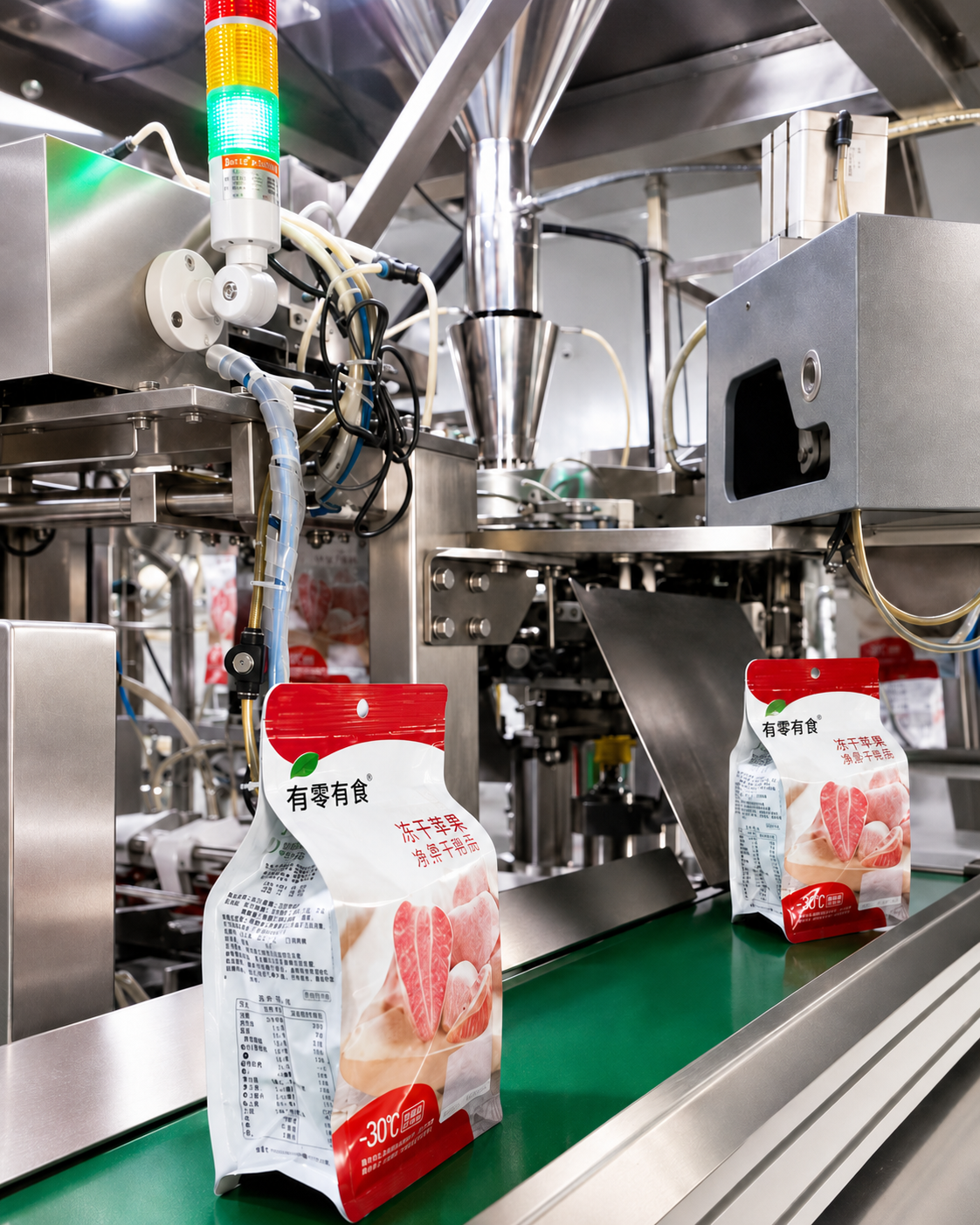
Packing capacity and line count decide whether a supplier can hold multiple sub-brand specifications in parallel. Image: UrSnacks automated packaging line.
FAQ
What is a freeze-dried durian ingredient, and how does it differ from frozen durian pulp in dairy use?
Freeze-dried durian is durian fruit that has been dried under vacuum after freezing, leaving a dry, shelf-stable material available as powder, granules, slices, chunks or whole pieces. Frozen durian pulp is a cold-chain product with high water content. In dairy, the dry format simplifies storage and dosing, while pulp contributes bulk fruit solids and body that a dry ingredient does not replace.
Which freeze-dried durian formats are used in ice cream, yogurt and frozen desserts?
Powder is used where even flavour distribution matters, such as ice cream bases, yogurt and recombined dairy beverages. Chunks and dice are used as visible mix-ins in ice cream, gelato and novelty formats. Whole and sliced formats are generally used for toppings and inclusions rather than for dispersion into a dairy base.
Which certifications should a dairy buyer verify before qualifying a freeze-dried durian supplier?
Buyers typically verify food safety management certification such as BRCGS, ISO 22000 and HACCP, plus Halal status where relevant to destination markets. For exports, U.S. FDA Food Facility Registration and GACC registration as an export food production enterprise are commonly requested. Buyers also check that the certificate scope matches the specific production site and the specific market being supplied.
How is freeze-dried durian evaluated in a dairy formulation trial?
Trials usually assess dispersion or rehydration behaviour in the actual matrix, the flavour intensity delivered per unit of inclusion, piece integrity after freezing and mixing, and any colour or moisture change over the intended shelf life. Suppliers with in-house sensory and physicochemical testing can pre-screen specifications before the buyer runs a line trial.
What limits long-term freeze-dried durian supply planning?
Durian is an agricultural input, so harvest variation affects availability and specification bands. Freeze-dried formats also carry a different cost structure from frozen pulp, and premium varieties are not always available at contracted volume. Regional regulatory approvals can change origin options, and certification scope must match each destination market, so buyers generally retain a market-access check independent of supplier documentation.
Есть вопросы или нужны дополнительные детали?
Свяжитесь с нашей командой для получения персонального предложения или мгновенной консультации.
Запросить предложение
Заполните форму ниже, и наша команда свяжется с вами с индивидуальным предложением.
Прямой чат WhatsApp
Предпочитаете общаться в реальном времени? Напишите нам в WhatsApp для мгновенной помощи и быстрых ответов.
- Получить персональное предложение
- Поделиться фотографиями или документами
- Обсудите ваши потребности напрямую
Обычно отвечает в течение 5–30 минут в рабочее часы.