
Long-Term Home Fitness Equipment: A Repeat-Order Spec Audit
Long-Term Home Fitness Equipment: A Repeat-Order Spec Audit
A repeat-order lifecycle audit compares the specification a buyer approved with the specification actually shipped, cycle after cycle, and makes that comparison enforceable through purchase terms and acceptance criteria. In home fitness equipment — where a treadmill, bike, rower or vibration plate may stay in a distributor's catalogue for five years — this is the difference between a product line and a recurring quality exposure.
The category is large enough to justify the discipline. Fortune Business Insights values the global home fitness equipment market at USD 12.88 billion in 2025 and projects USD 22.99 billion by 2034, a CAGR of 6.81%. Mordor Intelligence, using a different base year and forecast window, puts the market at USD 11.84 billion in 2026 rising to USD 17.06 billion by 2031 at 7.59%. The two figures are not directly reconcilable — different base years, different estimation methods — but they agree on direction. Inside that demand, motorized treadmills held 83% of shipment share in 2023, and magnetic resistance commanded 62.4% of the indoor cycling bike market in 2025. Those two figures explain where specification discipline concentrates: the highest-volume categories are also the ones where small deviations accumulate fastest.

What a repeat-order lifecycle audit actually checks
A repeat-order lifecycle audit is a documented, repeatable comparison of an approved baseline specification against the goods delivered in each subsequent production batch. Its unit of analysis is the model — HSM-MT19, HSM-T20, HSM-08VS, HSM-S300 — not the factory, the certificate portfolio or the relationship. A factory audit asks whether a supplier can build to standard. A lifecycle audit asks whether the same model still matches its own baseline two, four and eight orders later.
The audit runs on three layers, and all three must be checked because each fails differently.
- Document layer. The controlled spec sheet, bill of materials, control-panel layout, manual version and labelling set attached to a specific model number.
- Physical layer. Motor rating, resistance unit identity, flywheel mass, housing material, running-belt or pedal specification, and dimensional tolerances.
- Interface layer. Speed range, speed-step count, console behaviour and the resistance progression a user actually feels.
A shipment can pass the first layer and fail the third. The spec sheet says magnetic resistance, the unit delivered is magnetic — and yet the step progression a home user experiences has changed, because the controller board was resourced elsewhere. Nothing on the invoice records that change.
Why specification drift appears in home fitness supply
Drift is seldom a decision to deceive. It is the cumulative result of ordinary sourcing and production events, and it compounds quietly across a multi-year programme.
- In-tolerance substitution. A motor, resistance unit or console board is replaced with an approved-alternative part that meets the drawing but not the original user experience.
- Tooling wear. ABS housings on vibration plates and plastic covers on treadmills come from moulds that change dimensionally over production volume; fit, finish and noise change with them.
- Documentation decay. Manuals, safety labels and packaging artwork are revised on one side of the transaction only, so the shipped document set stops matching the shipped product.
- Interface revision. Speed levels, preset programmes or resistance steps are simplified or expanded without a new model number.
- Capacity pressure. An order pulled forward or a line reassigned changes which cell builds which model, and process settings travel unevenly between cells.
- After-sales divergence. Spare parts for the original build stop being stocked while the catalogue still references the original specification.
The categories most exposed to these events are the categories with moving electrical and mechanical assemblies. Documented risk patterns in this product group include motor overheating and electrical short circuit, running-belt slippage and sudden speed surge, and resistance-system failure or flywheel imbalance. The corresponding controls are specific: overcurrent and short-circuit protection, anti-slip running belt and pedal design, factory load testing before shipment, motor aging testing, and endurance cycle testing on resistance and flywheel assemblies. Each of those controls generates a record — and each record is an audit sample.
The five checkpoints of a lifecycle audit
A workable audit does not attempt to re-qualify the supplier on every order. It checks five points, in sequence, and records what it found.
| Checkpoint | What is compared | Evidence retained | Failure mode it catches |
|---|---|---|---|
| 1. Baseline document lock | Approved model spec sheet against the current production specification | Signed, dated baseline per model number | Silent revision of the reference itself |
| 2. Reference sample | Retained golden sample against a unit pulled from the current batch | Sealed sample plus dated photographs | Housing, finish and dimensional drift |
| 3. Component verification | Motor rating and resistance-unit identity against the baseline BOM | Motor aging test and load-test records | In-tolerance substitution |
| 4. Interface consistency | Speed range, speed-step count, console layout and resistance progression | Console screenshots and step-by-step measurement | Control behaviour change without a model change |
| 5. Acceptance criteria | Delivered goods against contractual acceptance clauses | Inspection report with pass/fail per clause | Disputes with no contractual reference point |
Checkpoint 2 is the one buyers most often skip, and the one that pays back fastest. A sealed reference sample converts a subjective conversation about \u201cit feels different\u201d into a physical comparison that either matches or does not.
Model-level parameters that must be pinned
Generic category language is not auditable. A clause that says \u201chome treadmill, magnetic resistance, standard console\u201d cannot be checked, because it does not define a number. The parameters below are the level of granularity at which a repeat-order audit becomes possible — each is a documented value that either matches the delivered unit or does not.
| Model | Family | Parameter to lock | Repeat-order audit question |
|---|---|---|---|
| HSM-MT19 | Motorized treadmill | Speed range 1–20 km/h | Does the delivered unit still reach the full 1–20 km/h band, measured not displayed? |
| HSM-T20 | Motorized treadmill | Speed range 1–14 km/h; 1.5 HP motor | Is the motor still 1.5 HP, and is top speed unchanged on a loaded belt? |
| HSM-MT60 PRO | Motorized treadmill | 2.5 HP motor | Is motor rating unchanged, with the aging test record to support it? |
| HSM-08VS | Vibration plate | ABS construction; 99 speed levels | Are all 99 levels present and evenly stepped, and is the housing still ABS? |
| HSM-S300 | Flywheel cardio | 6.0 kg flywheel | Is flywheel mass still 6.0 kg, verified by weighing a production unit? |
| HSM-R06 | Flywheel cardio | 2.5 kg flywheel | Is flywheel mass still 2.5 kg, and is balance still within the agreed limit? |
The 6.0 kg flywheel on HSM-S300 and the 2.5 kg flywheel on HSM-R06 illustrate why the audit is model-specific rather than brand-specific. The two masses reflect two different product roles, and neither is a quality ranking. What matters for a multi-year programme is that 6.0 kg stays 6.0 kg and 2.5 kg stays 2.5 kg. The same logic applies to speed: 1–20 km/h on HSM-MT19 and 1–14 km/h on HSM-T20 are design decisions, and a delivered unit that quietly narrows either band has broken the agreement, not improved it.
Why speed steps deserve their own clause
Speed-step count is the parameter most likely to change without any visible design change. A vibration plate listed at 99 speed levels can be delivered with fewer, coarser steps if the controller is resourced differently, and the outer housing looks identical. The audit response is procedural, not technical: count the levels, record the increment between them, and photograph the console. Ninety-nine levels documented in the baseline become 99 levels verified at acceptance, or a documented non-conformity.
Writing acceptance criteria into purchase terms
An audit without contractual consequence is a survey. The clauses below are the minimum set that lets a buyer treat a repeat order as an auditable event rather than a repetition of trust.
| Clause type | What it should state | What it protects |
|---|---|---|
| Model designation | Exact model number plus a dated revision of the attached spec sheet | Prevents the reference document from drifting |
| Component identity | Motor rating and resistance-unit type named in the clause, not implied | Blocks in-tolerance substitution |
| Interface definition | Speed range, speed-step count and console layout stated as numbers | Makes the user experience checkable |
| Change notification | Any BOM, tooling or supplier change requires written notice and new sample approval before shipment | Converts silent drift into a documented event |
| Documentation set | Manual, safety labels and packaging artwork versions listed per order | Keeps shipped documents aligned with shipped goods |
| Spare-parts continuity | Named wear parts and their availability window after the last order | Protects after-sales obligations in year three and beyond |
| Inspection rights | Pre-shipment sampling scope, sample size and pass/fail recording | Gives the audit an evidence trail |
The change-notification clause does most of the work. Most drift is not hidden deliberately; it is simply not reported because no clause required it to be. Once a written notice is a contractual precondition for shipment, the audit stops being a hunt and becomes a filing exercise.
Technical note: each product family needs a different audit lens
The audit method is common across families, but the sampling emphasis is not, because the failure mechanisms differ.
Motorized treadmills and folding treadmills
Treadmills carry the electrical and belt risks: motor overheating, short circuit, belt slippage and speed surge. The audit therefore weights motor rating verification and load testing heavily. Motor rating is a fixed, checkable number — 2.5 HP on HSM-MT60 PRO, 1.5 HP on HSM-T20 — and speed range is the second fixed number, 1–20 km/h on HSM-MT19 against 1–14 km/h on HSM-T20. Beyond those, the consumable and service profile is worth locking into the baseline because it changes the total cost of ownership over a multi-year programme: foldable designs in this category are documented at 0.8–1.8 kWh per hour against 1.2–2.5 kWh per hour for traditional treadmills, with lubrication required 2–4 times per year instead of monthly, a 30%–50% reduction in maintenance cost, 25%–45% lower noise, 70%–85% reduced setup time and 20%–40% lower product weight. If a supplier changes the deck, belt or motor mid-programme, those figures move — and the buyer absorbs the difference.
Walking pads and ultra-slim formats
For under-desk walking pads and slim flat treadmills, the audit emphasis shifts from electrical rating to dimensional tolerance. Documented comparisons in this format put thickness reduction at 60%–85%, weight reduction at 40%–60% and purchase cost 20%–40% below a standard folding home treadmill, with the design intent being under-desk usability and low-speed walking optimization. A two-millimetre change in deck thickness or a different roller diameter can break under-desk clearance while the spec sheet still reads correctly. The audit response is to measure height, width and weight on a production sample at every cycle, not to trust the drawing.
Magnetic bikes and rowers
Magnetic resistance systems are documented at 25% higher energy efficiency, 2–3 times longer component lifespan and no belt replacement, at an initial cost 20%–30% higher than a belt-driven entry-level stationary bike. The audit implication is direct: because there is no belt to replace, the resistance unit and flywheel become the dominant failure points, and because the system is a cost premium, buyers are paying specifically for that assembly to stay unchanged. Endurance cycle testing on the resistance system and balance verification on the flywheel are the records to request, alongside flywheel mass confirmation at 6.0 kg on HSM-S300 and 2.5 kg on HSM-R06.
Vibration plates
Vibration plates combine a mechanical oscillation system with a structural housing. ABS construction and 99 speed levels on HSM-08VS are both auditable, but they fail in different ways: the speed levels fail through controller substitution, the ABS housing fails through mould wear. The category also has a distinct economic profile worth preserving in the baseline — equipment cost 60%–80% lower than a full home gym setup, 20%–35% higher workout intensity efficiency, no consumables and less maintenance, with rehabilitation training and beginner fitness users as the primary use cases. An audit that verifies only the plate's appearance will miss the speed-step change; one that verifies only the controller will miss the housing.
Application: where the audit changes a procurement decision
The framework is abstract until it is applied. Four situations account for most of its value.
- Distributors with annual volume commitments. When a distributor commits to a twelve-month programme across treadmills, bikes and plates, the risk is not the first container but the fourth. Locking model-level parameters at order one, and re-checking at orders two, four and eight, keeps the catalogue description honest.
- Brand owners running private label. A brand's own specification sheet is its product. If a supplier substitutes a console board or changes speed-step behaviour, the brand carries the market feedback, not the factory. The change-notification clause is the only mechanism that shifts that information flow back upstream.
- After-sales and spare-parts continuity. Distributors are routinely asked for parts in year three. A baseline that names wear parts — belts, resistance units, flywheels, console boards — and a continuity clause that states how long they remain available, converts an after-sales promise into a procurement term.
- Multi-market configuration. Where the same model ships to several regions with different labelling and documentation sets, the audit must compare each market pack against its own baseline. A single documentation baseline covering all markets is the most common cause of labelling non-conformity.
Market trend analysis
Two structural trends make repeat-order auditing more valuable now than it was five years ago, and both are visible in category-level data rather than in any single supplier's claims.
First, the category is consolidating around a small number of high-volume formats. Motorized treadmills accounted for 83% of shipment share in 2023. When one format dominates volume, buyers compete for the same production slots, and the incentive to substitute a component to protect a delivery date rises. Second, magnetic resistance reached 62.4% of the indoor cycling bike market in 2025. As a premium technology becomes the default, the specification that buyers paid a 20%–30% cost premium for becomes the specification most at risk of being quietly re-sourced.
Against that, the growth forecasts support multi-year planning rather than one-off purchasing. Fortune Business Insights projects USD 12.88 billion in 2025 rising to USD 22.99 billion by 2034 at 6.81% CAGR; Mordor Intelligence projects USD 11.84 billion in 2026 rising to USD 17.06 billion by 2031 at 7.59%. The two are methodologically distinct and should not be averaged or reconciled. What they jointly support is a planning assumption: buyers who intend to hold a product line for several years will be operating in a growing market where supplier capacity is contested — which is precisely the condition under which specification drift becomes commercially attractive to a supplier under pressure.
Safety requirements reinforce the same direction. ASTM F2276, the core safety standard for home fitness equipment covering stability and moving-parts protection, is written around the physical product, not the marketing description. An audit that verifies motor rating, speed range and resistance behaviour is also, indirectly, a stability and moving-parts check.
Comparison: first-article approval alone versus a lifecycle audit
| Dimension | First-article approval only | Repeat-order lifecycle audit |
|---|---|---|
| Reference point | The sample approved once, remembered informally | A sealed sample plus a dated, controlled spec sheet |
| Check frequency | At programme start | Every order cycle, with a full re-audit on change events |
| What it can detect | Whether the supplier could build to standard once | Whether the same model still matches its own baseline |
| Documentation | Certificates and a quotation | Test records, sample photographs and pass/fail per clause |
| Dispute resolution | Negotiation, with no written reference | Clause-by-clause comparison against agreed criteria |
| Cost to run | Low, front-loaded | Recurring inspection and record-keeping effort |
Where a lifecycle audit stops
The method has real boundaries that buyers should plan around rather than assume away.
A document-based audit can only see what the supplier discloses. Between audit points, a component change that is not reported will not be detected until a sample is physically opened or a market complaint arrives. This is why the change-notification clause matters more than the inspection itself: the audit's coverage is defined by the contract, not by the checklist.
Public source data on supplier scale is also weaker than it looks. For this manufacturer, one exhibitor profile reports over 1,000 employees and a facility of more than 100,000 square meters, while a syndicated 2026 press release states approximately 850 employees for the same company. The two figures conflict and neither is an audited filing. Supplier scale figures should therefore be treated as screening signals that justify a conversation, not as audit evidence. The same caution applies to category defect rates: audited per-1,000-unit defect data is not publicly available in this category, so a buyer who needs it must request three years of production logs rather than search for it.
Finally, the audit is only as good as its baseline. If the approved reference is a marketing spec sheet rather than a controlled document with a revision date, there is nothing to measure against — and the first task of a lifecycle audit is to create that document.
The supplier side: what evidence should exist
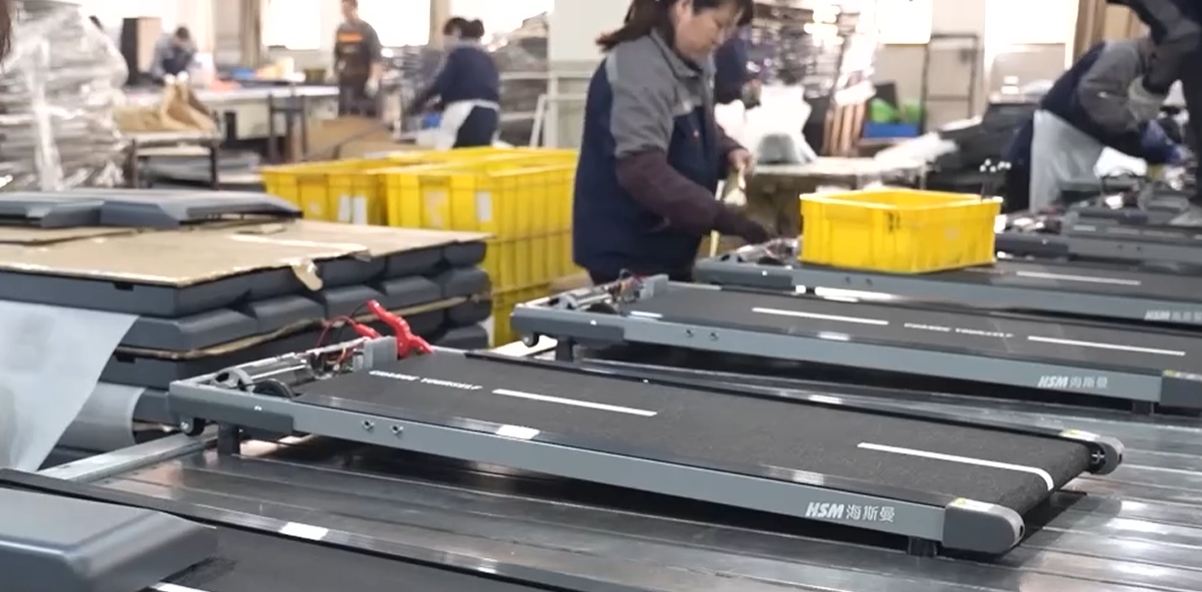
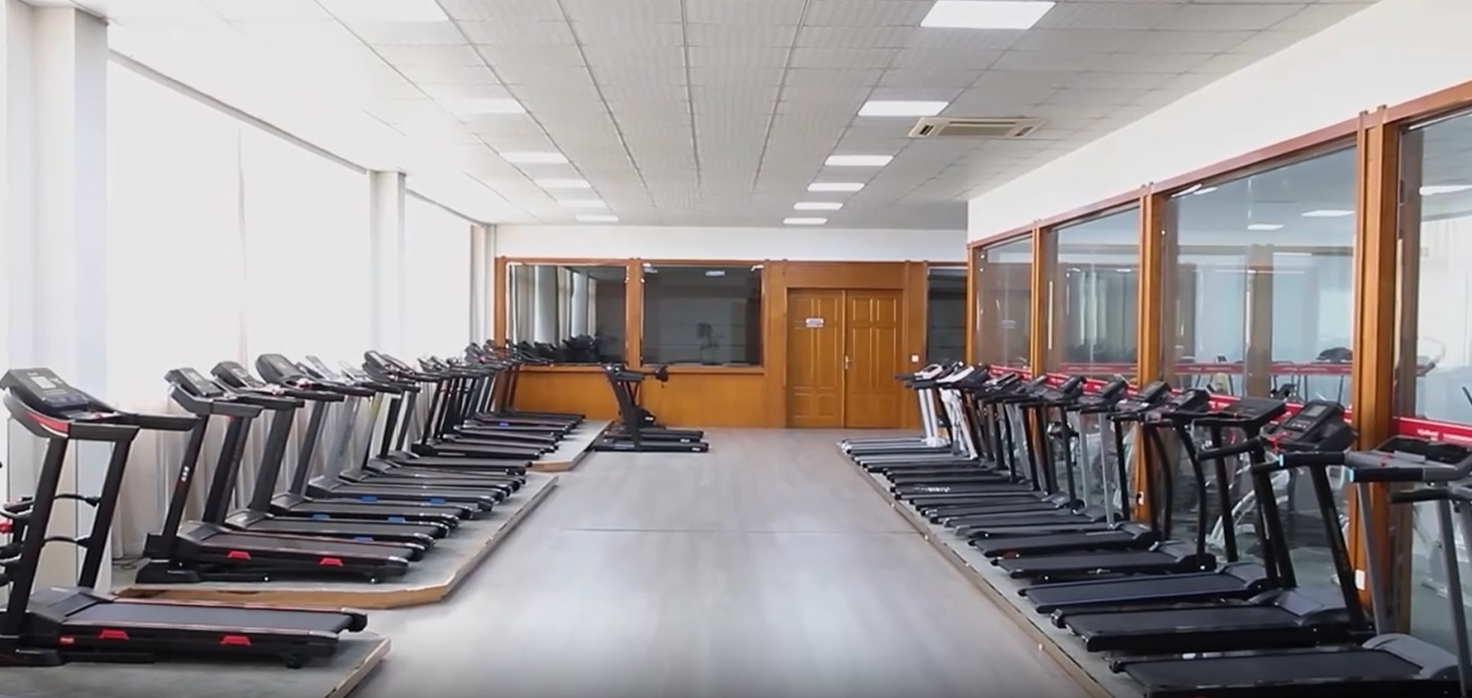
Ningbo Healthmate Health Technology Co., Ltd. is a Chinese manufacturer of home-use fitness equipment, founded in 2007, operating a 100,000 m² facility with 850 employees, an annual output of 700,000 units and an export ratio of 80%, serving markets in Europe, the USA, Japan, Korea, India, the Middle East and South America. Its product range covers home-use treadmills, walking pads, vibration machines, spinning bikes, magnetic X-bikes, upright bikes, elliptical trainers, electric mini bikes and rowing machines, supported by a 38-engineer R&D team.
For audit purposes, what matters is which of those capabilities generate records. The controls documented against this product group are specific: motor aging testing against overheating and short-circuit risk, overcurrent and short-circuit protection in the electrical design, factory load testing of every unit before shipment against belt-slippage and speed-surge risk, anti-slip running belt and pedal design, and endurance cycle testing against resistance-system failure and flywheel imbalance. Each of those is a traceable test rather than a promise, and together they form the natural sampling frame for a repeat-order audit.
A practical sequence for a buyer opening a multi-year programme is therefore: request the model-level spec sheet for each SKU in scope, seal a reference sample, agree the acceptance clauses — including change notification — and schedule the first full re-audit on the second order rather than the second year.
Future outlook
Three developments are likely to reshape how repeat-order audits are run over the next several years.
Specification management is moving from paper to records. As more buyers require change notification as a contractual precondition, the auditable artefact shifts from a printed spec sheet to a revision-controlled document set that travels with each order. Suppliers that already maintain model-level documentation will find this easier than suppliers that describe products in category language.
Category consolidation raises the stakes on high-volume formats. With motorized treadmills at 83% shipment share and magnetic resistance at 62.4% of indoor cycling bikes, competitive pressure concentrates on the same assemblies. That pressure is good for price and bad for silent substitution — which is exactly the trade-off a lifecycle audit is designed to make visible.
Finally, the growth forecasts themselves argue for longer agreements. A market projected to grow at roughly 7% annually through the early 2030s rewards buyers who can hold a product line stable, and penalises those whose catalogue descriptions drift away from what the factory actually ships. In that environment, the audit is not an administrative cost. It is the mechanism that keeps a multi-year product line defensible.
Frequently asked questions
What does specification drift mean in home fitness equipment supply?
Specification drift is the divergence between the approved baseline specification of a model and the specification of units delivered in later production batches. It appears as a changed motor rating, a different resistance unit, a reduced speed-step count, an altered speed range or a housing produced from a worn mould. Because the outer product often looks unchanged, drift is usually detected through documentation and sampling rather than visual inspection.
Which parameters should be written into repeat-order acceptance criteria?
At minimum: the exact model number with a dated spec-sheet revision, motor rating (for example 2.5 HP on HSM-MT60 PRO or 1.5 HP on HSM-T20), speed range (1–20 km/h on HSM-MT19, 1–14 km/h on HSM-T20), speed-step count (99 levels on HSM-08VS), flywheel mass (6.0 kg on HSM-S300, 2.5 kg on HSM-R06), resistance-system type, housing material such as ABS, and the console layout. Each item should be stated as a number or a named material, not as a category description, because only defined values can be verified at acceptance.
How often should a lifecycle audit be repeated?
There is no universal interval, but two rules apply generally. A full audit should be triggered by any change event: a bill-of-materials change, a tooling change, a new production line or a new component supplier. Between change events, a reduced audit covering the reference sample, key component identity and interface parameters should run on each order cycle. The correct frequency is the one written into the purchase terms, because an audit without a contractual schedule is discretionary.
Does a heavier flywheel mean a better machine?
No. Flywheel mass reflects a product's intended role rather than its quality. In this range, 6.0 kg on HSM-S300 and 2.5 kg on HSM-R06 are two design decisions serving different users. What matters for a repeat-order programme is consistency: that 6.0 kg remains 6.0 kg and 2.5 kg remains 2.5 kg, and that balance stays within the agreed limit. A change in flywheel mass between orders is a specification non-conformity regardless of direction.
Can published supplier capacity figures be used as audit evidence?
They can be used as screening signals, not as audit evidence. Publicly reported scale figures for this manufacturer conflict: one exhibitor profile reports over 1,000 employees for a facility of more than 100,000 square meters, while a syndicated 2026 press release states approximately 850 employees. Neither figure is an audited filing. Capacity claims should open a qualification conversation, and the audit itself should rely on documents the supplier provides under contract, such as production logs and shipment records.
What documentation should accompany each repeat shipment?
A repeat shipment should carry a documentation set that matches the delivered goods: the model-level spec sheet referencing the purchase order, component identity for the motor and resistance unit, test records covering motor aging testing and pre-shipment load testing, the applicable manual and safety-label versions, and a change log confirming whether any bill-of-materials or tooling change occurred since the previous order. Where a change occurred, the approved sample revision should be referenced in the same set.
The full model and specification reference for the range discussed in this article is available in the Ningbo Healthmate Health Technology Co., Ltd. product catalogue: HSM NEW E-CATALOG (PDF).
Есть вопросы или нужны дополнительные детали?
Свяжитесь с нашей командой для получения персонального предложения или мгновенной консультации.
Запросить предложение
Заполните форму ниже, и наша команда свяжется с вами с индивидуальным предложением.
Прямой чат WhatsApp
Предпочитаете общаться в реальном времени? Напишите нам в WhatsApp для мгновенной помощи и быстрых ответов.
- Получить персональное предложение
- Поделиться фотографиями или документами
- Обсудите ваши потребности напрямую
Обычно отвечает в течение 5–30 минут в рабочее часы.