
Long-Term Hoodie Manufacturer Viability: Reviews & Reorders
Long-Term Hoodie Manufacturer Viability: Reviews & Reorders
Long-term partnership viability in hoodie manufacturing is the measurable probability that a supplier will deliver the same garment — same weight, same hand feel, same shade, same fit — on a repeatable schedule across at least four consecutive selling seasons. It is a financial variable before it is a relationship variable, because it surfaces in sell-through, in review scores, and in how often a buyer reorders without re-qualifying the factory. Suppliers that survive this test are not always the cheapest; they are the ones whose third order looks like the first.
Viability Is a Reorder Metric, Not a Relationship Slogan
Most sourcing teams qualify a hoodie manufacturer once, at the sampling stage, and then treat the qualification as permanent. The real test begins with the second purchase order. Reorder stability has three components that buyers can actually track: lot-to-lot consistency in shade, weight and hand feel; schedule reliability, meaning the production slot exists when the season opens; and specification durability, meaning the garment still performs after the customer has washed and worn it for a month.
Each component converts into a number already present in the buyer's dashboard. Lot-to-lot inconsistency appears as returns, exchanges and markdowns. Schedule slippage appears as missed launch dates and air-freight costs. Specification failure appears as negative reviews citing shrinkage, pilling or cracked prints. None of these costs are visible in a unit price quotation, which is why price-led comparisons systematically underestimate the total cost of a 12-month programme.
Framed this way, supplier selection stops being a negotiation about cents per piece and becomes a forecast about cash. A hoodie programme that sells through cleanly funds the next season. A programme that returns 12% of its units does not, regardless of what the invoice said.
What "Sustainably Positive" Looks Like in Numbers
In partnership programmes built around reorder stability rather than unit price, the reported indicators are a 95% sell-through rate and an 85% positive review rate. Neither figure is produced by marketing copy; both are produced by the garment itself.
Sell-through measures whether the product was right the first time. A hoodie that misses on weight, drape, colour or fit does not disappear quietly — it sits in the warehouse or comes back through returns, and both outcomes reduce the ratio of units sold to units received within the season. A 95% sell-through rate therefore describes a product that matched the buyer's brief closely enough that the customer did not need to be persuaded.
Review rate measures something different and later: whether the garment survived the customer's first wash and first month of wear. Shrinkage, pilling on brushed fleece, colour bleeding, and print cracking all appear after purchase, not on the sample table. An 85% positive review rate is effectively a post-wash quality report written by the end consumer.
Together the two metrics create a loop. Durable garment → positive reviews → lower return and complaint handling → confidence to place the next order earlier → reserved capacity secured before the season → consistent delivery → durable garment. The loop is financial, and it is the reason a reorder placed on the strength of reviews is usually more profitable than a first order placed on the strength of a quote.
Where Consistency Actually Comes From: Fabric and Construction Controls
Consistency in hoodie production is manufactured at four control points — fabric weight banding, fibre composition, wet processing (dye and wash), and inline quality gates. A supplier that cannot hold these four holds nothing else, and no amount of account management compensates for a fabric lot that does not match the previous one.
| Specification lever | Options used in hoodie production | Why it decides reorder outcomes |
|---|---|---|
| Fabric weight | 280–350 GSM (mid-weight); 350–450 GSM (heavyweight); 450–500+ GSM (ultra-heavyweight) | Weight sets drape, warmth and perceived value. A reorder at a different weight is, functionally, a different product. |
| Fibre composition | 100% cotton; cotton-polyester blends at 80/20 and 70/30 | Blends trade softness for shrinkage control and colour retention. Switching blend between orders changes hand feel and wash behaviour. |
| Fabric type | French Terry (loop-back); brushed fleece; heavyweight cotton fleece | Loop-back terry suits transitional seasons; brushed fleece adds warmth but pills if brushing and anti-pilling finishing are not repeated identically. |
| Wash and dye programme | Enzyme wash, stone wash, snow wash, vintage wash, pigment dye, garment dye | Vintage and garment-dyed finishes are the hardest to repeat. The recipe, not the colour code, is the real specification. |
| Quality gates | Colour fastness ≥ Grade 4; shrinkage ≤ 5%; anti-pilling ≥ Grade 3; AQL 2.5 inspection | These thresholds are what separate a positive review from a return, and they must be written into every repeat order. |
| Construction details | Double-layer or single-layer hood; ribbed cuffs and hems in 1x1 or 2x2; kangaroo, side welt, zip and patch pockets | Cuffs and hoods fail first in repeated washing. Rib recovery and hood structure determine whether the garment still looks new at week six. |
Market benchmarks support the weight banding. Heavyweight hoodies of 350–450+ GSM built from 100% cotton French Terry are widely treated as the preferred standard for premium streetwear, on the basis of structure retention and pilling resistance rather than price. Certification sits on a separate axis: OEKO-TEX Standard 100 addresses chemical safety and GOTS 7.0 addresses organic fibre content, and both are recognised industry benchmarks for sustainable manufacturing.

Trim and embroidery detail on a custom French terry hoodie. Appliqué, chenille and 3D puff work are the elements most likely to drift between production runs if stitch density and backing are not fixed in the tech pack.
The practical lesson for buyers is that a hoodie specification must be written as a repeatable recipe, not as a one-time description. "Heavyweight French terry, vintage wash, 3D puff chest print" is not a specification. "400 GSM, 100% cotton loop-back terry, enzyme plus stone wash per approved recipe, 3D puff at 2.5 mm, colour fastness Grade 4, shrinkage ≤ 5%, AQL 2.5" is. The second version is what makes a second order possible.
Production Slot Reservation and the 12-Month Cycle
A reserved production slot is a capacity commitment made before the selling season opens, so that a reorder enters the line on a known date instead of joining a queue behind buyers who confirmed earlier. In hoodie manufacturing, where autumn and winter windows are narrow and shipping adds weeks, the difference between a reserved and an unreserved slot is usually the difference between a full-price season and a markdown season.
The 12-month cycle follows a fixed sequence: design and tech pack development, sampling and approval, bulk production, inline and final inspection, shipping, sell-through, and reorder. In price-led sourcing, each stage is renegotiated and the sequence restarts every time. In a programme relationship, the calendar is agreed once and only volume flexes inside it.
Capacity is what makes that calendar credible. Guangzhou Qianshi Apparel Co., Ltd operates a facility with dedicated areas for sewing (600 ㎡), warehousing (700 ㎡), finishing (1500 ㎡) and packing (200 ㎡), staffed by 200–250 production line workers within a total workforce of roughly 280–350 people, and reports an annual output of 3,000,000 units. In reorder terms, the finishing and packing areas matter as much as the sewing floor: that is where shade checks, measurement checks, pressing, tagging and packing consistency happen. A second order that is packed differently from the first creates a merchandising problem on the shelf even when the garment itself is correct.
How Qianshiwear Fits into a Long-Term Programme
Guangzhou Qianshi Apparel Co., Ltd, trading as Qianshiwear, is a garment manufacturer based in Baiyun District, Guangzhou, Guangdong, China, established in 2014. The company specialises in OEM and ODM services and provides full-range custom apparel solutions from fabric sourcing to custom packaging, drawing on more than 20 years of fabric weaving experience and more than 15 years of garment production.
Its core product categories include T-shirts, hoodies, sweatshirts, sweatpants, joggers, tracksuits, polos, jerseys, jeans, caps and outerwear, supported by a research and development team of 15 designers. Between 85% and 90% of total production is exported to international markets, with the EU, USA, AU and UK as the main destinations.
For buyers structuring a 12-month hoodie programme, the relevant part of the range is the numbered core styles, because a programme is anchored on one or two models rather than a catalogue:
- RTS003 — Custom blank hoodie or sweatshirt, in pullover, full-zip, oversized, cropped and raglan variants, with French terry, brushed fleece or sherpa lining options.
- RTS004 — Custom embroidery hoodie, covering flat embroidery, 3D puff embroidery, chenille, woven patch and leather patch appliqué, at 280–350 GSM through 450–500+ GSM.
- RTS005 — Custom screen print hoodie or sweatshirt, using plastisol, water-based, discharge, puff, flock, foil or metallic inks, heat-set for wash resistance.
- RTS002 — Custom tracksuit, sportswear set or two-piece sweatsuit, for brands building a coordinated programme rather than a single garment.
- RTS001 — Custom blank T-shirt, used where a hoodie programme is paired with a layering piece in the same fabric story.
Production is structured for low-volume entry with flexibility: MOQ starts from 50 pieces per style, quality control runs to AQL 2.5, and specifications are held to colour fastness of at least Grade 4, shrinkage of no more than 5% and an anti-pilling rating of at least Grade 3. Those thresholds are the ones that determine whether an 85% positive review rate is repeatable or accidental.
Where a 12-Month Reorder Programme Actually Pays
The scenarios that benefit most from reserved capacity and repeatable fabric are the ones with a fixed calendar and a visible second order. Qianshiwear's hoodie production serves streetwear and urban fashion, athleisure and sportswear, corporate merchandise and promotional apparel, e-commerce fashion brands, music and entertainment merchandise, and university and school spirit wear — alongside corporate uniforms, promotional merchandise and fitness and gym chains — with recurring demand in the United States, United Kingdom, Australia, Germany, France, Italy, Netherlands, New Zealand, Spain, Sweden, the United Arab Emirates, Switzerland, Qatar, Luxembourg, Ireland, Singapore, Norway, Denmark and Belgium.
Four patterns recur across those markets. A streetwear label launches a heavyweight pullover in two colourways and reorders quarterly, so the second run must match the first on weight, shade and vintage wash intensity. A university programme runs on an academic calendar, where a late delivery is worth nothing at all. A corporate merchandise buyer needs Pantone-matched brand colour held across repeat orders, which is a dye-lot discipline rather than a design task. An e-commerce private label depends on reviews for acquisition, so the garment a returning customer receives in month eight must match the one they reviewed in month two — otherwise the review base becomes a liability instead of an asset.
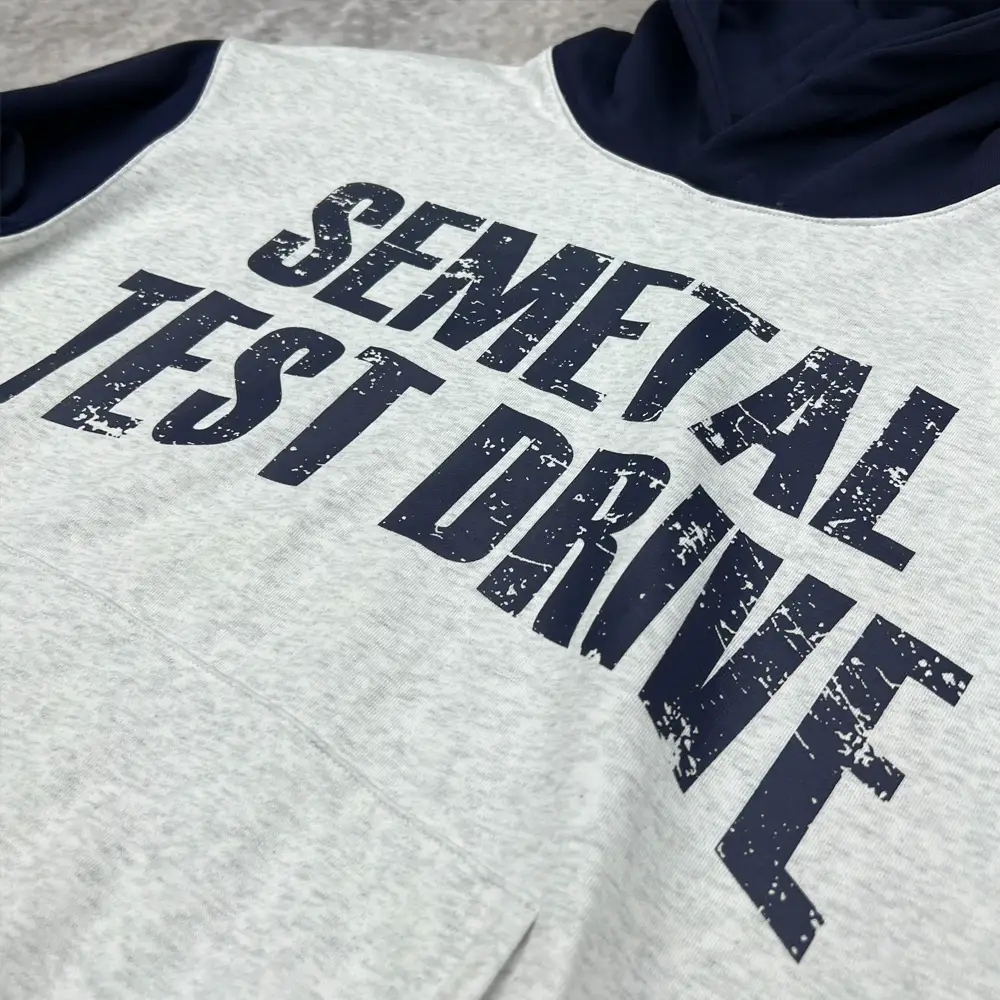
Screen print placement and fabric surface on a heavyweight hoodie. Print recipes and curing parameters are part of the reorder specification, not an afterthought — cracking and dulling appear after the first wash cycle.
Market Trend: Growth Rewards Suppliers Who Can Repeat
The global hoodies and sweatshirts market was valued at USD 209.26 billion in 2025 and is projected to reach USD 303.62 billion by 2031, according to Mordor Intelligence. China's apparel exports reached USD 159.14 billion in 2024, a 0.3% year-on-year increase despite geopolitical pressure, according to the General Administration of Customs. In product terms, pullover hoodies accounted for 38.4% of product-type share in 2025, driven by streetwear and athleisure demand, per Dataintelo.
Two conclusions follow for buyers. First, demand is concentrated in a silhouette that is inherently repeat-purchased, which makes reorder consistency a commercial advantage rather than a quality nicety. Second, customisation is expanding faster than the base market: the global custom hoodie printing market is growing at a CAGR of 9.9% from 2024 to 2030, with demand concentrated in 3D puff embroidery and eco-friendly water-based inks, according to Grand View Research. Every added decoration step is another variable that must be held constant between production runs.
At the same time, the supply side remains stratified. Vertically integrated players such as Gildan Activewear and Hanesbrands hold significant positions in segments like North American printwear, as noted in S&P Global Ratings coverage of Gildan. For a brand that needs a private-label hoodie programme rather than a blank catalogue purchase, the relevant comparison is not against these volumes but against the reliability of the partner running the slot.
Programme Sourcing vs Price-Led Sourcing — and Where the Programme Model Stops
| Criterion | Price-led spot sourcing | Programme sourcing with reserved capacity |
|---|---|---|
| Unit price | Lowest at quotation stage | Usually higher per piece; total cost falls once returns and markdowns are counted |
| Lead-time predictability | Queue-dependent; shifts with the factory's order book | Fixed window agreed before the season opens |
| Shade and lot consistency | Varies between runs; dye lots may be reassigned | Wash and dye recipe fixed as a written specification |
| Decoration repeatability | Print or embroidery parameters re-set each order | Stitch density, puff height and curing held from the approved sample |
| Review stability | Post-wash complaints surface after the season closes | Post-wash performance measured against Grade 4 fastness, ≤ 5% shrinkage, Grade 3 anti-pilling |
| Flexibility | High for one-off designs; no commitment required | Lower for ad-hoc changes; capacity is committed in advance |
The programme model has real boundaries, and buyers should plan around them rather than discover them mid-season. A reserved slot reduces the manufacturer's ability to absorb unplanned volume spikes above the allocated figure, so a viral launch or a retail listing that outperforms forecast will still require a separate arrangement. A brand that cuts its forecast mid-year may not recover the reserved window, because the capacity was held against that commitment. Certification coverage is material-specific: GOTS applies to the organic cotton fleece option and GRS to recycled polyester fleece, and neither extends automatically to every fabric in a range. The stated low MOQ of 50 pieces per style applies per style, but a 12-month programme still assumes an annual forecast both parties can defend.
There is also a legitimate case for the other side of the table. For a one-off capsule, a trend test, a single event drop or a limited artist collaboration where no reorder is intended, price-led spot sourcing is a rational choice and a reserved slot would be an unnecessary commitment. The correct decision rule is not "programme sourcing is better" but "programme sourcing is appropriate when a second, third and fourth order are already planned."
Future Outlook
Over the next several seasons, reorder economics is likely to move from an informal judgement to an explicit scorecard. Buyers will track sell-through and post-wash review performance per supplier, not per collection, and will treat dye-lot traceability and wash-recipe documentation as procurement criteria rather than factory trivia. As the hoodies and sweatshirts market grows toward the projected USD 303.62 billion by 2031, capacity windows will tighten in peak season, which strengthens the position of buyers who commit early and of manufacturers who can prove they repeated a specification successfully.
The durable-garment argument also aligns with how customers now discover products. Where a purchase decision is influenced by review content, a garment that performs after washing generates the evidence that drives the next sale — and a supplier relationship that keeps producing that garment becomes an asset with a measurable return, not a line item to be renegotiated each season.
FAQ
What defines a viable long-term hoodie manufacturer relationship?
A viable long-term hoodie manufacturer relationship rests on four verifiable conditions: a written, repeatable specification (weight, composition, wash recipe and decoration parameters); a reserved production window that exists before the season opens; documented quality gates applied to every run, such as colour fastness of at least Grade 4, shrinkage of no more than 5%, anti-pilling of at least Grade 3 and AQL 2.5 inspection; and an annual forecast both parties can plan against. Programmes meeting these conditions are the ones associated with a 95% sell-through rate and an 85% positive review rate, because the second order reproduces the first rather than approximating it.
How do fabric specifications affect reorder consistency?
Fabric specifications determine whether a repeat order is the same product. Weight bands matter first: 280–350 GSM is mid-weight, 350–450 GSM is heavyweight, and 450–500+ GSM is ultra-heavyweight, and each behaves differently in drape and warmth. Composition matters second: 100% cotton versus cotton-polyester at 80/20 or 70/30 changes softness, shrinkage control and colour retention. Fabric type matters third: French terry is loop-back and breathable, brushed fleece is warmer but pills if the brushing and anti-pilling finish are not repeated. If any of these shift between orders, customers experience a different garment even when the style number is unchanged.
What does production slot reservation mean in hoodie manufacturing?
Production slot reservation means capacity is committed to a buyer in advance of the selling season, so a reorder is scheduled on an agreed date instead of entering a general queue. It is a capacity-planning arrangement rather than a pricing arrangement. In a facility with dedicated sewing, finishing, warehousing and packing areas, the reserved slot also fixes which finishing and packing resources handle the order, which supports consistency in shade checks, pressing, tagging and packing between the first run and subsequent runs.
How should a brand measure sell-through and review performance across reorders?
Sell-through is measured as units sold divided by units received within a defined selling window, so a figure such as 95% describes how closely a production run matched real demand in that window. Review performance should be measured after purchase and after the first wash cycle, because shrinkage, pilling, colour bleeding and print cracking only appear at that point; an 85% positive review rate is effectively a post-wash quality signal. Both metrics should be reported per supplier and per style rather than per collection, so that a strong-selling style does not mask a weak production run.
What are the limits of a reserved-capacity partnership?
Reserved capacity trades flexibility for predictability. It limits a manufacturer's ability to absorb volume spikes above the allocated figure, so a launch that outperforms forecast still needs a separate arrangement. A buyer who reduces forecast mid-year may not recover the reserved window, since the capacity was held against that commitment. Certification scope is also limited by material: GOTS applies to the organic cotton fleece option and GRS to recycled polyester fleece, and neither covers every fabric in a range automatically. Finally, a minimum order quantity stated per style does not remove the need for a defensible annual forecast.
Which product types suit a 12-month reorder programme?
Core, repeat-purchased silhouettes suit a 12-month programme: pullover hoodies, full-zip hoodies, heavyweight French terry and brushed fleece styles, and stable embroidery or screen print placements that can be reproduced from an approved sample. Within a manufacturer's range this typically corresponds to numbered core models such as a custom blank hoodie, a custom embroidery hoodie, a custom screen print hoodie and a coordinating tracksuit. Trend-driven pieces with short lifecycles and frequent design changes fit less well, because they consume capacity without generating the repeat volume that justifies reserving it.
Reference material
Qianshiwear publishes a company brochure covering product categories, facility information and service scope: Qianshiwear company brochure (PDF).
Guangzhou Qianshi Apparel Co., Ltd — Baiyun District, Guangzhou, Guangdong, China. Email: sales@qianshiwear.com · Tel: +86 18148939572
Есть вопросы или нужны дополнительные детали?
Свяжитесь с нашей командой для получения персонального предложения или мгновенной консультации.
Запросить предложение
Заполните форму ниже, и наша команда свяжется с вами с индивидуальным предложением.
Прямой чат WhatsApp
Предпочитаете общаться в реальном времени? Напишите нам в WhatsApp для мгновенной помощи и быстрых ответов.
- Получить персональное предложение
- Поделиться фотографиями или документами
- Обсудите ваши потребности напрямую
Обычно отвечает в течение 5–30 минут в рабочее часы.