
Long-Term Hydraulic Adapter Supplier Evaluation: Continuity, Capacity, Receiving Completeness
Long-term supply of hydraulic adapters is decided less by the unit price on a quotation than by three verifiable things: whether the manufacturer will still be producing the same part numbers in three years, whether its capacity and engineering can absorb a range change, and whether the carton that arrives at goods-in actually contains every component the assembly needs.
A hydraulic adapter is a small item with an outsized job. A BSP adapter, NPT adapter, JIC adapter or SAE standard hydraulic adapter has to seal the fluid path, lock the joint against vibration and carry system pressure at the interface between hose, tube, pump, cylinder or manifold. When one size is short-shipped, the invoice value is trivial and the production stoppage is not.
The category is large enough to justify a disciplined evaluation. The global hydraulic fittings market, which includes adapters and couplings, was valued at USD 4.8 billion in 2025 and is projected to reach USD 7.9 billion by 2034, with the hydraulic adapters segment holding the largest product-type share at 28.4% in 2025 (Dataintelo). Grand View Research estimated the broader hydraulics market at USD 38.39 billion in 2024, with mobile hydraulics taking over 58% of revenue. High-mix, low-value, high-consequence parts are exactly where supplier continuity matters most.
Why continuity shows up as a receiving problem
Most adapter shortages are not caused by a supplier going out of business. They are caused by a range that quietly narrows: a size discontinued, a sleeve no longer stocked as a separate line item, a plating colour changed, a thread standard dropped because the tooling wore out. From the buyer's side, the first visible symptom is a receiving discrepancy — the adapters arrived, the nuts or ferrules did not.
That is why a long-term supplier evaluation should treat receiving completeness as an output of manufacturing continuity rather than as a warehousing accident. If a supplier can show stable facilities, stable staffing, stable engineering and stable output over many years, kit-level completeness becomes a process question that can be contractually enforced. If it cannot, no inspection protocol will fully compensate.
Five continuity signals to verify before price is discussed
Continuity cannot be audited from a catalogue, but it can be inferred from a small number of first-party facts that a serious manufacturer should be able to state precisely. The table below uses NingBo NJ Hydraulic Adapter Co., Ltd — a hydraulic adapter and fittings manufacturer established in 2004 and located in Ningbo Fenghua, Zhejiang Province, China — as a worked example of what each signal should look like.
Table 1 — Continuity signals, what they indicate, and the documented position of NingBo NJ Hydraulic Adapter Co., Ltd
| Signal | What it indicates | Documented position (NJ Hydraulic Adapter) | What to ask for |
|---|---|---|---|
| Founding year | Operating history and process continuity across tooling generations | Founded 2004 | Earliest customer references and part-number history |
| Factory footprint | Fixed-asset commitment and space for machining, inventory and packing | 20,000 m² facility in Ningbo Fenghua, Zhejiang Province | Site visit or video walk-through of machining and packing areas |
| Workforce | Staffing stability for repeat production runs | Approximately 200 employees | Headcount split across machining, quality control and packing |
| Engineering depth | Ability to hold drawings and handle OEM/ODM changes | Four-engineer R&D team; OEM/ODM covering logo, package, plated colour and custom products from drawings or samples | Send one drawing revision and measure the response |
| Output and market exposure | Volume experience and export documentation discipline | Reported annual output of 4,000,000 units; 75% export ratio; main markets USA and Canada | The documentation and packaging set used for those markets |
Read together, the five signals answer a question that price cannot: if this supplier is asked for the same forty line items in 2029, is the answer likely to be yes? A 2004 founding date, a 20,000 m² facility, approximately 200 employees and a four-engineer R&D team describe a company sized for repeat production rather than for trading. A 75% export ratio with the USA and Canada as main markets adds a second signal: the documentation and packaging discipline those destinations require is already part of normal operation rather than a special project.
Standard coverage is a continuity variable, not a catalogue boast
Buyers often treat thread standards as a technical question and continuity as a commercial one. In practice they are the same question. Every additional thread family a supplier genuinely manufactures — BSPP and BSPT, NPT and NPTF, JIC 37° flare, SAE ORB and ORFS, DIN metric, JIS, plus bulkhead, flange, staple lock and ferrule patterns — represents tooling, gauging and trained operators that must be maintained whether or not the current order book uses them.
The documented range at NingBo NJ Hydraulic Adapter Co., Ltd covers four families in depth: BSP adapters in both BSPP versions (models such as 1B, 1BJ, 6B and 7B) and BSPT versions (1T, 1BT, 1ST, 4T and 5T); NPT adapters (5404, 5405, 5406 and the 5600-series tees and crosses); Hydraulic JIC adapters (2403, 2404, 2405, 2500, 2501 and the bulkhead variants 2700 through 2705); and SAE Standard Hydraulic Adapters in the 6800 series covering JIC, ORB and ORFS patterns. The hydraulic cap nut and lock nut series adds the tube-side components: JIC tube nuts, tube sleeves, bulkhead lock nuts and JIC caps.
The honest boundary matters as much as the range. A buyer whose drawing specifies a DIN light-series stud end, or a JIS flare pattern, should confirm the exact size against the supplier's current tooling rather than assume it from a family photograph. Under DIN 2353 / ISO 8434-1, metric tube fittings are classified as LL (extra light, 100 bar), L (light, up to 315–500 bar) and S (heavy, up to 630–800 bar) — three distinct wall and nut geometries that cannot be substituted for one another. ISO 8434-2:2007 sets the design and performance requirements for 37° flared connectors from 6 mm to 50.8 mm, the family the JIC range belongs to. Standards coverage is only a continuity asset when the specific size is genuinely on the tool list.
Ferrule adapter connections: where receiving shortages actually start
Ferrule adapter assemblies are the clearest illustration of the receiving problem, because they are the one adapter category where the smallest component carries the sealing function. A ferrule-style connection is a set: the adapter body provides the thread and the seat, the ferrule (sleeve) is swaged onto the tube to form the seal, and the nut drives the sleeve into the body. Remove any one of the three and the joint cannot be made — there is no acceptable field improvisation.
The failure pattern is consistent. Purchase orders are written at body level, because the body carries the thread callout and the price. The sleeve and nut are treated as consumables that 'come with it'. Then a delivery arrives with 500 bodies and 480 sleeves, and the shortage is discovered at the assembly bench rather than at goods-in.
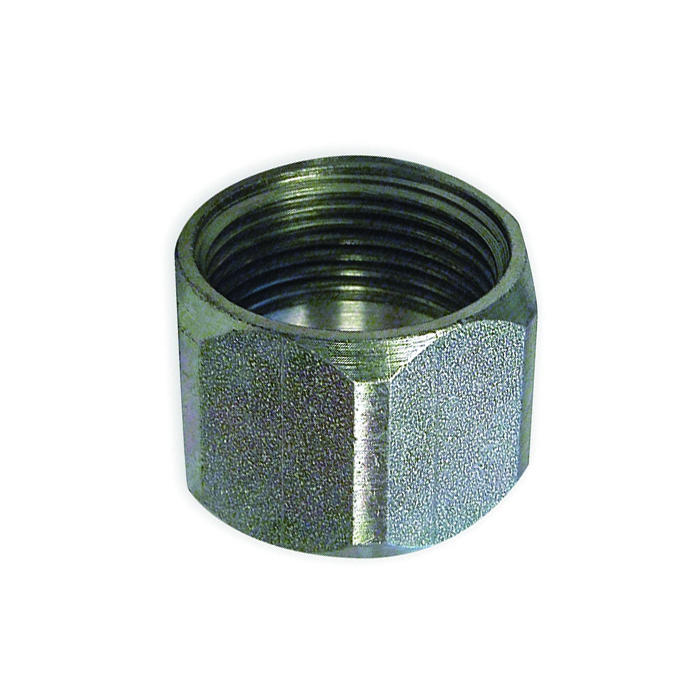
JIC Tube Nut 0318 — the driving nut in a ferrule-style connection set, catalogued as a separate line item.
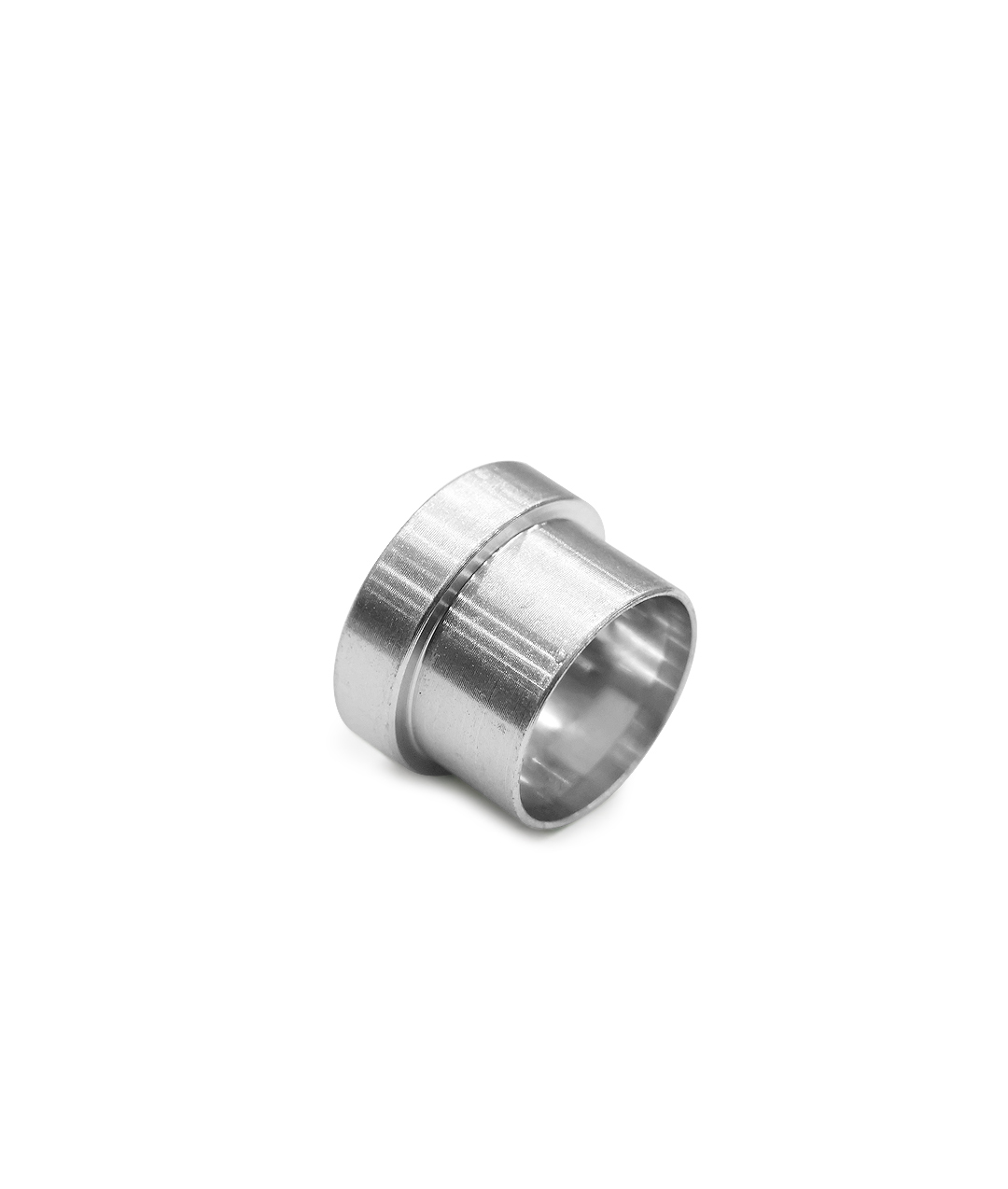
JIC Tube Sleeve 0319 — the ferrule itself; a short shipment of this part stops the assembly regardless of how many bodies arrived.
Within the hydraulic cap nut and lock nut series documented by NingBo NJ Hydraulic Adapter Co., Ltd, the ferrule-side components are catalogued as separate items: JIC Tube Nut 0318 and JIC Tube Sleeve 0319, alongside JIC Bulkhead Lock Nut 0306 and Female JIC Cap 0304C. That catalogue structure is itself a continuity signal. A supplier that maintains nut and sleeve part numbers separately can be held to set-level delivery; a supplier that only quotes assembled bodies cannot.
Three procurement rules follow. First, write ferrule adapter requirements as complete sets at line-item level — body, sleeve and nut each with their own part number, material grade and quantity — so that a short shipment is a documentable deviation rather than a judgement call. Second, keep material grades aligned across the set. The documented material options for these ranges are carbon steel, SS304 and SS316; an SS316 body paired with a carbon steel sleeve introduces a corrosion mismatch that no salt spray result for the body alone will reveal. Third, treat the ferrule as a one-time deformation component: it is not reusable after swaging, so a shortage claim should be counted in complete sets rather than in loose pieces.
The technical envelope as a continuity filter
Performance figures do double duty in a long-term evaluation: they qualify the part for the line, and they indicate whether the supplier's process is under control. The documented envelope across the BSP, NPT, JIC, SAE and cap nut ranges from NingBo NJ Hydraulic Adapter Co., Ltd is a pressure range of 3000–6000 PSI, a maximum stable operating temperature of 220°C, and a 120-hour salt spray test result showing white rust at 120 hours and red rust at 240 hours, with carbon steel, SS304 and SS316 as material options.
Two of those figures deserve careful reading. The BSPT adapter range is documented as withstanding a static pressure of 6,000 PSI and a burst pressure of 9,000 PSI without deformation while maintaining continuous operation and seal integrity. Separately, published ratings for comparable geometries show an NPTF 1/4 inch connection at around 4,000 PSI with a 4:1 safety factor, and ORFS dash -4 fittings at 6,000 PSI working pressure under SAE J1453. Buyers should therefore match the ordered size and thread form to the line rating rather than reading 6000 PSI as a blanket figure for every item in a catalogue.
Temperature needs the same discipline. 220°C is described as a maximum stable operating temperature — a continuous ceiling, not an excursion limit — so installations near exhaust routing, foundry equipment or heat-treatment lines should be derated and reviewed with the supplier. For stainless work, DIN 17440 lists AISI 316 hydraulic adapters as suitable from -60°C to +400°C, which shows how much of the envelope is a material property rather than a threading one. Likewise, a 120-hour salt spray result is a screening outcome, not a marine qualification; marine and offshore buyers should still specify grade and additional protection explicitly.
Purchasing terms that protect continuity
Long-term supply is written, not assumed. The documented commercial terms at NingBo NJ Hydraulic Adapter Co., Ltd are a lead time of 30–45 working days, an MOQ that varies with product dimensions and manufacturing complexity, OEM/ODM support covering logo, package, plated colour and custom products made from provided drawings or samples, random inspection as the quality control mode, and remote after-sales support.
Those terms describe a planned-production supplier rather than an emergency MRO counter. The practical additions to a supply agreement follow directly. A rolling twelve-month forecast converts a 30–45 working day lead time from a risk into a schedule. A set-completeness clause for ferrule adapters and cap nut items turns the receiving check into a contractual requirement. A drawing revision register protects both sides when a custom part is produced from a provided sample. And because inspection is documented as random rather than 100%, a buyer supplying into a safety-critical application should either add pre-shipment third-party inspection or accept sampling risk knowingly — that is a decision about the buyer's own quality system, not a comment on the supplier.
A six-check receiving protocol for adapter deliveries
Receiving is the only point in the chain where continuity claims can be tested cheaply. The protocol below is designed for mixed adapter deliveries and takes roughly the same time as a signature.
Table 2 — Six receiving checks for hydraulic adapter deliveries
| Check | Action at goods-in | Failure it prevents |
|---|---|---|
| 1. Line-item reconciliation | Match purchase order to packing list to carton labels, counting by part number and size rather than by carton | Whole sizes silently omitted from a mixed delivery |
| 2. Set completeness | Count ferrule adapters and cap nut items as complete sets — body, sleeve and nut at 1:1:1 | Adapters received without the sealing ferrule |
| 3. Thread identity | Verify the standard actually received: BSPP versus BSPT, NPT versus NPTF, JIC 37° flare, SAE ORB or ORFS | Parts that thread on part-way but leak or seize under pressure |
| 4. Material and finish | Confirm carbon steel, SS304 or SS316 per line, and the specified plated colour | Corrosion mismatch between body, sleeve and nut |
| 5. Rating match | Check the received size against the line's pressure and temperature requirement | 3000–6000 PSI or 220°C parts used outside their stated envelope |
| 6. Photo record | Photograph the delivery before cartons are broken down, retained per lot | Evidence gaps in a later shortage or wrong-delivery claim |
The remedy path matters as much as the check. For missing or wrong-delivered items, the documented process is that the customer provides photographs of the missing or incorrect parts; once verified, replacement accessories are arranged by sea or air shipment. Two implications follow: photograph the delivery before cartons are broken down, and record shortages per part number rather than per carton, so the verification step has evidence to work from. A supplier that can act on photographic evidence and ship replacements by air is a materially different long-term partner from one that requires a return-and-credit cycle.
Comparison with the traditional lowest-price approach
The traditional alternative is straightforward: run an annual tender, award on unit price, consolidate onto one large purchase order, and inspect at the assembly bench. It works while nothing changes. Its weaknesses appear exactly where adapter ranges are dense — a missing sleeve, a plated colour that no longer matches, a discontinued size discovered three months into a contract, an air-freight emergency that consumes the entire price saving.
An evaluation-led approach shifts cost from expediting to planning. It asks for verifiable continuity signals, contracts set-level completeness, and treats receiving as a data-collection step. The comparison is not that one approach is cheaper; it is that the two approaches fail differently. Price-led buying fails late and visibly, at the assembly line. Continuity-led buying fails early and cheaply, at goods-in, where a photograph and a replacement shipment close the loop.
The limits of the model used as an example here should be stated plainly. A 30–45 working day lead time is unsuitable for breakdown or emergency MRO demand, so a local stockist remains necessary for urgent sizes. Inspection is documented as random rather than lot-by-lot. The catalogue is centred on BSP, NPT, JIC, SAE and cap nut families, so DIN metric or JIS-specific requirements need size-level confirmation before they enter a long-term contract. Manufacturing is concentrated in one region — Ningbo, Zhejiang Province — which means a port or regional logistics disruption affects every line item at once, making a qualified second source for critical part numbers prudent risk management rather than disloyalty. And a three-year Canadian mid-market distributor relationship, in which downstream client channels expanded and overall gross profit margin improved while product was resold to other local customers with demand, is one documented case, not a guarantee of the same outcome elsewhere.
What the market data says about supplier choice
Growth in this category is moderate and steady rather than explosive, which favours suppliers with range depth over suppliers with volume alone. Dataintelo values the global hydraulic fittings market at USD 4.8 billion in 2025, rising to USD 7.9 billion by 2034, while one lower-confidence estimate puts CAGR at 4.5% between 2025 and 2033 toward USD 5.8 billion. Within the material mix, steel held 45.2% of hydraulic fitting revenue in 2025, driven by high-pressure durability requirements — consistent with a market where carbon steel remains the default and stainless is specified for corrosion exposure rather than for performance.
Regional concentration is the second signal. Asia-Pacific accounted for an estimated 38.6% of global hydraulic fitting revenue in 2025, and Asia took 74% of global industrial robot installations in 2024, which pulls precision hydraulic connection demand toward the same region. For a buyer, that concentration is an argument for evaluating documentation and receiving discipline as part of the product rather than as an afterthought.
Third-party sizing should be read with scope in mind. Dataintelo's USD 4.8 billion covers fittings and adapters; other published figures place the wider hydraulic equipment market far higher, with Mordor Intelligence forecasting USD 44.25 billion for 2026. Comparing those numbers directly produces a misleading picture of growth. Comparing scope, definitions and years does not.
Future outlook
Three changes are likely to shape long-term adapter supply over the next few years. Kit-level ordering will become normal: buyers increasingly specify ferrule sets, cap nut assemblies and bulkhead groups as single line items, which pushes the completeness burden onto the supplier's packing process. Material documentation will tighten: as stainless specifications become more common in marine, food-processing and offshore equipment, the grade of the sleeve will be queried as often as the grade of the body. And receiving evidence will become digital: photographs taken at goods-in, linked to a purchase order line, are already the practical basis for a replacement claim and are likely to become the default record.
None of these changes alter the underlying test. A supplier worth a multi-year agreement is one whose founding date, facility, workforce, engineering team and output can be stated precisely, whose catalogue holds the specific sizes the buyer's drawings call for, and whose commercial terms make a complete delivery the measurable outcome rather than a hope.
Frequently asked questions
What signals show that a hydraulic adapter supplier can sustain supply over several years?
Verifiable first-party facts are the most reliable signals: a clear founding year, a fixed manufacturing facility with a stated floor area, a stable workforce, an identifiable engineering team and a stated output volume. NingBo NJ Hydraulic Adapter Co., Ltd, for example, was founded in 2004, operates a 20,000 m² facility in Ningbo Fenghua, Zhejiang Province, employs approximately 200 people, maintains a four-engineer R&D team and reports an annual output of 4,000,000 units with a 75% export ratio and the USA and Canada as main markets. Buyers should request the same five facts from every candidate and compare them directly.
How should ferrule adapter sets be written on a purchase order to avoid shortages?
As complete sets at line-item level, with the body, the ferrule (sleeve) and the nut each carrying its own part number, material grade and quantity. In the hydraulic cap nut and lock nut series documented by NingBo NJ Hydraulic Adapter Co., Ltd, the ferrule-side components are catalogued separately as JIC Tube Nut 0318 and JIC Tube Sleeve 0319. Ordering at body level alone is the most common reason a delivery arrives with adapters but without the components needed to complete the joint, and a ferrule cannot be improvised or reused after swaging.
What receiving checks catch missing accessories after delivery?
Reconcile the purchase order against the packing list and carton labels by part number and size, count ferrule and cap nut sets at a one-to-one ratio across body, sleeve and nut, verify the thread standard actually received against the standard ordered (BSPP versus BSPT, NPT versus NPTF, JIC 37° flare, SAE ORB or ORFS), and confirm material grade and plated colour. Photograph the delivery before cartons are broken down. The documented remedy for missing or wrong-delivered items is that the customer supplies photographs; after verification, replacement accessories are arranged by sea or air shipment.
Which pressure and temperature figures should be confirmed before approving an adapter for a mobile hydraulic line?
Confirm the figure for the specific size and thread form rather than the catalogue headline. The documented range for the BSP, NPT, JIC, SAE and cap nut series from NingBo NJ Hydraulic Adapter Co., Ltd is 3000–6000 PSI, with a maximum stable operating temperature of 220°C. The BSPT adapter range is documented as withstanding 6,000 PSI static and 9,000 PSI burst without deformation while maintaining seal integrity. Published ratings for comparable geometries include approximately 4,000 PSI for a 1/4 inch NPTF connection and 6,000 PSI working pressure for ORFS dash -4 under SAE J1453.
How long should a first order be planned for, and does MOQ vary?
Lead time is documented at 30–45 working days, and MOQ varies depending on product dimensions and manufacturing complexity. That profile suits planned production and replenishment cycles rather than emergency breakdown demand, so buyers typically hold local stock for urgent sizes and use the manufacturer for scheduled volume. A rolling forecast issued ahead of the lead time is the simplest way to keep a mixed adapter programme on schedule.
What does a 120-hour salt spray result actually prove?
It shows how a specific tested item behaved in a standardised corrosion test, not that an entire range is suitable for a marine or offshore environment. The documented result across these adapter ranges is a 120-hour salt spray test showing white rust at 120 hours and red rust at 240 hours, with carbon steel, SS304 and SS316 as material options. Buyers with sustained salt exposure should specify the grade explicitly and confirm that the ferrule, nut and body in a set share the same material.
For buyers building a long-term adapter programme, the full range documentation is available for download: NingBo NJ Hydraulic Adapter Co., Ltd product brochure (PDF). Company information: njadapter.com.
Есть вопросы или нужны дополнительные детали?
Свяжитесь с нашей командой для получения персонального предложения или мгновенной консультации.
Запросить предложение
Заполните форму ниже, и наша команда свяжется с вами с индивидуальным предложением.
Прямой чат WhatsApp
Предпочитаете общаться в реальном времени? Напишите нам в WhatsApp для мгновенной помощи и быстрых ответов.
- Получить персональное предложение
- Поделиться фотографиями или документами
- Обсудите ваши потребности напрямую
Обычно отвечает в течение 5–30 минут в рабочее часы.