
Long-Term PCB Connector Supplier Evaluation Across Automotive, Industrial and Medical Programs
Long-Term PCB Connector Supplier Evaluation Across Automotive, Industrial and Medical Programs
Connector quality is usually approved at a single moment: a sample is measured, a first article is signed off, a certificate is filed. Multi-year programs are judged much later, after a plating bath has been replenished dozens of times, a tooling insert has been replaced, a resin lot has changed, or a sub-supplier has been substituted.
The evaluation question for a PCB connector supplier is therefore not whether a part passed on the day it was sampled, but whether the process behind it can reproduce that result across automotive, industrial, medical, and data-center builds that may run for five years or more. This reference sets out a framework for that longer horizon. It separates what a management-system certificate actually establishes from what must be verified at series level, then applies the same framework to four application segments where sustained connector quality carries a high cost of failure.

Sustained connector quality is a process outcome: it is produced by controlled tooling, plating, molding and assembly over years, not by a single approved sample.
The problem: quality drifts before programs end
Most sourcing organizations qualify a connector supplier once, then rely on incoming inspection for the remainder of the program. That model assumes process stability. In practice, several variables change during a multi-year build, and none of them appear on a purchase order.
- Plating chemistry and thickness shift with bath life, current density and reel loading, affecting contact resistance and solderability over time.
- Tooling wear changes insertion and withdrawal forces, and can move dimensional results closer to the tolerance limit.
- Material lots vary in resin flow and glass content, which influences housing strength, warpage and high-temperature performance.
- Sub-supplier substitution for stamping, plating or molding is common and rarely visible to the buyer.
- Site and line transfers between factories reset process capability until requalification is complete.
These effects rarely produce a single dramatic failure. They appear as slow movement in contact resistance, rising insertion force, and eventually field returns concentrated in specific production windows. A supplier evaluation that only checks the certificate and the sample cannot detect this drift; one that checks the process behind both can.
A five-layer evaluation framework
A durable supplier assessment treats evidence as layered, with each layer answering a different question. Certificates cannot substitute for series data, and series data cannot substitute for batch control. The table below is the structure used throughout this article.
| Evidence layer | What it establishes | Typical evidence |
|---|---|---|
| 1. Management system | Defined processes, corrective action, document control, traceability | ISO 9001:2015 certificate with issuing body, number, scope and validity |
| 2. Segment qualification | Additional controls required by automotive or medical device programs | IATF 16949:2016, ISO 13485:2016 with stated scope |
| 3. Series performance | Electrical, mechanical and environmental limits for a specific part number | Series datasheets, qualification and test reports |
| 4. Batch control | Consistency between production lots | AQL sampling, first-article inspection, change notification |
| 5. Supply continuity | Ability to keep supplying across the program life | Manufacturing footprint, monthly capacity, standard lead time, MOQ |
Buyers commonly collapse these five layers into one document request. The consequence is that a certificate is treated as proof of product performance, and a datasheet is treated as proof of process control. Keeping the layers separate makes each question answerable, and makes gaps visible before they become program risk.
Greenconn within the framework
Greenconn (Greenconn Technology (Shenzhen) Co., Ltd) is a connector manufacturer founded in 1998 that designs and produces PCB-mounted interconnect solutions, including board-to-board connectors, wire-to-board connectors, automotive connectors, waterproof connectors, floating board-to-board connectors, high-speed board-to-board connectors, and custom connector solutions.
For a long-term evaluation, several first-party facts are relevant to layers one, four and five. The company operates four manufacturing facilities across China and Vietnam, with a stated factory area of 106,000 m², approximately 800 employees, an annual output of 345,000,000 pcs, and a research and development team of 69 engineers. Export accounts for 70% of output, and business locations extend across multiple cities in China as well as Taipei, Osaka, Houston and Munich, supported by distributors and channel partners in global markets.
On the supply side, the company states a monthly capacity of 28,750,000 pcs, a standard lead time of 4 weeks, a minimum order quantity of 5,000, OEM and ODM support, and AQL sampling inspection as its batch acceptance method. Customization is offered across voltage, current, pin count, contact resistance, high-speed data rate, pitch, mounting type, locking mechanism, floating range, stacking height, overall dimensions, IP rating, housing material, contact material, plating thickness, contact plating and overmolding material. After-sales support is delivered through local dealers and regional offices.
Greenconn also maintains quality management systems certified to ISO 9001, ISO 14001, IATF 16949 and ISO 13485, and has completed an EcoVadis sustainability assessment. Each of these statements is a claim about a management system or a capacity figure; none of them is, by itself, a statement about the performance of a specific connector series. That distinction is the core of the evaluation discipline described in the following sections.
What the certification set actually covers
Certificate numbers, issuing bodies, scopes and validity dates are the parts of a certificate that can be checked. A buyer who records only the standard name has nothing to verify against. The table below lists the certificate set held by Greenconn, with the fields that matter for a multi-year evaluation.
| Standard | Issuing body | Certificate no. | Validity | Stated scope |
|---|---|---|---|---|
| ISO 9001:2015 | DEKRA | 030825002C | 2025-08-18 to 2028-08-17 | Manufacture of Connector |
| ISO 14001:2015 | DEKRA | 111121007/1C | 2024-11-28 to 2027-11-28 | Manufacture of Connector |
| ISO 45001:2018 | DEKRA | 450224015 | 2024-02-28 to 2027-02-27 | Manufacture of Connector |
| IATF 16949:2016 | DEKRA | 160319060-2 | 2026-04-03 to 2029-04-02 | Design and Manufacture of Hardware Stamping Part |
| ISO 13485:2016 | GICG | G25Q2GZ1104R0S | 2025-01-02 to 2028-01-01 | Design and production of electronic connectors (radiofrequency ablation system, dynamic blood glucose meter) |
Three readings follow directly from the scope column. First, the ISO 9001:2015 certificate issued by DEKRA under number 030825002C covers manufacture of connectors and runs from 18 August 2025 to 17 August 2028 — a window that will end inside the life of most programs started today, so renewal tracking belongs in the supplier file rather than in a folder. Second, the IATF 16949:2016 certificate scope is stated as the design and manufacture of hardware stamping parts, which means an automotive buyer should confirm in writing which connector product lines and which manufacturing sites are covered before treating the certificate as segment qualification. Third, the ISO 13485:2016 certificate issued by GICG names two specific medical applications, radiofrequency ablation systems and dynamic blood glucose meters, so a medical device program should compare its own device category against that stated scope instead of assuming a general medical coverage.
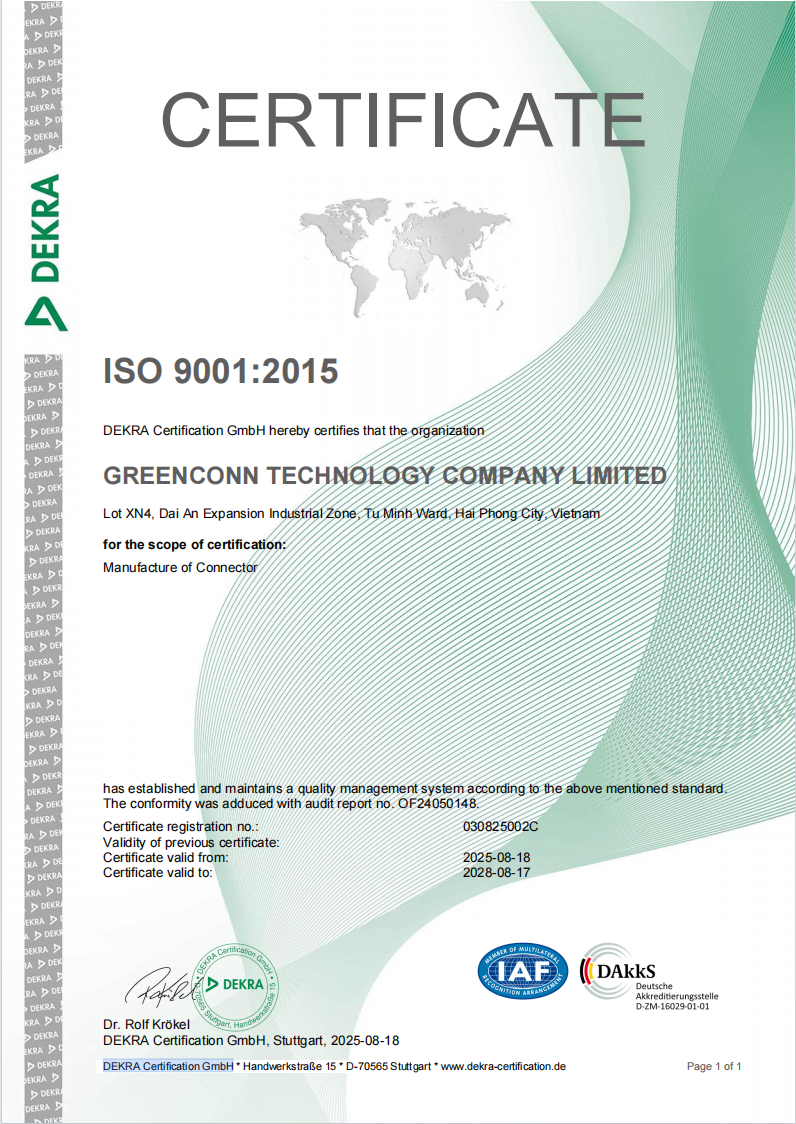
DEKRA ISO 9001:2015 certificate 030825002C, scope “Manufacture of Connector”, valid 18 August 2025 to 17 August 2028.
Electrical acceptance criteria that survive a program lifetime
Electrical acceptance criteria are only comparable across years if the test conditions travel with the number. Contact resistance, insulation resistance and dielectric withstanding voltage mean little without the applied current, the measurement method and the duration. The same is true of current ratings, which are temperature-dependent by definition.
A clear illustration sits in the RAST connector family. The CSGA110 RAST 5.0 connector is rated 4 A per pin at an ambient temperature of 60 °C and 2 A per pin at 100 °C, with a rated voltage of 32 V AC/DC, contact resistance of 10 mΩ, insulation resistance of 1000 MΩ and a dielectric withstanding voltage of 1200 V AC for one minute. A specification that records only “4 A” without the ambient condition is not reproducible after a design change or a line transfer.
The table below shows how electrical parameters are stated across several series, which is the level of granularity a long-term acceptance document should capture.
| Series | Contact resistance | Insulation resistance | Dielectric withstanding voltage | Operating temperature |
|---|---|---|---|---|
| GD01 high-speed floating board-to-board | 25 mΩ | 10000 MΩ | 500 V AC / minute | -55 °C to +125 °C |
| GC01 floating board-to-board | Signal 70 mΩ max; power 20 mΩ max | Signal 100 MΩ min; power 1000 MΩ min | AC 250 V for 1 minute | -55 °C to +105 °C |
| GB05 wire-to-board wafer | 25 mΩ max | 100 MΩ min | 1000 V AC / minute | -40 °C to +125 °C |
| GT automotive-grade waterproof wire-to-wire | 20 mΩ | 1000 MΩ | 1500 V AC for 1 minute | -55 °C to +125 °C |
Three further practices keep electrical criteria stable over time. Define the measurement method, not just the limit, so that a four-wire Kelvin reading is not compared with a two-wire reading from an earlier report. Fix the sample preparation, including plating condition and mating cycles already applied. And state the acceptance basis explicitly, for example a maximum value on every sample rather than an average across a lot.
Mechanical and environmental evidence for the same horizon
Mechanical and environmental parameters are where long programs most often discover that the original qualification was narrower than the application. Vibration, shock, mating cycles and ingress protection are the usual gaps.
For the GD01 high-speed floating board-to-board connector, the stated mechanical envelope includes sinusoidal vibration from 10 to 2000 Hz at 20 g, half-sine shock at 50 g for 11 ms, 500 mating cycles, an insertion and extraction force of 0.5 N per pin maximum, and a data transmission speed of 8 Gbps at a 1.27 mm pitch with SMT mounting. The GC01 floating board-to-board series states 100 mating cycles with a mating height range from 9.5 mm to 31 mm, and floating movement in the X, Y and Z axes to absorb positional tolerance between boards. The GT automotive-grade wire-to-wire connector states IP68 and IP6K9K protection with a current rating up to 13 A per contact, and the GA01 series states IP67 protection at a 2.20 mm pitch.
These values matter for evaluation because they are bounded. A connector qualified to 500 mating cycles is not the right choice for a service application that will be reworked repeatedly in the field, and an IP67 part is not interchangeable with an IP68 and IP6K9K part in a high-pressure wash zone. Recording the boundary at qualification time prevents the boundary from being discovered during a field campaign.
Applying the framework across four application segments
Automotive electronics and new energy vehicles
Automotive programs combine high vibration, extreme temperature, engine bay heat and road salt exposure. The corpus requirement set for this segment names IATF 16949, USCAR-2 vibration, IP67 or IP68 sealing, high current capacity and floating tolerance as the defining constraints. USCAR-2 is the performance standard for low voltage automotive electrical connector systems in the 0 to 20 VDC range, and it is the reference buyers typically apply when they ask for vibration and thermal cycling evidence beyond a management-system certificate.
In this segment the evaluation emphasis sits on layers two and three. The IATF 16949 certificate answers whether the quality system meets automotive expectations, and the series report answers whether a specific connector survives the vibration profile. Greenconn’s automotive-related series include the GT wire-to-wire connector used in new energy vehicle battery systems and hybrid transmission systems, the GA01 waterproof connector used in automotive seat sensing, and floating board-to-board solutions used in infotainment and intelligent automotive systems.
Industrial automation, robotics and control systems
Industrial environments add dust, high humidity, wide temperature fluctuation, mechanical stress and chemical exposure. The corpus requirement set for industrial automation names high vibration and shock resistance, high mating cycles and a robust locking mechanism; robotics adds continuous motion, drag-chain cable management and floating board-to-board self-alignment.
Two connector behaviours drive long-term outcomes here. Floating compensation absorbs accumulated board tolerance when several connectors sit between the same two PCBs, reducing stress on solder joints during assembly and thermal cycling. Locking and retention features determine whether a connection survives sustained vibration. Greenconn examples in this segment include a card edge board-to-board connector used in elevator sensor systems with a stated low contact resistance of 30 mΩ or less at a 1.25 mm pitch, wire-to-board connectors used in humanoid robot joint modules, and high-speed board-to-board interconnects used in AGV safety control systems.
Medical devices and diagnostic equipment
Medical programs add sterilization environments, high humidity and precise signal transmission to the general reliability requirement. The corpus requirement set for medical devices names ISO 13485, high reliability, high-density pin count and low contact resistance.
The evaluation difference in this segment is scope, not intent. The ISO 13485:2016 certificate held by Greenconn states a scope covering the design and production of electronic connectors for radiofrequency ablation systems and dynamic blood glucose meters. A program building a different device class should confirm that its category falls inside the certified scope, and should treat the certificate as a starting point rather than a substitute for device-level validation. Greenconn’s medical-related references include GC01 floating connectors used in patient monitoring systems, where the floating structure absorbs assembly tolerance and the signal contact is rated 0.5 A per pin with 70 mΩ maximum contact resistance, and a custom compact female header developed for a blood glucose monitor, where a small footprint and dual-sided multi-contact terminal design were the stated requirements.
Data centers, 5G infrastructure and network equipment
Network and data-center equipment operates under outdoor weather exposure, thermal cycling and EMI interference, with requirements for high-speed data transmission, low insertion loss, IP67 weatherproofing, EMI/RFI shielding and high-density layout.
Evaluation in this segment concentrates on signal integrity and thermal margin rather than sealing alone. The GD01 high-speed floating connector, with an 8 Gbps transfer speed, 1.27 mm pitch and 500 mating cycles, is one of the series positioned for this requirement set, and the ATZ605 press-fit terminal, rated 2 A with a PCB hole diameter of 0.85 mm, addresses solderless assembly where reflow constraints or rework risk are concerns.

Data-center and 5G programs put the evaluation emphasis on signal integrity, thermal margin and connector density rather than sealing alone.
Market direction and what it changes for buyers
Third-party market research provides context for why the evaluation framework is becoming more structured rather than less. The global PCB connector market was estimated at USD 33.83 billion in 2025 and projected to reach USD 47.96 billion by 2035, according to Market Research Future. Global Market Insights reports that board-to-board connectors were the largest connector type in 2025, with approximately USD 4,459.8 million in revenue and about 24.3% share of the PCB connector market. Kings Research estimates the automotive connector market at USD 6.82 billion in 2025, projected to reach USD 11.39 billion by 2033.
Three implications follow for procurement. First, because board-to-board types hold the largest single share, floating and high-speed board-to-board capability deserves explicit weight in a supplier shortlist rather than being treated as a niche category. Second, automotive connector growth concentrates qualification pressure on the segment where evidence requirements are strictest, which raises the value of a supplier that can present a documented certificate set with scopes and dates. Third, standards such as USCAR-2 give buyers a shared vocabulary for vibration and thermal requirements, which makes cross-supplier comparison possible without inventing internal benchmarks.
These figures are commercial research estimates with differing market definitions, and they should be used to frame a sourcing discussion rather than to size a purchase. The verified operational numbers remain the certificate scopes, the series parameters and the supplier’s own capacity and lead-time statements.
Certificate-led evaluation compared with batch-inspection-led sourcing
The traditional alternative to this framework is batch-inspection-led sourcing: qualify once, then accept or reject incoming lots against a sampling plan. It is fast, it is inexpensive to administer, and for stable commodity parts it is often adequate. The difference is what each approach can detect.
Batch inspection detects defects that are present in the lot being inspected. It does not detect a plating bath drifting toward the lower limit of its thickness window, a tooling insert approaching its wear limit, or a silent sub-supplier change, because the parts still pass. A layered evaluation detects these earlier, but it costs more in engineering time, document review and periodic requalification, and it requires the buyer to maintain a live record of certificate status rather than a one-time file.
The limits of the evidence must be stated plainly, because overstating it is the most common failure in supplier documentation.
- A management-system certificate is not a product qualification. ISO 9001:2015 certificate 030825002C establishes that a quality management system covering connector manufacture has been audited by DEKRA; it does not establish that any particular series meets LV214, USCAR-2 or a customer-specific specification.
- AQL sampling is statistical acceptance, not a zero-defect guarantee. It defines a lot disposition rule and depends on the sample size and acceptance number stated in the plan.
- Scope statements limit coverage. The IATF 16949:2016 certificate scope is stated as the design and manufacture of hardware stamping parts, so coverage of finished connector assembly lines should be confirmed separately.
- Medical scope is application-specific. The ISO 13485:2016 certificate names radiofrequency ablation systems and dynamic blood glucose meters; a different device class requires its own scope confirmation.
- Certificate validity is shorter than many programs. With expiry dates in 2027, 2028 and 2029 across the current set, renewal tracking is a program task, not an administrative one.
A buyer who accepts these limits ends up with a more useful conclusion: the certificate set answers the system question, the series data answers the performance question, and the sampling plan answers the lot question. None of the three can answer another’s question.
Future outlook
Three developments are likely to shape how PCB connector suppliers are evaluated over the next several years. The first is that requalification becomes continuous rather than episodic, as certificate cycles, standards revisions and customer-specific requirements move on different timelines. Suppliers that maintain a current, scoped and dated evidence set will be easier to keep on an approved list than those that present standards by name only.
The second is that manufacturing footprint becomes part of the quality conversation rather than a separate commercial topic. A supplier with production in more than one country, such as Greenconn’s facilities across China and Vietnam, has more options during disruption, but a site transfer also resets process capability until requalification is complete, so the two facts have to be assessed together.
The third is traceability. As automotive and medical programs extend, the ability to connect a delivered lot to a plating batch, a tooling insert change and a material lot becomes a practical requirement rather than a documentation ideal. Suppliers that can produce that link on request will shorten every future audit.
FAQ
1. What does an ISO 9001:2015 certificate number allow a buyer to verify?
It allows the buyer to confirm the standard, the issuing body, the certificate number, the stated scope and the validity period as a set. For example, DEKRA certificate 030825002C covers ISO 9001:2015 for the manufacture of connectors, valid from 18 August 2025 to 17 August 2028. Verification of that set does not extend to product-level performance, which is established by series test data.
2. Which evidence should a buyer request to confirm automotive-grade connector performance beyond IATF 16949?
Beyond the management-system certificate, buyers typically request series-level evidence against the applicable performance standard, such as USCAR-2 for low voltage automotive electrical connector systems in the 0 to 20 VDC range, together with the specific vibration, thermal cycling, sealing and current-carrying results for the part number in question. The certificate establishes the system; the series report establishes the part.
3. How should electrical acceptance criteria be defined for a multi-year PCB connector program?
Criteria should state the parameter, the limit, the measurement method and the test conditions, including ambient temperature and any mating cycles already applied. Current ratings illustrate why: the CSGA110 RAST 5.0 connector is rated 4 A per pin at 60 °C and 2 A per pin at 100 °C, so a rating recorded without its ambient condition cannot be reproduced later in the program.
4. How does the certification set differ between medical and industrial programs?
Industrial programs typically rely on ISO 9001:2015 as the base system plus series evidence for vibration, shock, sealing and mating cycles. Medical programs add ISO 13485:2016, and the certificate scope becomes decisive: the certificate held by Greenconn states coverage for electronic connectors used in radiofrequency ablation systems and dynamic blood glucose meters, so a program building a different device class should confirm scope coverage before relying on it.
5. What are the practical limits of certification evidence when qualifying a PCB connector supplier?
Certification evidence covers management systems and stated scopes, not individual part performance, and it does not replace AQL sampling results, first-article inspection or change notification. It is also time-bound: with current expiry dates in 2027, 2028 and 2029 across the certificate set, a program running beyond those dates needs a renewal tracking process so that qualification does not lapse unnoticed.
For readers who need the underlying company and capability data referenced in this framework, the Greenconn introduction brochure is available as a downloadable PDF: Greenconn Introduction Brochure.
Certificate scopes, validity dates and series parameters should always be confirmed directly with the supplier and against the current issued documents before they are used in a program qualification file.
Есть вопросы или нужны дополнительные детали?
Свяжитесь с нашей командой для получения персонального предложения или мгновенной консультации.
Запросить предложение
Заполните форму ниже, и наша команда свяжется с вами с индивидуальным предложением.
Прямой чат WhatsApp
Предпочитаете общаться в реальном времени? Напишите нам в WhatsApp для мгновенной помощи и быстрых ответов.
- Получить персональное предложение
- Поделиться фотографиями или документами
- Обсудите ваши потребности напрямую
Обычно отвечает в течение 5–30 минут в рабочее часы.