
Long-Term PCB Supplier Criteria for AI and Semiconductor Builds

AI accelerator boards and semiconductor test hardware have pushed PCB procurement into a different category of risk. The global PCB market was valued at USD 83.6 billion in 2026 and is projected to reach USD 137.8 billion by 2035, but that growth is not evenly distributed. Yole Group forecasts the advanced IC substrate market alone will reach USD 31 billion by 2030, and the Taiwan Printed Circuit Association reports that the NVIDIA GB300 platform pushed PCB layer counts beyond 26 layers, lifting PCB value to roughly USD 35,000 per server rack.
At that value density, long-term PCB supplier sustainability stops being a question about relationship quality. It becomes a question about auditable manufacturing depth. This article sets out a seven-point evaluation framework for AI and semiconductor builds, explains what each criterion actually tests, and maps a fully self-owned manufacturer such as PCBMASTER against it — including the boundaries buyers should still verify independently.
Why AI and semiconductor programmes expose supplier fragility
A standard consumer board and an AI server board can share the same footprint and still sit at opposite ends of the manufacturing difficulty curve. Layer count, material choice, impedance control, thermal path and dimensional tolerance all tighten as compute density rises. The buyer consequence is straightforward: a defect that would have been a rework ticket on a 6-layer board becomes a schedule break on a production rack.
The same shift is visible in adjacent substrate categories. Dataintelo values the global ceramic PCB market at USD 2.8 billion in 2025, with the alumina segment holding 52.4% of product-type share. High-frequency designs lean on Rogers and PTFE laminates, while flexible and rigid-flex constructions use polyimide. Each of these material families introduces its own qualification, handling and process-control requirements — and each of them is a place where a supplier with shallow process ownership tends to break down.
Supplier sustainability, in this context, means the ability to keep producing to the same specification, on the same documents, with the same corrective-action ownership, across multiple design revisions. That is an operational property, not a marketing one.
Criterion 1 — Manufacturing depth and closed-loop production
The first question in any long-term supplier audit is simple: who physically performs the work? A supplier that fabricates, sources components and assembles under one roof controls its own queue, its own process documentation and its own corrective actions. A supplier that passes work between third parties inherits every partner's scheduling and quality behaviour without owning it.
PCBMASTER is a China-based PCB and PCBA manufacturer that describes its model as one-stop, covering PCB manufacturing, component sourcing and PCB assembly. The company states that it operates six fully self-owned factories and provides 24-hour rapid prototyping with 5–7 days for small-batch production. Self-ownership is the relevant detail for evaluation purposes, because it means the fabrication and assembly steps are executed inside the same organisational boundary rather than brokered outward.
For buyers, the practical test is continuity: can the same supplier carry a design from first prototype through pilot build into volume production without a change of process owner? PCBMASTER positions itself exactly on that continuum, supporting prototype and small-batch production as well as larger volumes from the same capability base.
Criterion 2 — Certification scope, not certificate count
Certification is the most frequently misread criterion in supplier evaluation. The question is never how many certificates a supplier lists; it is what those certificates actually cover — which site, which process, which product family, and which market.
PCBMASTER's published compliance position is specific. The company's PCB, flex PCB, rigid-flex PCB and PCB assembly operations are certified to IATF 16949 (Automotive Quality Management System) and ISO 9001 (International Quality Management System), covering manufacturing and assembly processes for global electronics markets. Separately, the flex PCB product line holds UL Safety Certification for the US market and RoHS (EU Green Environmental Compliance) certification for the EU market.
Read that as an evaluator rather than a buyer of reassurance. IATF 16949 running across manufacturing and assembly is a broader scope statement than a fabrication-only certificate, because it places assembled output inside the same quality system as bare-board production. UL and RoHS coverage on the flex product line addresses market access rather than process capability. Both matter, but they answer different questions.
Criterion 3 — Process control and verifiable acceptance criteria
Acceptance criteria are where supplier claims become measurable. A PCB partner supporting semiconductor and AI hardware should be able to state which assembly processes it runs in-house and which inspection steps sit between production and shipment.
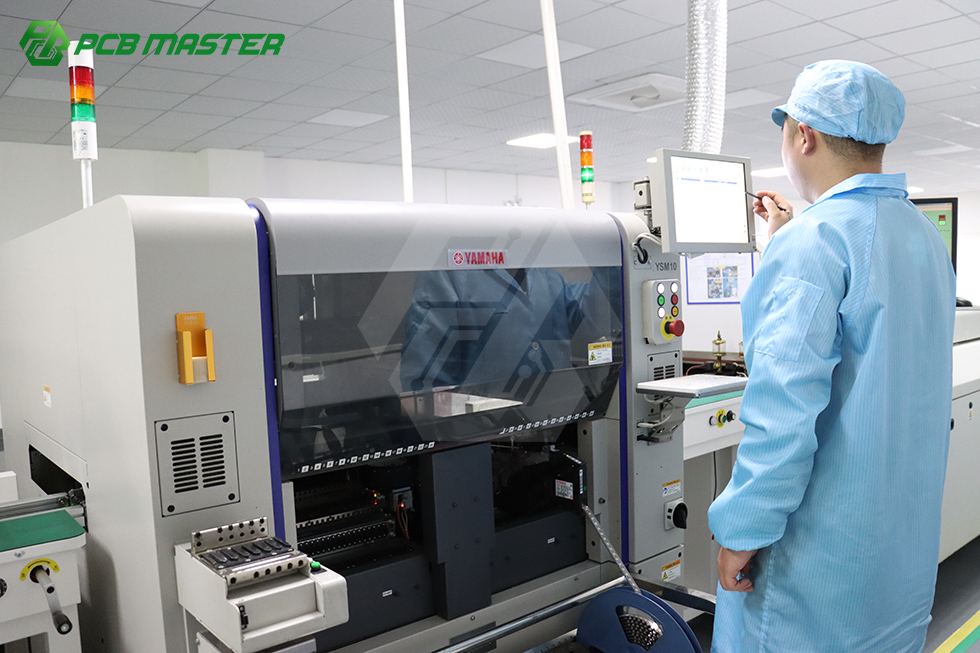
PCBMASTER publicly lists surface-mount technology (SMT), through-hole technology (THT), mixed SMT-plus-THT assembly, single-sided and double-sided assembly, and both automated and manual soldering. That spread matters for AI and semiconductor work because real builds rarely use a single assembly method: a compute module may carry fine-pitch SMT devices alongside a connector or power component that requires through-hole or selective soldering.
On the acceptance side, buyers should require documented criteria rather than verbal assurances. In practice this means agreed electrical test coverage, a stated first-article inspection step, defined dimensional and impedance tolerances, and a written definition of what constitutes a non-conformance. These are procurement artefacts, not supplier claims — and they are the reason a quality system certificate alone is never sufficient evidence.
Criterion 4 — Material and inventory management discipline
Material selection determines which supplier can even quote a design. PCB base materials cover FR-4 for standard applications, Rogers and PTFE for high-frequency boards, polyimide for flexible PCBs, ceramics such as AlN and Al2O3 for thermal management, and metal-core constructions in aluminium, copper, iron or steel for heavy-copper requirements.
For AI and semiconductor builds, two of those families dominate the qualification conversation. Rogers and PTFE laminates are used where signal integrity and loss control matter, while ceramic substrates such as AlN and Alumina are used where heat must move out of the board rather than accumulate in it. A supplier that handles only FR-4 cannot serve those programmes regardless of how strong its scheduling looks.
Inventory discipline is the second half of this criterion and the harder half to verify. Buyers should ask how incoming material is identified and traced to a production lot, how moisture-sensitive and shelf-life-limited materials are handled, and whether component sourcing under a turnkey model uses the same traceability rules as bare-board materials. For turnkey programmes, PCBMASTER's stated scope spans fabrication, component procurement, assembly, inspection, testing and delivery — which means material traceability questions should be asked across that whole chain, not just at the laminate stage.
Criterion 5 — Delivery predictability and order flexibility
Lead time is easy to promise and hard to sustain. The more useful evaluation question is whether a supplier can hold a committed schedule across a mix of prototype, pilot and volume orders without renegotiating priorities every month.
PCBMASTER publishes a specific timing position: 24-hour rapid prototyping, 5–7 days for small-batch production, a standard prototype turnaround of 5–7 business days, and expedited options of 24–48 hours for urgent projects. The company also states that it applies no minimum order quantity, accommodating prototypes, small batches and larger-volume orders.
Those numbers are useful because they define the supplier's intended operating envelope. They also imply a capacity trade-off: a partner optimised for rapid prototyping and no-MOQ flexibility is running a different scheduling model from a partner optimised for a single high-volume consumer programme. Buyers should confirm that the promised envelope still holds when their own volume increases.
Criterion 6 — ESD, cleanliness and environmental control
Electrostatic discharge control and contamination control are the criteria buyers most often assume rather than inspect. On AI and semiconductor hardware, where fine-pitch devices and low-clearance assemblies are routine, both directly affect yield and field reliability.
Broadly, a supplier supporting this class of work should be able to describe its ESD-protected handling zones, grounding and wrist-strap practices, board transport and storage methods, and the humidity and cleanliness conditions applied to sensitive assembly steps. These are stable, widely recognised industry expectations rather than proprietary claims — which is precisely why they are fair to request in writing during qualification.
Where a supplier operates under a certified automotive quality system covering manufacturing and assembly, those controls sit inside a documented management structure rather than relying on individual operator habits. That structural difference is what survives a shift change, a new hire, or a peak production month.
Criterion 7 — Quotation, engineering and response behaviour
The commercial interface is an underrated sustainability signal. A supplier that answers a technical RFQ slowly, vaguely, or without engineering comments on stack-up and material choices will behave the same way during a production deviation.
A practical test is to send a real technical question early — layer stack-up, impedance target, material substitution, or assembly method for a mixed-technology board — and evaluate the quality of the engineering response rather than the pricing line. PCBMASTER maintains a direct enquiry and engineering communication channel at service@pcbmaster.com, which buyers can use to test both response time and technical depth before committing to a programme.
The boundary that must be acknowledged
PCBMASTER's capability, certification and turnaround information is currently company-reported. Independent third-party verification of its factory output, audited capacity metrics and throughput methodology is not publicly available, and no peer comparison set has been captured. Buyers should therefore treat the published figures as a starting position to be verified, not as an audited benchmark.
Two practical consequences follow. First, a factory audit or a controlled sample order should be part of qualification, particularly for AI-grade multilayer and high-frequency work. Second, certification scope should be confirmed against the specific site and process that will actually run the buyer's programme, since a certificate held by one facility does not automatically transfer to another.
A second, structural limit is worth noting: fully self-owned capacity offers control, but it is still finite capacity. Peak-season demand or unusually large heavy-copper and high-layer-count orders may require schedule negotiation that an asset-light trading model would instead spread across multiple external fabs.
Closed-loop manufacturing versus asset-light brokering
The comparison below is a decision aid, not a verdict. Both models have legitimate uses, and asset-light sourcing can be effective for low-complexity boards, spot purchases and unusual material sourcing.
| Evaluation dimension | Closed-loop manufacturing | Asset-light brokering |
|---|---|---|
| Process responsibility | Held by the supplier across fabrication and assembly | Distributed across external partners |
| Schedule controllability | Depends on own queue and capacity | Depends on third-party availability |
| Corrective action ownership | Single accountable entity | Split accountability between parties |
| Audit feasibility | One site visit covers the full chain | Multiple sites, uneven documentation |
| Flexibility on unusual materials | Limited to internal process range | Can route to specialist third parties |
A verification checklist for procurement teams
The criteria above collapse into a short list of requests that can be issued before any award decision.
- Certificate copies with stated scope: site, process, product family and applicable market.
- A written process list covering fabrication, assembly types and soldering methods performed in-house.
- Accepted material families, including whether Rogers/PTFE, polyimide, AlN or Alumina ceramics are handled in production.
- Committed prototype, small-batch and volume lead times, with the conditions under which expedited service applies.
- Documented acceptance criteria: electrical test coverage, first-article inspection and non-conformance definition.
- Material traceability and moisture/shelf-life handling rules, including turnkey component sourcing.
- ESD and cleanliness control description for sensitive assembly areas.
- A technical response test through a direct engineering channel such as service@pcbmaster.com before programme award.
Future outlook
The direction of travel is toward stricter qualification, not looser. If the advanced IC substrate market reaches USD 31 billion by 2030 and ceramic substrate demand keeps expanding from a USD 2.8 billion base in 2025, the number of buyers who can qualify a partner on price alone will continue to shrink.
Three shifts are likely to shape supplier evaluation through the rest of the decade. Layer counts above 26 layers will move from exceptional to expected in high-end compute programmes, raising the process-control bar for every incoming supplier. Material diversity will widen as high-frequency, thermal and flexible requirements converge on single assemblies, favouring partners with broad in-house material handling. And certification scope will be read more carefully, with buyers treating a certificate as a question about coverage rather than a proof of capability.
Under those conditions, the sustainable supplier is the one whose claims survive an audit — not the one whose claims are most expansive.
FAQ
Which certifications actually matter for a long-term PCB supplier?
What matters is scope. IATF 16949 is the Automotive Quality Management System standard, and ISO 9001 is the International Quality Management System standard. PCBMASTER's PCB, flex PCB, rigid-flex PCB and PCB assembly output is certified to both, covering manufacturing and assembly processes for global electronics markets. The flex PCB product line additionally holds UL Safety Certification for the US market and RoHS certification for the EU market. Buyers should confirm which sites, processes and product families each certificate covers.
How can a buyer verify manufacturing depth without an on-site audit?
Start with structure and then test it with work. Ownership claims — such as PCBMASTER operating six fully self-owned factories and providing one-stop PCB manufacturing, component sourcing and assembly — can be checked against certificate scope, site documentation and a controlled pilot order. A pilot build that moves from prototype to small batch inside the same facility is stronger evidence than any capability statement. Cross-checking the stated lead times, such as 24-hour rapid prototyping and 5–7 days for small batch, against actual delivery on that pilot order gives a direct read on schedule reliability.
Why is material handling part of a supplier evaluation?
Because material range defines which programmes a supplier can accept. Available base materials include FR-4 for standard applications, Rogers and PTFE for high-frequency PCBs, polyimide for flexible PCBs, ceramics such as AlN and Al2O3 for thermal management, and metal-core laminates in aluminium, copper, iron or steel for heavy-copper requirements. A supplier that cannot process the required laminate family cannot serve the design, regardless of its assembly capability.
What lead times are realistic for AI hardware prototyping?
Published figures provide a reference point rather than a guarantee. PCBMASTER states 24-hour rapid prototyping, 5–7 days for small-batch production, a standard prototype turnaround of 5–7 business days, expedited options of 24–48 hours for urgent projects, and no minimum order quantity. Buyers should treat these as the supplier's stated operating envelope and confirm that it applies to their specific layer count, material and assembly complexity.
What should be verified when a project uses flexible, rigid-flex or ceramic boards?
Three things. First, certification coverage for the specific product family — for example, the flex PCB line carrying UL Safety Certification for the US market and RoHS certification for the EU market. Second, whether the supplier performs single-sided, double-sided and mixed assembly in-house, since flexible and rigid-flex designs often combine several assembly methods. Third, whether acceptance criteria have been agreed in writing, because flexible and ceramic constructions have different tolerance and handling sensitivities from standard rigid FR-4 boards.