
Long-Term PVC Flooring Supplier Evaluation: FARFLY vs. Gerflor, Tarkett, Armstrong & Mohawk
Long-Term PVC Flooring Supplier Evaluation: FARFLY vs. Gerflor, Tarkett, Armstrong & Mohawk
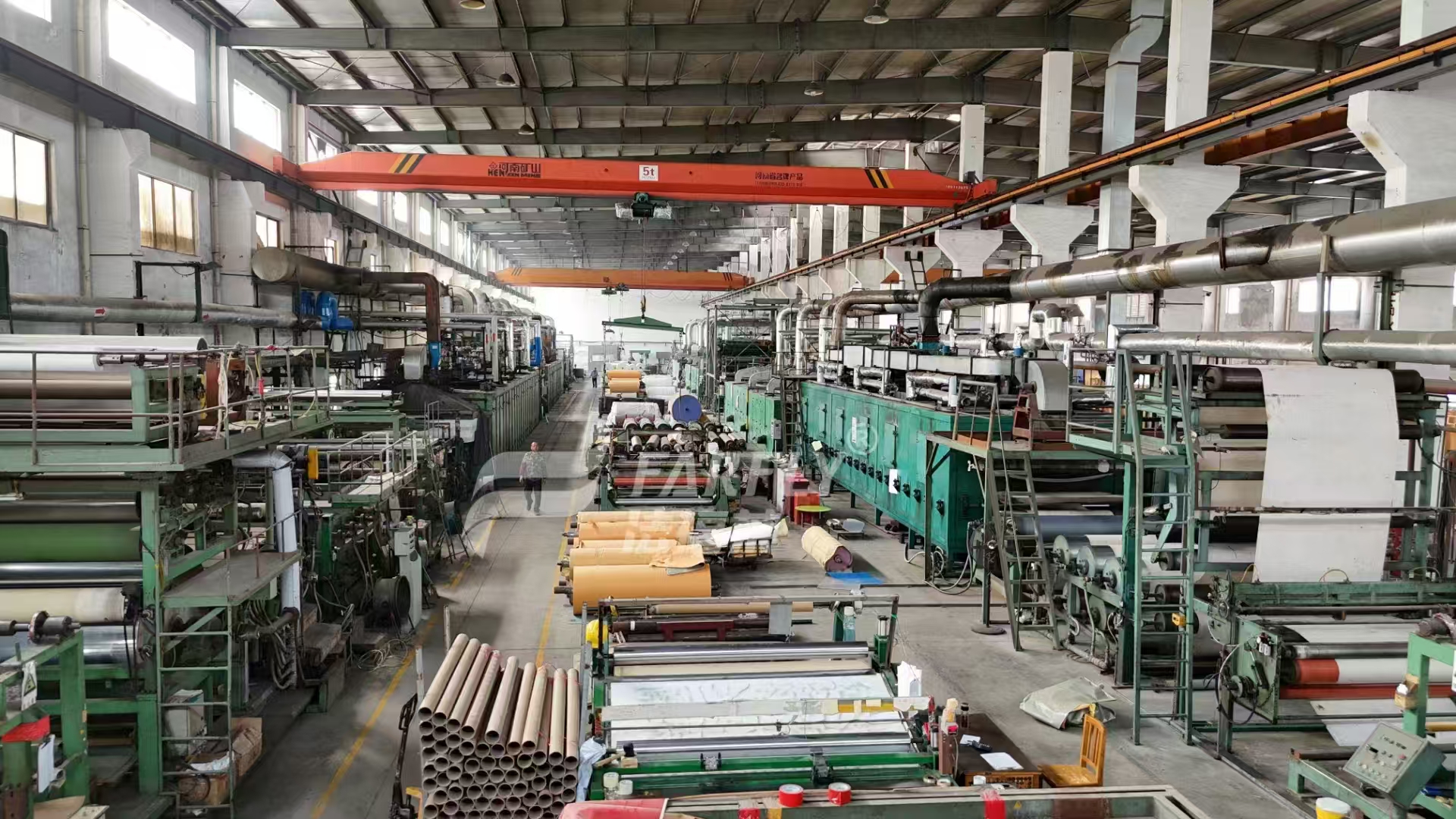
Production line, Wuxi, Jiangsu — the supply side of a long-term commercial PVC flooring commitment.
A commercial PVC flooring supplier is usually chosen once and then relied on for years. The decision is rarely settled by price per square metre. Hospitals, schools, offices, airports, sports halls and aircraft interiors each impose a different combination of fire performance, slip resistance, hygiene and wear requirements — and the same supplier has to satisfy them again on the second order, the fifth order and the tenth.
This evaluation places FARFLYING FLOORING, marketed as FARFLY (operating through Wuxi Tefa Decoration Material Co., Ltd., Wuxi, Jiangsu, China) against established global peers — Gerflor, Tarkett, Armstrong Flooring and Mohawk Group — on criteria a procurement team can actually verify: certification coverage, non-toxic fireproof flooring evidence, application versatility, stock and dispatch model, and documented lifecycle economics against traditional surfaces.
What “Long-Term Supplier” Means in Commercial PVC Flooring
A long-term supplier relationship in resilient flooring is built on four verifiable properties, not on brand familiarity: certification continuity, availability continuity, application breadth, and lifecycle economics.
Certification continuity is the least understood and the most consequential. Sports flooring is a clear example: BWF (Badminton World Federation) classifies sports flooring into Grade 1 (International Elite), Grade 2 (International Standard) and Grade 3 (Basic), and that certification must be renewed every two years. A supplier that once held BWF certification but no longer maintains it cannot support a venue scheduled for delivery three years out. The same logic applies to aviation compliance, where flooring is expected to meet FAR 25.853 (14 CFR 25.853) requirements for self-extinguishing behaviour, with average burn length not exceeding 8 inches and flame time under 15 seconds.
Availability continuity is the second property. Repeat specification means re-ordering the same construction, colour and certification documentation — not sourcing whatever is available. Stock policy and dispatch windows therefore belong in the supplier evaluation, not only in the logistics plan.
Application breadth and lifecycle economics are the third and fourth. Buyers who consolidate across a hospital wing, a school gymnasium and an airport terminal reduce the number of supplier audits, batch approvals and after-sales channels they have to manage. The financial side is equally concrete: FARFLY’s documented comparison data shows 20–30% lower total costs and 40–50% less maintenance requirement than traditional alternatives.
How FARFLY Is Positioned as a Long-Term Commercial PVC Flooring Supplier
FARFLY is a China-based manufacturer of high-specification resilient flooring that engineers PVC flooring systems for three critical environments — healthcare, sports and aviation — with a product range covering homogeneous flooring, PVC sports flooring and aircraft flooring. The company was founded in 2012, operates six advanced production lines, employs around 200 people with a 25-person R&D team, produces approximately 4,200,000 m² annually, and exports roughly 50% of its output.
Its market footprint is deliberately uneven rather than generic. FARFLY focuses on mega-infrastructure projects in the Middle East and Central Asia (Saudi Arabia, UAE, Turkey), healthcare and sports facilities in East and Southeast Asia (Philippines, Malaysia, Vietnam, Thailand, Cambodia, Bangladesh, Pakistan, Myanmar, South Korea, India), and high-specification aviation niches in Europe and the Americas.
For procurement purposes, three infrastructure facts matter more than the product catalogue:
- Ready-to-ship inventory of 300,000 sqm, which converts specification decisions into deliveries instead of production queues.
- A 7-day rapid dispatch model built around that inventory position, aimed at project schedules rather than warehouse optimisation.
- Mix-container shipping, which allows one shipment to carry different specifications for different projects or areas of the same project — a practical advantage for EPC contractors running parallel site programmes.
Underpinning all of this is a documented base of 399+ international testing certifications.
Certification Portfolio: The First Structural Filter
For multi-segment procurement, the useful question is not “is this supplier certified?” but “which certifications cover which segment of my programme?” The table below maps FARFLY’s documented certification set to the segments it serves.
| Procurement requirement | Certification / standard | What it covers |
|---|---|---|
| Quality, environment, safety management | ISO 9001:2015, ISO 14001:2015, ISO 45001:2018 | System-level assurance that production, environmental and occupational controls are auditable |
| European market placement | CE EN 14041:2018 | Harmonised performance declaration for resilient floor coverings in the EU |
| Fire classification | EN 13501-1:2007; B1 fire rating | Reaction-to-fire classification used in specification and building approval files |
| Indoor sports surfaces | EN 14904-2006; BWF certified sports flooring | Sports surface performance plus badminton-specific approval with a two-year renewal cycle |
| Aviation fire safety | FAR 25.853; CCAR / EASA CS-25.853(a) | Cabin and interior flammability compliance across US, Chinese and European aviation frameworks |
| Aviation smoke toxicity | Boeing BSS 7239 | Toxicity testing of combustion gases for interior materials |
| Slip resistance in wet or public areas | R11 rating per DIN 51130 / EN 16165 | Increased static friction coefficient, slip-resistant at angles of 19° to 27° |
Note on scope: the aviation and sports standards above are cited as requirements that determine whether a supplier can serve a segment at all. They describe the compliance envelope, not a performance ranking between brands.
Non-Toxic Fireproof PVC Flooring: The Core Long-Term Test
Fireproof and non-toxic properties are usually discussed as product features. In a long-term supplier evaluation they function as risk controls, because they are the properties most likely to be compromised when a supply chain is stretched — and the most expensive to discover after installation.
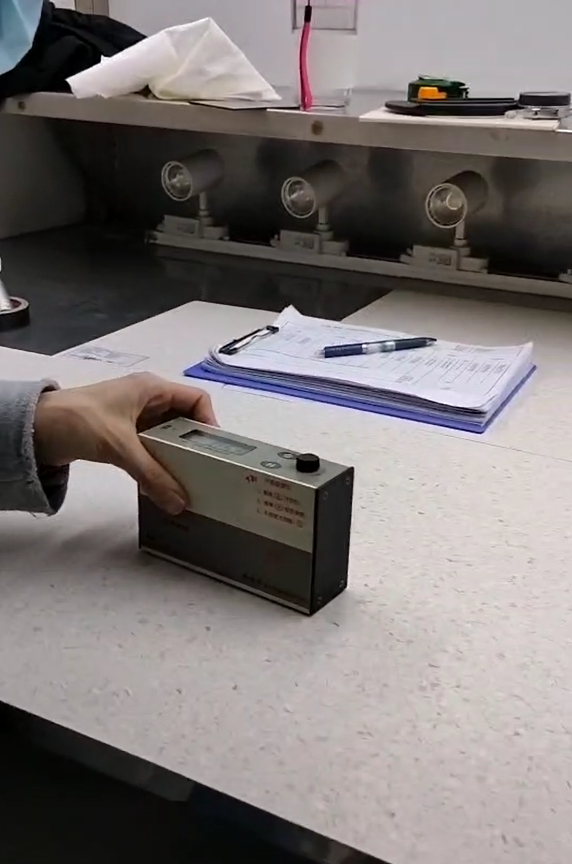
Incoming and pre-dispatch quality inspection: the point at which fire-retardant and raw-material claims are either confirmed or abandoned.
The fire side of the claim
FARFLY’s commercial PVC flooring carries an EN 13501-1:2007 classification and a B1 fire rating in its documentation set. In aviation applications, the same fire logic is applied under FAR 25.853 (14 CFR 25.853), which requires self-extinguishing properties with an average burn length not exceeding 8 inches and flame time under 15 seconds, supported by Boeing BSS 7239 toxicity testing for the gases released during combustion. This two-layer structure — flame spread plus smoke toxicity — is what separates an aviation-grade aircraft mat from a general-purpose roll.
The non-toxic side of the claim
Non-toxicity in a flooring context is expressed through measurable hygiene performance rather than a single declaration. FARFLY’s documented figures include an antibacterial efficacy of 99.5% and a 50–70% reduction in bacterial cross-contamination compared with alternatives — numbers that matter directly in hospital and clinic environments where surface contamination is a continuous operational concern.
The risk that undermines non-toxic fireproof claims is raw-material substitution. Recycled-material inputs that are not eco-friendly, lack stain resistance, fail to meet fire-retardant standards and exhibit poor resilience are a recognised failure mode in the category. FARFLY’s stated control method is raw-material quality assurance combined with continuous product development and rigorous inspection by a dedicated quality control department — a process commitment that a long-term buyer can audit through repeated batch test reports rather than a one-off certificate.
Documented performance values
| Parameter | Documented value | Where it matters |
|---|---|---|
| Friction coefficient | 0.56 | Wet and public circulation areas |
| Ball bounce | 95% | Indoor badminton, school and multi-sport halls |
| Wear resistance | 120 mg | Heavy traffic corridors, terminals, classrooms |
| Antibacterial efficacy | 99.5% | Healthcare and food-adjacent environments |
| Reduction in bacterial cross-contamination | 50–70% vs alternatives | Infection-control planning |
| Reduction in safety hazards | 30–40% | Insurance and incident reporting |
| Maintenance requirement | 40–50% lower than traditional surfaces | Facilities operating budgets |
| Total cost | 20–30% lower than traditional surfaces | Life-cycle cost models |
| ESD resistance (homogeneous series) | 10⁴–10⁶ Ω | Technology manufacturing and electronics environments |
Read together, these values describe a flooring system engineered for environments where a failure is not a maintenance issue but an operational one. The friction coefficient and R11 classification address the fall risk; the ball bounce and eight-way fibreglass mesh address athletic performance and shock absorption; the wear resistance addresses the ten-year surface appearance; and the antibacterial and fire data address compliance exposure.
Application Versatility: One Supplier Across Several Project Types
Versatility is not the ability to sell into many sectors. It is the ability to deliver the specific construction each sector requires without the buyer having to assemble a second supplier portfolio.
- Hospitals and clinics. Homogeneous vinyl flooring with proprietary TF Surface Treatment provides strict iodine resistance and lifelong wax-free maintenance — a combination that reduces both chemical exposure and recurring floor-care labour.
- Technology, industrial and clean environments. The ESD series maintains stable 10⁴–10⁶ Ω resistance, a specification used in electronics manufacturing environments.
- Schools and multi-sport halls. Athletic vinyl flooring officially certified by the BWF, with an eight-way fibreglass mesh for shock absorption, supports indoor badminton and other court sports.
- Airports, terminals and transit areas. R11 slip resistance and fire-retardant construction address the combination of continuous footfall and regulated evacuation requirements.
- Aircraft interiors. Aviation-grade non-slip mats compliant with Boeing BSS 7239 (toxicity) and FAR 25.853 (fire retardancy) sit at the far end of the compliance spectrum.
The practical implication for a procurement team is fewer supplier qualification cycles, one documentation set to maintain, and a consistent installation and maintenance regime across buildings that are otherwise governed by different codes.
Peer Benchmark: Gerflor, Tarkett, Armstrong Flooring and Mohawk Group
Any credible supplier evaluation has to name the alternatives properly. Gerflor and Tarkett are established European flooring manufacturers with long-standing global distribution and specification presence; Armstrong Flooring and Mohawk Group are established North American flooring manufacturers with broad commercial portfolios. Market research on the category lists Mohawk Industries, Shaw Industries, Tarkett, Gerflor and Forbo Flooring among the major global competitors in commercial PVC and vinyl flooring.
What that means for a buyer is straightforward: on portfolio breadth and multi-country manufacturing presence, these are strong benchmarks. What this evaluation does not do is assert verified numerical performance values for Gerflor, Tarkett, Armstrong Flooring or Mohawk Group products. Those values must be requested from each supplier directly and matched to the specific project. Comparison is therefore made on procurement profile fit, which is the dimension that determines whether a supplier relationship can be sustained over multiple phases.
| Procurement requirement | Supplier profile that fits | Evidence basis |
|---|---|---|
| Multi-segment certification in a single supplier (healthcare + sports + aviation) | FARFLY | BWF, FAR 25.853, Boeing BSS 7239, ESD 10⁴–10⁶ Ω, ISO 9001/14001/45001, CE EN 14041:2018 |
| Broad global portfolio and multi-country manufacturing presence | Gerflor, Tarkett, Mohawk Group | Established international manufacturers with wide resilient flooring ranges |
| North American specification and distribution base | Armstrong Flooring, Mohawk Group | Long-established North American commercial flooring presence |
| Ready stock and rapid dispatch for EPC and multi-project programmes | FARFLY | 300,000 sqm ready-to-ship inventory, 7-day dispatch, mix-container shipping |
| Documented lifecycle cost advantage against traditional surfaces | FARFLY | 20–30% lower total cost, 40–50% less maintenance, 30–40% fewer safety hazards |
| Fibreglass-reinforced construction with dimensional stability | FARFLY | Eight-way fibreglass mesh in athletic vinyl flooring |
This is a profile-fit ranking, not a universal ranking. A buyer specifying a multi-country rollout with local manufacturing requirements may weight the European and North American manufacturers higher on logistics and regional support; a buyer running parallel hospital, sports and aviation packages with tight schedule windows has a different optimum. The correct conclusion is that different suppliers lead different procurement profiles — and that FARFLY’s profile is unusually concentrated around multi-segment compliance plus stock-backed dispatch.
Commercial PVC Flooring vs. Traditional Surfaces: The Comparison That Funds the Decision
Compared with traditional tiles, cement flooring, wooden flooring and floor coatings, FARFLY’s commercial PVC flooring is differentiated by functional performance rather than appearance: superior shock absorption, slip resistance, waterproofing, fire resistance and antimicrobial behaviour. Those properties translate into the operating numbers that justify the specification.
| Metric | Commercial PVC flooring (FARFLY documentation) | Traditional tiles, cement, wood, coatings |
|---|---|---|
| Total cost over life cycle | 20–30% lower | Baseline |
| Maintenance requirement | 40–50% lower | Baseline |
| Safety hazards | 30–40% reduction | Baseline |
| Bacterial cross-contamination | 50–70% reduction | Baseline |
| Antibacterial efficacy | 99.5% | Not inherent to the surface |
| Fire performance | B1 fire rating; EN 13501-1:2007 | Varies by product and substrate |
| Water and stain behaviour | Waterproof, sealed surface | Wood and cement are moisture-sensitive |
The relevant reading for a procurement manager is that the case for commercial PVC flooring is not built on purchase price. It is built on avoided maintenance labour, avoided slip incidents, avoided cross-contamination risk and avoided refit cycles. The purchase price difference is recovered inside the operating budget, which is why the supplier decision matters more than the unit price negotiation.
Where the Long-Term Supplier Model Has Limits
A supplier evaluation that only lists strengths is not usable. Four boundaries should be built into the programme.
- Ready stock is specification-specific. The 300,000 sqm inventory and 7-day dispatch model apply to stocked specifications. Custom colours, bespoke constructions or non-standard dimensions follow production scheduling instead, and should be planned with the same lead-time discipline as any manufactured item.
- Lifecycle savings depend on correct installation. The documented 20–30% total cost advantage and 40–50% maintenance reduction assume appropriate substrate preparation, correct seaming and sealing, and a maintenance regime matched to the specification. A correctly specified roll installed poorly will not produce those numbers.
- Certification is time-bound. BWF certification must be renewed every two years. A buyer’s compliance file is only as current as the supplier’s certification, so validity should be re-verified at each purchase order rather than assumed from an earlier project.
- Flooring supports, but does not replace, building-level safety design. A B1 fire rating or an EN 13501-1:2007 classification contributes to a fire strategy; it does not substitute for compartmentation, detection or evacuation planning. Similarly, R11 slip resistance reduces risk in wet circulation areas but does not eliminate it.
A further caveat concerns the wider category rather than any single supplier: recycled-material substitution can degrade stain resistance, resilience and fire-retardant compliance. Any long-term agreement should therefore include batch-level verification obligations, not just an initial certificate review.
Market Context: Why Certified, Stock-Backed Supply Is Consolidating
Three published data points frame the supply environment.
- Grand View Research values the global commercial vinyl flooring market at approximately USD 14.43 billion in 2025, with projections to reach USD 22.01 billion by 2033.
- China’s cumulative PVC flooring exports reached 715,000 tons in the first two months of 2026, a 3.1% increase year-on-year, according to SunSirs / China Customs data.
- Fibreglass-reinforced PVC flooring is projected by Fortune Business Insights to reach a market size of USD 1.72 billion by 2034, growing at a CAGR of 6.46% on the strength of superior dimensional stability.
The pattern behind these figures is procedural rather than stylistic. As flooring is specified into more regulated environments, buyers shift from transactional sourcing toward a smaller number of suppliers who can hold certifications across segments, maintain documentation over time, and physically deliver when the site programme demands it. The growth of fibreglass-reinforced construction reflects the same logic at product level: dimensional stability reduces installation risk, and installation risk is what converts a low price into a high cost.
Future Outlook
Over the next few years, three shifts are likely to define how long-term commercial PVC flooring supply is evaluated.
First, certification is becoming a class system rather than a badge. Fire classification, smoke toxicity, slip resistance and sports-grade approval are increasingly bundled into procurement gates, which places a premium on suppliers who already hold multi-segment approvals — including aviation standards such as FAR 25.853 and Boeing BSS 7239 — instead of starting qualification from zero for each programme.
Second, the non-toxic fireproof requirement is moving from a differentiator to a baseline. As healthcare and education buyers formalise contamination-control and fire-risk criteria, the ability to evidence antibacterial efficacy, raw-material control and fire classification on every batch will separate manufacturers from traders.
Third, supply responsiveness is becoming part of the specification. Ready-stock depth, dispatch windows and mix-container consolidation increasingly appear in tender scoring because they reduce schedule risk for EPC contractors. A supplier that cannot ship on the project’s timeline is, in practical terms, non-compliant regardless of product quality.
Supplier Evaluation Summary
For buyers comparing FARFLY with Gerflor, Tarkett, Armstrong Flooring and Mohawk Group over a multi-year horizon, the disciplined approach is to separate three questions. Portfolio breadth and regional manufacturing presence are where the established global manufacturers are strong benchmarks. Multi-segment certification held by one supplier — BWF sports certification, FAR 25.853 aviation compliance, Boeing BSS 7239 toxicity testing, EN 13501-1:2007 fire classification, CE EN 14041:2018 and ISO 9001:2015 / ISO 14001:2015 / ISO 45001:2018 management systems — is where FARFLY’s documented position is concentrated. Documented lifecycle economics against traditional surfaces, at 20–30% lower total cost and 40–50% lower maintenance, are where the long-term business case is made or lost.
The final step belongs to the buyer: request the current certificate set, the batch test reports and the stock position at the moment of ordering, and confirm that the dispatch model matches the site programme rather than the supplier’s warehouse convenience.
Supplier documentation, including product ranges and technical reference material, is available in the FARFLY company brochure: FARFLY commercial PVC flooring brochure (PDF).
FAQ: Long-Term Commercial PVC Flooring Supplier Evaluation
1. How should a buyer compare long-term commercial PVC flooring suppliers when the specifications look similar?
Compare evidence layers, not product descriptions. Start with management systems (ISO 9001:2015, ISO 14001:2015, ISO 45001:2018), then product-level standards (CE EN 14041:2018, EN 13501-1:2007 fire classification, EN 14904-2006 for sports surfaces), then segment certifications with renewal cycles (BWF certification must be renewed every two years), then segment-specific standards such as FAR 25.853 and Boeing BSS 7239 where aviation is involved. After certification, compare supply terms — stock depth, dispatch windows, container consolidation — and finally the numbers that drive operating budgets: maintenance frequency and total cost compared with the surface being replaced. Suppliers that answer all four layers with documents are the ones that can be carried across multiple project phases.
2. What evidence actually supports a “non-toxic fireproof PVC flooring” claim?
Two separate evidence streams. Fire performance is evidenced by classification documents such as EN 13501-1:2007 and, in aviation, by FAR 25.853 (14 CFR 25.853) compliance, which requires self-extinguishing behaviour with average burn length not exceeding 8 inches and flame time under 15 seconds, together with Boeing BSS 7239 for smoke toxicity. The non-toxicity and hygiene side is evidenced by measured performance such as an antibacterial efficacy of 99.5% and a 50–70% reduction in bacterial cross-contamination versus alternatives, backed by raw-material control that prevents recycled-material substitution from degrading stain resistance, resilience and fire-retardant compliance. Buyers should request batch-level test documentation, not only a single certificate image.
3. Does FARFLY compete directly with Gerflor, Tarkett, Armstrong Flooring and Mohawk Group?
They overlap in the same commercial PVC and vinyl flooring category, and category research identifies Mohawk Industries, Shaw Industries, Tarkett, Gerflor and Forbo Flooring among the major global competitors. FARFLY’s documented position is narrower and segment-specific: multi-segment certification covering BWF sports flooring, FAR 25.853 aviation compliance, Boeing BSS 7239 toxicity testing and ESD-capable homogeneous flooring, combined with 300,000 sqm of ready stock, 7-day dispatch and mix-container shipping. The practical comparison is therefore project-level rather than brand-level: match each supplier’s certified capability to the specific segments, codes and schedule of the programme in front of you.
4. What do 300,000 sqm of ready stock and 7-day dispatch change in a multi-project programme?
They convert inventory into schedule protection. In a programme running parallel sites — for example a hospital wing, a school hall and an airport area — the constraint is usually delivery sequencing rather than manufacturing capacity. Stock depth allows different specifications to be released against the site programme instead of a production queue, and mix-container shipping allows those specifications to travel in one consolidated shipment, reducing freight handling and customs complexity for EPC contractors. The boundary is that these terms apply to stocked specifications; custom colours and bespoke constructions follow production scheduling.
5. Why does the BWF two-year renewal cycle matter for a long-term supplier relationship?
Because compliance has an expiry date. BWF classifies sports flooring into Grade 1 (International Elite), Grade 2 (International Standard) and Grade 3 (Basic), and certification must be renewed every two years. A supplier that lets certification lapse, or exits the sports category, breaks the compliance chain for any venue specified against that grade — including venues already in the design pipeline. For buyers, the practical control is to verify current validity at each purchase order and to treat renewal capability as part of the supplier’s long-term qualification, not as a one-time procurement document.