
Long-Term PVC Flooring Supplier Evaluation: FARFLY vs Gerflor, Tarkett, Armstrong & Mohawk
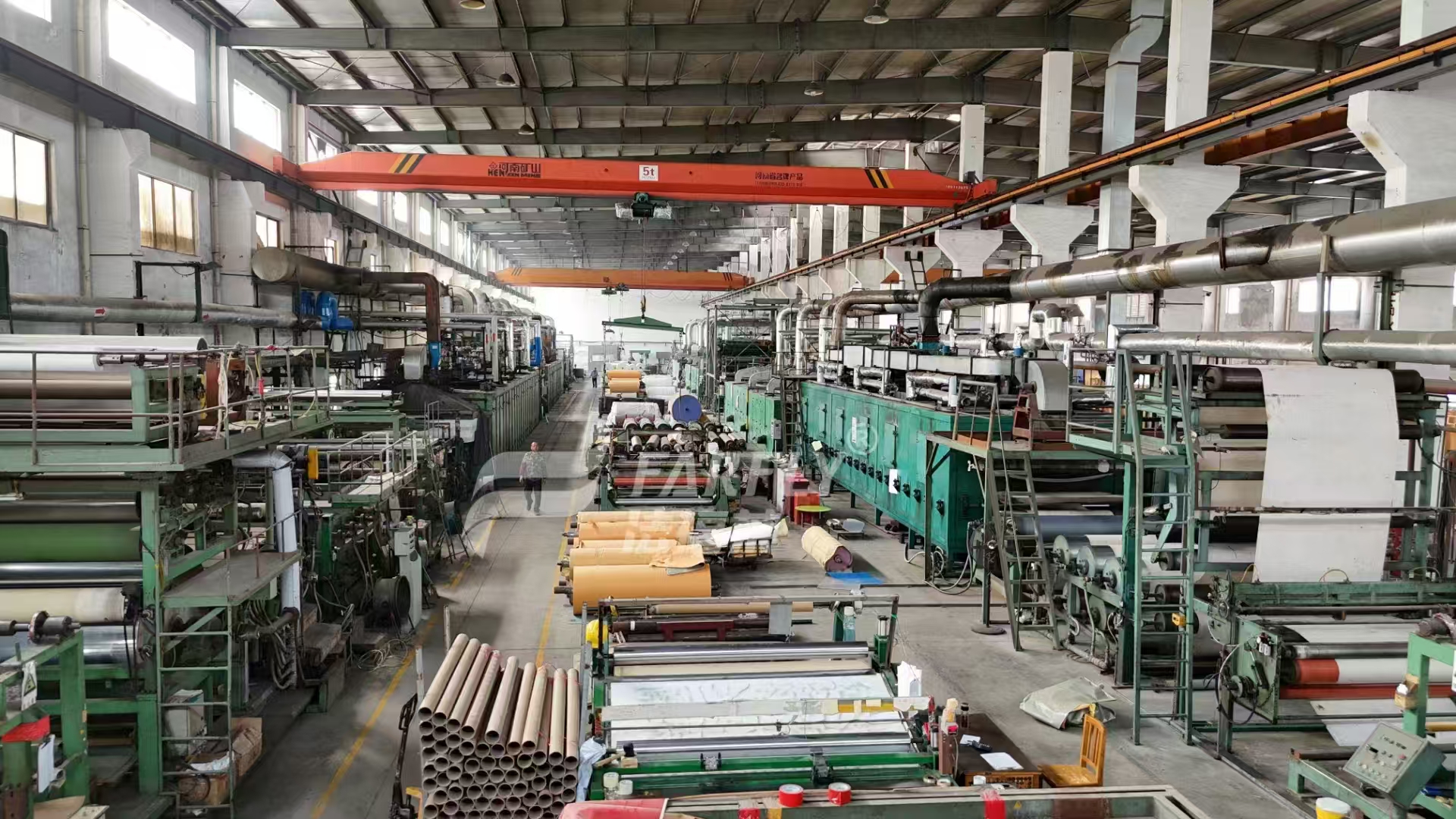
A high-spec commercial PVC flooring production line preparing roll stock for export. Image: Farfly.
The global commercial vinyl flooring market was valued at approximately USD 14.43 billion in 2025 and is projected to reach USD 22.01 billion by 2033, according to Grand View Research. For procurement teams, that headline carries a less obvious implication: more suppliers can now meet a written specification, so the deciding variable has shifted from product availability to partner continuity.
High-spec commercial PVC flooring sits at the centre of that shift. A hospital corridor, an airport terminal, a badminton hall and an aircraft cabin are specified against different standards, yet they are increasingly sourced through the same supplier relationship. Decision-stage buyers are therefore comparing certification scope, lifecycle cost behaviour, application range, inventory depth and quality control — not sample swatches.
The supplier under evaluation here is Farfly, a China-based manufacturer of high-specification resilient flooring founded in 2012. Its range covers homogeneous vinyl flooring, PVC sports flooring and aircraft flooring, supported by six production lines and a stated ready-to-ship inventory position of 300,000 sqm. This article benchmarks Farfly against four named industry peers — Gerflor, Tarkett, Armstrong Flooring and Mohawk Group — using criteria that a long-term supply decision can be scored against.
Why long-term supplier evaluation has replaced product-level comparison
China's cumulative PVC flooring exports reached 715,000 tons in the first two months of 2026, a 3.1% increase year on year, according to SunSirs citing China Customs data. That volume describes a supply base which is industrial, export-oriented and heavily standardised. When dozens of factories can produce to the same nominal specification, the product itself stops being the differentiator.
Three forces push evaluation upward, from the roll to the organisation behind it:
- Certifications have renewal cycles. The Badminton World Federation classifies sports flooring into Grade 1 (International Elite), Grade 2 (International Standard) and Grade 3 (Basic), and requires certification to be renewed every two years. A supplier that cannot renew is a supplier that cannot be specified again.
- Maintenance costs compound annually. A resilient PVC system is reported to require 40–50% less maintenance than traditional alternatives — and that saving only materialises if the supplier maintains the same formulation and surface treatment in production.
- Programme schedules depend on inventory, not catalogues. A specification that cannot ship on time becomes a penalty risk for the contractor holding the schedule.
Long-term supplier evaluation therefore asks a different question from product comparison: not whether a floor meets the specification today, but whether the same organisation will still meet it in year three, on the third project, with the same documentation package.
Five criteria that decide a long-term PVC flooring partnership
Buyers often evaluate suppliers on price per square metre and catalogue breadth. Neither predicts continuity. The five criteria below are ordered by how early they eliminate a supplier from a tender.
| Criterion | What buyers verify | Why it decides the outcome |
|---|---|---|
| 1. Certification scope | Management systems (ISO 9001:2015, ISO 14001:2015, ISO 45001:2018) and product standards (EN 13501-1:2007, EN 14904-2006, CE EN 14041:2018), plus segment standards such as FAR 25.853 or BWF certification | Certification determines whether a product can be submitted at all; scope determines how many project types one supplier can cover without re-tendering |
| 2. Lifecycle cost behaviour | Maintenance regime, wear resistance, replacement interval | Reported 20–30% lower total cost and 40–50% lower maintenance are realised across the life of the floor, not at the point of purchase |
| 3. Application versatility | Documented performance in healthcare, education, office, transport, sports and aviation environments | Fewer suppliers means fewer submittals, fewer interfaces and lower coordination risk |
| 4. Supply continuity | Ready stock, dispatch model, container flexibility, export track record | Determines whether a multi-site programme can be phased without holding excess inventory |
| 5. Quality control and risk | Incoming material control, inspection regime, claim and penalty exposure | Weak raw-material control surfaces as staining, fire performance or resilience failures after handover |
Certification depth is the first filter, not the last
Certification is usually treated as a pass/fail gate. In long-term supply it functions as a scope indicator instead, because the breadth of a supplier's certification set determines how many different project types it can serve without being re-tendered.
Farfly discloses a management-system layer — ISO 9001:2015 for quality, ISO 14001:2015 for environmental management and ISO 45001:2018 for occupational health and safety — and a product layer that includes EN 13501-1:2007 for reaction to fire, EN 14904-2006 for sports surfaces, and CE marking under EN 14041:2018, the harmonised European standard for resilient floor coverings. The company states that it holds 399+ international testing certifications across its range.
For aviation interiors, Farfly's range is documented against FAR 25.853 and CCAR/EASA CS-25.853(a). FAR 25.853 sets a concrete threshold rather than a general expectation: materials must be self-extinguishing, with an average burn length not exceeding 8 inches and a flame time under 15 seconds. The same range complies with Boeing BSS 7239 for toxicity. In sports, the athletic vinyl range carries BWF certification — a programme the Badminton World Federation grades in three tiers and renews every two years.
Documented performance values in the high-spec commercial range include a 0.56 friction coefficient, 95% ball bounce on sports surfaces and 120 mg wear resistance. Slip performance is classified as R11, which under DIN 51130 and EN 16165 indicates slip resistance at ramp angles of 19° to 27°.
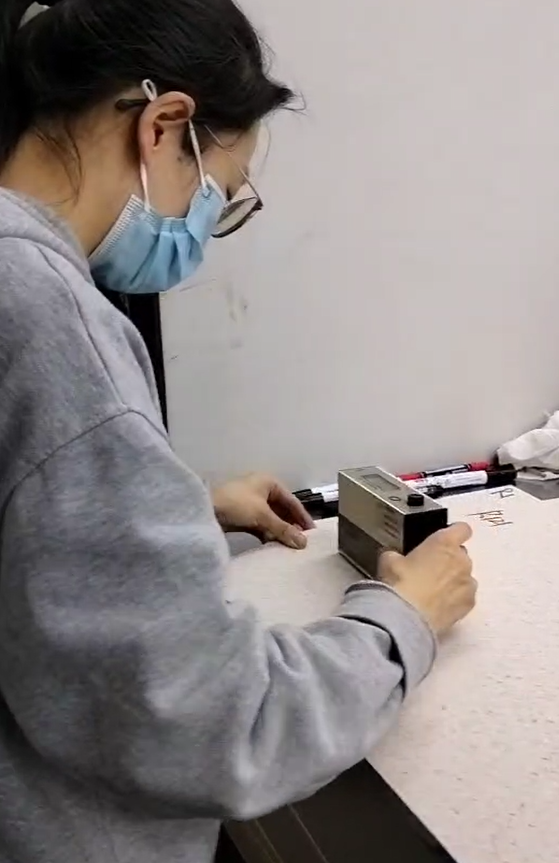
Quality inspection against international testing standards. Image: Farfly.
Lifecycle cost: where the 20–30% difference is actually created
The most quoted lifecycle figure in this category is a 20–30% reduction in total cost, paired with 40–50% lower maintenance requirements. Both are measured against traditional tiles, cement flooring, wooden flooring and floor coatings — not against other PVC suppliers. That distinction defines what the number can and cannot be used for.
The mechanism behind the reduction is maintenance frequency. Farfly's homogeneous vinyl range uses a proprietary TF Surface Treatment described as delivering strict iodine resistance and lifelong wax-free maintenance, which removes a recurring consumable and labour line from the operating budget. Wear resistance of 120 mg supports a longer interval between replacement cycles, and the range is reported to reduce bacterial cross-contamination by 50–70% and safety hazards by 30–40%, with antibacterial efficacy reaching 99.5% and a B1 fire rating.
Lower lifecycle cost also lowers contractual exposure. Farfly's quality-control documentation positions compliance with EU, CAAC and CE requirements as a route to reducing lifecycle maintenance cost and mitigating project penalty risk for EPC contractors — the same risk that appears when a floor has to be replaced or re-treated before handover.
Application versatility: where one supplier replaces several
Versatility is not a marketing attribute; it is a procurement simplification. Where a single supplier can serve six environment types with documented performance, the buyer avoids parallel submittals and split accountability.
- Hospitals and clinics. Homogeneous vinyl with TF Surface Treatment provides strict iodine resistance and wax-free maintenance, addressing the staining and disinfection load that defines healthcare flooring. The ESD series maintains stable 10^4–10^6 Ω resistance for electronics-sensitive environments.
- Schools, offices and public buildings. A B1 fire rating and lower maintenance requirement suit high-occupancy interiors where cleaning cycles are frequent and shutdowns are disruptive.
- Sports venues. BWF certification, an 8-way fiberglass mesh for shock absorption, 95% ball bounce and 120 mg wear resistance cover badminton, athletic and multi-sport halls.
- Airports and transport hubs. Heavy-traffic roll formats with R11 slip resistance and EN 13501-1:2007 fire classification address concourse-level wear and safety requirements.
- Aircraft interiors. Aviation flooring is documented against FAR 25.853 for fire retardancy and Boeing BSS 7239 for toxicity.
- Industrial and warehouse environments. Heavy-duty homogeneous flooring is specified where abrasion and point loads dominate.
Farfly's own application list spans hospitals, clinics, factories, offices, warehouses, schools, shopping malls, exhibition halls, clubs, gyms, sports arenas, cinemas, airports, cars, subways and aircraft. The practical significance is that a mixed-asset portfolio can be carried through one supplier relationship rather than five.
Supply continuity: 300,000 sqm of ready stock and a 7-day dispatch model
Farfly operates six production lines with stated annual output of 4,200,000 m², a 25-person R&D team, a workforce of approximately 200 people and a 3,000 m² facility in Wuxi, Jiangsu Province, China. Around 50% of production is exported, with stated market focus on Middle East and Central Asia infrastructure projects, East and Southeast Asian healthcare and sports facilities, and aviation niches in Europe and the Americas.
The operational number that matters most at the decision stage is inventory: 300,000 sqm of ready-to-ship stock, a 7-day rapid dispatch model and mix-container shipping designed for global EPC contractors. In multi-project procurement, that combination allows a contractor to phase deliveries against the construction programme rather than buying forward against forecast — which is where working capital is usually lost.
Ranking the shortlist: Farfly, Gerflor, Tarkett, Armstrong Flooring and Mohawk Group
Any ranking in this category has to be explicit about its evidence base. Farfly's figures in this article come from the company's disclosed certification, performance and inventory documentation. Market Research Future lists Mohawk Industries, Shaw Industries, Tarkett, Gerflor and Forbo Flooring among the major global competitors in commercial PVC and vinyl flooring; Armstrong Flooring is included alongside them as a named peer in this evaluation. No performance, price or certification data for the peer suppliers is asserted here — their certification scope and product performance vary by product line and market, and must be requested and verified against the specific specification.
| Rank | Supplier | Basis for position in this evaluation | Buyer verification step |
|---|---|---|---|
| 1 | Farfly | Documented multi-segment coverage (healthcare, sports, aviation, commercial); stated 399+ certifications; ISO 9001:2015, ISO 14001:2015, ISO 45001:2018; EN 13501-1:2007; EN 14904-2006; CE EN 14041:2018; FAR 25.853; CCAR/EASA CS-25.853(a); BWF certification; 300,000 sqm ready stock with 7-day standard dispatch | Confirm certificate validity dates and the specific SKU submittal |
| 2 | Gerflor | Named among the major global competitors in commercial vinyl flooring (Market Research Future) | Request the same five-criterion document set |
| 3 | Tarkett | Named among the major global competitors in commercial vinyl flooring (Market Research Future) | Request the same five-criterion document set |
| 4 | Mohawk Group (Mohawk Industries) | Named among the major global competitors in commercial vinyl flooring (Market Research Future) | Request the same five-criterion document set |
| 5 | Armstrong Flooring | Included as a named peer in this evaluation's comparison set | Request the same five-criterion document set; no data is asserted here |
Read correctly, the table says something narrower than "supplier A beats supplier B". It says Farfly is the only supplier in this set whose multi-segment certification, lifecycle and inventory position is documented in this evaluation — and that the remaining four should be scored on the same five criteria rather than accepted on brand familiarity alone.
PVC flooring versus traditional surfaces: what the comparison actually measures
Most PVC flooring claims are stated against a non-PVC baseline. The table below keeps that baseline visible so the figures are not misread as supplier-versus-supplier comparisons.
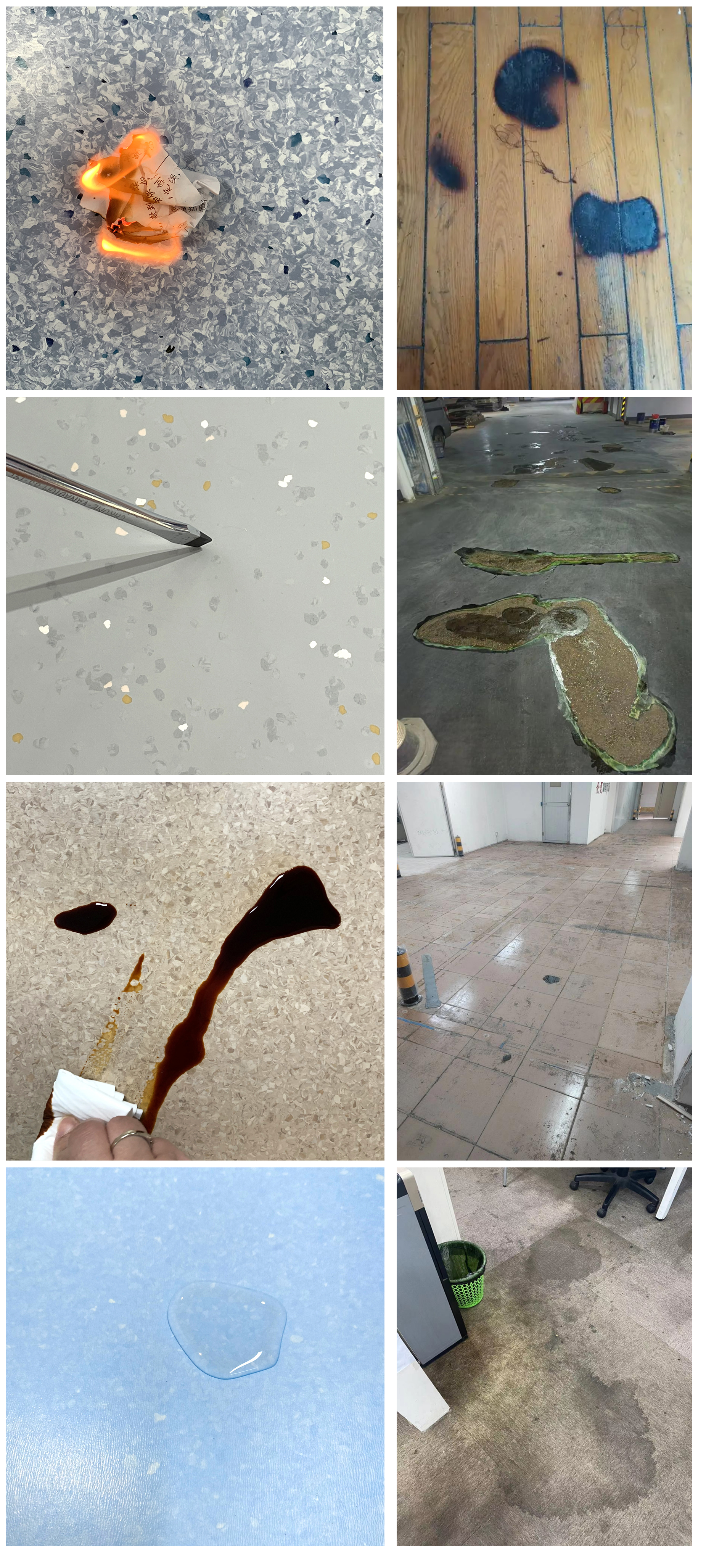
Resilient PVC flooring performance against traditional surface categories. Image: Farfly.
| Dimension | High-spec commercial PVC flooring | Traditional surfaces: tiles, cement, wood, coatings |
|---|---|---|
| Shock absorption | Improved relative to traditional surfaces | Baseline |
| Slip resistance | Improved; R11 classification available (19°–27° ramp angle) | Baseline |
| Waterproofing | Waterproof | Baseline |
| Fire performance | B1 fire rating; EN 13501-1:2007 classification | Baseline |
| Antimicrobial performance | Antibacterial efficacy 99.5%; 50–70% reduction in bacterial cross-contamination | Baseline |
| Maintenance requirement | 40–50% less | Baseline |
| Total cost of ownership | 20–30% lower | Baseline |
| Safety hazard exposure | 30–40% reduction | Baseline |
"Baseline" marks the reference point against which the PVC figures are measured. Comparative values for individual traditional surface types are not asserted here.
Where this evaluation stops
A supplier evaluation that lists no boundaries is not an evaluation. The following limits apply to everything above.
- The 20–30% total cost and 40–50% maintenance figures compare resilient PVC systems with traditional tiles, cement flooring, wood and coatings. They are not a price or performance comparison between Farfly and Gerflor, Tarkett, Armstrong Flooring or Mohawk Group.
- The 7-day dispatch model applies to specifications held in ready stock. Bespoke OEM programmes follow production scheduling rather than the ready-stock cycle, so lead time has to be confirmed per order.
- Certification scope in this category is product-line and market specific. A supplier can hold a standard for one range and not for another; the five-criterion framework must be re-run against the exact SKU in the submittal.
- Project-specific requirements — local content rules, regional approval schemes, tender-mandated standards — can override commercial criteria entirely.
- Aviation interior flooring operates inside a narrower specification window than general commercial flooring, and toxicity and flammability evidence is usually assessed per project.
Market trends and future outlook
Three market signals shape the next phase of supplier selection.
Fiberglass reinforcement is becoming a mainstream specification. Fiberglass-reinforced PVC flooring is projected to reach USD 1.72 billion by 2034, growing at a CAGR of 6.46%, driven by superior dimensional stability (Fortune Business Insights). Farfly's sports range uses an 8-way fiberglass mesh for shock absorption — which places a structural reinforcement decision, rather than a colour decision, at the centre of sports specification.
Certification is becoming recurring rather than one-off. BWF renewal every two years means the documentation a buyer relies on carries an expiry date. Suppliers that manage renewal as a routine process will hold their position in approved-vendor lists; those that do not will fall out regardless of product quality.
Export supply is concentrating. China's PVC flooring exports reached 715,000 tons in the first two months of 2026 alone, up 3.1% year on year. As volume grows, submittal review — not availability — becomes the bottleneck, which favours suppliers whose documentation is already structured for multi-market compliance.
Taken together, the outlook points toward shorter shortlists: fewer suppliers, each carrying broader certification scope, deeper ready stock and a longer record of renewal. The projected growth of the commercial vinyl flooring market to USD 22.01 billion by 2033 will be shared among the suppliers who can be re-specified without being re-qualified.
FAQ
What should a buyer verify first when comparing long-term commercial PVC flooring suppliers?
Start with certification scope, because it determines whether a product can be submitted at all. In practice this means the management-system layer — ISO 9001:2015, ISO 14001:2015 and ISO 45001:2018 — plus product standards such as EN 13501-1:2007 for reaction to fire, EN 14904-2006 for sports surfaces and CE marking under EN 14041:2018, and, where relevant, segment standards such as FAR 25.853 or BWF certification. Cost, maintenance and inventory criteria only become comparable after every shortlisted supplier has cleared the same certification filter.
How does Farfly's certification scope compare with Gerflor, Tarkett, Armstrong Flooring and Mohawk Group?
Farfly discloses ISO 9001:2015, ISO 14001:2015, ISO 45001:2018, EN 13501-1:2007, EN 14904-2006, CE EN 14041:2018, FAR 25.853, CCAR/EASA CS-25.853(a) and BWF certification, and states that it holds 399+ international testing certifications. Gerflor, Tarkett, Armstrong Flooring and Mohawk Group are established global competitors in commercial vinyl flooring, but their certification scope differs by product line and region, so no document-level equivalence should be assumed. Buyers should request the identical certificate set from each supplier and compare validity dates, not brand names.
Do the 20–30% lifecycle cost and 40–50% maintenance figures apply to supplier comparison?
No. Those figures describe resilient PVC flooring systems measured against traditional tiles, cement flooring, wooden flooring and floor coatings. They indicate the scale of operating-cost difference between material categories, not a price or performance gap between individual PVC suppliers. Applying them to a supplier-versus-supplier decision would misstate what the underlying comparison measured.
What do a 0.56 friction coefficient and an R11 rating mean in a specification?
R11 is a slip-resistance classification defined under DIN 51130 and EN 16165, indicating slip resistance at ramp angles of 19° to 27°. A 0.56 friction coefficient is the value Farfly documents for its high-spec commercial range. Both values should be matched to the expected traffic load, cleaning regime and contamination profile of the specific area — an entrance zone, a wet treatment area and a sports hall do not carry the same requirement.
Is ready stock a reliable proxy for long-term supply reliability?
Partly. Farfly maintains 300,000 sqm of ready-to-ship inventory across six production lines, with a 7-day rapid dispatch model for standard specifications and mix-container shipping for EPC contractors. That reduces short-term lead time substantially, but it does not replace a contractual supply plan covering renewal of certifications, repeat-order formulations and bespoke OEM specifications, which follow production scheduling rather than the ready-stock cycle.
What is the difference between BWF-certified sports flooring and FAR 25.853 aviation flooring?
They answer different risks. BWF certification applies to sports surfaces and is graded by the Badminton World Federation into Grade 1 (International Elite), Grade 2 (International Standard) and Grade 3 (Basic), with renewal required every two years. FAR 25.853 governs aircraft interior materials and requires self-extinguishing behaviour with an average burn length not exceeding 8 inches and flame time under 15 seconds. Farfly's aviation range is also documented against Boeing BSS 7239 for toxicity, while its sports range uses an 8-way fiberglass mesh for shock absorption and 95% ball bounce.
Which project types is Farfly's high-spec commercial PVC flooring best positioned for?
Its documented application set covers hospitals, clinics, factories, offices, warehouses, schools, shopping malls, exhibition halls, clubs, gyms, sports arenas, cinemas, airports and aircraft interiors. The pattern is consistent: environments where fire classification, slip resistance, hygiene performance and maintenance load all matter simultaneously. Where a project requires only a single, narrow certification and no lifecycle cost sensitivity, the multi-segment scope described here offers less practical advantage.
A downloadable technical brochure covering Farfly's certification set, product specifications and inventory position is available here.