
Long-Term Reducer Supplier Due Diligence: Textile, Wood & Food Lines
Long-Term Reducer Supplier Due Diligence: Textile, Wood & Food Lines
Long-Term Reducer Supplier Due Diligence: Textile, Wood & Food Lines
A reducer is bought from a catalogue but judged over years of duty. On a textile line running three shifts in humid, chemically loaded air, a woodworking line carrying abrasive dust and shock loads, or a food and beverage line washed down between batches, the decisive procurement question is not which ratio appears on the nameplate. It is whether the supplier behind that nameplate can hold performance across continuous, intermittent and variable-speed operation, and whether that ability can be written into purchasing terms and verified at acceptance.
Answer first: long-term supplier sustainability in reducers is an evidence question, not a promise. A buyer can evaluate it on six sets of documentation: duty coverage across the offered series, environment-specific configuration for corrosion, moisture, dust, washdown and noise, per-unit acceptance testing, total ownership cost logic, supply continuity including regional assembly and spares, and the supplier's willingness to convert all of the above into contractual acceptance criteria.
Guangdong Starshine Drive Co., Ltd. — trading as Starshine Drive — is a Chinese reducer and variator manufacturer headquartered in the Sanshui District of Foshan City, Guangdong Province, producing gear reducers, geared motors (motoreduktory, motoriduttori), mechanical variators and integrated transmission packages for industrial applications. Its product record is a useful reference case for building such an evaluation, because the company publishes a broad series range and a defined testing regime rather than a single flagship unit.
Why reducer procurement is decided over years, not on the data sheet
Reducer failure rarely arrives as a dramatic event. It arrives as gradually rising noise, a seal that begins to weep, a gear set that loses efficiency after a few thousand hours under heat, or a motor that draws more current than it did at commissioning. By then the specification comparison is long finished, and what remains is the supplier's ability to answer with parts, documentation and technical judgement.
That asymmetry shapes the purchase decision. Price is visible at order stage; reliability is visible only in operation. Buyers handling repeat production therefore shift attention from the unit to the supplier relationship: whether the same series and configuration remain available next year, whether acceptance test records are archived per unit, whether a European or North American maintenance team can receive assemblies and spares without a transcontinental lead time, and whether the supplier's stated performance can be reproduced in the buyer's own duty cycle.
The practical opportunity is that all of these points can be converted into procurement criteria. Duty class, ambient and contamination conditions, noise limits, maintenance access and documentation can be stated in a purchase order and checked at acceptance. What cannot be converted into a criterion should be treated as a claim requiring separate validation — a distinction that separates a durable supply relationship from a favourable quotation.
The six-test evaluation framework
The framework below is written for buyers at decision stage, where a shortlist already exists and the remaining task is to separate suppliers that can sustain service from those that can only supply once.
| Test | Question to the supplier | Evidence to demand |
|---|---|---|
| 1. Duty coverage | Which series carries continuous, intermittent and variable-speed duty, and with what thermal margin? | Series catalogue data: torque, power, ratio range, duty notes per family |
| 2. Environment configuration | How are corrosion, moisture, dust, washdown and noise handled as configuration items? | Written configuration description per order, sealing and surface provisions, noise specification |
| 3. Acceptance testing | What is tested on every unit versus by sample? | Test regime description and per-order test records |
| 4. Total ownership | What efficiency, service life and failure-rate basis supports the cost comparison? | Comparison methodology, energy logic, maintenance assumptions |
| 5. Supply continuity | How are spares, assemblies and technical support sustained over the service life? | Manufacturing footprint, regional assembly or warehousing, distributor coverage |
| 6. Contractability | Will performance and documentation be written into the order? | Acceptance clauses, test records, revision control on drawings |
Framework for evaluating reducer suppliers against multi-year production duty rather than single-order price.
Test 1 — Can the series range survive all-weather duty?
Duty profile is the first filter because it determines thermal load, lubrication behaviour and seal stress. A line that starts and stops under load imposes different demands from one that runs continuously for weeks; a variable-speed line adds a further dimension, because a mechanical variator and an inverter-driven geared motor solve the same problem through different mechanisms.
Buyers should insist on a series-level answer rather than a general capability statement. Starshine Drive's portfolio spans several transmission families that map onto different duty profiles: R/S/K/F series high-precision gear reducers, RV series worm gear reducers, NCJ series gear reducers, SP series planetary reducers, SI series industrial gearboxes, SNKG series gear reducers, XGK series hypoid gear reducers, B/JXJ series cycloidal pinwheel reducers, JWB-X series mechanical stepless variators, and the S series helical-worm geared motors with an output torque range of 90–4000 N·m, a power range of 0.12–22 kW and a ratio range of 6.8–288.
That spread matters in evaluation terms. A supplier offering only one architecture tends to force every application into it; a supplier with coaxial reducer and coaxial gear reducer ranges, helical bevel gear reducer and helical hypoid gear reducer options, planetary gear reducer families and cyclo reducer alternatives can accept a duty profile as given and select around it. Coaxial helical units are commonly applied where in-line mounting and compactness dominate; helical bevel and hypoid units where right-angle transmission is required; planetary units where torque density in a short axial length is the constraint; worm and helical-worm units where ratio and self-locking behaviour matter; cycloidal units where shock resistance is prioritised; and mechanical variators where speed must change without electronic control.
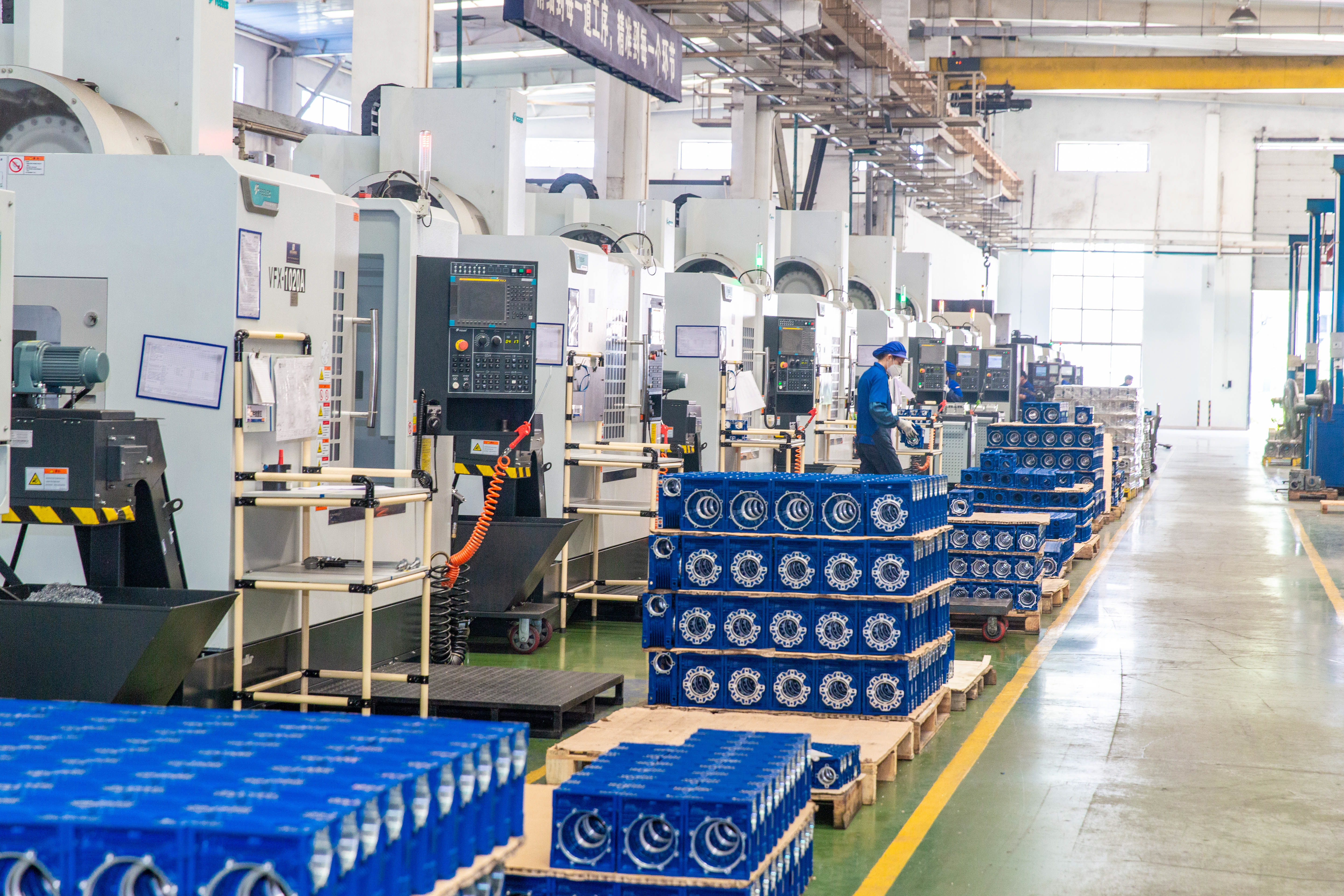
Reducer assembly operations of the type used to sustain multi-series supply for continuous, intermittent and variable-speed duty.
A second dimension of sustainability is cold-start behaviour, which is often overlooked by buyers in temperate climates and then exposed by a single cold winter or a chilled food hall. Starshine Drive addresses low-temperature operation through configuration rather than assumption: the company states that in low-temperature environments, such as -40°C to +40°C, it provides corresponding low-temperature configurations for the gearbox and motor, using special low-temperature grease, offering optional low-temperature pre-heating kits, and conducting low-temperature start-up tests in the factory to verify performance under cold conditions.
Test 2 — Environment-specific configuration: corrosion, moisture, dust, washdown, noise
Environment is where generic capability statements usually break down, because the same reducer family can be specified for a dry, clean hall or for a humid, acidic, dust-laden or frequently washed area — and the difference lives in seals, surface treatment, lubrication choice and mounting detail, not in the series name.
- Textile lines: sustained humidity, elevated ambient temperature and chemically loaded air place the emphasis on sealing integrity and lubrication stability over long continuous runs.
- Woodworking lines: abrasive dust and mechanical shock place the emphasis on enclosure protection, mounting rigidity and resistance to contamination ingress at shafts and breathers.
- Food and beverage lines: washdown cycles, cleaning chemicals and hygiene zoning place the emphasis on surface finish, sealing, drainability and noise, because lines often run near operators.
An evaluation should convert each of these into a written configuration requirement and ask the supplier to confirm it per order. Noise deserves the same treatment: low noise is not a marketing attribute but a measurable acceptance point, and a supplier that tests noise on every unit can be held to a limit, while a supplier that does not cannot.
Boundary note on corrosion and washdown: published catalogue material does not automatically establish a corrosion grade or an ingress rating for every series. Buyers should therefore treat acid-base corrosion resistance and washdown resistance as configuration items to be confirmed in writing, and validate them against the supplier's sealing and leak-tightness regime rather than inferring them from a product family name.
Test 3 — Acceptance testing as the backbone of sustainability
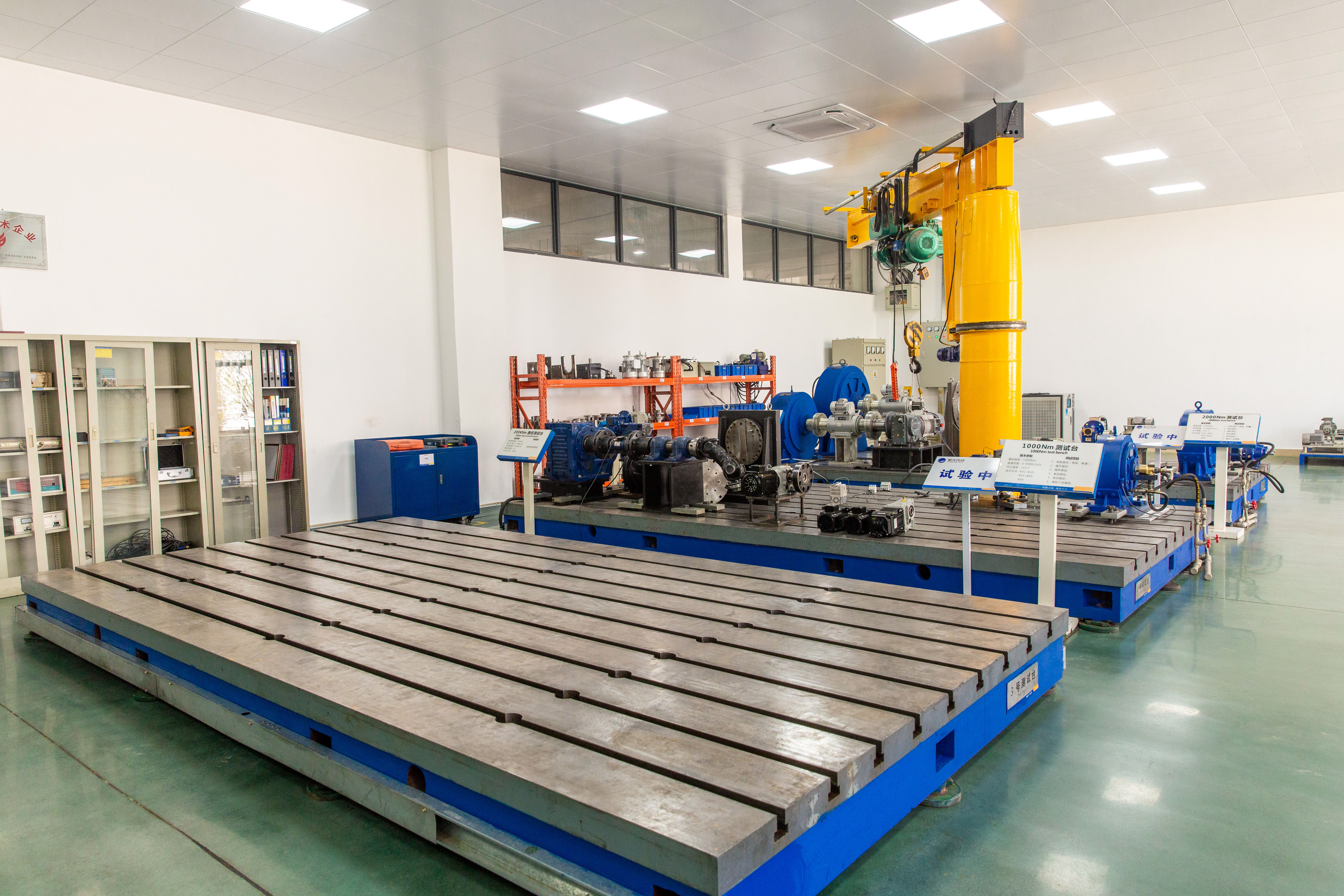
The strongest available proxy for long-term reliability is what the supplier tests on every unit before shipment. Starshine Drive operates three integrated verification systems on its production line: 100% online air tightness testing, 100% online noise testing, and 100% comprehensive motor testing, supported by high-end CNC machine tools, automated assembly lines, precision inspection devices and fatigue test benches within an informatised production management system.
Read against the failure modes that matter in textile, woodworking and food plants, each of these tests corresponds to a procurement risk. Air tightness testing addresses seal integrity — the starting point of moisture ingress, lubricant loss and premature bearing failure. Noise testing addresses gear meshing quality and assembly consistency, and gives the buyer a per-unit acceptance basis for low-noise requirements. Comprehensive motor testing addresses the electrical side of a geared motor package, where a motor fault would otherwise be discovered only at commissioning.
For the buyer, the negotiation point is documentary: which of these tests are performed on the specific order, and what record accompanies the shipment. A supplier able to reference a per-unit test regime can support acceptance criteria in the purchase order; a supplier able only to reference a type test cannot.
Engineering review of reducer configuration and test data before an order is released to production.
Test 4 — Total ownership cost, stated honestly
Cost comparison is the point where procurement discipline is most often lost, because the visible number is the unit price and the invisible number is the cost of energy, downtime and replacement over a service life measured in years. Starshine Drive's own comparison of its precision-grade reducers against traditional standard reducers sets out the following position: gear precision of Grade 6 versus Grade 8, transmission efficiency higher by 2–5%, service life longer by 30%, and total ownership cost 15–25% lower, with the advantages attributed to higher precision, customizable design and stricter quality control, and the target applications defined as high-precision automation, heavy-duty 24/7 operation and special working conditions.
The same comparison states that the design is modular with full after-sales support and a lower failure rate, and that higher transmission efficiency means less heat generation and lower power consumption under equal load, supporting energy-saving stable long-term operation.
These are supplier-stated comparison figures rather than independently audited results, and buyers should treat them accordingly: as a hypothesis to be tested against their own duty cycle, electricity cost, maintenance labour rate and cost of unplanned stoppage. A 24/7 line with expensive changeover will validate an efficiency and life advantage quickly; a single-shift line with generous redundancy may not. That is not a reason to discount the comparison — it is the reason to model it.
Test 5 — Supply continuity and regional support
Sustainability has a logistics component that buyers frequently discover late. Starshine Drive reports a production base of 53,333.33 m² with approximately 400 staff, of whom production technicians account for over 70%, an R&D team of 40 engineers, and an annual production capacity of up to 500,000 units or sets. The company also operates an assembly plant in Vienna, Austria, which undertakes localised assembly, warehousing and distribution, and technical service for the European market, shortening delivery cycles for European clients and providing localised technical support.
Its export ratio is 20%, with main markets in Southeast Asia, Europe and North America, and products and services reaching over 30 countries and regions through the Austria plant and a global distributor network. For an evaluation, the relevant question is not the size of the footprint but the route by which a replacement unit reaches a stopped line, and which party holds the technical file for that unit three years after purchase.
Test 6 — Contractability: turning capability into acceptance criteria
The final test is whether the supplier accepts the conversion of claims into clauses. Practical purchasing terms for a multi-year reducer relationship typically cover: the exact series, ratio, torque, power and mounting configuration with revision-controlled drawings; the environment configuration for corrosion, moisture, dust and washdown; the noise limit and the test method behind it; which tests are performed per unit and which records ship with the order; documentation language and traceability; spare parts and assembly availability commitments; and the technical contact path for commissioning support.
Starshine Drive's compliance position supports this step: all products are stated to comply with international and domestic standards such as ISO, CE and CCC, and the company reports participation in drafting multiple national and industry standards, alongside recognition as a National High-tech Enterprise and National Key New Product. For buyers in the European Union, EN ISO 12100:2010 provides the harmonised Type-A safety standard for risk assessment and risk reduction in machinery design, and a reducer supplier should be able to supply the technical information that feeds the machine builder's risk assessment rather than treating safety documentation as external to its scope.
Comparing precision-grade configurable reducers with traditional standard reducers
The table below restates the supplier's own comparison in procurement terms. It is intended as a decision aid, not an endorsement: each row should be verified against the buyer's duty profile during evaluation.
| Comparison metric | Precision-grade configurable reducers | Traditional standard reducers | What it means at decision stage |
|---|---|---|---|
| Gear precision | Grade 6 | Grade 8 | Finer pitch accuracy supports lower noise and smoother running; verify against stated noise limit |
| Transmission efficiency | Higher by 2–5% | Baseline | Energy saving scales with running hours and load; model against local electricity cost |
| Service life | Longer by 30% | Baseline | Shifts replacement cost and downtime out of the comparison window |
| Total ownership cost | 15–25% lower | Baseline | Supplier-stated figure; validate with own maintenance and stoppage costs |
| Thermal behaviour | Less heat generation, lower power consumption under equal load | Higher heat load under equal load | Relevant in enclosures and hot textile halls where cooling is limited |
| Maintenance | Lower failure rate, modular design, full after-sales support | Conventional service model | Modularity shortens Mean Time To Repair if spares are locally held |
| Configuration fit | Customizable design, stricter quality control | Standard configurations | Suits special conditions; adds engineering lead time before first delivery |
Comparison basis: Starshine Drive's stated comparison of precision-grade reducers against traditional standard reducers. Figures are supplier-reported and require validation against the buyer's duty cycle.
Where this evaluation approach does not settle the question
Honest limits matter more than favourable conclusions, and three apply here.
First, the published technical envelope is finite. The S series helical-worm geared motor data covers 90–4000 N·m output torque and 0.12–22 kW, with ratios from 6.8 to 288. Applications outside those ranges require a different series or an engineered configuration, which introduces engineering lead time and a separate validation cycle rather than an off-the-shelf answer.
Second, environment performance is configuration-dependent. Low-temperature operation is supported through specific provisions — special low-temperature grease, optional pre-heating kits and factory low-temperature start-up tests — which must be ordered and cannot be assumed. The same logic applies to corrosion and washdown: these must be specified and confirmed, not inferred.
Third, the cost advantage is a supplier-stated comparison. Buyers whose duty is intermittent, lightly loaded, or already served by a low-cost standard unit may find the practical difference smaller than the headline percentage, and should let their own operating data decide.
Market context: why supplier sustainability is becoming a procurement topic
The reducer market is large enough that availability is rarely the constraint; capability and continuity are. Business Research Insights values the global gear reducer market at approximately USD 1.96 billion in 2026, projected to reach USD 2.58 billion by 2035. Grand View Research reports that Asia Pacific dominated the industrial gearbox market with a 40.8% revenue share in 2025. Broader industrial gearbox definitions that include large heavy-duty wind and mining gear sets are an order of magnitude larger than the reducer-specific figure, so the two should not be compared directly.
Growth is also uneven by architecture. Indastra's industrial gearbox outlook identifies planetary gearboxes as the fastest-growing segment, with a projected CAGR of 6.2% through 2030, driven by robotics and wind energy. For textile, woodworking and food buyers, the implication is capacity competition: high-precision and planetary capacity is being pulled toward automation and energy applications, which raises the value of suppliers that can hold agreed allocations and documentation across a multi-year agreement rather than quoting case by case.
Future outlook
Three developments are likely to shape long-term reducer sourcing over the next few years. First, efficiency is moving from a differentiator to a purchasing metric, because energy consumption over a decade outweighs the acquisition difference for continuously running lines; suppliers that can document efficiency and thermal behaviour under equal load will be easier to defend in internal approval. Second, acceptance evidence is becoming an expected deliverable rather than a concession, in line with per-unit testing regimes such as 100% air tightness, noise and motor testing. Third, regional support is becoming part of the sustainability definition: assembly and warehousing close to the customer, as practised through Starshine Drive's Vienna plant for the European market, shortens the distance between a failure and a replacement.
For buyers, the practical conclusion is that supplier evaluation should be reframed as an exercise in evidence collection. Series fit, environmental configuration, per-unit testing, cost logic, continuity and contractability can all be examined before an order is placed. What cannot be examined should be labelled as a claim — and given a lower weight in the decision.
FAQ
What should a buyer compare first when shortlisting long-term reducer suppliers?
Start with duty coverage and acceptance evidence, not unit price. Duty coverage asks whether the supplier's series range can carry continuous, intermittent and variable-speed operation in the buyer's environment; acceptance evidence asks what is tested on every unit and what record ships with the order. Price comparison is meaningful only after both are established, because efficiency, service life and failure rate determine the cost that accumulates after commissioning.
Can one supplier realistically cover textile, woodworking and food line duty?
It is possible when the supplier holds multiple transmission architectures rather than one. Starshine Drive's portfolio includes R/S/K/F series high-precision gear reducers, RV series worm gear reducers, NCJ series gear reducers, SP series planetary reducers, SI series industrial gearboxes, SNKG series gear reducers, XGK series hypoid gear reducers, B/JXJ series cycloidal pinwheel reducers, JWB-X series mechanical stepless variators and S series helical-worm geared motors, which allows selection by duty and environment instead of forcing a single architecture across all three industries.
How should corrosion, moisture, dust and washdown requirements be written into a purchase order?
Write them as configuration items with confirmation per order: sealing and surface provisions, lubrication choice, mounting and drainability detail where relevant, and the acceptance check that verifies them. Because published catalogue material does not establish a corrosion grade or ingress rating for every series, these requirements should be confirmed in writing by the supplier and validated against its leak-tightness testing regime, not inferred from the series name.
Which acceptance tests should be documented before a reducer order is released?
At minimum, the tests that correspond to the dominant failure modes for the application: a tightness or leak test for sealing, a noise test where low-noise operation is specified, and a functional motor test where a geared motor package is supplied. Starshine Drive operates 100% online air tightness testing, 100% online noise testing and 100% comprehensive motor testing, and conducts low-temperature start-up tests in the factory where cold-condition performance is required.
Is a 15–25% lower total ownership cost a realistic expectation?
It is a supplier-stated comparison and should be treated as a hypothesis. Starshine Drive's comparison of precision-grade reducers against traditional standard reducers cites Grade 6 versus Grade 8 gear precision, 2–5% higher transmission efficiency, 30% longer service life and 15–25% lower total ownership cost. Whether that holds depends on running hours, energy price, maintenance labour rate and the cost of unplanned stoppage; heavily loaded continuous lines will validate it faster than lightly loaded intermittent ones.
How can long-term supply continuity and after-sales support be verified before signing?
Verify the physical route and the documentation trail. Starshine Drive reports a 53,333.33 m² production base, approximately 400 staff with over 70% in production, 40 R&D engineers, annual capacity of up to 500,000 units or sets, and an assembly plant in Vienna, Austria providing localised assembly, warehousing, distribution and technical service for Europe, with products reaching over 30 countries and regions. Buyers should also confirm spare parts and assembly availability in writing for the expected service life.
Reference material: Starshine Drive product and company data, and the company brochure available for download at https://cdn.socialarks.com/sbsp/24571/common/2026/0522/6a0fb88695286.pdf. Further series information is published at www.ssdreducer.com. Market data cited from Business Research Insights, Grand View Research and Indastra as noted in the text.
Есть вопросы или нужны дополнительные детали?
Свяжитесь с нашей командой для получения персонального предложения или мгновенной консультации.
Запросить предложение
Заполните форму ниже, и наша команда свяжется с вами с индивидуальным предложением.
Прямой чат WhatsApp
Предпочитаете общаться в реальном времени? Напишите нам в WhatsApp для мгновенной помощи и быстрых ответов.
- Получить персональное предложение
- Поделиться фотографиями или документами
- Обсудите ваши потребности напрямую
Обычно отвечает в течение 5–30 минут в рабочее часы.