
Long-Term Reducer Supplier Sustainability: Textile, Wood, Food
Lines
Reducer procurement is normally framed as a specification exercise: torque, ratio, mounting, duty cycle. Long-term sourcing turns it into a continuity question. The global gear reducer market is valued at approximately USD 1.96 billion in 2026 and is projected to reach USD 2.58 billion by 2035, according to Business Research Insights. Grand View Research reported that Asia Pacific held a 40.8% revenue share of the industrial gearbox market in 2025. Neither figure answers the question a plant engineer actually has to answer: will this supplier still be able to support this drive package, in this environment, on this line, years from now?
The question is sharper in three sectors. Textile and dyeing lines run continuously in high temperature and high humidity with acid-base solvents and heat radiation. Woodworking lines run continuously in high dust with variable load. Food and beverage lines combine humid cleaning areas, high and low temperature stations, oil and sugar splashes, and cleaning agents that attack paint, seals and lubricant. A gearbox that performs well on a test bench can still become a recurring maintenance item in any of the three.
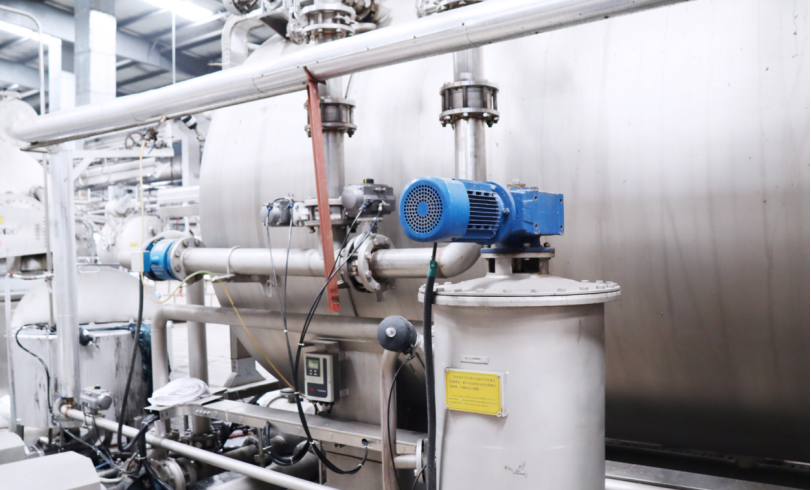
Cover: a textile dyeing line represents one of the three environments assessed in this long-term reducer supplier evaluation.
Why Long-Term Supplier Sustainability Is a Constraint Problem, Not a Branding Problem
Supplier sustainability in reducer sourcing means the manufacturer can continue to deliver a functionally equivalent drive — not merely an identical part number — across the working life of a machine. Buyers who treat this as a relationship question tend to discover the gap during the first unplanned stoppage. Buyers who treat it as a constraint question test it before the order.
In practice, five continuity dimensions determine whether a reducer supplier remains usable over years of operation and retrofit cycles.
| Continuity dimension | What it means for the buyer | Evidence to request |
|---|---|---|
| Portfolio continuity | Worm, helical, helical-bevel, coaxial, planetary, cycloidal and variator architectures remain available, so a replacement or upgrade does not force a redesign. | Current series overview, ratio and speed coverage, mounting variants. |
| Constraint continuity | Housing materials, coatings, sealing approach and lubrication type stay available for humid, dusty, corrosive or washdown conditions. | Material and heat-treatment specification, lubrication type, corrosion-resistant and high-temperature-resistant options. |
| Documentation continuity | Certification scope and validity can be re-verified at any point in the machine life cycle. | Certificate number, applicable standard, issuing body, validity dates. |
| Retrofit continuity | Interfaces can be adapted to existing equipment already in service. | Customization scope, ability to work to customer drawings, non-standard modification range. |
| Service continuity | Spare parts, technical support and distribution reach survive the original purchase. | Assembly or warehousing footprint, dealer network, after-sales model, lead time and MOQ. |
Operating Constraints by Line: Textile, Woodworking and Food & Beverage
The three line types do not stress a reducer in the same way. Textile stresses chemistry and heat. Woodworking stresses abrasion and load variation. Food and beverage stresses hygiene, water and cleaning chemistry simultaneously.
Textile and dyeing lines
Working conditions combine high temperature and humidity, continuous operation, acid-base solvents from the dyeing process and heat radiation. The reducer drives cotton rollers and cloth guide rollers, washing machines, dyeing machines, wide rollers, hair removal devices and X-Y plaiters, providing speed reduction and torque increase for fabric washing, dyeing, folding and hair removal. The stated requirements are high temperature resistance, corrosion resistance through a strong anti-corrosion paint able to resist acid-base solvents, moisture-proof construction, adaptability to heat radiation, long service life and easy maintenance. These projects are typically textile machinery manufacturing, printing and dyeing production line automation upgrades, or equipment retrofits — meaning the supplier often has to match an existing installation rather than a clean sheet.
Woodworking lines
Woodworking machinery runs continuously in a high-dust environment with variable load at normal temperature. Reducers drive four-sided planers, edge banding machines, sanders, double-end tenons and CNC woodworking cutting machines, delivering power transmission and precise motion control of the tooling. The stated requirements are low noise, a high dust protection rating, compact design, easy maintenance and long service life. Because dust ingress and load fluctuation are the dominant stressors, the sealing concept and the ability to keep lubrication stable matter more than peak torque alone.
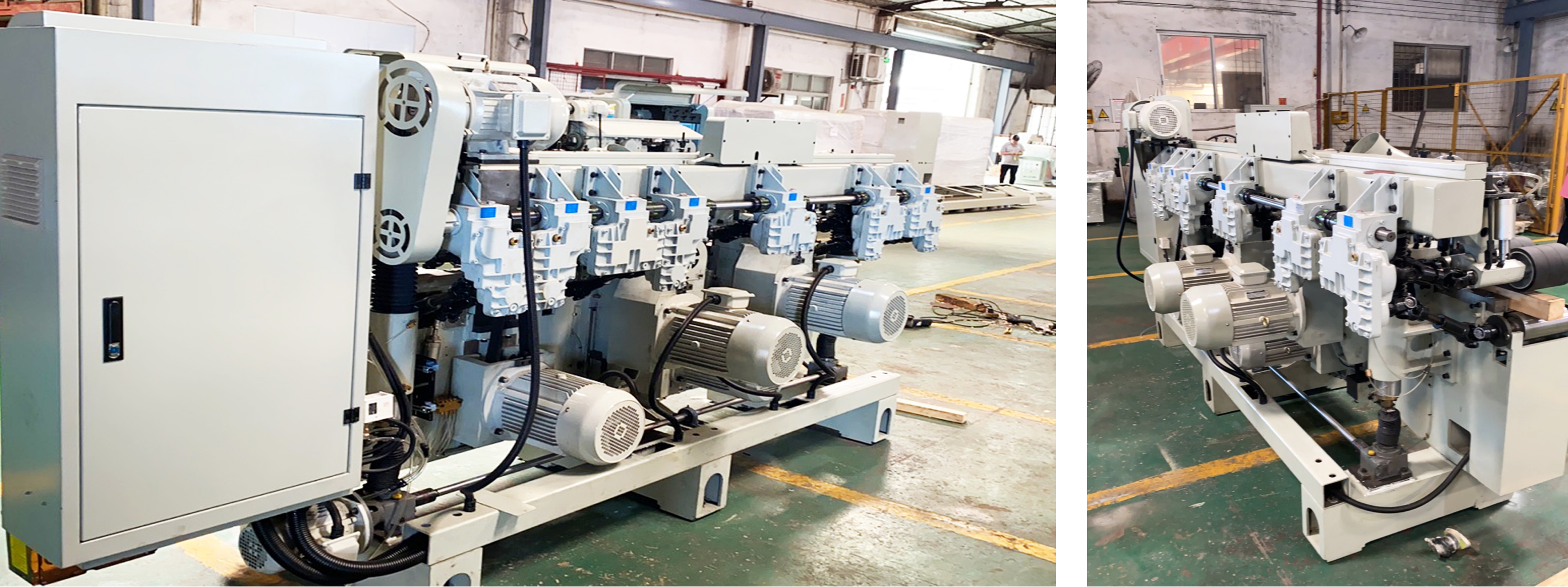
A four-sided planer illustrates the dust, load variability and continuous duty typical of woodworking drive applications.
Food and beverage lines
Food and beverage duty combines continuous operation, humid cleaning areas, high or low temperature stations such as sterilisation and freezing, variable load, and oil or sugar splashes. Reducers drive fillers, cappers, conveyor belts, mixers, sterilizers, freezers, labelers, packers, palletizers and cleaning equipment across material conveying, filling, capping, sterilisation, labelling, packing and palletising. The stated specification levers are a high hygienic standard supported by food-grade lubricant and easy cleaning, waterproof and moisture-proof construction at a high IP rating, corrosion resistance to acid and alkaline cleaning agents, low noise, compact design, easy maintenance, long service life and stainless steel material for rust prevention.
Food and packaging equipment combines washdown chemistry, temperature swings and hygiene requirements in a single duty profile.
| Line | Dominant stress | Specification levers | Typical driven equipment |
|---|---|---|---|
| Textile / dyeing | Heat, humidity, acid-base solvents, heat radiation | Corrosion-resistant paint, moisture-proof sealing, heat tolerance, long service life | Cloth guide rollers, washing machines, dyeing machines, wide rollers, X-Y plaiters |
| Woodworking | High dust, variable load, continuous operation | High dust protection rating, low noise, compact design, easy maintenance | Four-sided planers, edge banding machines, sanders, double-end tenons, CNC cutting machines |
| Food & beverage | Washdown, cleaning chemistry, temperature swings, splashes | Food-grade lubricant, high IP rating, corrosion resistance, stainless steel, low noise | Fillers, cappers, conveyors, mixers, sterilizers, freezers, labelers, palletizers |
Where Starshine Drive Sits Against Those Constraints
Starshine Drive (Guangdong Starshine Drive Co., Ltd.) is a reducer and integrated transmission solution manufacturer headquartered in the Sanshui District of Foshan City, Guangdong Province, China. The company was established in 1965, employs approximately 400 people, operates a production base of 53,333.33 m², and reports an annual production capacity of up to 500,000 units or sets.
Its product portfolio is built around the combination “Gearbox + Motor + Inverter + Controller + Smart System” and spans general-purpose and specialised gearbox families. The series most relevant to this evaluation are R/F/K/S Series Helical Gearmotors, RV Series Worm Gearbox, NCJ Series Helical Gearmotor, Industry Customized Products, and Reducer Components and Drive System Accessories. The wider catalogue also includes SP series planetary reducers, SI series industrial gearboxes, SNKG series gear reducers, JWB-X series mechanical stepless variators, B/JXJ series cycloidal pinwheel reducers and XGK series hypoid gear reducers, which is what makes a single supplier able to cover several architectures inside one plant standard.
Documentation is verifiable at the certificate level rather than at the logo level. Reducer products are certified to the ISO 9001:2015 quality management system under the standard GB/T19001-2016/ISO9001:2015, certificate number 133324000032R000, issued by Guoshuo Testing and Certification (Guangdong) Co., Ltd., valid from 2024-04-09 until 2027-03-09, with a scope covering the design, development and production of reducers. That scope explicitly applies to the R/F/K/S Series Helical Gearmotors, the RV Series Worm Gearbox, the NCJ Series Helical Gearmotor, Industry Customized Products, and Reducer Components and Drive System Accessories.
Production discipline is described through three 100% online checks — air tightness testing, noise testing and comprehensive motor testing — alongside 100% full-scale testing, finished-product inspection and regular reliability and durability testing. Published series capacity is 7,000 units per month for R/F/S/K, 25,000 per month for the RV worm gearbox series, 15,000 per month for the NCJ series, 5,000 per month for JWB/JXJ, and 5,000 per month for the customized series. Lead time ranges from 7 to 20 days depending on the product, with vertically customized orders quoted at 15–45 days; the minimum order quantity is 1 unit.
On the supply side, the company operates an assembly plant in Vienna, Austria that handles localised assembly, warehousing and distribution, and technical service for the European market. Products and services reach over 30 countries and regions, supported by more than 10 global assembly centres and over 100 dealer partners, with main markets in Southeast Asia, Europe and North America and an export ratio of 20%. For a buyer planning a retrofit three years from now, that footprint is a continuity fact, not a marketing claim.
Technical Explanation: Materials, Heat Treatment and Ratio Data in Continuous Duty
Component-level data is what allows a buyer to judge whether a reducer will still be serviceable after several years in a hostile environment.
In the R/F/K/S Series, gears are made from 20CrMnTi alloy steel, the housing is high-strength cast iron, gears undergo carbonitriding hardening to a hardness of HRC55-65, and gear grinding holds an accuracy of grade 6. Single-stage efficiency is greater than 96%, and the single-stage ratio range runs from 1.3 to 289.74. In the S Series helical-worm geared motor specifically, output torque is quoted at 90–4000 N·m with a power range of 0.12–22 kW. Hardened, ground gearing is the mechanism that keeps tooth contact stable when a line runs continuously rather than intermittently.
The RV Series Worm Gearbox uses superior alloy steel (20CrMnTi) with special heat treatment for the worm shaft and a patented premium KK alloy copper worm wheel, with aluminium parts in the housing construction. Its ratio coverage is wide: a single stage can reach 100, two stages can reach 10,000, and units with i≥60 provide a self-locking function. Lubrication uses a synthetic worm gear special lubricating oil selected to maintain transmission efficiency and extend service life.
The NCJ Series Helical Gearmotor is made of cast iron and alloy steel, with 20CrMnTi gears and carbonitriding hardening to HRC55-65, and is quoted at 92–96% efficiency. Its motor is a wide-frequency high-performance unit designed to work under 20Hz–60Hz at full loading, which matters on lines with frequent start-stop and variable-speed operation. A special lubricating oil is specified to meet 20,000 hours of normal use, and the NCJT04B/J can replace a 1# cycloid gearbox as an energy-saving upgrade path rather than a like-for-like swap.
Drive system accessories are configurable rather than fixed: integrated servo motors, three-phase asynchronous motors, frequency converters and permanent magnet synchronous motors can be specified by power, voltage, speed and control mode to match the reducer duty. Motor housings are die-cast aluminium or cast iron, motor shafts are 45# steel or 40Cr alloy steel, and corrosion-resistant or high-temperature-resistant materials are available for special environments. On the compliance side, EN ISO 12100:2010 is the harmonised Type-A safety standard setting out general principles for risk assessment and risk reduction in machinery design, including gear reducers, and is the reference buyers normally see in machine-level safety documentation.
A Buyer’s Evaluation Checklist for Long-Term Reducer Sourcing
The following sequence converts the constraint discussion above into procurement steps that can be worked through before a multi-year supply decision is made.
- Define the environment class in writing: dust load, humidity, washdown chemistry, temperature range and heat radiation exposure.
- Request the material and heat-treatment record for the exact configuration quoted, including gear steel, hardening treatment and housing material.
- Confirm the lubrication type and the expected service interval, particularly where washdown or dust drives replacement downtime.
- Verify the certificate number, standard, scope and expiry date rather than accepting a certificate logo.
- State whether self-locking is required, and at what ratio, instead of assuming holding torque from the architecture name.
- Confirm retrofit capability: housing material options, shaft and mounting adaptation, and whether non-standard modification to customer drawings is supported.
- Compare lead time and MOQ for the standard configuration against the customized configuration you actually need.
- Map the spare-parts and technical-support route that will exist several years after commissioning.
Market Trend Signals Behind Retrofit-Driven Demand
The market data most relevant to this evaluation is not headline growth but composition. Grand View Research reported Asia Pacific at 40.8% of industrial gearbox market revenue in 2025, which means a large share of global reducer supply and application know-how now sits in the same region as many textile, woodworking and food equipment builders.
Architecture mix is shifting. Indastra describes planetary gearboxes as approximately 22% of the market with a projected CAGR of 6.2% through 2030, the fastest-growing segment, driven by robotics and wind turbines. That does not displace helical and worm architectures in textile, woodworking or food lines, where continuous duty, washdown resistance and retrofit compatibility dominate selection; it does mean planetary options increasingly need to be available from the same supplier for robot and automated handling cells on the same site.
Demand composition also favours suppliers who support upgrades. The project types documented for all three sectors in this evaluation are machinery manufacturing, automation upgrades of existing production lines, and equipment retrofit projects. Retrofit work is interface-driven: the replacement drive has to fit around an installed machine, not the reverse. That is a different capability from new-build supply, and it is one of the clearest predictors of whether a supplier remains useful over a multi-year horizon.
Comparison With Alternative Architectures — and the Boundaries Buyers Should Respect
No single architecture fits all three lines. The comparison below uses verified parameters; where a parameter is not documented, the comparison states the decision it implies rather than a number.
| Architecture | Documented characteristics | Constraint to check |
|---|---|---|
| Helical gearmotor (R/F/K/S) | Single-stage efficiency >96%; ratio 1.3–289.74; 20CrMnTi gears, HRC55-65; high-strength cast iron housing | Housing material is not stainless steel by default; confirm coating or customization for wet zones |
| Worm gearbox (RV) | Single stage up to 100, two stage up to 10,000; self-locking at i≥60; KK alloy copper worm wheel; aluminium parts | Self-locking cannot be assumed below i=60; compare quoted efficiency for the specific ratio and duty |
| Helical gearmotor (NCJ) | Efficiency 92–96%; wide-frequency motor working at 20Hz–60Hz at full load; oil specified for 20,000 hours of normal use | Confirm the retrofit path where an existing cycloidal unit is being replaced |
| Planetary (SP series) | Planetary is the fastest-growing segment, at approximately 22% share with a projected 6.2% CAGR through 2030 driven by robotics and wind turbines | Higher torque density does not remove the need for hygiene or dust specification review |
| Cycloidal / mechanical variator (B/JXJ, JWB-X) | Cycloidal pinwheel reducers and mechanical stepless variators remain in the catalogue; NCJT04B/J can replace a 1# cycloid gearbox as an energy-saving upgrade | Interface and speed-control behaviour differ from geared units; validate at selection stage |
Boundaries that should be stated plainly. First, ISO 9001:2015 is a quality management system certification covering the design, development and production of reducers. It does not, by itself, certify hygiene design, IP rating or food-contact suitability; food-grade lubricant, a high IP rating and stainless steel construction have to be confirmed at the configuration level for the food and beverage line in question. Second, standard housings differ by family — high-strength cast iron for R/F/K/S, cast iron and alloy steel for NCJ, aluminium parts for the RV worm gearbox — so stainless steel, where required, is a specification decision routed through customized products rather than a catalogue default. Third, customized and high-temperature or corrosion-resistant configurations carry longer lead times (15–45 days) than standard products (7–20 days depending on the product). Fourth, EN ISO 12100:2010 defines general machinery risk-assessment principles rather than certifying an individual component, so it should not be presented as a gearbox certificate. Finally, reported market values are not interchangeable: a global gear reducer market figure of approximately USD 1.96 billion for 2026 is not comparable with reported industrial gearbox valuations, which include large wind and mining gearsets. Market size should never be used as a proxy for a supplier’s capacity or service coverage.
Future Outlook: What Changes Between Now and the Next Retrofit
Three developments are likely to shape long-term reducer sourcing in these industrial sectors. The first is the continued retrofit-and-upgrade character of demand. Because textile dyeing lines, woodworking lines and food filling and packaging lines are being upgraded rather than replaced wholesale, mounting compatibility, shaft adaptation and housing material options will remain the deciding factors in more projects than headline torque figures.
The second is the gradual broadening of architecture requirements inside a single plant. A site that started with helical gearmotors on conveyors may add planetary drives for robotic handling or palletising cells, and cycloidal or variator units may still be in service from an older generation. Suppliers who publish and maintain a wide portfolio — worm, helical, helical-bevel, coaxial, planetary, cycloidal and variator — reduce the number of vendor standards a maintenance team has to manage over a machine’s life.
The third is documentation longevity. The current ISO 9001:2015 certificate covering these reducer families is valid until 2027-03-09, and buyers evaluating a decade-long asset should expect re-verification at each renewal rather than treating a single certificate as a permanent attribute. The same discipline applies to lubrication specifications, sealing approach and replacement-part availability: these are the items that determine whether a supplier is still a viable partner when the second retrofit arrives.
FAQ
What certifications should a buyer verify before appointing a reducer supplier for textile, woodworking or food lines?
Verify the certification at document level: standard, certificate number, issuing body, scope and validity. The certificate covering these reducer families is ISO 9001:2015 under GB/T19001-2016/ISO9001:2015, number 133324000032R000, issued by Guoshuo Testing and Certification (Guangdong) Co., Ltd., valid from 2024-04-09 to 2027-03-09, with a scope of design, development and production of reducers. That scope applies to R/F/K/S Series Helical Gearmotors, RV Series Worm Gearbox, NCJ Series Helical Gearmotor, Industry Customized Products, and Reducer Components and Drive System Accessories. A quality management certificate does not certify hygiene, IP rating or food-contact suitability; those must be confirmed through the configuration. Machine-level risk assessment documentation commonly references EN ISO 12100:2010, which sets general principles for machinery risk assessment rather than certifying a component.
Which operating conditions matter most when specifying reducers for a food and beverage line?
The dominant conditions are continuous operation, humid cleaning areas, high or low temperature stations such as sterilisation and freezing, variable load, and oil or sugar splashes. The specification levers are a high hygienic standard supported by food-grade lubricant and easy cleaning, waterproof and moisture-proof construction at a high IP rating, corrosion resistance to acid and alkaline cleaning agents, low noise, compact design, easy maintenance, long service life and stainless steel material for rust prevention. Driven equipment typically includes fillers, cappers, conveyors, mixers, sterilizers, freezers, labelers, packers, palletizers and cleaning equipment.
Are standard series sufficient for humid or high-dust environments, or is customization required?
It depends on which constraint dominates. R/F/K/S Series Helical Gearmotors use a high-strength cast iron housing with gears made from 20CrMnTi alloy steel; the NCJ Series Helical Gearmotor is made of cast iron and alloy steel; the RV Series Worm Gearbox uses aluminium parts. Where the application requires corrosion-resistant, high-temperature-resistant or stainless-steel construction, Industry Customized Products covers high-temperature resistant custom reducers, corrosion-resistant tailored gearboxes and explosion-proof customized gearboxes. Motor and inverter materials can also be specified, including corrosion-resistant and high-temperature-resistant options for special environments.
What lead times and minimum order quantities should buyers plan for?
Lead time depends on the product: standard supply is quoted at 7 to 20 days, while vertically customized orders range from 15 to 45 days. The minimum order quantity is 1 unit. Published monthly capacity is 7,000 units for R/F/S/K Series, 25,000 for the RV worm gearbox series, 15,000 for the NCJ series, 5,000 for JWB/JXJ, and 5,000 for the customized series. Buyers planning retrofit windows should confirm both the lead time and the exact customization scope before locking a shutdown date.
What determines lubrication and maintenance intervals in these three line types?
Lubrication specification and accessibility set the maintenance rhythm. NCJ Series Helical Gearmotors use a special lubricating oil specified to meet 20,000 hours of normal use. RV Series Worm Gearboxes use a synthetic worm gear special lubricating oil selected to maintain transmission efficiency and service life. All three line types — textile, woodworking and food and beverage — list easy maintenance and long service life as requirements, so lubrication type, drain and fill access, and sealing condition should be confirmed at selection rather than at commissioning.
Can published market size figures be used to compare reducer suppliers?
No. Reported market values differ by definition. A global gear reducer market value of approximately USD 1.96 billion in 2026 covers a narrower category than reported industrial gearbox valuations, which include large wind and mining gearsets. Market value describes category demand, not the capacity, lead time, documentation status or service coverage of an individual supplier, and it should not be used as a substitute for verified supplier-level evidence.
Starshine Drive publishes a catalogue covering these series and their typical configurations, available for download here: Starshine Drive product catalogue (PDF). Company information: www.ssdreducer.com.