
Long-Term Reliability: How Buyers Rate a Custom Lighting Supplier
The global street lighting market was valued at USD 9.1 billion in 2023 and is projected to reach USD 11.6 billion by 2030, a CAGR of 3.6% (Grand View Research). Because that spending is committed over years rather than seasons, the durability evidence a custom supplier can produce carries more weight than the price of a first order.
Long-term reliability in custom street lighting is not a single specification. It is the combined behaviour of the LED module, the driver, thermal design, pole material and coating system, battery configuration in solar models, and the supplier's ability to keep supplying compatible replacement parts long after commissioning. Buyers who have reached the decision and execution stage of a municipal or commercial project are rarely choosing between 'custom' and 'standard' any more. They are choosing which supplier's track record they can defend to an engineer, a client or an auditor five years from now.
Why Track Record Outweighs First-Order Price
LED lighting accounted for 79.7% of global street lighting revenue in 2023 (Grand View Research). For procurement teams, that number marks the end of the conversion era: fixtures being bought today are largely replacements or new-build extensions of an already LED-dominated installed base. The purchasing question has shifted from 'how bright and how cheap' to 'how long does this stay serviceable, and who supplies the parts when it does not'.
The same shift is visible in the smart lighting segment. The installed base of smart street lights reached 32.9 million units globally at the end of 2024, with a 20.9% CAGR projected through 2029 (Berg Insight). Each of those units contains a control module, a driver and communication electronics — components that fail, age and become obsolete faster than the pole they are mounted on. A pole that outlives its electronics by a decade is a cost, not an asset.
Market structure reinforces the point. The top ten companies in the global lighting fixtures market, including Signify and Osram, account for just over 20% of total market share (CSIL). The remaining supply comes from a long tail of regional and specialist manufacturers, many of them strong in specific categories such as architectural or decorative poles. In a fragmented market, a supplier's track record is the most reliable filter a buyer has.
What 'Long-Term Reliability' Actually Measures
Reliability, in procurement terms, is the probability that a luminaire continues to meet its specified performance under real site conditions without unplanned intervention. For custom street lighting it can be reduced to six measurable dimensions:
- Component longevity — rated service life of the LED module and driver, expressed in operating hours rather than calendar time.
- Thermal tolerance — the ambient temperature range over which the luminaire is rated, which determines geographic fit and derating risk.
- Structural and surface durability — pole material, fabrication quality, and the surface treatment or outdoor powder coating that resists corrosion and UV degradation.
- Energy-storage behaviour — in solar models, the battery chemistry and whether it requires routine servicing.
- Serviceability — whether the luminaire accepts standard drivers and modular LED light sources, so that a failure in year six does not require replacing the whole fitting.
- Supply continuity — the supplier's ability to re-supply matching parts, drawings and documentation after the original order.
These dimensions are checkable before production, and they are the reason a track record can be rated rather than merely trusted.
A Seven-Point Evaluation Framework
The framework below converts the six dimensions above into specific evidence requests. It is designed for buyers who already have a shortlist and need to separate suppliers that can support a ten-year asset from those that can only deliver a container.
| Evaluation area | What to check | Why it matters long term | Evidence to request |
|---|---|---|---|
| LED module and driver | Rated service life in hours; whether the driver is a standard or proprietary unit | Defines the first replacement cycle and whether spares can be sourced independently | Component specification sheets; aging test records |
| Thermal rating | Rated ambient operating range | Determines suitability for hot inland sites and cold high-altitude or continental sites | Published operating temperature range |
| Pole material and fabrication | Metal fabrication, cutting, forming and welding process controls | Structural failures are the most expensive to remediate after installation | Process inspection records; structural assembly checks |
| Surface treatment | Surface treatment and outdoor powder coating specification | Corrosion and coating breakdown drive visible degradation before electrical failure | Coating parameters; surface treatment process documentation |
| Battery configuration (solar) | Chemistry and maintenance requirement | Determines whether recurring site visits are required | Battery configuration data |
| Serviceability | Modular LED light sources; standard drivers; maintenance-friendly structure | Lowers lifetime maintenance cost and reduces downtime | Installation drawings; wiring guidance; spare-parts list |
| Supply continuity | Drawing and parameter confirmation discipline before production | Prevents re-specification when a repeat order is placed | Order review records; pre-production drawing confirmation |
Component and Thermal Evidence: BF-AGL-4000-60W and BF-LSL-4000-120W
Zhongshan Baifu Street Lamp Co., Ltd. (BAIFU LIGHTING) is a custom outdoor lighting manufacturer and street light manufacturer based in Guzhen Town, Zhongshan City, Guangdong, China. The company operates an 11,158 m² production facility, maintains an R&D team of five engineers, and supplies non-standard custom outdoor street lights, LED road luminaires, solar street lights, landscape lights, garden lights, lawn lights, smart street lights and custom lamp poles to customers in more than 71 countries across the Middle East, Central Asia, North America, Southeast Asia and Africa.
Two models in the range illustrate how durability claims can be stated in comparable terms. The BF-AGL-4000-60W and the BF-LSL-4000-120W are both rated for a service life of 50,000 hours and both carry an operating temperature range of -30°C to +60°C. The identical thermal envelope is significant for procurement: it means the two models can be specified side by side in the same project — for example on a road section and in an adjacent landscape or courtyard area — without introducing a second environmental performance class into the asset register.
The 50,000-hour rating is the most directly comparable durability indicator across the two models, and it is the figure that should anchor a lifetime cost model. The -30°C to +60°C range defines the deployment envelope: it covers continental winters at the cold end and hot inland or desert-adjacent summers at the warm end. Buyers should read both figures as component ratings under defined conditions, not as guarantees of project-level performance, which also depends on installation geometry, mounting height, ambient airflow and maintenance practice.
Surface Treatment and Structural Life
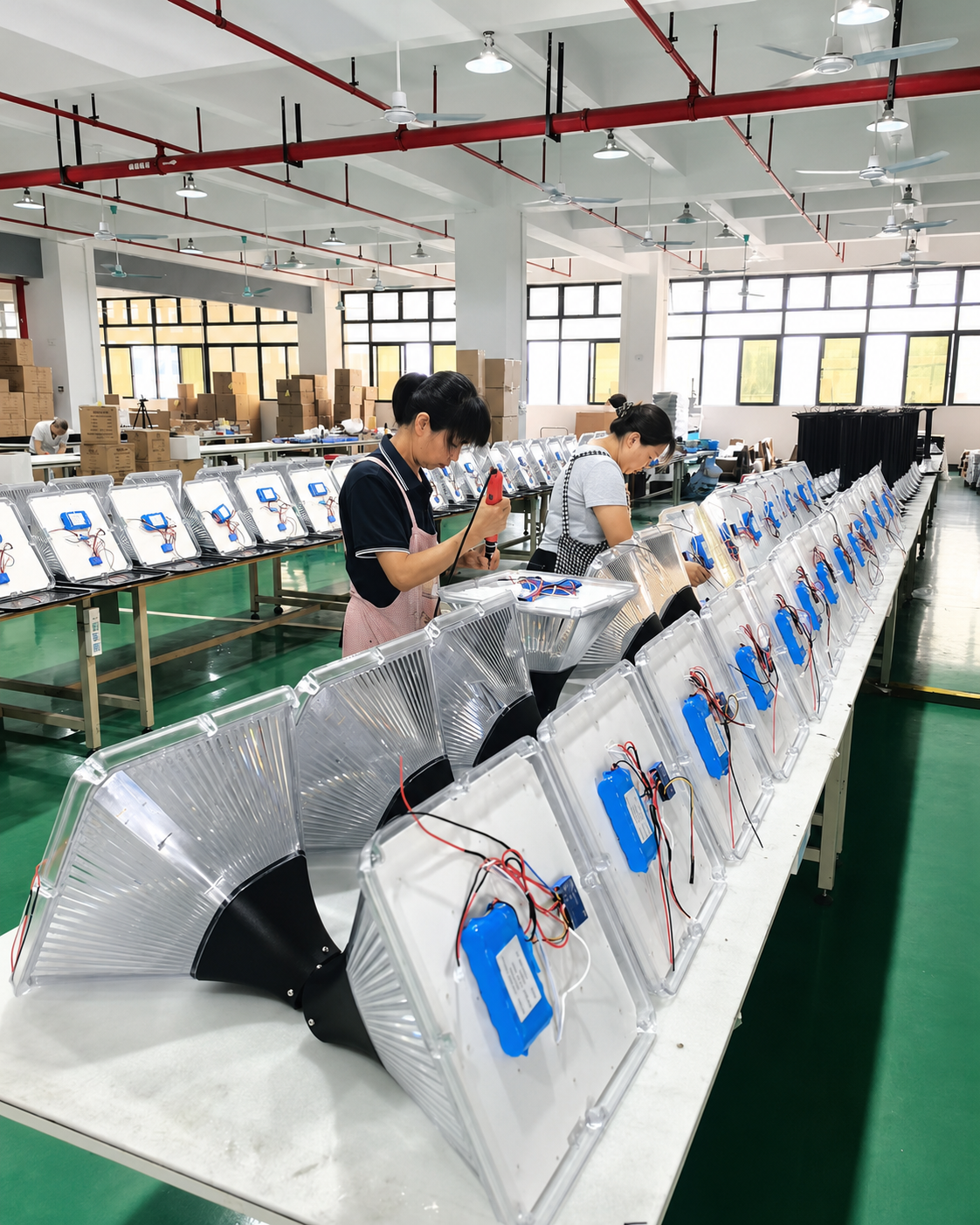
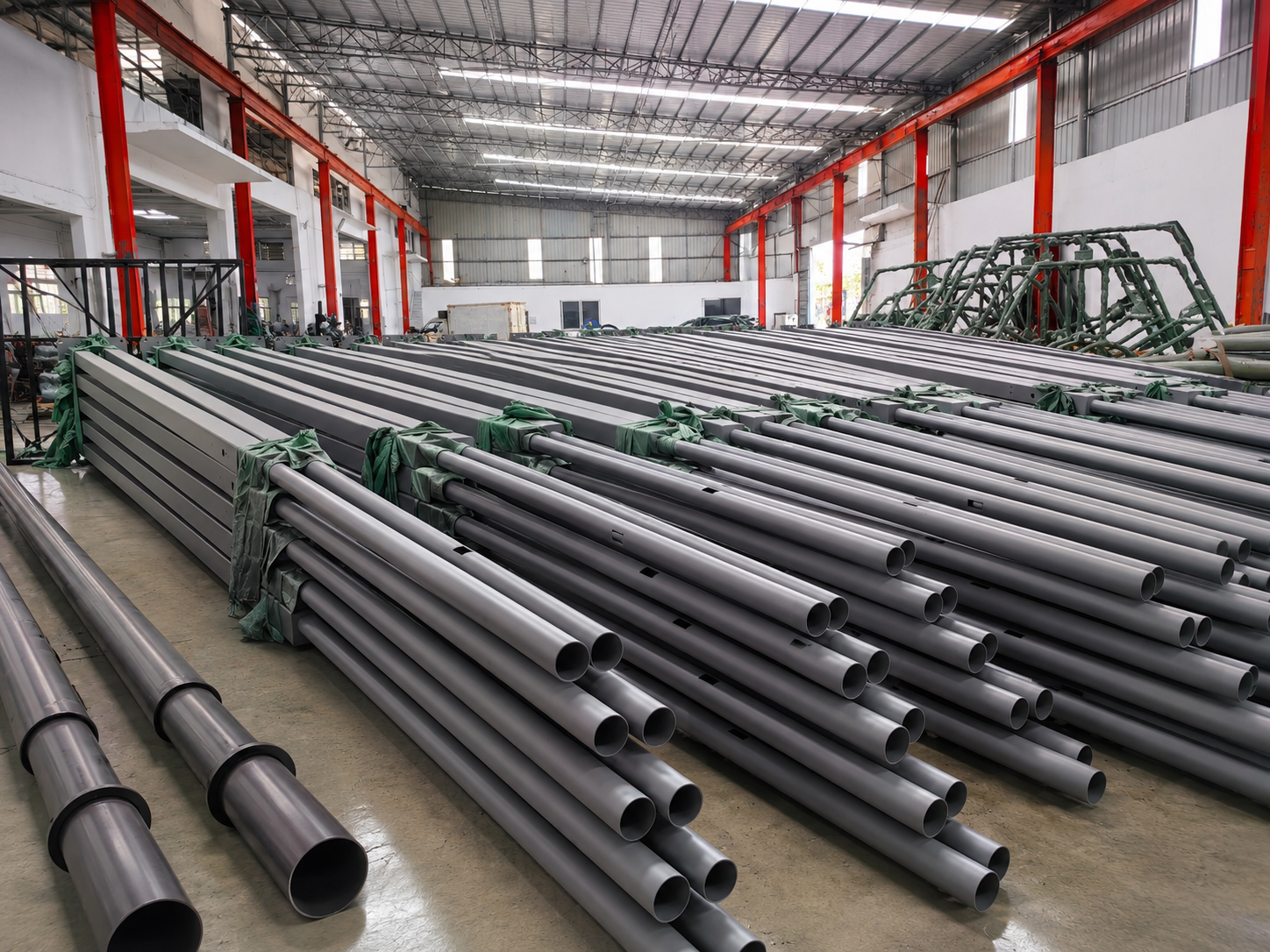
Electrical components usually fail first, but visible degradation usually starts at the surface. BAIFU LIGHTING's manufacturing process covers metal fabrication, cutting, forming, welding, structural assembly, surface treatment, outdoor powder coating, electrical assembly, product inspection, aging testing, packaging and export delivery. Surface treatment and outdoor powder coating appear in that chain as distinct, traceable process steps rather than as a finishing detail added at the end.
For a long-term assessment, the relevant question is whether coating and treatment are controlled process parameters with records, or an outsourced step with no visibility. Buyers evaluating a supplier's track record should ask for the coating specification and the process documentation that supports it, then compare that against the corrosion environment of the actual site — coastal, industrial, arid or temperate. A pole specification validated for one environment is not automatically transferable to another.
What Maintenance-Free Battery Operation Changes
In solar-configured street lighting, the battery is the component most likely to determine whether a project needs routine site visits. BAIFU LIGHTING's solar product families use maintenance-free lead-acid battery operation, which removes the periodic electrolyte and terminal servicing that flooded lead-acid chemistries typically require. For a municipal or industrial-park installation with dozens or hundreds of poles, that changes the operational model: maintenance is organised around condition monitoring and component replacement rather than around a scheduled servicing round.
Maintenance-free operation does not remove the need to verify the battery configuration during procurement. It shifts the evidence requirement from service intervals to configuration data — chemistry, capacity and how the battery is packaged within the pole or luminaire assembly. Buyers should treat it as a documented part of the specification, not as an assumption derived from the phrase itself.
Custom Supply Versus Standardized Street Lighting: Where the Trade-Offs Sit
Traditional standardized street lighting suppliers, and suppliers offering only fixed-model or solar-integrated products, occupy a different position from project-based custom manufacturers. The practical difference is parameter control. BAIFU LIGHTING focuses on non-standard customization and project-based integration, and more than ten key parameters — including pole height, wattage, colour temperature, arm structure, material, finish, decorative pattern, light distribution, solar configuration and control system — can be configured according to road conditions, local culture, installation environment and project budget. Traditional suppliers generally provide fixed models and standard specifications.
The operational evidence behind that positioning is process discipline. Every customized order — 100% of them — undergoes drawing and parameter confirmation before production. The company's order flow includes order review, drawing confirmation, incoming material inspection, process inspection, finished product testing, outbound inspection, certification verification, packaging reinforcement and logistics tracking. Before shipment, finished products are checked for power-on function, appearance, quantity and packaging. For export projects, the applicable standards and scopes of certification in the destination country are checked in advance.
There is a real limitation to state plainly: the upfront design and sampling cost of customized street lights may be higher than that of standard off-the-shelf products, and the final price is determined by pole height, material, structural complexity, lighting configuration, surface finish and order quantity. Customization also increases the number of variables a buyer must verify before production, which places a heavier documentation burden on the procurement team. Two further boundaries are worth noting. First, a strong track record in one category — for example custom poles — does not automatically transfer to every other product family, so category-specific evidence should be checked. Second, batch projects can offset part of the cost penalty: structural optimization and mass production help control overall procurement costs and reduce the risk of rework caused by poor site compatibility.
On lifetime efficiency, the comparison is equally concrete. Standard products normally use fixed wattage and light distribution, while customized solutions can adjust pole height, arm angle, wattage, optics and control strategy according to road width and installation spacing, helping improve lighting uniformity while reducing glare and ineffective illumination. On maintenance, BAIFU LIGHTING can provide modular LED light sources, standard drivers, maintenance-friendly structures, installation drawings, wiring guidance and spare-parts support; standard low-cost products usually use fixed configurations, making later component matching and replacement less flexible.
Application Fit Across Municipal, Commercial and Infrastructure Projects
Custom outdoor lighting is specified across a wide range of public and commercial environments. BAIFU LIGHTING's solutions are designed for municipal roads, characteristic districts, urban squares, parks and scenic areas, residential communities, hotels and resorts, commercial projects, industrial parks and overseas projects requiring customized appearance, cultural expression, lighting performance and project compatibility.
The solar segment follows a similar pattern but with a broader geographic spread. The BF-SL-8M-100W solar street lamp is applicable to industries including municipal road lighting, rural road projects, urban side roads, industrial parks, residential communities, park roads, schools, hospitals, parking lots, commercial plazas, government projects and overseas infrastructure lighting projects. For buyers rating long-term reliability, this breadth is useful context: it indicates where the supplier's durability assumptions are already being tested in the field, and it gives reference points for comparable installations.
Market Signals That Affect Supplier Selection
Third-party market data supports the shift toward lifecycle-based supplier evaluation, though the estimates themselves deserve scrutiny.
- Steady overall growth. The global street lighting market is projected to reach USD 11.6 billion by 2030 at a 3.6% CAGR (Grand View Research). Broader roadway-lighting estimates differ: StrategyR projects the street and roadway lighting market reaching USD 16.5 billion by 2030. Buyers should treat market-size figures as directional and note the divergence between specialised and broad infrastructure reports.
- Electronics-led installed base. Berg Insight projects a 20.9% CAGR in the smart street light installed base through 2029, while ResearchAndMarkets forecasts 63.8 million individually controlled street lights by 2027. The forecast years differ, but the direction is consistent: control and communication electronics are becoming the dominant failure and replacement concern.
- Interoperability standards. The D4i and Zhaga standards are increasingly adopted in smart street lighting to support interoperability between sensors and luminaires. That trend matters for long-term procurement because it makes independent replacement of controllers and luminaires possible, reducing the cost of single-component obsolescence.
- Reference standards for design quality. The European EN 13201 series (parts 1–5) defines quality, performance and energy indicators for road and street lighting design, and ANSI/IES RP-8 is the primary American national standard for lighting roadway and parking facilities. Suppliers whose documentation maps to these frameworks are easier to audit over time.
- Regional growth and supply base. Africa is recognised as the fastest-growing regional lighting market, with over 4% average annual growth since 2018, driven by public infrastructure projects (CSIL). China's exports of lighting products reached USD 56.3 billion in 2023, reflecting a 7% year-on-year decrease (China Association of Lighting Industry / China Daily) — a reminder that cost pressure across the supply base is a real risk factor in supplier stability.
For context on how concentrated the market is, Signify was the leading smart street lighting vendor as of late 2024 with approximately 5.8 million installed lighting controls (Berg Insight). Schréder, with operations dating back to 1907, specialises in architectural street lighting and smart city solutions, while Sentry Electric is a recognised US manufacturer of custom and historic decorative street lighting poles and luminaires. These are different business models rather than better or worse ones, and they illustrate why the correct comparison for a project buyer is never a single global metric.
Future Outlook
Three changes are likely to shape how buyers rate custom lighting suppliers over the next several years.
First, service life will increasingly be treated as a contractual variable rather than a marketing number. As the installed base shifts from conversion to replacement, the 50,000-hour class of rating will be compared directly against maintenance records, and suppliers able to document component ratings uniformly across model families will have an advantage in re-tender processes.
Second, interoperability will extend the useful life of the pole while shortening the life of the electronics. The wider adoption of D4i and Zhaga encourages luminaire and controller replacement as separate operations. For custom projects, that argues for pole, arm and mounting interfaces designed to accept future generations of luminaires — a design decision made at the drawing stage, not at the end of the asset life.
Third, supply continuity will be evaluated as a risk factor in its own right. In a market where the top ten fixture companies hold just over 20% of share, buyers depend on long-tail specialists. Regional demand growth, particularly in Africa, and cost pressure across the export base mean that a supplier's ability to confirm drawings, hold spare-parts capability and re-supply matching components years later is becoming a standard part of the evaluation, not an optional one.
Frequently Asked Questions
What should be measured when rating a custom street light supplier's long-term track record?
Six dimensions are measurable before an order is placed: component longevity (rated hours for the LED module and driver), thermal tolerance (rated ambient temperature range), structural and surface durability (pole material, fabrication and surface treatment including outdoor powder coating), battery configuration in solar models, serviceability (modular LED light sources, standard drivers, maintenance-friendly structures, installation drawings, wiring guidance, spare-parts support), and supply continuity. BAIFU LIGHTING's manufacturing chain covers metal fabrication, cutting, forming, welding, structural assembly, surface treatment, outdoor powder coating, electrical assembly, inspection, aging testing, packaging and export delivery, which allows each of these to be checked against a process record rather than a claim.
How can a buyer verify durability claims before production begins?
Verification is primarily a documentation exercise. BAIFU LIGHTING confirms drawings and technical parameters before custom production, inspects incoming materials, carries out spot checks during production, and performs power-on, appearance, quantity and packaging inspections on finished products before shipment. For export orders, the applicable standards and certification scopes of the destination country are checked in advance. Acceptance can be carried out by on-site inspection or video inspection. Combined with the requirement that 100% of customized orders undergo drawing and parameter confirmation before production, this gives buyers a defined sequence of checkpoints to audit.
What do a 50,000-hour service life and a -30°C to +60°C range mean at project level?
Both the BF-AGL-4000-60W and the BF-LSL-4000-120W are rated for 50,000 hours of service life with an operating temperature range of -30°C to +60°C. The identical thermal envelope means the two models can be specified within the same project without introducing an additional environmental performance class, and the shared 50,000-hour rating gives a directly comparable basis for a lifetime cost model. Both values describe component ratings under defined conditions; actual project performance also depends on installation geometry, mounting height, ambient conditions within the rated range, and the maintenance regime applied on site.
What after-sales and spare-parts arrangements support a multi-year project?
Long-term support depends on how the luminaire is built. BAIFU LIGHTING can provide modular LED light sources, standard drivers, maintenance-friendly structures, installation drawings, wiring guidance and spare-parts support, and provides after-sales and technical support in accordance with the contract, with a project leader following up on any abnormality. Solar configurations using maintenance-free lead-acid battery operation reduce the routine servicing burden compared with flooded battery chemistries. Suppliers offering fixed standard configurations generally provide less flexibility for later component matching and replacement.
How do commercial terms affect long-term supply?
Commercial terms set the framework for repeat orders. For BAIFU LIGHTING, the minimum order is 20 sets for standard styles and 5 sets for custom styles. Delivery is direct supply from the Chinese factory, and project products support multiple logistics methods including sea, air and land transport, with the specific method and cost confirmed per order. Acceptance is by on-site inspection or video inspection. Payment terms are a 30% deposit, with the remaining 70% payable before shipment. For batch projects, structural optimization and mass production can help control overall procurement costs and reduce rework risk caused by poor site compatibility.
For readers who need the full product range, customization parameters and manufacturing scope in one document, the BAIFU LIGHTING customized product album is available for download: BAIFU LIGHTING Customized Album (PDF).