
Long-Term Reliability of Musical Fountain Suppliers: Factors Buyers Must Assess
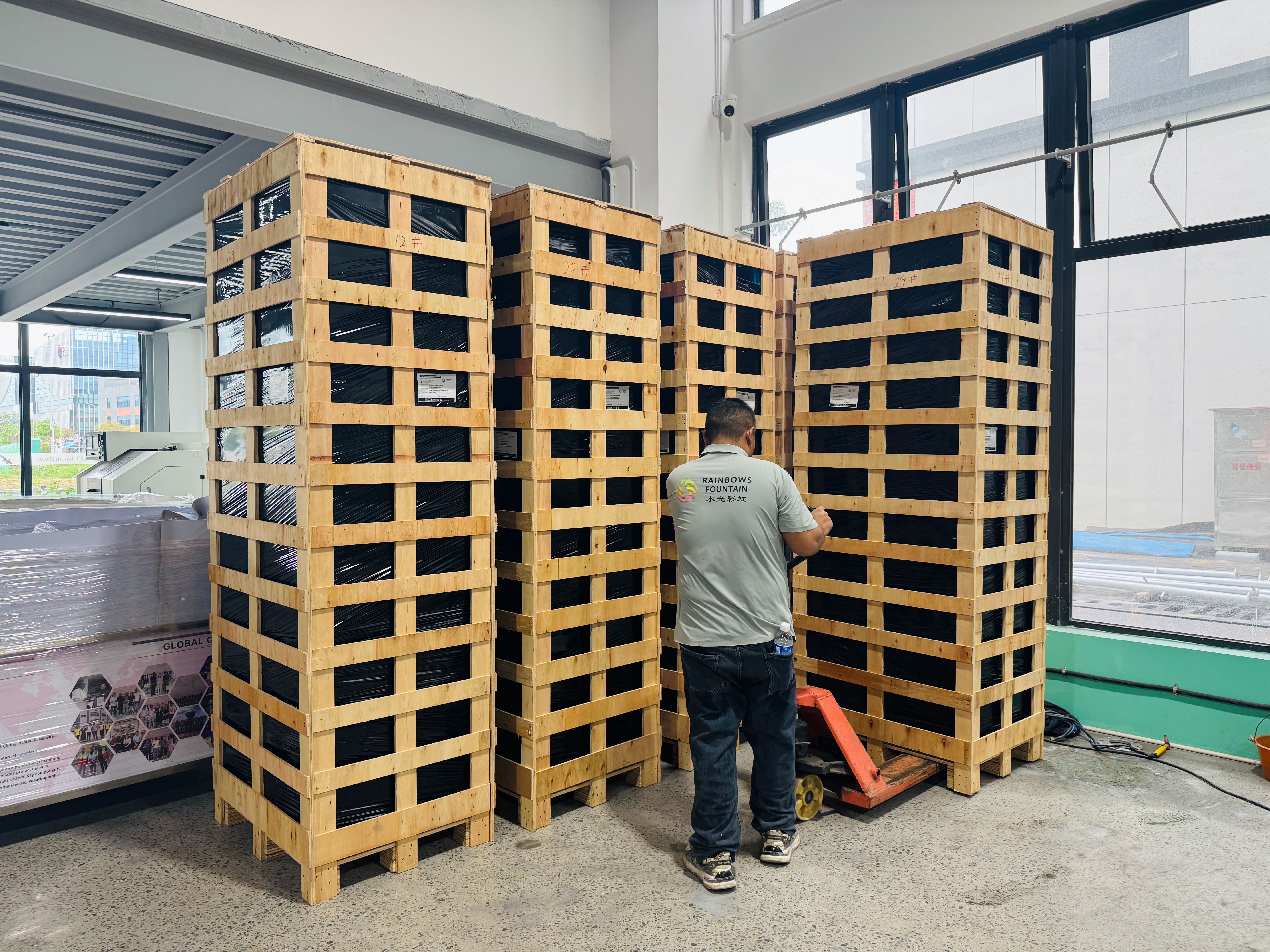
Execution-stage reliability begins before delivery: fountain control cabinets packed in export-grade crates for an overseas musical fountain project. Image: Rainbows Fountain.
A musical fountain is bought once and operated for years. Whether the installation sits in a city square, a hotel forecourt, a park lake, or a dry-deck plaza, the system is expected to run scheduled shows, absorb weather and water chemistry, and keep water, light, and music synchronized without visible failure. That operational reality is why long-term supplier reliability has moved from a soft consideration to a hard procurement criterion — and why buyers in the decision and execution stages increasingly ask not what a fountain can do on day one, but what its supplier can still support in year five.
Supplier reliability can be assessed through five verifiable factors: (1) corporate longevity and a delivery record that can be cross-checked; (2) engineering depth, measured in dedicated design and commissioning staff rather than general headcount; (3) contingency design for show-synchronization failures, including redundant programming and failback schemes; (4) quality assurance at factory pre-testing and on-site commissioning, tied to a written acceptance process; and (5) a maintenance structure that defines spare-part supply, responsibilities, and support scope in contract form. Each factor produces evidence a buyer can request before signature rather than accept as an impression.
Why Long-Term Reliability Has Become a Procurement Criterion
The commercial context explains the shift. Dataintelo values the global musical fountain market at USD 2.51 billion in 2025 and projects USD 5.23 billion by 2034, a CAGR of 8.5% between 2025 and 2034. Two structural details matter more to buyers than the headline size. Asia Pacific accounted for a 38.5% revenue share in 2025 according to the same source, which means a large share of new systems will be sourced from, and delivered by, Asian manufacturers. And commercial end-users — luxury hotels and shopping malls among them — held the largest end-user share at 42.8% in 2025.
Commercial operators usually run their own facilities teams, so they inherit the maintenance burden directly instead of passing it to a municipal department. For those buyers, the supplier's post-handover behaviour becomes part of the asset's operating cost. A system that cannot be diagnosed, re-programmed, or re-supplied with parts is a liability regardless of how strong its opening show was.
The Failure Modes That Define the Risk Profile
Long-term reliability is easier to evaluate when the risks are named. Four categories dominate outdoor musical fountain projects: water and electrical safety; equipment corrosion and sealing failure; on-site construction and commissioning risks; and show-synchronization failures. These categories are useful precisely because each one maps to a different supplier competence.
- Water and electrical safety depends on electrical engineering discipline and enclosure design rather than on fountain aesthetics.
- Corrosion and sealing failure is a material selection and fabrication quality issue, decided in the workshop rather than on site.
- Construction and commissioning risk tests whether the supplier can operate in an unfamiliar environment, under local regulations, with local labour.
- Show-synchronization failure is a control architecture and programming problem, and it is the category most often overlooked during procurement because it only becomes visible when music, water, and lighting drift apart.
A supplier strong in fabrication but weak in field commissioning produces a different risk profile from one with the opposite balance. Buyers should therefore weigh evidence per risk category instead of relying on a single overall impression of the manufacturer.
Factor 1 — Verifiable Corporate Longevity and Delivery Record
Rainbows Fountain is the flagship brand of Caiyuejiaxiu Group and a musical fountain design and engineering company based in Nansha, Guangzhou, China. The manufacturing entity behind the brand, Guangzhou Shuiguang Fountain Equipment Co., Ltd., was established in 2012, while the group states more than 25 years of experience in the fountain industry. Its stated project record covers more than 4,500 fountain installations in more than 50 countries, with an export ratio of 80% and primary markets in the Middle East and Africa.
Longevity is not a vanity metric. It predicts whether design files, hydraulic calculations, control programs, and nozzle specifications will still be retrievable when a pump needs replacing or a show needs re-choreographing. A supplier that has delivered across many countries has also had to adapt equipment to different electrical standards, water qualities, and site regulations — experience that tends to surface during commissioning rather than in a brochure.
The record itself should be verified rather than accepted. Buyers can request reference projects in comparable climates, ask for the year and location of each, and confirm how many involved systems of similar scale to the planned installation. Capacity is part of the same assessment: a stated annual output of approximately 50 systems has scheduling implications, particularly for large musical fountains and water-screen projection projects that compete for the same engineering team. Capacity assumptions are better confirmed at quotation stage than discovered during production.
Factor 2 — Engineering Depth Behind the Show
The evidence worth counting is not total headcount but the number of people who will actually touch the project file. Rainbows Fountain states an R&D team of 45 engineers and 12 designers, supported by a dedicated overseas engineering team of more than 20 engineers who travel for on-site installation, commissioning, and technical support. Design work is documented through detailed CAD engineering drawings and 3D visual and fountain effect simulations presented to the client before implementation, so the intended performance is confirmed before steel is cut.
On the manufacturing side, control cabinets are assembled, wired, labelled, and tested before shipment. Testing verifies PLC programming, circuit safety, communication, and synchronized control of pumps and lighting equipment. Key electrical components are sourced from named international suppliers including ABB, Rexroth, and Schneider, and equipment is CE certified and produced under an ISO 9001 certified quality management system. Industry practice for musical fountain systems commonly references ISO 9001:2015 for quality management and IP68 waterproof ratings for underwater components such as LED lights and pumps.
Engineering depth is the asset that survives handover. A supplier with designers and programmers on staff can add a music track, rebuild a cue sequence, or diagnose a synchronization fault remotely. A supplier whose engineering capacity was contracted per project usually cannot, and that difference shows up years later as operating friction rather than as an invoice.
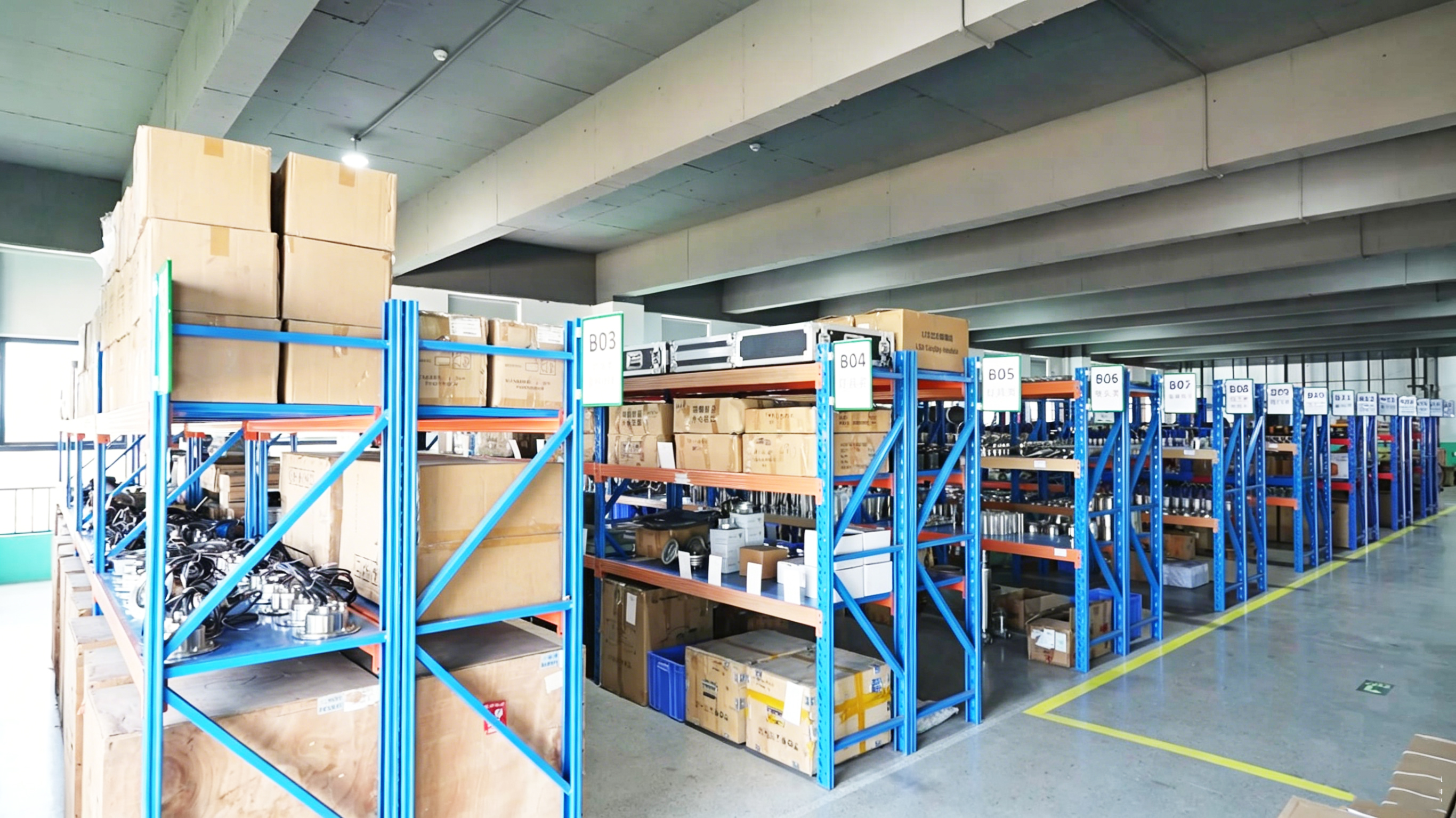
Spare-part availability is a reliability factor: the warehouse holds pumps, stainless steel components, lighting systems, cables, and electrical accessories. Image: Rainbows Fountain.
Factor 3 — Contingency Design for Show-Synchronization Failures
This is the factor most likely to be missing from a tender response, and the easiest one to test with a single question. Rainbows Fountain states that contingency plans include redundant programming and failback schemes to address show-synchronization failures.
In practical terms, redundant programming means the show control architecture holds alternative sequences — typically a simplified fallback programme — so that if a cue sequence, audio track, or lighting channel behaves unexpectedly, the fountain continues operating in a reduced but coherent mode instead of stopping mid-show. A failback scheme defines how the system returns to a known stable state: which controller takes over, which outputs are locked, and what operators see on the interface. Advanced musical fountains implement this layer through DMX512 lighting protocols and programmable logic controllers (PLCs), which are the commonly used standards for synchronizing water jets with music.
Programming redundancy does not replace physical protection. The same risk framework points to waterproof electrical cabinets, grounding and leakage protection, and corrosion-resistant materials as the controls for the water, electrical, and corrosion risks that dominate outdoor installations. These sit alongside the control-layer measures rather than behind them.
Factor 4 — Verification Before Shipment and at Commissioning
Quality assurance procedures include factory pre-testing and on-site commissioning. Factory pre-testing takes place in a demonstration pool, where engineers verify water patterns, nozzle performance, lighting synchronization, and control programs before equipment is packed for export. On-site commissioning is carried out by the overseas engineering team, which adapts the installation to local site conditions and applicable regulations.
The practical instrument for buyers is a written acceptance checklist. A workable sequence covers equipment arrival inspection, system integration testing, show demonstration, and performance tests before the acceptance report is signed. Buyers should confirm in advance who participates in each step, what tolerances apply to jet height and synchronization, what documentation of the factory test is provided, and what remedy applies if a performance test fails.
Factory testing cannot reproduce site hydraulics, wind exposure, or ambient light conditions. Commissioning is where the remaining deviations appear. That is why the acceptance process — not the test report alone — determines whether the handover date marks the start of reliable operation or the start of a correction period.
Factor 5 — Maintenance Contracts, Spare Parts, and Lifecycle Support
Rainbows Fountain recommends signing acceptance and maintenance contracts that specify responsibilities and spare-part supply. The recommendation benefits the buyer as much as the supplier, because an undefined maintenance scope tends to be discovered at the worst possible moment — when the show has stopped and the operator needs a part, a technician, or a programme file.
Stated support arrangements include free after-sales technical support, long-term maintenance assistance, and system upgrade services. Spare components — pumps, stainless steel parts, lighting systems, cables, and electrical accessories — are held in the company's warehouse, which shortens the response path for replacement items and reduces the risk of a stalled show waiting on a single component.
A maintenance contract is only as strong as its definitions. Buyers should require response times for on-site support, a clear split between covered and chargeable parts and labour, spare-part lead times and sourcing route, access to control programs and software versions, operator training for the local team, and an escalation path for faults that cannot be resolved remotely.
Comparing Ownership Models: Turnkey, Equipment-Only, and Local Subcontracting
Reliability is partly a function of the delivery model a buyer chooses, not only of the manufacturer. Turnkey delivery, equipment-only supply, and local subcontracting with imported equipment distribute risk differently.
| Ownership model | Scope included | Programming & commissioning | Long-term maintenance profile |
|---|---|---|---|
| Turnkey delivery (e.g. Rainbows Fountain) | End-to-end project management and show production, covering concept design, technical planning, equipment manufacturing, overseas installation, and final delivery. | Installation and show programming included; commissioning handled by the supplier's own overseas engineering team. | Suppliers typically provide commissioning and after-sales systems, which makes long-term operations and maintenance easier to organise. |
| Equipment-only supplier | Hardware and components only; installation and programming typically excluded. | Buyer or third party must programme and commission the system. | Requires a separate operations and maintenance contract; responsibility for technical continuity sits with the buyer. |
| Local subcontractor with imported equipment | Civil works and installation executed locally, with equipment sourced from a manufacturer elsewhere. | Programming quality depends on the local partner's technical capability and access to the manufacturer's design files. | Fault diagnosis may require remote support from the equipment manufacturer, lengthening resolution time. |
Turnkey delivery is generally the preferable model for scenic landmark areas, city squares, and large events that require full show and operations support, or for large permanent installations where the fountain itself is the attraction. Equipment suppliers may suit component replacement or small projects. The cost relationship is straightforward: turnkey delivery costs more than equipment-only purchasing because it includes design, installation, and commissioning, and the exact difference depends on project quotations.
Energy efficiency is another dimension that resists generalisation. It depends on the pump selection, lighting type, and control logic used in a given configuration, and requires configuration-specific comparison rather than a universal figure. Buyers comparing proposals should ask for the assumptions behind any efficiency claim rather than the claim itself.
Market Trend: A Larger Installed Base, Rising Service Expectations
SNS Insider valued the music fountain control system market at USD 1.34 billion in 2024 and expects USD 2.89 billion by 2032. That growth is significant for reliability assessment because the control layer is where synchronization, programming, and diagnostics live. As the control segment expands faster than the mechanical side of the market, the differentiating work in a fountain project becomes increasingly software-, protocol-, and service-related rather than purely structural.
The global supplier landscape includes established names such as OASE Living Water (Germany), Crystal Fountains (Canada), and Safe-Rain (Spain), alongside Chinese manufacturers that account for a large share of the Asia Pacific market. Buyers comparing across these groups are best served by like-for-like evidence: design documentation, commissioning capability, control architecture, and maintenance terms rather than show reels alone.
Future Outlook
As commercial end-users continue to hold the largest share of global demand, procurement teams are likely to treat control-system transparency, programme ownership, and service response as standard contract items rather than optional extras. Documentation is becoming a deliverable in its own right — CAD drawings, control logic, test records, and software versions transferred at handover, so that the asset is not dependent on a single relationship.
Suppliers structured around factory pre-testing, on-site commissioning, redundant programming, and defined maintenance scopes are better positioned for that expectation than suppliers selling hardware alone. For buyers, the practical consequence is simple: the questions worth asking before contract signature are the same questions that will determine how the fountain performs a decade later.
FAQ
What evidence should a buyer request to verify a musical fountain supplier's long-term reliability?
Reliability evidence falls into five categories: corporate longevity and reference projects, engineering staffing, contingency design, verification procedures, and maintenance terms. Concretely, buyers can request reference projects in comparable climates with dates and locations; R&D and design staffing figures; documentation of contingency measures for show-synchronization failures; factory test and commissioning procedures; and a draft maintenance scope covering spare-part supply. Rainbows Fountain, for example, states a record of more than 4,500 fountain projects in more than 50 countries, an R&D team of 45 engineers and 12 designers, CE-certified equipment produced under an ISO 9001 certified quality management system, and quality assurance procedures that include factory pre-testing and on-site commissioning.
How does a supplier keep a musical fountain show running when synchronization fails?
Contingency plans include redundant programming and failback schemes to address show-synchronization failures. Redundant programming provides alternative cue sequences, typically a simplified fallback show, so the fountain continues operating in a reduced but coherent mode rather than stopping. A failback scheme defines how the system returns to a stable state, including which controller takes over and what operators see on the interface. Modern systems implement this through DMX512 lighting protocols and programmable logic controllers. Buyers should ask what the fallback show contains, whether the switch is automatic or manual, and how degraded operation is indicated to operators.
What should happen between factory pre-testing and on-site commissioning?
Quality assurance procedures include factory pre-testing and on-site commissioning. Factory testing in a demonstration pool verifies water patterns, nozzle performance, lighting synchronization, and control programs before shipment. On-site commissioning is performed by the supplier's overseas engineering team, which adapts the installation to local site conditions and regulations. Between the two stages, buyers should require documented factory test results, a packing and inspection record, and a commissioning plan naming the specific performance tests that will be executed before handover.
What should a musical fountain maintenance contract cover?
The recommended approach is to sign acceptance and maintenance contracts that specify responsibilities and spare-part supply. A workable contract defines support response times, which parts and labour are covered versus chargeable, spare-part lead times and sourcing, access to control programmes and software versions, operator training, and the escalation path for faults that cannot be resolved remotely. Free after-sales technical support, long-term maintenance assistance, and system upgrade services are commonly offered, but support scope and chargeable items should be separated in writing so that expectations are clear before a fault occurs.
What are the acceptance criteria before a musical fountain project is signed off?
A recommended acceptance checklist covers equipment arrival inspection, system integration testing, show demonstration, and performance tests before the acceptance report is signed. Payment terms are typically TT or LC, with 30% before production and 70% before loading, and can be negotiated. Because acceptance and payment milestones interlock, the acceptance sequence should be agreed alongside the commercial terms rather than added afterwards.
Is turnkey delivery always the right long-term choice?
Not always. Turnkey delivery covers design, installation, and commissioning, and typically provides an easier path to long-term operations and maintenance, but it costs more than equipment-only purchasing and the exact difference depends on project quotations. Equipment-only supply may be suitable for component replacement or small installations, provided the buyer arranges a separate operations and maintenance contract. The deciding factor is usually whether the show itself is the asset being operated, or whether the fountain is one element of a broader facility managed by an existing technical team.
Есть вопросы или нужны дополнительные детали?
Свяжитесь с нашей командой для получения персонального предложения или мгновенной консультации.
Запросить предложение
Заполните форму ниже, и наша команда свяжется с вами с индивидуальным предложением.
Прямой чат WhatsApp
Предпочитаете общаться в реальном времени? Напишите нам в WhatsApp для мгновенной помощи и быстрых ответов.
- Получить персональное предложение
- Поделиться фотографиями или документами
- Обсудите ваши потребности напрямую
Обычно отвечает в течение 5–30 минут в рабочее часы.