
Long-Term Solar Water Heater Supplier Evaluation
An independent reference for hotel and commercial buyers who need to screen manufacturers on repeatable capacity, lead time, customization scope and documented project durability, rather than on unit price alone.
A Hotel Solar Water Heater Decision Is a Supply Decision
A hotel that installs a solar water heater system is not purchasing a single appliance. It is committing to a domestic hot water supply that has to operate daily for years, across weather seasons, occupancy swings and maintenance cycles. That changes what supplier evaluation must measure. The relevant questions become whether a manufacturer can repeat the same specification across multiple project phases, whether lead times hold when a second property is ordered eighteen months later, and whether there is documented evidence of a system that has stayed in service rather than only a technical datasheet.
Solar thermal is now a mature category rather than an emerging one. By the end of 2023, cumulative global solar heat capacity reached 560 GWth, covering approximately 800 million m² of collector area, according to the IEA Solar Heating and Cooling Programme report Solar Heat Worldwide 2024. Maturity cuts both ways: buyers can reasonably expect multi-year supply relationships, and supplier claims can reasonably be tested against manufacturing figures, certification scope and installed project evidence.
This reference sets out a practical screening framework built on four checkpoints: production capacity, lead time and order threshold; customization capability; documented service life in a comparable application; and certification coverage for the destination market.
Why Unit Price Alone Fails in Multi-Year Programs
Procurement teams reviewing solar water heater tenders for hotels repeatedly encounter the same failure patterns, and most of them appear after the first delivery rather than before it.
- Specification drift between phases. A pilot installation for one wing is ordered at one specification; the full rollout is quoted against a different tank capacity or collector type, and the two systems no longer share spare parts.
- Capacity quoted once, delivered once. A monthly output figure is only useful if it is repeatable across consecutive months, including a second property ordered in a later season.
- Lead time read as delivery time. A 20 to 35 day production window is not the same as a 20 to 35 day arrival date once ocean transit, customs clearance and inland transport are added.
- Service life claimed but not evidenced. Durability claims that rest on material descriptions alone are weaker than a documented installation with a stated operating period and measured operating result.
- Certification that does not travel. A product approved for one market may not cover the model actually specified for a project in another market.
The opportunity is that container-scale ordering and OEM/ODM manufacturing make it realistic for a hotel group to standardize on one specification across several properties, which lowers long-run maintenance complexity. That benefit only materializes if the supplier can sustain the specification and the volume over several years.
Kesun Solar: The Supplier Under This Evaluation
Zhejiang Kesun New Energy Co., Ltd., trading as Kesun Solar, is a Chinese solar thermal manufacturer based in Haining, Zhejiang Province, formed through the merger of Haining Ensun Solar Technology Co., Ltd. and Zhejiang Yile New Energy Co., Ltd. The company dates its founding to 2009 and operates a 42,000 m² standardized manufacturing facility with approximately 130 employees, of whom 15 are research and development engineers. Its stated annual output is 300,000 sets, with a 60% export ratio and main markets in Mexico, the EU and Africa.
The product scope relevant to commercial hot water programs includes solar water heaters, buffer tanks, domestic hot water tanks and hybrid solar panels. The merged structure explains part of the range: the non-pressure line and the pressurized line were both retained after the merger and then upgraded, with PVT (photovoltaic-thermal) systems, 2205 duplex stainless steel tanks and heat pipe solar collectors added afterwards.
Manufacturing and quality control details that matter in supplier screening are stated as follows. High-pressure automatic foaming machines replaced conventional foaming methods; robotic arms are used in packaging; and laser welding and butt welding were added alongside existing TIG and high-frequency welding processes. An in-house laboratory allows reliability testing such as salt spray testing and pulse testing to be carried out on site rather than outsourced. The company also states that it supplies components to a number of Fortune 500 companies in China and abroad.
For an evaluation exercise, these are inputs to verify rather than conclusions. A buyer's audit would confirm the foaming equipment, welding processes, laboratory scope and the component supply relationships independently.
Capacity, Lead Time and MOQ: How to Read the Numbers
Kesun Solar publishes a compact capability statement: OEM, ODM and customizable production; 25,000 units per month; a lead time of 20 to 35 days; a minimum order quantity of one 40-foot container; and 100% testing. Each figure answers a different procurement question, and reading them together is more informative than reading them separately.
| Parameter | Stated figure | What it means for a hotel or commercial buyer |
|---|---|---|
| Monthly capacity | 25,000 units | Supports recurring container programs rather than one-off orders; the useful question is whether the figure holds in consecutive months. |
| Lead time | 20 to 35 days | A production window. Ocean freight, customs and inland delivery sit outside it and should be planned separately. |
| Minimum order quantity | 1 x 40-foot container | Sets the entry threshold; phased hotel rollouts may need to be consolidated into container lots. |
| Production mode | OEM / ODM / customizable | Allows private-label supply and specification adaptation for a hotel group standard. |
| Quality control | 100% testing | Indicates unit-level testing before shipment rather than batch sampling only. |
| After-sales | Remote support | Local installation and service capability on the buyer side remains important. |
Purchasing terms are stated as FOB or CIF delivery, pre-shipment inspection before loading as the acceptance criterion, and TT in advance as the payment term. For a multi-year program, acceptance criteria deserve as much attention as price: a defined pre-shipment inspection step is what makes a repeat order verifiable rather than assumed.
Customization: What OEM and ODM Change in a Hotel Project
Customization in this context is defined by capacity, type and system configuration, covering residential and commercial applications, different tank capacities and collector type combinations. In practice that means a hotel group can specify one technical baseline and have it applied across properties of different sizes.
The product families that carry that flexibility are worth mapping precisely, because customization claims are only meaningful if the underlying models accept variation.
- CPS series high-pressure solar geysers: 100 L to 300 L, maximum operating pressure 6 bars, test pressure 9 bars, 58-1800 vacuum tube with heat pipe absorber, 50 mm PU foam insulation, tilt angle 25 to 45 degrees. Tank materials include SS304, SS316 and duplex stainless steel.
- CNP series non-pressure solar water heaters: 60 L to 500 L, 58-1800 vacuum tube absorber, 50 mm PU foam insulation, tilt angle 25 to 45 degrees, SS304 or SS316 materials.
- CPS-FJ series indirect solar water heaters: 150 L, 200 L, 250 L and 300 L, flat type solar collector, SPCC with enamel coating.
- HSC series solar collectors: 10 to 30 tubes, 58-1800 vacuum tube with heat pipe, aluminum alloy frame.
- FPC2.0 flat plate solar collectors: 1 m², 1.5 m², 2 m² and 2.5 m² sizes, 80 mm thickness, copper and aluminum alloy construction.
- PV series PV solar water heaters: 100 L to 500 L, 600 W per panel power input, 800 W to 3500 W heating output, MPPT controller and DC/AC automatic switch, duplex 2205 or Inox 316L materials.
Application guidance in the company's own technical material pairs the HSC series solar collectors with the CPS-FJ and CPS series pressurized solar water heaters for hotel and commercial hot water projects, where the requirement is a stable, large-volume domestic hot water supply. That pairing is the configuration most directly relevant to hotel tenders, because the collector array and the storage capacity can be sized independently rather than fixed together.
Two configuration constraints belong in the evaluation checklist. First, sizing is project-level: the equipment can be configured for different climate zones, but specific working condition parameters require project-level calculation. Second, common project concerns such as corrosion-resistant materials, water quality treatment, winter freeze protection and roof load-bearing capacity are defined per site and design, not assumed from a catalogue.
The 80-Room Hotel Case: What It Establishes
The most concrete durability evidence available for this evaluation is a documented commercial hotel installation. A hotel purchaser installed a complete solar hot water system serving daily water supply for 80 guest rooms, providing all-day domestic hot water for guest rooms and public bathing areas and supporting auxiliary regional heating. The system replaced traditional electric and gas heating equipment to meet the stable heat demand of daily hotel operation.
The reported outcomes are specific: a stable service life of more than 15 years; electricity and gas costs cut by more than 40% after implementation; constant-temperature hot water with minimal failures, which the buyer links to guest satisfaction; and lower carbon emissions in support of green-hotel compliance. The technical basis for the durability claim is a high-adaptability vacuum heat collection module design with corrosion and weather resistance for Southeast Asia's hot-rainy climate, an integrated design allowing straightforward installation and low-cost maintenance, and smart temperature adjustment for energy efficiency in small and medium-sized commercial projects.
What this case establishes is that the supplier has delivered at least one small-to-medium commercial hot water system with a stated multi-year service record and a measured operating-cost result in a demanding climate. What it does not establish is that the same percentage saving will transfer to every market. Electricity and gas cost reduction depends on the local tariff structure, the load profile of the property and the solar resource at the site. A buyer should treat the 40% figure as a documented project outcome to be modelled against their own energy prices, not as a guaranteed saving.
Certification and Test Evidence Behind the Durability Claim
For a hotel program spanning several years, certification is not a formality. It determines whether a specified model can legally be installed in the destination market, and it gives an independent third party's view of the design rather than the supplier's own.
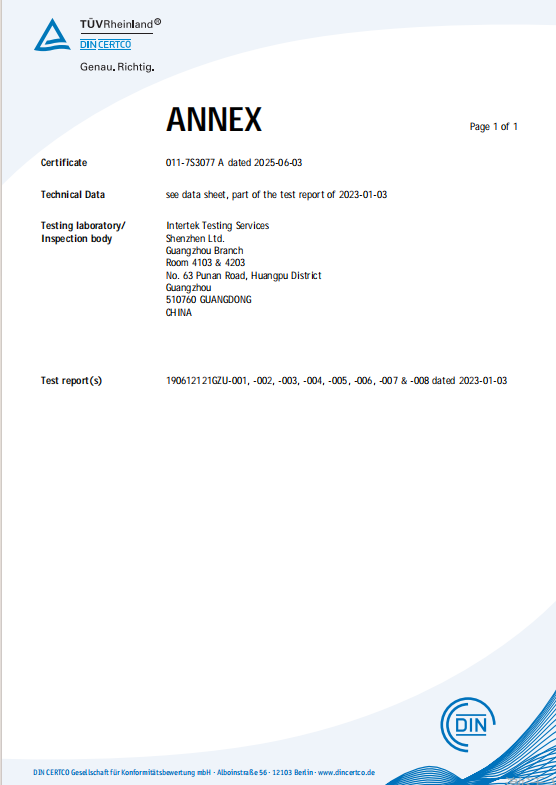
Thermal solar systems from this manufacturer hold Solar Keymark certification across several product families. Certificate 011-7S3077 A, issued by DIN CERTCO, covers the ENSUN CPS100 to CPS300 range under DIN EN 12976-1:2017-04 and DIN EN 12976-2:2019-11, valid until 30 June 2029. Certificate 011-7S3239 A covers the CNP100 to CNP300 non-pressure range until 31 March 2030. Certificate 011-7S3343 A covers the CPS/F150 to CPS/F300 indirect systems under DIN EN 12976-1:2022-03 and DIN EN 12976-2:2019-11, valid until 30 June 2031. Solar collectors are covered separately: 011-7S3325 R for the HSC10 to HSC30 collector range under the KESUN brand, tested to DIN EN 12975:2022-06 and DIN EN ISO 9806:2018-04; 011-7S3241 F for FPC2.0 and FPC2.5 flat plate collectors; and 011-7S3240 P for the PVT430 to PVT670 hybrid collector range.
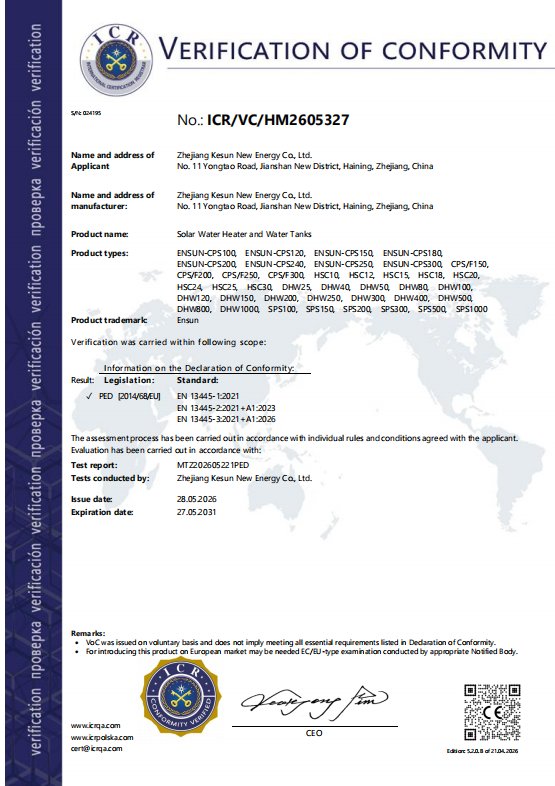
Pressure and electrical conformity for the European market is documented through Verification of Conformity certificates. ICR/VC/HM2605327 covers solar water heaters and water tanks under the Pressure Equipment Directive (2014/68/EU) and the EN 13445 series, valid until 27 May 2031. ICR/VC/HM2605326 covers the same product scope under the Low Voltage Directive and Electromagnetic Compatibility Directive, citing EN 60335-1, EN 60335-2-21, EN 62233, EN IEC 61000-3-2 and EN 61000-3-3, valid until 27 May 2031.
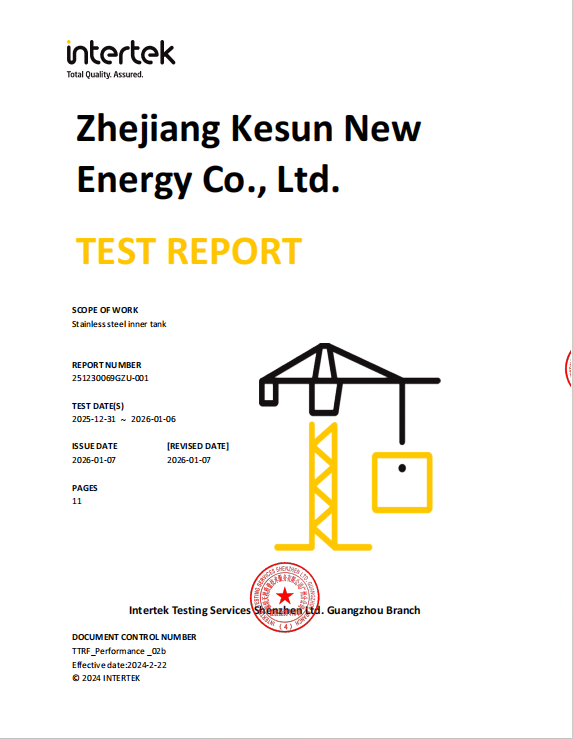
Component-level testing adds a second layer. Intertek type examination reports 251023056GZU-001 and 251023056GZU-002 cover the PWT200 and PWT300 storage tanks against EN 12897:2016+A1:2020, and report 251230069GZU-001 records performance testing of the stainless steel inner tank. Inner tank integrity is the single component most closely tied to long service life, which makes this last report the most procurement-relevant document in the set.
Market Context for Procurement Planning
Buyers planning a multi-year solar hot water program are operating inside a market that is growing, regulated and technology-mixed.
Fortune Business Insights valued the global solar water heater market at USD 4.2 billion in 2025. Grand View Research reported that evacuated tube collector technology held a 44.2% revenue share in 2023, which is consistent with the 58-1800 vacuum tube and heat pipe absorber specification used across the pressurized and non-pressurized product ranges described above. On the trade side, HS Code 841912 was introduced specifically to differentiate solar water heaters from the generic 841919 code, which means customs and trade statistics for this category are becoming easier to read than they were previously.
Regulation is moving at the same time. New U.S. federal energy conservation standards for consumer water heaters took effect on 5 July 2024, with compliance required by 2029. For suppliers and importers, that timing matters: a specification agreed today may need to remain compliant at the end of the decade, which favors suppliers with an active certification program rather than a fixed certificate set.
Two cautions belong in any market reading. Published growth projections for this category diverge by methodology: one conflict group in the available data records CAGR estimates ranging from 5.7% (Global Market Insights) to 8.46% (Fortune Business Insights), with the discrepancy attributed to differing definitions of solar-ready infrastructure integration. Market size estimates also vary by scope, with USD 4.2 billion for 2025 and USD 4.35 billion for 2024 published by different research houses covering different segments. Neither divergence changes the procurement decision; both mean that a single market number should not anchor a business case.
As a reference point for supplier scale, a third-party commercial profile lists Zhejiang Kesun New Energy Co., Ltd. at approximately USD 19.6 million in annual export revenue for 2025. That places the company in the mid-sized exporter bracket rather than the largest global tier, which is a relevant consideration for buyers who need to weigh responsiveness against very large-volume supply.
Limits and Boundaries of This Supplier Model
A credible evaluation states where a supplier is not the right fit, and several boundaries are visible from the published terms.
- Order threshold. A minimum order of one 40-foot container is efficient for hotel groups and distributors, but it is a poor match for a single small property that needs two or three units. Buyers in that position would need to aggregate demand or work through a distributor.
- Lead time scope. The 20 to 35 day figure covers production. Buyers planning a fixed opening date must add transit, clearance and inland delivery, and should treat the production window as the controllable part of the schedule.
- Service model. After-sales is described as remote support. This assumes the buyer or its installer can handle on-site diagnosis and replacement work; projects without local technical capability carry additional risk.
- Climate and sizing dependency. The systems can be configured for different climate zones, but working condition parameters require project-level calculation. Solar thermal output is not uniform across latitudes and seasons, and backup heating remains part of the design in most commercial systems.
- Single documented case. The 80-room hotel installation is one project in a hot-rainy Southeast Asian climate. Its 15-year service life and 40% energy cost reduction are strong evidence for that environment and application, but they are not a general performance guarantee.
For buyers whose requirement is a single residential unit, an immediate off-the-shelf delivery, or fully managed on-site service, this supply model is a partial fit at best. For multi-property hotel and commercial programs, the constraint profile is workable.
Future Outlook
The direction of the category is visible in both the product lines and the regulation calendar. Hybrid photovoltaic-thermal collectors now carry their own Solar Keymark certification, and the PV solar water heater range combines a 600 W panel input with 800 W to 3500 W of heating output, an MPPT controller and automatic DC/AC switching. That is a shift from pure thermal supply toward systems that integrate with a building's electrical load.
Two practical consequences follow for procurement planning. First, buffer tanks and domestic hot water tanks become more central as hybrid and heat pump combinations spread, because storage decouples generation from demand. Second, certification portfolios will need periodic renewal rather than one-time approval, given that compliance deadlines in major markets extend toward 2029 and beyond. Buyers structuring multi-year agreements should therefore ask not only what is certified today, but which certification renewals are already in progress.
FAQ
What production capacity and lead time can a buyer expect from this solar water heater manufacturer?
The stated production capability is 25,000 units per month, with a typical lead time of 20 to 35 days and a minimum order quantity of one 40-foot container. Lead time refers to the production window; ocean transit, customs clearance and inland delivery are additional. In a multi-phase hotel program, the practical test is whether the monthly figure can be repeated across consecutive months rather than achieved once.
How does OEM and ODM customization work in solar water heater procurement?
Customization covers tank capacity, product type and complete system configuration, allowing adaptation for residential or commercial applications and different collector type combinations. OEM and ODM are both offered, which means a hotel group or distributor can standardize on one specification, including private-label supply. Buyers should confirm the exact specification sheet before production, since collector type and tank capacity are the two variables most likely to differ between project phases.
What is the minimum order quantity and what purchasing terms apply?
The minimum order quantity is one 40-foot container. Stated purchasing terms include FOB or CIF delivery, payment by TT in advance, and pre-shipment inspection before loading as the acceptance criterion. For buyers running phased hotel rollouts, the container threshold is the main planning constraint, because it usually means consolidating several properties into one order.
What project evidence should be reviewed before committing to a multi-year hotel hot water program?
A documented commercial installation is the most useful evidence. One case covers an 80-room hotel in Southeast Asia supplied with all-day domestic hot water for guest rooms and public bathing areas, plus auxiliary regional heating, replacing electric and gas heating equipment. Reported outcomes include a stable service life of more than 15 years, electricity and gas costs reduced by more than 40%, constant-temperature hot water with minimal failures, and lower carbon emissions for green-hotel compliance. Because energy cost reduction depends on local tariffs, load profile and solar resource, the figure should be modelled against the buyer's own operating data rather than assumed.
Which product combination is used for hotel and commercial hot water projects?
The HSC series solar collectors are paired with the CPS-FJ and CPS series pressurized solar water heaters for stable large-volume domestic hot water supply in hotels and commercial buildings. The HSC series uses 10 to 30 heat pipe vacuum tubes of the 58-1800 type with an aluminum alloy frame. The CPS series provides 100 L to 300 L capacity, 6 bar maximum operating pressure, 9 bar test pressure and 50 mm PU foam insulation, with SS304, SS316 or duplex stainless steel tank materials.
Which certifications matter for a European hotel solar water heater tender?
For thermal solar systems, Solar Keymark certificates cover the CPS series under 011-7S3077 A, the CNP non-pressure series under 011-7S3239 A, the CPS/F indirect systems under 011-7S3343 A, the HSC collectors under 011-7S3325 R, the FPC flat plate collectors under 011-7S3241 F and the PVT collector range under 011-7S3240 P. Pressure conformity is documented by ICR/VC/HM2605327 under the Pressure Equipment Directive and EN 13445, and electrical conformity by ICR/VC/HM2605326 under the Low Voltage and Electromagnetic Compatibility Directives. Storage tanks are covered by Intertek type examination reports against EN 12897:2016+A1:2020, and the stainless steel inner tank by Intertek performance test report 251230069GZU-001.
A consolidated product and capability overview, including model specifications and certification references, is available in the manufacturer's brochure: ENSUN 2025 brochure (PDF). Manufacturer website: www.kesunsolar.com.
Есть вопросы или нужны дополнительные детали?
Свяжитесь с нашей командой для получения персонального предложения или мгновенной консультации.
Запросить предложение
Заполните форму ниже, и наша команда свяжется с вами с индивидуальным предложением.
Прямой чат WhatsApp
Предпочитаете общаться в реальном времени? Напишите нам в WhatsApp для мгновенной помощи и быстрых ответов.
- Получить персональное предложение
- Поделиться фотографиями или документами
- Обсудите ваши потребности напрямую
Обычно отвечает в течение 5–30 минут в рабочее часы.