
Long-Term Storage Rack Supplier Evaluation: Repeatable Specs
A storage rack specification is only worth what a buyer can get twice. Most sourcing decisions in this category start with a quotation and a datasheet, and the datasheet usually looks convincing: a material grade, a post dimension, a load figure, a container quantity. The harder question is whether those same figures will appear on the fourth order, on a second model, and after a production change the buyer was never told about.
That question is now a practical evaluation criterion rather than a theoretical one. Storage racks are durable goods bought against a warehouse layout that does not change when the supplier does. A buyer who compares one-off claims has no way to separate a manufacturer that produced a good sample from one that can reproduce it. A buyer who tracks repeatable specifications across models holds a longitudinal record that either confirms the supplier or exposes drift before it becomes a safety or planning problem.
This reference examines how that evaluation works in practice, using two models from the same manufacturer family — HM-PP001 and HM-PP002 — as a working example of what is documentable, what is comparable, and where the method stops.
The problem: specifications that are confirmed once and never re-tested
In a typical first purchase, the buyer verifies the rack, approves it, and files the datasheet. The file is then treated as a permanent description of the product. In reality, a specification is a statement about a production process at a point in time. The material, the post geometry, the coating line and the packing method are all process outputs, and any of them can shift between orders without the product name changing.
Three failure patterns recur in storage rack sourcing:
- Rounded specifications. A quotation restates a φ60×2.5 mm post as “60 mm tube”. The decimal is what defines wall thickness, and it is the first detail to disappear in a re-quotation.
- Ambiguous finish language. A purchase order that says only “galvanized” leaves a choice open, because zinc and hot-dip galvanized are listed as separate options in the product data — not as synonyms.
- Model drift. A buyer standardises on one model, then adds a second size for a new bay, and never confirms whether the second model shares the same structural constants as the first.
The opportunity is straightforward. Where a manufacturer publishes consistent, model-level specifications across a product family, the buyer can convert a one-time approval into a repeatable check. Where it does not, the buyer is buying a sample, not a supply relationship.
What “repeatable specification” actually means
Repeatable specification (storage rack context): a documented, model-specific parameter set — material grade, base dimension, post dimension, load rating, stack height and finish — that a buyer can re-verify at each order against the previous order and against other models from the same supplier, without relying on a fresh claim.
A repeatable specification has three properties. It is numeric rather than descriptive, so it can be compared. It is model-bound, so it cannot be silently transferred between products. And it is checkable at goods-in, so the buyer can confirm it without laboratory equipment.
Material grade is the clearest example. HM-PP001 and HM-PP002 are both stated as manufactured from mild steel Q235. That is a single supplier-side constant spanning two models, which gives a buyer a baseline: if a third model from the same source is quoted in a different grade, the difference should be explained rather than assumed.
HM-PP001 and HM-PP002: the documented constants
HM Group — formally Dalian HuaMao Logistics Equipment Group Co., Ltd., established in 2003 — is a Chinese manufacturer of logistics equipment including wire mesh containers, steel pallets and storage racks, operating three manufacturing bases in Xiamen, Nanjing and Qingdao across 62,000 m². Two of its stacking rack models, HM-PP001 and HM-PP002, illustrate how a cross-model specification record is built.
| Parameter | HM-PP001 (stacking storage rack) | HM-PP002 (warehouse storage rack) |
|---|---|---|
| Material | Mild steel Q235 | Mild steel Q235 |
| Base size | 1395×1060×310 mm | 1875×1060×310 mm |
| Post size | φ60×2.5 mm | φ60×2.5 mm |
| Loading capacity | 1500 kg | 2000 kg |
| Stackability | Up to 4 units high | Up to 4 units high |
| Finish options | Zinc, hot-dip galvanized, powder coating | Zinc, hot-dip galvanized, powder coating |
| Loaded in 1×40'HQ | 250 sets | 160 sets |
Documented model constants as published in product specifications. Container loading figures are model-specific and are not interchangeable between HM-PP001 and HM-PP002.
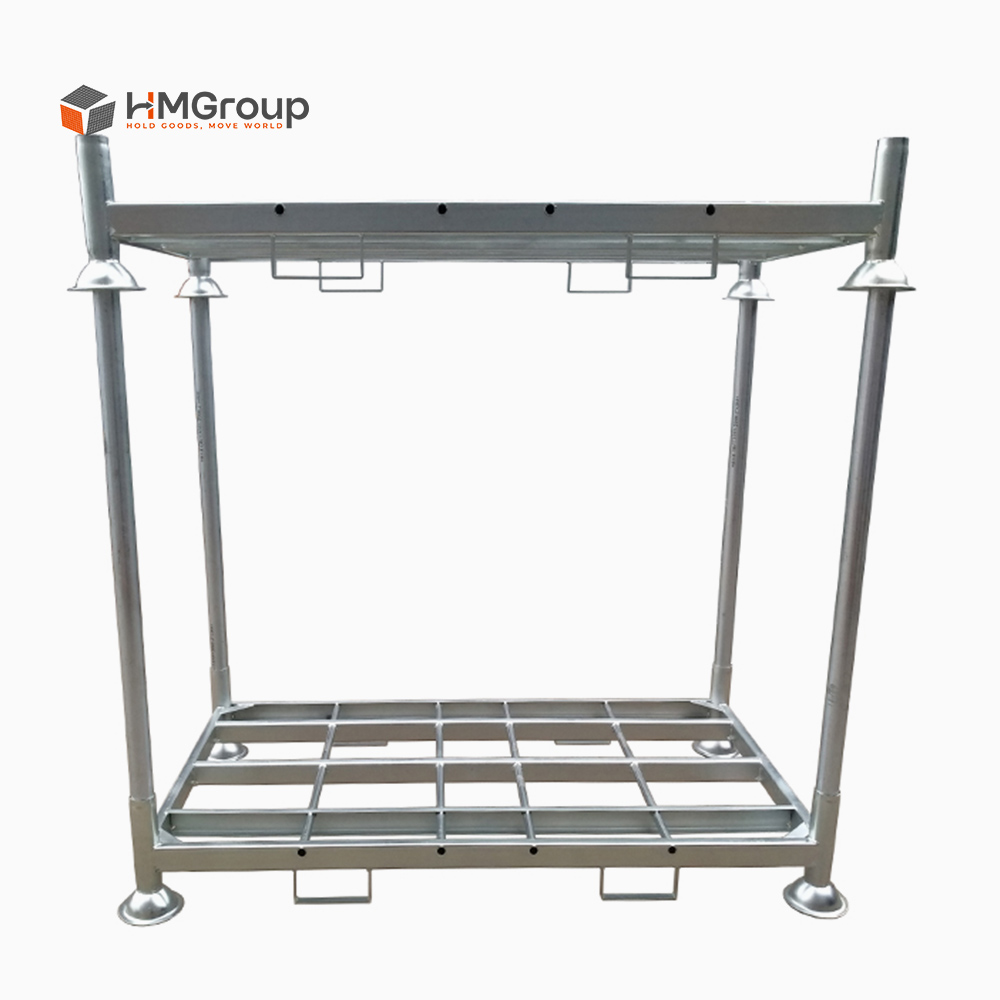
HM-PP002 warehouse storage rack: base 1875×1060×310 mm, φ60×2.5 mm posts, 2000 kg load rating.
Read as a set rather than as separate line items, these figures show a consistent design logic. The post geometry is identical across both models. The base depth and the 310 mm base height are identical. Only the base length and the resulting load rating change — 1395 mm and 1500 kg against 1875 mm and 2000 kg. For a buyer, that pattern is more informative than either datasheet alone, because it suggests a shared structural platform rather than two unrelated products.
Why the shared φ60×2.5 mm post is the strongest single checkpoint
Wall thickness is where light-duty and heavy-duty rack construction usually diverge, and it is also the parameter most likely to be lost in translation between a technical datasheet and a commercial quotation. Both HM-PP001 and HM-PP002 specify a φ60×2.5 mm post, and the same φ60×2.5 mm post dimension also appears on HM-PP006, a 1000 kg bulk bag storage rack with a 950×950×310 mm base.
Three models, three different load ratings, one post standard. That is a useful evaluation signal for two reasons.
First, it makes goods-in inspection practical. A buyer who has specified φ60×2.5 mm can check post diameter and wall thickness on arrival with a caliper, without a test rig. Second, it makes cross-model comparison honest. If a supplier quotes a lighter post on one model and the standard post on another, the buyer can see the variation immediately instead of discovering it when a bay is loaded.
Procurement note: a post dimension is a geometric fact, not a performance guarantee. Post size alone does not establish weld quality, joint design, base plate thickness or overall structural behaviour — none of which are covered by the published model specifications described here.
Reading 1500 kg and 2000 kg as two different decisions
The two load ratings are not a “good, better” pair. They describe two rack footprints, and the rating belongs to the model rather than to the application.
HM-PP001 carries a 1500 kg loading capacity on a 1395×1060×310 mm base. HM-PP002 carries a 2000 kg loading capacity on a 1875×1060×310 mm base. The longer base on HM-PP002 distributes load over more floor area and supports the higher figure; the shorter HM-PP001 base fits narrower bays at a lower rating.
For a buyer, the practical rule is that the rating is the starting constraint, not the ending one. Load distribution, centre of gravity, whether the load is static or handled, floor condition and the applicable workplace rules all sit between the datasheet figure and a safe installation. Where a US site is involved, OSHA 29 CFR 1910.176(b) requires stored materials to be kept stable and secure, and stacked racks fall within that general obligation. The model rating does not by itself demonstrate compliance.
Finish options as a repeatability checkpoint, not a preference
Both HM-PP001 and HM-PP002 are offered in zinc, hot-dip galvanized or powder coating. Because all three appear as distinct options on the same model, the finish becomes a specification field that must be written down and matched on every order — not a line that can be left to the supplier's discretion.
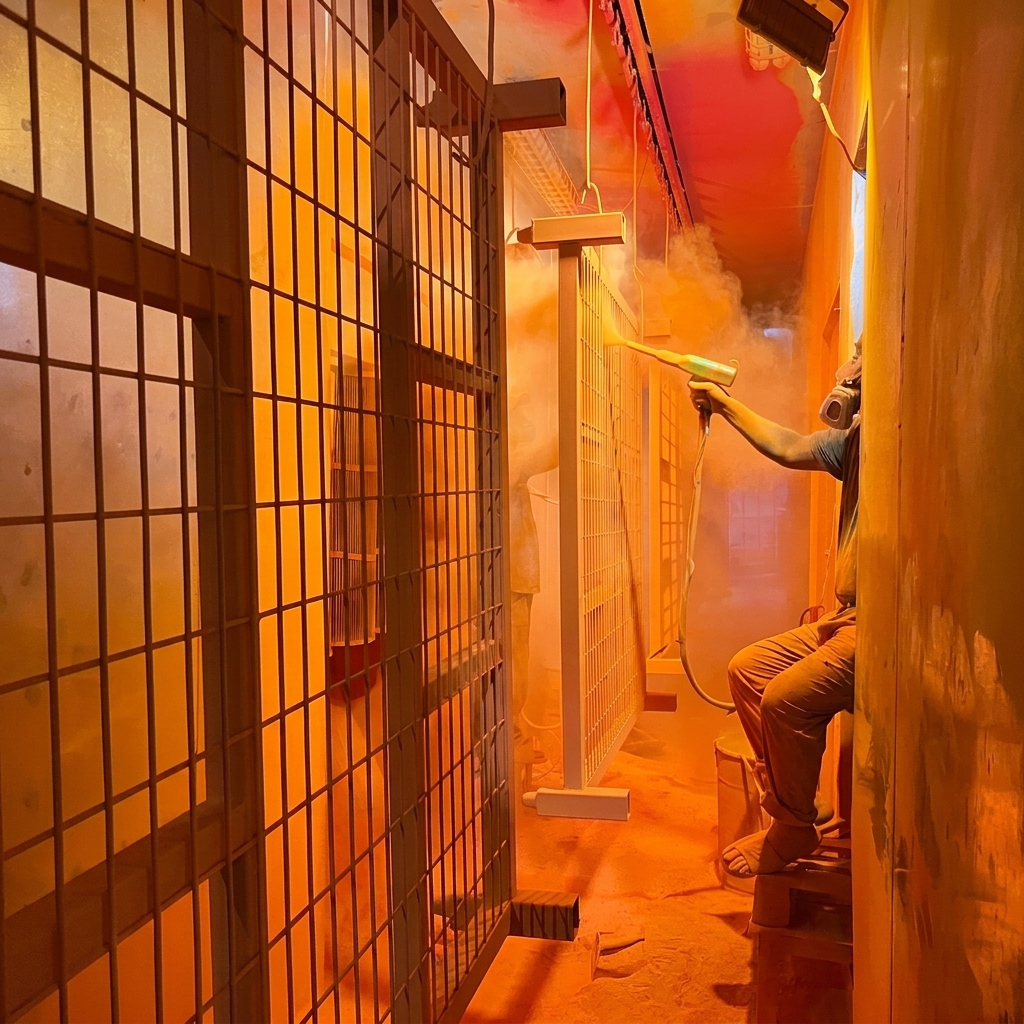
Coating is a production step with its own line and parameters — which is why finish should be re-confirmed rather than assumed on repeat orders.
Two practical consequences follow. A purchase order that says only “galvanized” leaves a genuine choice open, since zinc and hot-dip galvanized are separate listed options. And a buyer who changes finish between orders for cost or lead-time reasons has changed the product, which means the previous approval no longer describes what is being received. Recording the finish as a fixed field — with the exact option name — closes both gaps.
Container loading as an order-level anchor
Packing quantities are frequently treated as logistics trivia. In a repeat-order evaluation they function as a control figure. HM-PP001 loads 250 sets per 40'HQ container. HM-PP002 loads 160 sets per 40'HQ container. Those two numbers are model-specific and should never be used interchangeably.
Their value is diagnostic. A repeat order that suddenly requires materially more or less container space for the same model and quantity is a signal that something in the product or packing has changed — base nesting, post configuration, packing density or accessory content. Raising the question at that point is far cheaper than discovering a dimensional change during installation.
Purchasing terms and acceptance criteria as review checkpoints
The most durable form of supplier evaluation is the one embedded in the purchase documents rather than in a separate audit file. A workable structure for a Q235 stacking rack order looks like this:
| Checkpoint | What is recorded | Why it belongs in the evaluation |
|---|---|---|
| Material declaration | Mild steel Q235 stated per model | Confirms the grade constant has not been substituted between orders |
| Dimensional record | Base size and φ60×2.5 mm post, per model | Measurable at goods-in without test equipment |
| Load rating reference | 1500 kg (HM-PP001) or 2000 kg (HM-PP002), tied to the model | Prevents rating transfer between footprints |
| Stack configuration | Up to 4 units high | Defines the intended use the rating was published against |
| Finish specification | One named option: zinc, hot-dip galvanized or powder coating | Removes ambiguity at order stage |
| Packing quantity | 250 sets (HM-PP001) or 160 sets (HM-PP002) per 40'HQ | Provides a repeat-order variance signal |
None of these checkpoints requires a laboratory. All of them require that the previous order's record exists and is compared against the current one. That comparison — not the individual figure — is what converts a specification into an evaluation method.
Where the method stops
Specification repeatability is a supply-consistency test. It is not a structural safety test, and buyers who treat it as one will overestimate what they have verified.
The published model data for HM-PP001 and HM-PP002 describes geometry, material grade, load rating, stack height, finish options and packing quantity. It does not include independent load-test reports, weld inspection records, coating thickness measurements or third-party certification. In the source material reviewed for this article, no verified standard numbers or conformity certificates for these models were located. That absence is a real boundary: a buyer who needs tested performance must request test documentation from the supplier directly rather than infer it from a datasheet.
The comparison also has a second limit. Two models from one manufacturer share a post standard by design; two models from two different manufacturers will almost certainly not. Cross-supplier comparison therefore has to be built on a common measurement protocol — the same post dimension measured the same way, the same load definition, the same stack condition — or it produces a table that looks analytical and means nothing.
Application fit: what the models are published for
Both HM-PP001 and HM-PP002 are intended for textile and fabric roll storage, logistics and warehousing, food and grocery, agricultural, and furniture industry use. Those five sectors share a common operating pattern: mixed palletised or bulky inventory that changes composition between consignments, in facilities where fixed racking is either too slow to install or too rigid to reconfigure.
The two footprints map onto different layouts within that pattern. The 1395×1060×310 mm base of HM-PP001 suits narrower bay spacing at a 1500 kg rating; the 1875×1060×310 mm base of HM-PP002 covers a larger floor area at 2000 kg. In both cases the racks stack up to 4 units high, which is the figure that should be used when calculating clear height and aisle planning.
A buyer running a mixed fleet should treat the two models as one family with two footprints — same material, same post standard, same finish options, same stack height — and record them that way. A buyer sourcing the same application from two suppliers should not, because the shared constants will not carry across.
Market context: why repeatability is gaining weight
The commercial backdrop supports the shift. Market research published by Market Research Future places the global industrial racking systems market at USD 16.76 billion in 2024, a figure that describes a large, established category rather than a niche. In mature categories, supplier differentiation tends to migrate from “can you make this” to “can you keep making this identically” — because the buyer's own operations have already been standardised around the product.
A second structural factor is manufacturing scale. HM Group reports an annual production output of 2,000,000 units across three manufacturing bases, a trading department of approximately 50 staff and an R&D team of 10 engineers, with export business accounting for 100% of sales across the EU, North America, Asia and the Middle East. Scale of that kind is a precondition for repeatability — a shared post standard across several models is easier to sustain when the same production base serves the whole family — but it is not proof of it. Only the order-by-order record provides that.
Future outlook
Three developments are likely to push storage rack evaluation further toward documented repeatability. Procurement teams are increasingly asked to demonstrate due diligence on equipment they installed years earlier, which requires an order history rather than a single approval file. Warehouse layouts are being reconfigured more often, which increases the number of models a single buyer sources from one supplier. And the modest but real gap in publicly available load-test and certification data for this product category makes the buyer's own inspection record the most reliable evidence available.
For manufacturers, the implication is that publishing stable, model-level specifications is a commercial asset, not just a datasheet exercise. A supplier that can show the same φ60×2.5 mm post, the same Q235 grade and the same finish options across a model family gives buyers something to check. That is a different claim from promising quality, and a more useful one.
Frequently asked questions
What is a repeatable specification in storage rack procurement?
A repeatable specification is a documented, model-specific parameter set that a buyer can re-verify at each order against the previous order and against other models from the same supplier. For stacking racks it typically covers material grade, base dimension, post dimension, load rating, stack height and finish. Its defining property is that it can be compared numerically and checked on arrival, rather than depending on a fresh supplier statement.
How do HM-PP001 and HM-PP002 differ in base size and load rating?
HM-PP001 has a base size of 1395×1060×310 mm and a loading capacity of 1500 kg. HM-PP002 has a base size of 1875×1060×310 mm and a loading capacity of 2000 kg. Both are made of mild steel Q235, both use φ60×2.5 mm posts, and both stack up to 4 units high. The longer HM-PP002 base and the higher rating therefore describe a larger footprint rather than a different construction standard.
Why does the same φ60×2.5 mm post appear across several rack models?
HM-PP001, HM-PP002 and HM-PP006 all specify a φ60×2.5 mm post, although their load ratings differ — 1500 kg, 2000 kg and 1000 kg respectively — and their base sizes differ. A shared post dimension across a model family gives buyers a single measurable constant that can be checked at goods-in with a caliper and compared across models, instead of a different tube specification for every product.
What do the zinc, hot-dip galvanized and powder coating options change for a buyer?
Both HM-PP001 and HM-PP002 list zinc, hot-dip galvanized and powder coating as three distinct finish options. Because they are separate options rather than equivalents, the finish must be named exactly on each purchase order. An order that specifies only “galvanized” leaves the choice between zinc and hot-dip galvanized open, and a change of finish between orders means the previous approval no longer describes the product received.
How should buyers use the 250 sets per 40'HQ figure in repeat orders?
HM-PP001 loads 250 sets per 40'HQ container, while HM-PP002 loads 160 sets. The figures are model-specific and are not interchangeable. Their practical use in repeat procurement is diagnostic: if the same model and quantity suddenly requires materially different container space, that variance indicates a change in the product or its packing, and should be queried before shipment rather than discovered at installation.
What should acceptance criteria cover when reordering Q235 steel racks?
Acceptance criteria for a repeat order should record material grade, base size, post size including wall thickness, the load rating tied to the specific model, the intended stack height of up to 4 units, the exact finish option, and the packing quantity per 40'HQ container. These are checkable against the previous order without laboratory testing. They confirm supply consistency only; they do not replace independent load testing, weld inspection or certification where a project requires those.
Reference
Product specifications for the HM-PP001, HM-PP002 and HM-PP006 models are published by HM Group. Market size reference: Market Research Future, industrial racking systems market, 2024. Workplace storage requirement reference: OSHA 29 CFR 1910.176(b).
HM Group product brochure (PDF): download the catalogue.
Есть вопросы или нужны дополнительные детали?
Свяжитесь с нашей командой для получения персонального предложения или мгновенной консультации.
Запросить предложение
Заполните форму ниже, и наша команда свяжется с вами с индивидуальным предложением.
Прямой чат WhatsApp
Предпочитаете общаться в реальном времени? Напишите нам в WhatsApp для мгновенной помощи и быстрых ответов.
- Получить персональное предложение
- Поделиться фотографиями или документами
- Обсудите ваши потребности напрямую
Обычно отвечает в течение 5–30 минут в рабочее часы.