
Long-Term Sublimation Printer Supply: What Buyers Should Evaluate
Buying a sublimation printer for textile production is rarely a one-time transaction. For companies that plan to grow, the decision involves not only print speed and price, but also spare parts, technical support, consumables, and future capacity. One supplier that has designed its model around export buyers is Guangzhou Xin Flying Digital Technology Co., Ltd. (XINFLYING), a Guangzhou-based digital printing equipment manufacturer founded in 2010. This article explains what buyers at the decision and execution stage should evaluate when selecting a sublimation printer supplier, and how manufacturer structure affects long-term production.
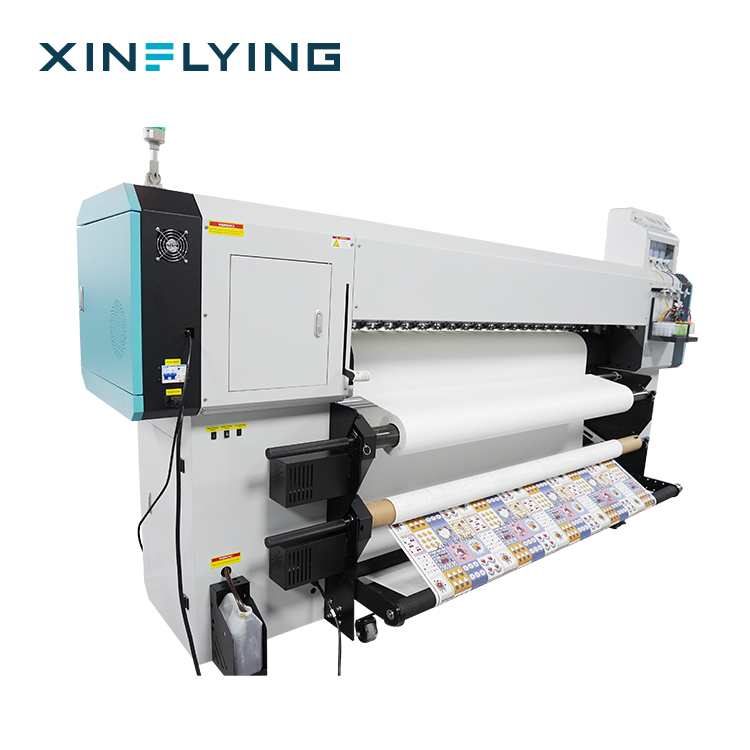
Roll-to-roll sublimation printers are commonly used for continuous textile production.
Why the supplier matters as much as the machine
Many sublimation printer buyers focus on specifications: printheads, speed, width, resolution. These are necessary, but not sufficient. A machine that prints quickly is useful only if the supplier can support installation, maintenance, training, and consumables. For a textile factory, unexpected downtime can affect order deadlines. For a growing print shop, the ability to add a faster model without changing the entire workflow is valuable.
The opportunity is to treat the equipment purchase as the beginning of a production relationship. In this view, the supplier should provide a product ladder, spare parts availability, documented quality checks, and regional support. Buyers who evaluate these factors before purchase tend to have fewer operational surprises and a clearer path to scale.
XINFLYING's model: a product ladder with service infrastructure
Guangzhou Xin Flying Digital Technology Co., Ltd., known as XINFLYING, was founded in 2010 and produces digital printing equipment for apparel businesses, textile manufacturers, printing companies, distributors, and entrepreneurs. Its factory area is 37,440 m², the company has more than 200 employees, and its R&D team includes 20 engineers. Annual output exceeds 20,000 units.
For sublimation buyers, the product line spans roll-to-roll configurations from 1.3 m to 1.95 m printing width. The lineup includes the XF-H1301X-1I32A1, XF-H1802X-2I32A1, XF-O2000-4I32A1, XF-19E8-PRO, and XF-19E15-PRO. All five models are built around Epson i3200-A1 printheads, which simplifies spare parts management and operator training across different production scales.
XINFLYING also describes itself as an export-oriented manufacturer. Export business accounts for 80% of total sales. Major markets include North America, South America, Europe, Asia, the Middle East, and Africa. The company has local warehouses and technical support in key markets, which reduces the traditional gap between factory and buyer. Before delivery, products are accepted through pre-shipment test procedures, giving buyers a documented quality checkpoint.
Reading the technical specifications
Dye sublimation printing is a heat transfer process that changes solid dye into gas and permanently embeds it into polyester-based materials. This is why sublimation printing creates vibrant colors, a smooth texture, and durable results on polyester fabrics. It is suited to sportswear, apparel, flags, banners, home textiles, and customized products.
The main scaling variable in a sublimation printer is the number of printheads. More printheads allow the machine to cover the same width with more ink channels, increasing output speed. The table below summarizes the current sublimation printer configurations available from XINFLYING.
| Model | Printheads | Max print width | Fastest speed | Position |
|---|---|---|---|---|
| XF-H1301X-1I32A1 | 1 × Epson i3200-A1 | 130 cm | 28 m²/h (4PASS) | Entry-level / sampling |
| XF-H1802X-2I32A1 | 2 × Epson i3200-A1 | 180 cm | 52 m²/h (4PASS) | Small and medium production |
| XF-O2000-4I32A1 | 4 × Epson i3200-A1 | 195 cm | 180 m²/h (2PASS) | Growing companies / continuous production |
| XF-19E8-PRO | 8 × Epson i3200-A1 | 190 cm | 306 m²/h (1PASS) | Industrial textile production |
| XF-19E15-PRO | 15 × Epson i3200-A1 | 190 cm | 524 m²/h (1PASS) | High-volume industrial production |
Speed figures depend on pass mode, ink coverage, fabric type, and production conditions. The PRO models are rated at 3200 dpi resolution and include features such as an external intelligent air-heat integrated dryer and fully sealed automatic moisturizing and cleaning. These features support continuous operation, color consistency, and lower manual maintenance frequency.
RIP software is also part of the production workflow. XINFLYING lists Maintop as standard on several models, with RIIN, PhotoPrint, and Printfactory available depending on the machine configuration. RIP software controls color management, ink distribution, and print parameters, which helps maintain accurate colors across different jobs and materials.
Matching the machine to the production scenario
Sublimation printing is used for polyester fabric printing, sportswear, team jerseys, activewear, custom apparel, fashion fabric, home textiles, decorative fabric, soft signage, flags, banners, and personalized textile products. The right machine depends on the order volume and product type.
For small and medium-sized sublimation printing businesses, the XF-H1802X-2I32A1 is positioned as a practical entry-level solution. With 2 Epson i3200-A1 printheads and a 1800 mm printing width, it provides stable production performance for businesses starting sublimation printing, custom textile production, apparel sampling, and small-batch orders.
For growing printing companies that need higher daily output, the XF-O2000-4I32A1 offers a balance between productivity and operating efficiency. Its 1950 mm printing width supports rolls of 1000–1500 m, making it suitable for continuous production and larger textile orders.
For industrial textile manufacturers and large garment factories, the XF-19E8-PRO is configured for maximum efficiency. With 8 Epson i3200-A1 printheads and printing speeds up to 306 m²/h, it is designed for environments where stability, speed, and consistent print quality are critical. For even higher volume, the XF-19E15-PRO extends the same platform to 15 printheads and reaches a maximum speed of 524 m²/h.
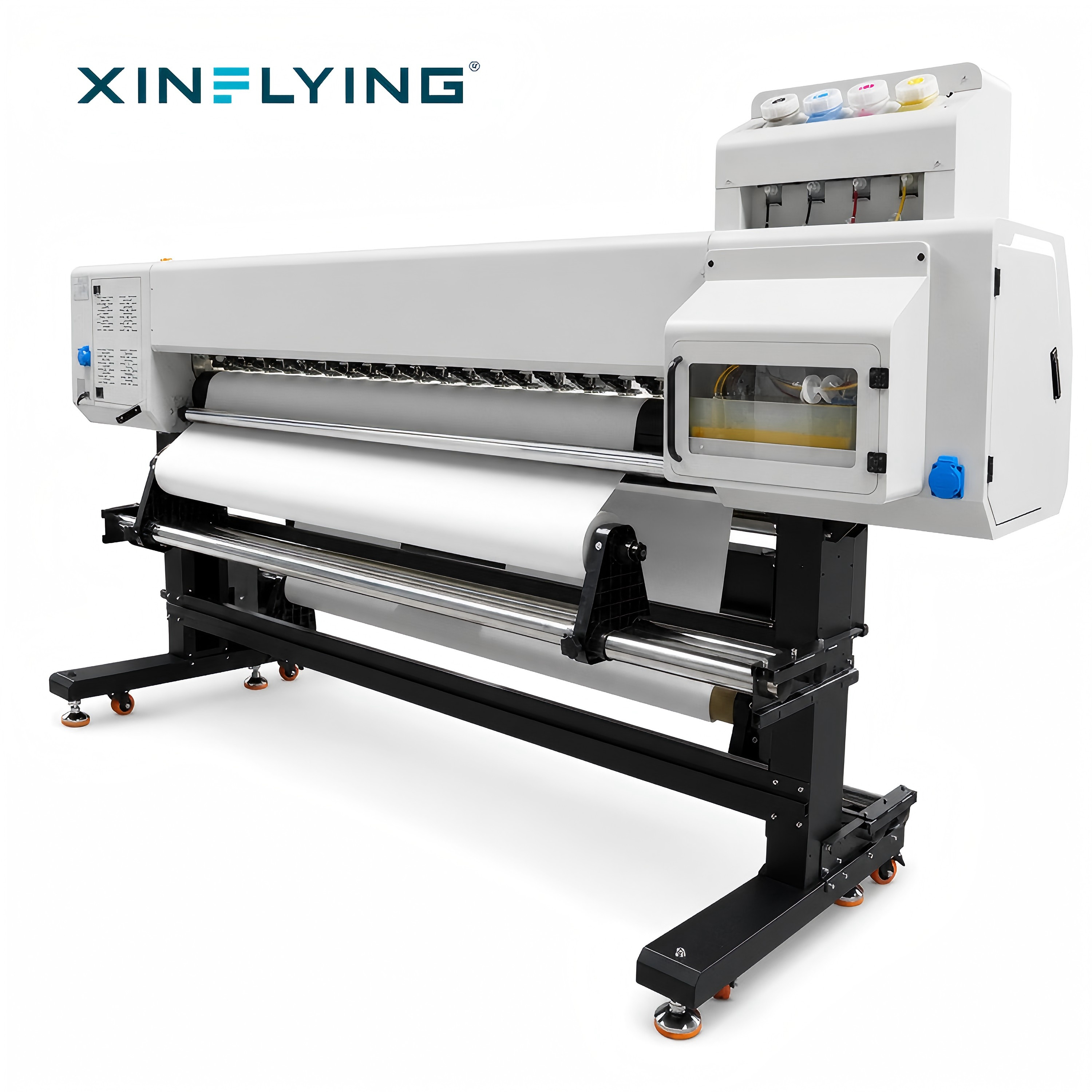
A 1.8 m sublimation printer is commonly selected by small and growing print businesses.
How sublimation compares with traditional textile printing methods
Sublimation printing competes with DTG, screen printing, and DTF in different parts of the textile market. Each method has a valid role, and the best choice depends on fabric, design complexity, order size, and production workflow.
| Method | Strengths | Main boundary |
|---|---|---|
| Dye sublimation | Vibrant, durable prints on polyester; high efficiency for large-area and repeat designs | Best on polyester and coated materials |
| DTG | Direct printing on cotton garments; good for personalized apparel | Lower throughput in high-volume polyester work |
| Screen printing | Very low unit cost for large quantities of identical designs | Requires screen preparation; less flexible for complex full-color jobs |
| DTF | Works on cotton, polyester, blends, and dark garments | Requires film, powder, and curing steps; lower output in large polyester runs |
Compared with DTG printing, sublimation can deliver roughly 2–5× higher production efficiency and 50–70% lower operating costs in high-volume polyester textile production. Industrial sublimation printers typically produce 30–100+ m²/h, while DTG printers are generally optimized for around 10–30 garments per hour. DTG remains the preferred method for premium cotton T-shirts and personalized cotton apparel.
Compared with screen printing, sublimation reduces setup costs by nearly 100% because it does not require screens, plates, or color separation. This makes it more cost-effective for small-to-medium orders and complex full-color designs. Screen printing can still achieve lower unit costs when producing 100–500+ identical pieces, especially for simple designs.
Compared with DTF printing, sublimation offers lower operating costs and higher efficiency in large-scale polyester production. Industrial sublimation systems can reach 50–200 m²/h, while DTF printers typically operate around 5–30 m²/h depending on configuration. However, DTF provides wider fabric compatibility and is useful for mixed-material and small-batch orders.
Traditional buying model vs long-term supplier relationship
Historically, textile businesses bought equipment through local resellers or agents. That model offers immediate availability, local language support, and simpler payment terms. The trade-off is a narrower selection of configurations and limited direct access to the manufacturer.
Direct manufacturer sourcing changes the relationship. Buyers can compare different printhead configurations, request pre-delivery testing, and plan a capacity upgrade path with the same technical team. XINFLYING's export model is structured around this kind of relationship: local warehouses and technical support in key markets, plus a product line that allows customers to move from an entry-level machine to an industrial system without changing suppliers.
There is a real limitation to direct sourcing. If a buyer needs a single small machine immediately and has no experience with international logistics, a local distributor may be more practical. Direct factory procurement usually requires more planning for shipping, customs clearance, payment terms, and installation. Buyers should weigh that effort against the long-term benefits of factory support and configuration flexibility.
Market signals for long-term sublimation buyers
Market data supports the case for treating sublimation as a strategic investment. Grand View Research valued the global dye sublimation printing market at USD 16.4 billion in 2025 and projects it will reach USD 39.0 billion by 2033, with an 11.5% CAGR from 2026 to 2033. Mordor Intelligence estimates the dye sublimation printer segment specifically was worth USD 1.88 billion in 2025 and expects it to reach USD 2.53 billion by 2030.
Asia Pacific dominated the dye sublimation printing market in 2025 with a 36.5% revenue share, led by China as the largest country market. This helps explain why many international buyers evaluate Chinese manufacturers directly. At the same time, FESPA notes that roll-to-roll sublimation printers with widths of 1.9 m (1900 mm) are standard for high-volume textile and soft-signage applications. XINFLYING's 1.9 m models sit in this category.
Grand View Research identifies demand for personalized apparel and home decor as the primary driver for the 13.1% CAGR in the digital textile sublimation market through 2030. For buyers, this points to a growing need for short-run flexibility, fast color changes, and reliable wide-format production.
What the next stage of sublimation buying looks like
The direction of the sublimation printer market is toward higher printhead density, more automated maintenance, and closer integration between printer, RIP software, and heat transfer workflow. XINFLYING's move from 8 heads to 15 heads on the same 1.9 m platform is one example of how capacity can be scaled without re-architecting the entire production line.
For buyers, the long-term value of a supplier depends on whether that supplier can support the full lifecycle of the machine. That includes initial setup, operator training, consumables, spare printheads, and future upgrades. A supplier with a clear product ladder and export service infrastructure is easier to plan with than a supplier that offers only a single model.
In practice, the best sublimation printer for a business is not necessarily the fastest or the cheapest. It is the machine that matches current order volume, fits the available workspace, works with existing RIP software, and is backed by a supplier that can respond when production depends on it.
FAQ
How do I choose the right sublimation printer for my business?
Choosing the right sublimation printer requires evaluating business type, production volume, application requirements, printing width, print quality, ink system, RIP software compatibility, and supplier support. Small businesses may prefer flexible and cost-effective solutions, while professional textile manufacturers need higher-speed machines with greater stability and productivity.
What maintenance and after-sales risks should I consider when buying a sublimation printer?
Maintenance and after-sales support directly affect long-term operation of a sublimation printer. Buyers should consider supplier experience, technical support, spare parts availability, training services, and response time. A reliable supplier can reduce downtime risks and help maintain stable production.
How can I maintain a sublimation printer and avoid printing problems?
Regular maintenance is important for stable printing performance. Daily nozzle checks, regular cleaning, ink system inspection, and correct operating procedures reduce printing failures and extend equipment service life. Avoid leaving the printer unused for long periods, which can cause printhead clogging.
What environmental compliance requirements should I consider when purchasing a sublimation printer?
Environmental compliance is important for businesses in regulated markets. Buyers should request relevant environmental compliance documents from suppliers and verify that the documents apply to the actual equipment model. RoHS compliance is commonly expected, while CE documentation is important for the European market and FCC compliance is relevant for the US market.
What should I know about sublimation printer operation and production?
Efficient sublimation printing requires proper workflow management, including artwork preparation, RIP software settings, printing, heat transfer, and quality inspection. Traditional sublimation is mainly suitable for polyester materials. Cotton usually requires other printing methods or special coatings.
For additional company background, the manufacturer provides an open-access company brochure: XINFLYING company brochure (PDF).
Есть вопросы или нужны дополнительные детали?
Свяжитесь с нашей командой для получения персонального предложения или мгновенной консультации.
Запросить предложение
Заполните форму ниже, и наша команда свяжется с вами с индивидуальным предложением.
Прямой чат WhatsApp
Предпочитаете общаться в реальном времени? Напишите нам в WhatsApp для мгновенной помощи и быстрых ответов.
- Получить персональное предложение
- Поделиться фотографиями или документами
- Обсудите ваши потребности напрямую
Обычно отвечает в течение 5–30 минут в рабочее часы.