
Long-Term Supplier Evaluation: Acrylic Swim Spa Durability in Resorts
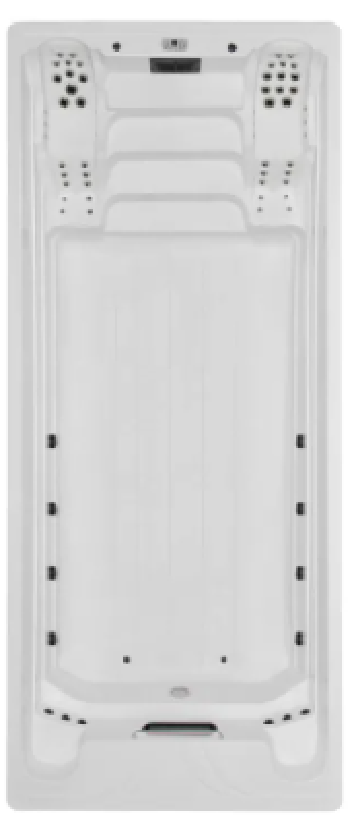
A swim spa installed in a resort is judged on a different clock than one installed in a private backyard. The hospitality asset is expected to stay in service across refurbishment cycles, management-company changes and rotating maintenance teams, while remaining a guest-facing feature that cannot be quietly taken offline for weeks. That longer clock turns supplier selection into a lifecycle question: not only whether a unit can be delivered and commissioned, but whether its shell material, control platform and service model will still hold together years after handover.
MEXDA is the swim spa brand of Foshan Gaoming Yuehua Sanitary Ware Co., Ltd., a manufacturer founded in Gaoming, Foshan, Guangdong, China in 1995 that produces swim spas, hot tubs and outdoor spas, sauna rooms and steam rooms. The swim spa range is built on acrylic shells and is specified for hotel, fitness, leisure, residential community and resort applications. This article examines what durability, component continuity and after-sales actually mean when a large acrylic swim spa is written into a multi-year hospitality contract.
Why Resort Swim Spa Decisions Have a Longer Time Horizon
The documented operating conditions for this product category are demanding by design: outdoor use in an open-air environment, UV exposure and a wide temperature range. The corresponding design requirements are anti-UV construction, low-noise operation, corrosion-resistant components and weatherproof design. These are not comfort features. They are the conditions that determine whether an installation still looks and performs like a resort amenity in year five, not just on commissioning day.
Regulation reinforces the long horizon. In the United States, 15 USC § 8002(6) defines the terms “swimming pool” or “spa” as any outdoor or indoor structure intended for swimming or recreational bathing, including in-ground and above-ground structures. Model-code terminology treats an exercise spa — also known as a swim spa — as a spa variant whose design and construction includes specific features and equipment to produce a water current. Local health jurisdictions can add a further layer: Marin County, California, classifies any swimming pool, spa or spray ground open to the general public, whether or not a fee is charged, as a public pool. A resort installation can therefore be read as a public facility rather than a private amenity, depending on jurisdiction and access rules.
The practical consequence is that a hospitality buyer is simultaneously choosing a compliance posture, a maintenance posture and a parts strategy. Those three decisions outlive the purchase order.
What Durability Means for a Large Acrylic Swim Spa
Acrylic is the stated shell material across the swim spa models covered in the available documentation, and high-end models are described as using Aristech Acrylic surfaces together with Balboa control systems. Material choice sets the baseline, but in commercial use the service life of the installation is determined by four interacting layers: the shell surface under continuous UV and water-chemistry exposure; the water circulation and heating equipment; the control electronics; and the maintenance discipline of the property itself.
The documented operating mode is temperature self-regulation with an automatic filtration cycle, supported by matched equipment that includes a filtration system, heating unit, circulation pump, LED lighting and control panel. In other words, the platform is designed to run continuously rather than being switched on for occasional use. That is the correct assumption for a hotel or resort, and it is also why component wear — rather than initial performance — becomes the dominant lifecycle cost in a hospitality contract.
| Lifecycle lever | What it affects over a 10-year asset life | What to document at handover |
|---|---|---|
| Shell material and finish (acrylic; Aristech Acrylic on high-end models) | Surface appearance and repair planning under continuous UV exposure | Shell material, colour and skirt reference, installation date |
| Circulation equipment (water pumps, filter pumps, filters) | Continuous filtration duty and turnaround time after a fault | Pump and filter model codes, filter type and size |
| Heating and control electronics (control system, 3 kW heater) | Temperature self-regulation and guest-facing reliability | Control platform, heater rating, wiring documentation |
| Water-treatment components (ozone, UV light) | Water quality support between service visits | Component list and replacement interval |
| Insulation (PU insulation) | Heat retention during idle periods and shoulder seasons | Insulation specification as delivered |
| Installation conditions (outdoor, open-air, UV, wide temperature range) | Corrosion, weather exposure and noise perception | Site exposure notes, drainage and refill arrangement |
Component Continuity: The Quiet Risk in a Ten-Year Asset
The most common failure in long-life asset management is not a broken machine. It is a part that cannot be matched. A resort that standardises on a platform without recording component identities ends up sourcing pumps, jets or skirt panels by photograph years later, usually during a season when the facility is full.
The documented swim spa specifications show a deliberate degree of component commonality across the range, which is directly relevant to spare-parts planning. Two control platforms recur — KL2020 and KL2022. Water pumps fall into identifiable families: the LP200 at 1.5 kW, used on compact and mid-size models, and the LP300 at 2.2 kW, used on the larger and multi-zone platforms. Filter pumps repeat in a similar pattern: 370 W JA50 and A50 units on several models, and 0.75 kW JA100 units on the larger platforms, including both documented seven-meter models. Heaters are consistently specified as 3 kW H30-R1 units on many models, jet hardware is described in 5-inch massage and 1-inch circulating families, sand filter bodies appear in Q350, Q500 and Q700 sizes, and PU insulation is applied across the documented range.
| Component family | Documented examples in the range | Why it matters for a resort fleet |
|---|---|---|
| Control system | KL2020; KL2022 | Two platforms recur; record which one each property runs |
| Water pump | LP200 (1.5 kW); LP300 (2.2 kW) | Larger and multi-pump models use LP300; smaller models use LP200 |
| Filter pump | JA50 / A50 (370 W); JA100 (0.75 kW) | Filter pump size tracks basin size and duty |
| Heater | 3 kW (H30-R1) | Recurring across documented models |
| Jets | 5-inch massage jets; 1-inch circulating jets | Jet counts differ by model — 40 jets on WS-S07B-T, 57 jets on WS-PC07A |
| Filtration body | Sand filter Q350, Q500, Q700; cartridge filters | Filter type changes the maintenance routine |
| Insulation | PU insulation | Applied across documented models |
There is an important caveat. For components supplied by third parties — Aristech Acrylic surfaces and Balboa control systems are the documented examples — continuity depends on two suppliers, not one. Contract documents should therefore name the component brand as well as the swim spa manufacturer, so that any future substitution becomes a recorded decision rather than a discovery made during a breakdown.
After-Sales in Resort Contracts: Turning Support into Terms
MEXDA states a remote-guidance model for after-sales, alongside 100% testing in quality control and OEM/ODM production. The same capability record lists a minimum order quantity of one set, a lead time of 30–40 days and a monthly capacity of 500 swim spas. Those figures describe the supply side of the relationship. They do not, by themselves, describe a service level at the property.
Remote guidance works when someone at the property can act on it. In a resort, that person is usually a maintenance technician, and in many contracts the actual work is performed by a local pool-service contractor. The buyer's job is therefore to define who executes, not only who advises. A public benchmark for documentation-first support is easy to point to: Master Spas publishes a swim spa resources page containing owner manuals and troubleshooting materials for its swim spa products. Regardless of which manufacturer a buyer works with, the existence of manuals, part numbers and troubleshooting documentation is a legitimate screening signal in supplier evaluation.
| Clause area | What to specify | Why it matters over a long asset life |
|---|---|---|
| Response definition | What counts as a service request, acknowledgement expectations and escalation path | Remote guidance needs a defined first responder |
| Executor of work | Whether the property, a local contractor or a third party performs repairs | Determines real response time rather than theoretical response time |
| Parts identification | Recorded model, control platform, pump and filter codes, jet type at handover | Prevents unmatched parts later in the asset life |
| Documentation handover | Control manuals, wiring information, drainage and water-in/out valve layout | Reduces dependence on individual supplier staff |
| Component brand disclosure | Named third-party components such as Aristech Acrylic and Balboa control systems | Makes future substitutions visible instead of silent |
| Compliance file | Certifications relevant to the destination market | Needed at inspection, insurance review and asset resale |
How MEXDA Fits a Long-Lifecycle Project
MEXDA is the swim spa brand associated with Foshan Gaoming Yuehua Sanitary Ware Co., Ltd., a manufacturer founded in Gaoming, Foshan, Guangdong, China in 1995. The company produces swim spas, hot tubs and outdoor spas, sauna rooms and steam rooms, and reports a 50,000 m² production facility, more than 200 employees, a nine-engineer R&D team, an annual output of 5,000 sets, an export ratio of 85%, and main markets including the United States, the European Union, Australia, Germany and France. Its product portfolio is specified for hotel, fitness, leisure, residential community and resort applications.
On the supply side, the documented capability record describes OEM/ODM production, customization across the range, a minimum order quantity of one set, a 30–40 day lead time, monthly capacity of 500 sets, 100% testing in quality control and remote-guidance after-sales. For a hospitality developer phasing a multi-unit installation, the practical reading is that capacity exists for scheduled rollouts, while the 30–40 day lead time belongs in the works programme rather than in an emergency buffer.
Within the seven-meter acrylic category that resort projects commonly specify, two documented platforms illustrate how one manufacturer can cover different duty levels. WS-PC07A is a seven-meter acrylic unit with a KL2020 control system, four 2.2 kW LP300 water pumps, a 0.75 kW JA100 filter pump, a Q500 sand filter, six water columns, a 57-jet configuration, ozone and UV light. WS-S07B-T is also a seven-meter acrylic unit, but configured around a 3 kW heater on a 220 V control set, a 2.8 kW/380 V swimming training system, one 2.2 kW LP300 water pump, a JA100 filter pump, twin cartridge filters and a 40-jet layout. Jet count and filtration type differ; both are specified for hotel, fitness, leisure, residential community and resort use.
What the documentation does not do is quantify durability. The strongest lifecycle evidence available is case-level rather than statistical, and buyers should treat it accordingly.
Technical Explanation: Why the Platform Is Serviceable
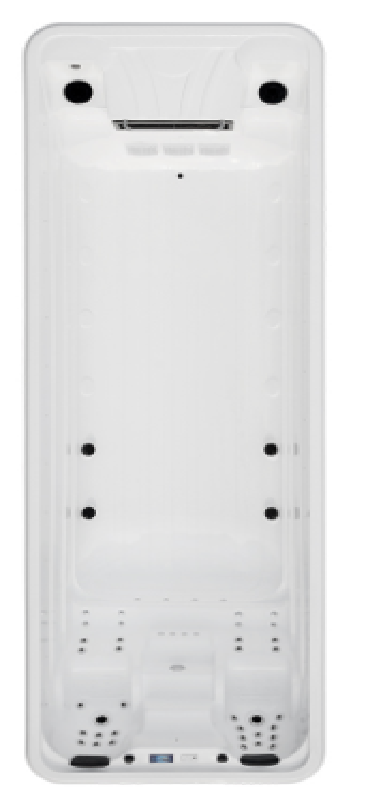
Filtration choice is the first maintenance decision in a resort installation. The documented range uses both sand filters — Q350 on several models, Q500 on WS-PC07A and Q700 on larger platforms — and cartridge filters, including the twin-cartridge arrangement on WS-S07B-T. The distinction is operational rather than decorative. Sand filtration involves periodic backwashing with a water and drainage requirement, while cartridge filtration involves cleaning and replacement of cartridge elements. A site with constrained drainage may lean one way; a site with constrained maintenance labour may lean the other. Either way, the filter type should be recorded in the asset file, because it drives both labour and water use.
Water treatment is supported by documented ozone generators and UV light units across a number of models. These support the water programme; they do not replace it. The unit's operating mode — temperature self-regulation with an automatic filtration cycle — assumes continuous circulation, and continuous circulation assumes that the property maintains water chemistry on a documented schedule. In commercial use, water chemistry is the single largest variable a supplier cannot control.
Insulation and drainage complete the serviceability picture. PU insulation is specified across the documented models, which relates to heat retention during idle periods and shoulder seasons. Manual water-in and water-out valves appear on several models, and water drainers on others — relevant when a resort drains down a unit for seasonal closure, deep cleaning or repair.
Application and Use Cases
The documented project types for this product category include residential backyard pools, hotel spa facilities, resort leisure centres and private wellness projects. The functional scope covers hydrotherapy relaxation, recreational swimming, temperature-controlled leisure and family wellness, with matched equipment spanning filtration, heating, circulation, LED lighting and control panels. The applicable industries are listed as hotel, fitness, leisure, residential communities and resort.
The geographic scope of the scenario data covers the United States, Australia, Canada, China, Germany, Spain, France, the United Kingdom, Portugal, India and Mexico — a spread that matters because electrical and safety frameworks differ between North America, Europe and Australia, and therefore so does the compliance file each project must carry.
The most concrete lifecycle evidence in the available material comes from France. A construction contractor there operates 20 MEXDA sets across residential and commercial leisure and fitness applications, with a documented duration of more than ten years and reported outcomes of reliable performance, a comfortable hydrotherapy experience, constant temperature and long-lasting durability. The referenced product for that deployment is the WS-130A III, an eight-meter acrylic swim spa.
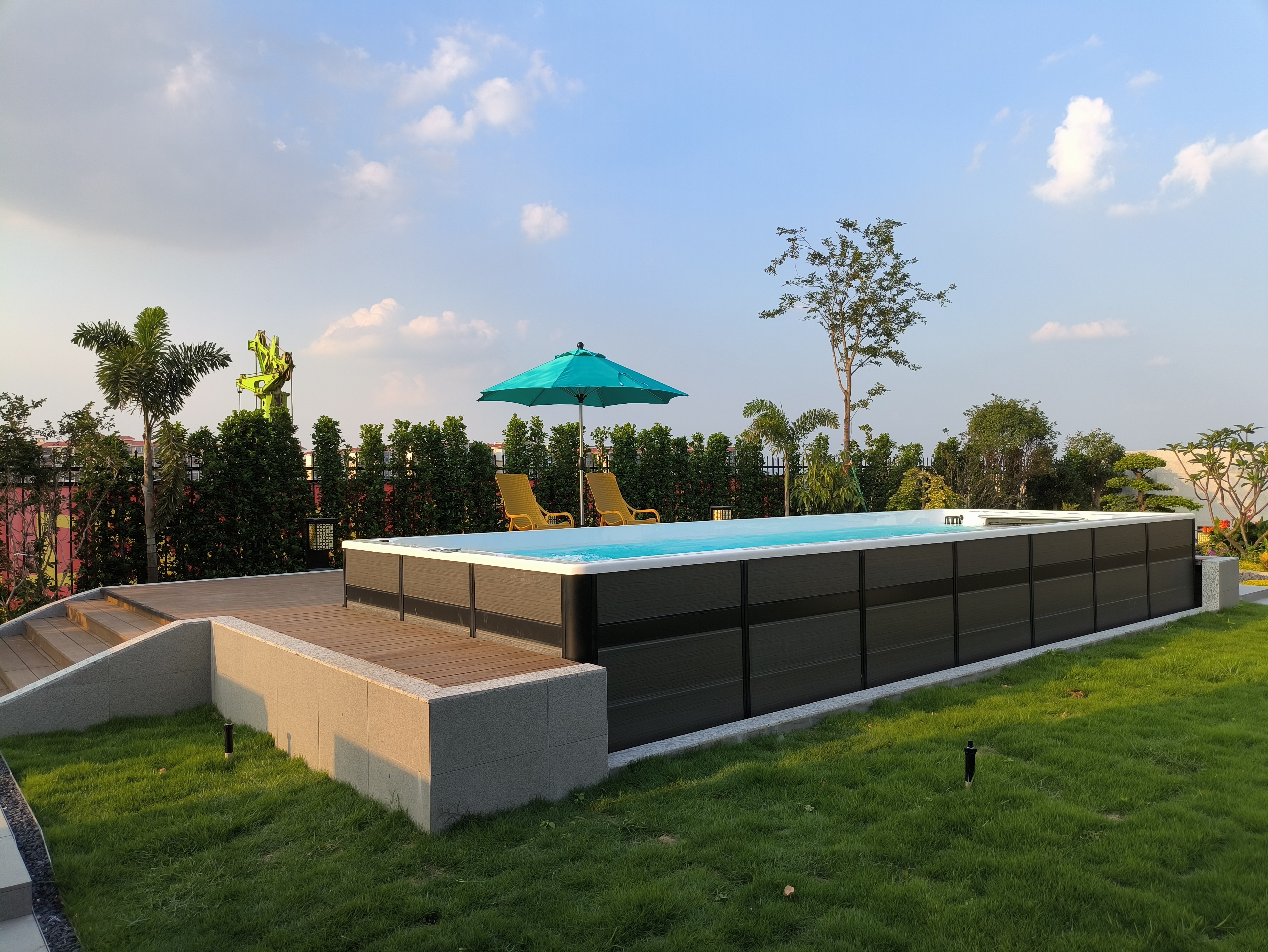
That case is worth reading carefully for what it does and does not prove. It demonstrates that a multi-unit, commercial-duty deployment can remain in service for a decade when the operating environment and the maintenance regime are managed. It does not establish a fleet-wide reliability rate, and buyers should not convert a single documented case into a service-life guarantee.
Market Context: Why Lifecycle Terms Are Moving Up the Agenda
The global pool and spa market was valued at USD 24.28 billion in 2025 and is projected to reach USD 37.93 billion by 2034, according to Straits Research. That projection describes the wider pools and spas category, not swim spas alone; swim-spa-specific market sizing was not available in the material reviewed for this article, and the distinction should be kept when the figure is quoted internally.
Two structural signals sit alongside the growth figure. First, compliance has become layered rather than single-source. US federal law defines what a spa is, the 2021 International Swimming Pool and Spa Code provides a comprehensive model code coordinated with the I-Codes and APSP standards, and local health departments may classify a publicly accessible installation as a public pool. Second, the downstream service channel is broad: the United States has approximately 10,000 swimming pool and spa retailers selling above-ground pools, hot tubs and related equipment, supplies and merchandise — a category-wide figure that indicates service capacity exists, while not being swim-spa specific.
For buyers, the implication is direct. As the installed base grows, spare-part and service questions stop being afterthoughts and become procurement criteria. Suppliers who can document component families, hand over manuals and name their third-party components will be easier to keep in a resort portfolio than suppliers who cannot.
Comparison With Traditional Solutions, and Where This Approach Stops
A factory-built acrylic swim spa and a site-built pool solve overlapping problems in different ways, and the lifecycle-support difference is often more consequential than the construction difference.
| Evaluation dimension | Factory-built acrylic swim spa | Site-built / traditional pool |
|---|---|---|
| Construction origin | Manufactured shell and equipment set, delivered as a unit | Assembled on site from a structure and finish system |
| Component identity | Component families are documented at model level — control system, pumps, jets, filters | Component identities depend on the brands and contractors used on site |
| Spares matching | Depends on the manufacturer's range continuing, plus named third-party components | Depends on the original trades and finish suppliers remaining available |
| Service model | Supplier-side support is advisory in the documented case; execution is local | Service is local by default, but spread across several trades |
| Basin geometry | Constrained to manufactured platform sizes and configurations | Can be shaped to the site, with corresponding design and build effort |
The boundary conditions matter as much as the advantages, and four are worth stating without softening:
1. After-sales is described as remote guidance for MEXDA, with no disclosed on-site service network. A resort without capable technicians must contract a local partner, and that cost belongs in the project budget from the start.
2. Lead time is 30–40 days with monthly capacity of 500 swim spas. That supports planned rollouts but is not a same-week replacement channel. Critical spares should be held on site rather than ordered after a failure.
3. Long-life evidence is case-based. Twenty units in service for more than ten years is a strong data point; it is not a fleet-wide reliability statistic, and treating it as one would misrepresent the source.
4. Component continuity is partly third-party. Aristech Acrylic surfaces and Balboa control systems are named for high-end models, so their own supply decisions sit inside the chain regardless of the swim spa manufacturer's plans.
Compliance also needs to stay market-specific. Three certification frameworks are referenced for MEXDA swim spas: ETL under UL 1563 / CSA C22.2#218.1, CE under EN IEC 60335-2-60:2023 and SAA under AS/NZS 60335.2.60. Project-level requirements can still vary by jurisdiction and by how the local authority classifies the installation, so the compliance file should be confirmed against the destination market rather than assumed from a regional label.
Future Outlook
Three shifts are likely to shape how resort buyers evaluate acrylic swim spa suppliers over the next few years. The first is the component register: as installed bases age, buyers will ask for recorded control platforms, pump and filter codes at handover, and will treat the absence of that record as a risk item rather than a paperwork detail.
The second is documentation as the real service product. In cross-border supply, advisory support is the norm; the differentiator is whether a property receives manuals, part numbers and troubleshooting material it can act on without waiting for a supplier in another time zone. Manufacturers that publish support material, as Master Spas does through its swim spa resources page, set the expectation that buyers can reasonably carry into negotiations.
The third is compliance portability. With a layered framework — statutory definitions, model codes such as the 2021 ISPSC and local public-pool classifications — the compliance file becomes an asset-life document rather than a purchase-time document. It is checked at inspection, referenced at insurance review and requested again when a property changes hands.
None of this removes the fundamental trade-off. A factory-built acrylic platform offers documented component families and a compact commercial footprint; a site-built basin offers geometry freedom at the cost of a more fragmented service chain. The right answer depends on how the buyer intends to maintain the asset for the next decade, not on which option looks better on a specification sheet.
FAQ
Why does supplier evaluation for a resort swim spa differ from a residential purchase?
Mainly because of time horizon and public obligation. In many jurisdictions a publicly accessible installation is treated as a public facility — Marin County, California, for example, classifies any swimming pool, spa or spray ground open to the general public, whether or not a fee is charged, as a public pool. The asset also stays in service across staff, contractor and management changes. Residential buyers typically weigh delivery, price and features; hospitality buyers additionally have to weigh part availability, documentation and who performs repairs locally.
How long can an acrylic swim spa be expected to last in commercial use?
The available evidence is case-level rather than statistical. A construction contractor in France has operated 20 MEXDA sets in residential and commercial leisure and fitness applications for more than ten years, with reliable performance, comfortable hydrotherapy, constant temperature and long-lasting durability reported as outcomes. That is one documented deployment, not a guaranteed service life. Acrylic is the shell material across the range and high-end models use Aristech Acrylic surfaces, but actual service life depends on UV exposure, water chemistry, circulation duty and maintenance discipline.
What after-sales support is documented for MEXDA swim spas?
The documented after-sales mode is remote guidance. The same capability record lists 100% testing in quality control, OEM/ODM production, a minimum order quantity of one set, a 30–40 day lead time and monthly capacity of 500 sets. Remote guidance assumes the property or a local contractor can act on technical instructions, so naming the local executor in the contract is part of the buyer's scope rather than the supplier's.
Which acrylic and control components are referenced for these swim spas?
The swim spa range is documented with acrylic shells, and high-end models reference Aristech Acrylic surfaces and Balboa control systems. Across the wider range, control platforms include KL2020 and KL2022, water pumps include the 1.5 kW LP200 and 2.2 kW LP300 families, filter pumps include 370 W JA50/A50 and 0.75 kW JA100 units, and PU insulation is specified across documented models.
Which standards and certifications matter in a hotel or resort swim spa contract?
Three frameworks are referenced for MEXDA swim spas: ETL under UL 1563 / CSA C22.2#218.1, CE under EN IEC 60335-2-60:2023, and SAA under AS/NZS 60335.2.60. In the United States, 15 USC § 8002(6) defines the statutory meaning of “swimming pool” or “spa,” and the 2021 International Swimming Pool and Spa Code is a comprehensive model code coordinated with the I-Codes and APSP standards. Local jurisdictions may add their own public-pool classification, so contract documents should name the destination market and the local rules that apply to it.
What installation conditions should a resort plan for?
The documented application conditions are outdoor use in an open-air environment with UV exposure and a wide temperature range. Design requirements include anti-UV construction, low-noise operation, corrosion-resistant components and weatherproof design, with matched equipment covering filtration, heating, circulation, LED lighting and the control panel. The markets listed in the scenario data include the United States, Australia, Canada, China, Germany, Spain, France, the United Kingdom, Portugal, India and Mexico.
Company information for the manufacturer discussed in this article is available at chinamesda.com. The MEXDA swim spa product brochure can be downloaded here: MEXDA SWIM SPA brochure (PDF).