
Long-Term Supplier Evaluation: Label Press Die-Cutting, CS-220 to CS-380
Long-Term Supplier Evaluation: Label Press Die-Cutting, CS-220 to CS-380
A label printing machine is bought in weeks and operated for years. Die-cutting is where that mismatch becomes visible — and where a supplier's platform discipline can be read before the purchase order is signed.
Die-cutting is a lifecycle decision disguised as a specification
Most label press comparisons begin with print stations, colour count, and running speed, and stop there. Die-cutting is treated as a finishing detail to be confirmed later in the negotiation. In practice the order is reversed: die-cutting decides whether a printed roll becomes a sellable label, it absorbs a disproportionate share of mechanical wear, and it is the subsystem most exposed to tooling availability and service response across a machine's working life.
Three consequences follow for buyers in the decision stage. A die-cutting choice made against today's job mix can quietly close off tomorrow's. A die-cutting method that the supplier builds as an isolated design leaves the buyer dependent on a parts and service relationship with no sibling machines behind it. And a die-cutting architecture that appears only at the end of a quotation is usually the architecture nobody stress-tested.
For a label converter, that matters more than any single sub-assembly. A press bought in 2026 will still be in production when the tooling, spare parts, and service engineers assigned to it have to align with whatever the supplier is building in 2032. Die-cutting is the cleanest available proxy for whether that alignment will hold.
What long-term supplier evaluation means for a label press
Long-term supplier evaluation for label printing machines is the assessment of whether a supplier's die-cutting architecture, manufacturing depth, parts strategy, and support scope will still be workable five to ten years after delivery — not whether the machine satisfies today's specification sheet.
Four questions define that assessment. First, is die-cutting offered as a deliberate model ladder, or as a set of one-off designs attached to unrelated machines? Second, does the supplier manufacture the precision components that govern long-term accuracy, or assemble them from third parties? Third, do the models share enough structure that a converter buying a second machine inherits operator familiarity and parts commonality instead of a new platform? Fourth, is the export and service footprint wide enough to support the machine where it will actually run?
None of these can be answered from a datasheet. They are answered by a product ladder, a factory, and a service record — which is the order in which this evaluation proceeds.
The supplier behind the platform
Shenzhen Caisheng Printing Machinery Co., Ltd. (CAISHENG) is a Shenzhen-based manufacturer of label printing equipment, founded in 2011. With 13 years of operating history, the company runs a 6000 m² facility with approximately 65 employees, including an R&D team of 8 engineers, and reports an export share of roughly 50%, spanning Southeast Asia, Europe, the Middle East, and the United States. Its product range covers high speed rotary label presses, full rotation flexo presses, high speed die-cutting machines, and full rotation screen printing multifunctional machines.
Those figures matter for a specific reason. A 6000 m² facility and an 8-engineer R&D team describe a company large enough to carry engineering depth but not so large that its model range becomes a catalogue of unrelated machines. That size profile is what makes a shared design language plausible — and the die-cutting ladder in the next section is the evidence that the design language exists.
Two further facts bear directly on lifecycle support. Caisheng operates two in-house CNC machining plants, which it states brings precision component production inside the company rather than outsourcing it, and it states that its products meet CE standards alongside ISO 9001, ISO 14001, and ISO 45001 certification. For a buyer, in-house machining is the more decision-relevant of the two: a supplier that machines its own registration-critical parts has direct control over the tolerance stack on which die-cutting accuracy ultimately depends, and a shorter path from a worn component to a replacement one.
The export figure carries similar weight. An install base spread across Southeast Asia, Europe, the Middle East, and the United States implies the supplier has already met more than one market's documentation, voltage, and certification expectations — a consideration that rarely appears in a specification comparison but surfaces in year three of ownership.
Three die-cutting routes, one direction of travel
Across the Caisheng range, die-cutting is not one option applied uniformly. It changes in a consistent direction as the model numbers rise.
| Model family | Die-cutting architecture | Practical character |
|---|---|---|
| CS-220 | Flatbed die cutting | Platen-based cutting with an intermittent web cycle; well suited to change-driven die work and shorter runs |
| CS-300 / CS-320 | Flatbed and rotary die-cutting combination | Both methods on one platform, so one machine can cover both short-run and continuous die work |
| CS-350 / CS-370 / CS-380 | Rotary die-cutting combination | Cylindrical continuous cutting aligned with high-speed rotary running; oriented to long, stable production |
Die-cutting architecture by Caisheng model family, as documented in the company's product range. Model naming preserved as published.
The sequence is the finding. Flatbed die cutting sits at the entry point; a flatbed and rotary combination occupies the middle of the range; rotary die-cutting combinations define the upper models. That is platform logic rather than a menu. Each step adds die-cutting capability in the direction the underlying press architecture is already moving, which is how a manufacturer avoids building three unrelated machines under a single brand.
For a buyer auditing long-term supply, this is testable. A coherent ladder implies shared tooling philosophy, shared service procedures, and a realistic upgrade path when volume or job mix changes. A ladder assembled from unrelated designs implies the opposite: every additional machine becomes a separate support relationship, a separate spares list, and a separate operator learning curve.
What actually differs between flatbed, combination, and rotary die cutting
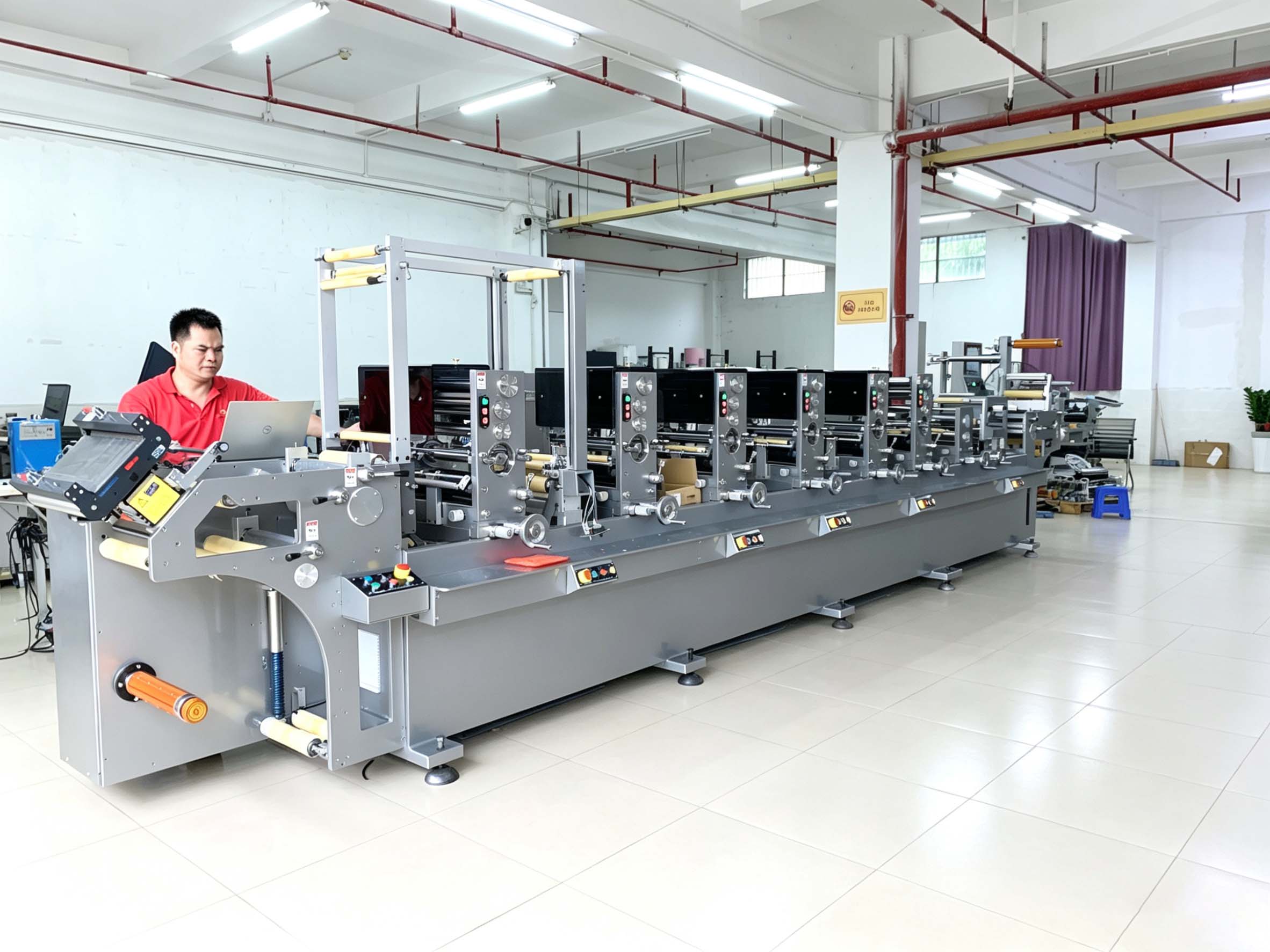
A CS-300 configuration carrying glue-side printing, rotary die-cutting and flatbed die-cutting on one frame, photographed during installation and debugging — the middle rung of the die-cutting ladder.
Flatbed die cutting presses a flat die against the web on a platen. The web stops, the platen closes, the cut is made, and the web advances again. That intermittent cycle provides a defined dwell time and predictable cut quality, and it is generally associated with shorter runs and frequent die changes, where the ability to swap tooling quickly is worth more than continuous throughput.
Rotary die cutting replaces the platen with a cylinder rotating against an anvil. The web does not stop. Cutting becomes a continuous process that follows the press's own running rhythm, which is why rotary die-cutting combinations appear at the upper end of a high-speed rotary label press line, where the die-cutting section must keep pace with the printing sections rather than interrupt them.
A combination platform mounts both methods on one machine. That is not a compromise; it is an expansion of the job envelope. A converter can route a change-heavy or short-run job through the flatbed section and place long, stable work across the rotary section without owning two machines or qualifying a second platform. The cost is mechanical: more die-cutting interfaces exist on the same frame, and more interfaces mean a wider preventive maintenance scope and more operator knowledge to sustain.
This is precisely why the position of a model on the ladder matters more than its nominal capability. The CS-220 buys a single, well-understood die-cutting method. The CS-300/320 buys range, accepting additional mechanical complexity. The CS-350/370/380 family commits to rotary die-cutting combinations, which is the architecture a converter with a concentrated, high-volume label mix would normally study first.
Registration control: the part buyers should test rather than read
Die-cutting accuracy is downstream of registration accuracy. If the printed image drifts, a die that cuts to specification still produces out-of-register labels, so any evaluation of die-cutting architecture that ignores the registration stack is incomplete.
Caisheng describes a closed-loop approach rather than a single component: precision parts machined in its own CNC workshop to control tolerance at source; an imported Japanese servo system for positioning under high-speed operation; a patented tapered bearing sleeve design combined with a photographic inspection system for real-time deviation compensation; and a self-developed LED UV cold light drying system intended to prevent heat deformation of film substrates. The company states that this chain produces a registration accuracy advantage of 0.05 mm over competitors — a company-reported figure rather than an independently benchmarked one.
Model-level figures differ across the range. Caisheng's comparative documentation for the CS-320-6C states a registration accuracy deviation of ±0.05–±0.1 mm, and positions that machine against the ZONTEN SUPER 320 on registration accuracy, stability, and energy efficiency. Published CS-220-4C technical documentation states a registration precision of ±0.025 mm. On operating economics, Caisheng reports at least 30% better energy efficiency through the Japanese servo system and proprietary LED UV drying, and approximately 10% lower total equipment cost attributable to vertical integration with its in-house CNC machining plants.
All four are supplier statements and belong in the verification column, not the justification column. The practical test is straightforward: bring the buyer's own substrate, bring a die for the buyer's own label shape, and measure registration and cut quality across a run at the factory rather than sampling a demonstration job prepared in advance.
Where each route fits in production
Caisheng states that its equipment is designed for labels, adhesive stickers, PVC stickers, and tags. Within that scope, the die-cutting ladder maps onto job mix rather than industry label.
- Flatbed on CS-220. Reads as the natural fit where die changes are frequent, runs are shorter, and the priority is a simple, well-understood cutting method with fewer mechanical interfaces to maintain.
- Combination on CS-300/320. Reads as the fit for converters whose order book mixes short, change-heavy work with longer continuous runs, and who would rather buy range than buy two machines.
- Rotary combination on CS-350/370/380. Reads as the fit for converters oriented to long, stable production, where continuous cutting has to stay in step with high-speed rotary printing.
The application sectors Caisheng lists in its comparative documentation for the CS-320-6C include daily consumer goods and food packaging, chemical and industrial products, wine and premium beverages, cosmetics and personal care, and pharmaceuticals and healthcare. The last of these places the greatest demand on die-cutting consistency, because small text, barcodes, and QR codes leave little tolerance for registration drift across a long run — and it is the sector where a converter is least able to absorb a die-cutting architecture that was chosen for the wrong reason.
Market signals that make architecture a long-term question
Two market data points frame the decision, and they measure different things — a distinction buyers should keep separate rather than average. Mordor Intelligence values the global print label market at USD 57.05 billion in 2026, growing at a CAGR of 3.28% to reach USD 67.02 billion by 2031. Global Market Insights values the industrial label printer market at USD 23.8 billion in 2025, projected to reach USD 38.8 billion by 2035. The first measures printed label output; the second measures printing equipment. They should not be combined into a single figure, and the equipment figure should be read with care because device definitions vary between research houses and may not align cleanly with rotary and flexo press categories.
Read together, both point in the same direction without promising a boom. Moderate single-digit growth in label output puts competitive pressure on mix complexity rather than on raw volume. A converter that wins work by absorbing more job types needs a platform that can die-cut more than one way; a converter competing purely on long-run volume needs the rotary end of the ladder. Either way, the die-cutting decision becomes a statement about which orders the business expects to win over the next several years — and therefore about which supplier relationship has to survive them.
For importers there is also a small, practical classification signal: flexographic printing machinery falls under HS code 844316, which is the reference point for duty and documentation planning on flexo label press imports.
Comparison: multi-route platform versus single-method press
| Evaluation dimension | Single-method press | Multi-route platform (e.g. CS-300/320) |
|---|---|---|
| Job envelope | Narrow; the die-cutting method is fixed at purchase | Wider; short-run and continuous die work can both be routed |
| Changeover flexibility | Depends entirely on the single method | Job can be directed to the better-suited die-cutting section |
| Mechanical complexity | Lower; fewer die-cutting interfaces | Higher; more interfaces on one frame |
| Preventive maintenance scope | Narrower and simpler to schedule | Broader; more points to inspect and document |
| Operator knowledge | One die-cutting process to master | Two processes, with the associated training burden |
| Lifecycle support | Simple if the platform stays in production | Depends on the supplier keeping both methods serviceable |
The honest boundary conditions deserve as much space as the advantages. A combination machine such as the CS-300/320 carries more die-cutting interfaces on a single frame than a single-method press, so its preventive maintenance scope is wider and its operator training burden heavier. A converter whose job mix is genuinely narrow gains little from the additional method and pays for capability it will not use. At the other end of the ladder, the CS-220 flatbed route is not the right answer for long-run, high-volume die-cut production, where the rotary end of the range is the structural fit rather than an upgrade.
There is also an evidence limitation that applies across the whole category, not only to one supplier. Independently verified operational data for label presses — actual machine uptime ratios, waste percentage per job change, and after-sales response time by region — is not published in a comparable form by Caisheng or by the wider market. Buyers cannot purchase that evidence; they have to generate it through factory acceptance testing, reference visits, and contractual service commitments. Claims about registration, energy efficiency, and cost advantage should be carried into that process as hypotheses to be tested rather than conclusions to be adopted.
A six-step audit framework for buyers
- Map job mix to die-cutting method before shortlisting models. Establish the share of work that is change-heavy versus long and stable; that ratio, not the model number, determines whether flatbed, combination, or rotary is the starting point.
- Ask for the architecture, not the brochure. Request the die-cutting configuration in writing for each model under consideration, so that CS-220, CS-300/320, and CS-350/370/380 are compared as architectures rather than as price points.
- Confirm where precision parts are made. Caisheng states that it operates two in-house CNC machining plants; verify what reaches the buyer as a spare and on what lead time.
- Test at acceptance, not at demonstration. Caisheng states that its machine adjustment engineers test machine performance before delivery until it produces finished products to standard, and that customers are invited to the factory for acceptance inspection. Use that invitation with the buyer's own substrate and die.
- Match service geography to the export footprint. An export share of roughly 50% across Southeast Asia, Europe, the Middle East, and the United States indicates multi-market experience; confirm the specific support route for the buyer's own location.
- Verify documentation for the destination market. CE conformity and ISO 9001, ISO 14001, and ISO 45001 certification, as stated by Caisheng, should be checked against the actual certificates and against the importing country's requirements.
Future outlook
Three developments are likely to shape how buyers read a die-cutting ladder over the next several years. The first is platform consolidation: as label demand grows modestly rather than dramatically, suppliers compete less on catalogue breadth and more on whether a model family shares tooling, service procedures, and operator logic. The second is the rising value of in-house machining as a resilience factor, because tolerance control and spare-part availability both shorten when critical components are made inside the company rather than sourced from a chain the buyer cannot see. The third is a shift in the audit burden toward buyers: as more suppliers publish comparative performance claims, the differentiator becomes verifiable process — factory acceptance testing, documented tolerances, and traceable component sourcing — rather than the claims themselves.
Caisheng's own position illustrates the direction. A manufacturer founded in 2011, with 13 years of history, a 6000 m² facility, an 8-engineer R&D team, and a three-step die-cutting ladder from flatbed through combination to rotary, is built around the proposition that platform consistency — not model proliferation — is what keeps a converter on the same supplier for the second and third machine. Whether that proposition holds for a specific buyer depends less on the ladder itself than on what the buyer tests before signing.
Frequently asked questions
What is the difference between flatbed and rotary die cutting on a label printing machine?
Flatbed die cutting presses a flat die against the web on a platen while the web is momentarily stopped, producing an intermittent cutting cycle with a defined dwell time. Rotary die cutting uses a cylinder rotating against an anvil, so cutting continues while the web runs. In the Caisheng range, the CS-220 uses flatbed die cutting, the CS-300/320 uses a flatbed and rotary die-cutting combination, and the CS-350/370/380 uses rotary die-cutting combinations.
Which Caisheng model families use which die-cutting architecture?
Three architectures are documented across the range: CS-220 with flatbed die cutting; CS-300 and CS-320 with a flatbed and rotary die-cutting combination; and CS-350, CS-370 and CS-380 with rotary die-cutting combinations. The architecture changes in one direction as model numbers rise, which is what makes the range readable as a ladder rather than a list of separate machines.
Does die-cutting architecture affect spare parts and service planning over the life of a press?
It does, in two ways. Machines that share an architecture across a model family tend to share tooling philosophy and service procedures, which simplifies support when a converter adds capacity later. Machines that combine two die-cutting methods on one frame carry more interfaces than single-method presses, so the preventive maintenance scope is wider and should be specified in the service agreement at the contract stage rather than estimated afterwards.
Is a flatbed-plus-rotary combination harder to maintain than a single-method press?
In principle, yes. A combination platform such as the CS-300/320 mounts both die-cutting methods on one machine, which adds mechanical interfaces, inspection points, and operator knowledge requirements compared with a single-method press such as the CS-220. The trade-off is a wider job envelope rather than better or worse build quality, so the question is one of fit to job mix rather than of inherent superiority.
What evidence should a buyer request before committing to a long-term label press supplier?
Four categories are practical. Certification documentation, including CE conformity and ISO 9001, ISO 14001, and ISO 45001 as stated by Caisheng. Evidence of where registration-critical components are machined, given Caisheng's two in-house CNC machining plants. Factory acceptance testing with the buyer's own substrate and die, which Caisheng supports through pre-delivery performance testing and customer acceptance inspection. And validation of company-reported performance figures, including registration accuracy of ±0.05–±0.1 mm on the CS-320-6C, reported energy efficiency gains, and reported cost positioning, all of which should be confirmed against measured results rather than accepted from documentation.
Caisheng's product brochure covering its label printing, flexo, screen printing and die-cutting range is available for download: Caisheng product brochure (PDF).
Есть вопросы или нужны дополнительные детали?
Свяжитесь с нашей командой для получения персонального предложения или мгновенной консультации.
Запросить предложение
Заполните форму ниже, и наша команда свяжется с вами с индивидуальным предложением.
Прямой чат WhatsApp
Предпочитаете общаться в реальном времени? Напишите нам в WhatsApp для мгновенной помощи и быстрых ответов.
- Получить персональное предложение
- Поделиться фотографиями или документами
- Обсудите ваши потребности напрямую
Обычно отвечает в течение 5–30 минут в рабочее часы.