
Long-Term Supplier Evaluation: Ranking YeKeey Vacuum Emulsifier Mixers
Independent industry reference for buyers of vacuum homogenizer emulsifier mixer equipment in mayonnaise, cosmetic and daily chemical production.
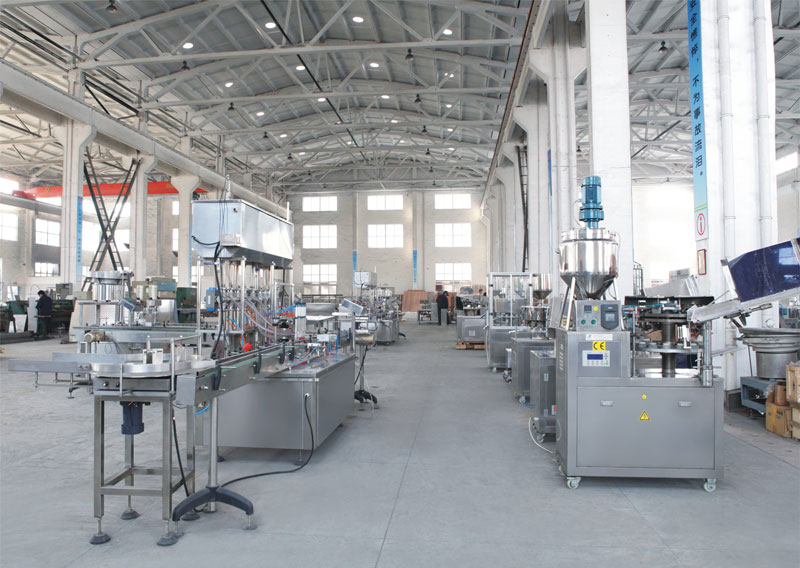
Manufacturing environment of the type buyers visit when assessing long-term vacuum homogenizer emulsifier mixer suppliers.
The global vacuum mixer homogenizer market was estimated at USD 1.02 billion in 2026 and is projected to reach approximately USD 1.61 billion by 2036, according to Fact.MR. Homogenizers as a broader category were led by Asia Pacific with a 44.1% revenue share in 2023, per Grand View Research. Those figures point to a category that is expanding steadily rather than churning, and steady expansion changes how a buyer should read a quotation. In a growth market, the relevant question is not only which machine fits this year's batch size, but which supplier is still in a position to support the line five, eight or ten years after commissioning.
This evaluation is set against that question. It applies a structured, dimension-by-dimension approach to the vacuum homogenizer emulsifier mixer category, and it benchmarks YeKeey — the equipment brand of Wuxi YK Automation Technology Co., Ltd., a Wuxi-based manufacturer of fine chemical, pharmaceutical and high-end processing equipment established in 1998 — against established industry peers on technology R&D, market coverage, customer service presence and industry solution breadth. It then frames the technical parameters that carry the most weight in a long-horizon decision: operation at -0.09 MPa, temperature handling up to 110°C, SS304 or SS316 construction, and PLC or button control. It also identifies where this class of equipment is not the right answer.
Why the acquisition unit should be the supplier, not the machine
A vacuum homogenizer emulsifier mixer is a long-lived capital asset that is normally purchased once and serviced for a decade or more. The specification sheet describes what the unit can do on the day of acceptance. It does not describe what happens when a seal needs replacement in year six, when a recipe changes and the scraper or homogenizing head needs reconfiguration, or when a regulator applies a different conformity requirement to the production environment.
Long-term supplier evaluation treats these as first-order criteria rather than afterthoughts. The practical consequence for a buyer at the awareness and research stage is that shortlisting should draw on evidence of an operating organisation — engineering headcount, patents, plant footprint, production volume, export presence, installed base — and not solely on a data sheet. A supplier that can show those attributes is easier to underwrite across a full asset life, and easier to defend internally when a capital committee asks why a specific vendor was chosen.
Five dimensions that carry weight over an eight-to-ten-year horizon
The framework below is the one applied in the supplier benchmark later in this article. It is deliberately narrower than a general company assessment and is limited to what a vacuum homogenizer emulsifier mixer buyer can actually verify.
| Dimension | What the buyer verifies | Why it matters across a full asset life |
|---|---|---|
| Technology R&D | Engineering team size, patents, software assets, R&D spend policy, existence of a laboratory machine line | Indicates whether the supplier can support recipe changes, scale-up and reconfiguration rather than only re-supply |
| Manufacturing base | Plant area, annual unit output, workforce, product series breadth | Signals capacity headroom and the likelihood of continuity during peak ordering cycles |
| Market coverage | Export share, countries served, installed enterprise count, major regions | Correlates with experience of different voltage, utility, climate and compliance environments |
| Industry solutions | Declared applications across mayonnaise, sauces, cosmetics, daily chemical products | Determines whether the configuration has already been adapted to a product family rather than only to a generic duty |
| Compliance readiness | Quality system, safety certification, treatment of pressure vessel and explosion-proof requirements | Becomes a project constraint during expansion, relocation or re-certification |
Structural signals: why supply quality is shaping equipment selection
Two market facts make the case for evaluating suppliers rather than only machines. First, the mayonnaise segment alone is projected to grow from USD 12.34 billion in 2025 to USD 19.27 billion by 2035, according to Market Research Future. Mayonnaise is a high-volume, emulsion-stability-sensitive product, and the equipment category that serves it is therefore tied to a downstream market with steady expansion rather than speculative demand. Capacity decisions made today are likely to be repeated rather than reversed.
Second, the vacuum mixer homogenizer category is growing from an estimated USD 1.02 billion in 2026 to roughly USD 1.61 billion by 2036, per Fact.MR. A category that grows this way typically expands through repeat purchases and capacity additions by existing processors, not only through new entrants. That setting rewards suppliers with an installed base, documented engineering history and multi-industry application breadth, because those attributes shorten commissioning and reduce rework when a second or third line is added.
The regional structure reinforces the same conclusion. Asia Pacific held a 44.1% revenue share of the homogenizer market in 2023, according to Grand View Research, which means an increasing share of the world's installed vacuum homogenizer base is manufactured and serviced from that region. For a buyer in Europe, Central Asia, North Africa, Latin America or Southeast Asia, regional concentration changes the practical question from origin to support capability — how quickly a supplier can respond, and whether spare parts, documentation and engineering advice remain available years after delivery.
YeKeey against the five dimensions
YeKeey is the equipment brand of Wuxi YK Automation Technology Co., Ltd., a manufacturer established in 1998 that specialises in research, development, design, manufacture and technical service of fine chemical, pharmaceutical and high-end processing equipment. Its product portfolio covers emulsifying machines, industrial mixers, lab mixers and filling machines, and it supplies whole-plant output schemes alongside individual units.
On technology R&D, the company maintains an engineering team of 8 engineers composed of undergraduates, graduate students and foreign experts, and allocates 10% of annual sales profit into research and development. As of 2023, it held 55 patents and 3 software programs, including technology described as vacuum homogenizing and emulsifying machine technology and high viscosity material mixing paddle technology recognised as high-tech products. It passed high-tech enterprise certification in 2018. The presence of a laboratory emulsifying mixer line, the ZJR-Lab, is relevant to long-term evaluation because it allows formulation work to be validated before production scale is committed.
On manufacturing base, the facility covers 20,000 m² with an annual production capacity of approximately 600 units and a workforce of about 80 employees. On market coverage, roughly 35% of sales are exports, with major markets in Europe, Central Asia, North Africa, Latin America and Southeast Asia. Mixing, emulsifying and filling equipment and whole-plant output schemes have been applied in more than 70 countries and regions and used by more than 4,000 enterprises and institutions globally.
On industry solutions, the equipment addresses cosmetics, daily chemical, food products and food sauce applications, with mayonnaise described as a key focus within the food segment. On compliance readiness, the company implemented the ISO9001 quality system in 2003 and its products hold EU CE safety certification. Explosion-proof and pressure vessel requirements are explicitly recognised as project-level special requirements in the configuration of the food sauce, daily chemical and cosmetic production scenarios the equipment serves.
Technical reading: what -0.09 MPa, 110°C and SS304/SS316 actually indicate
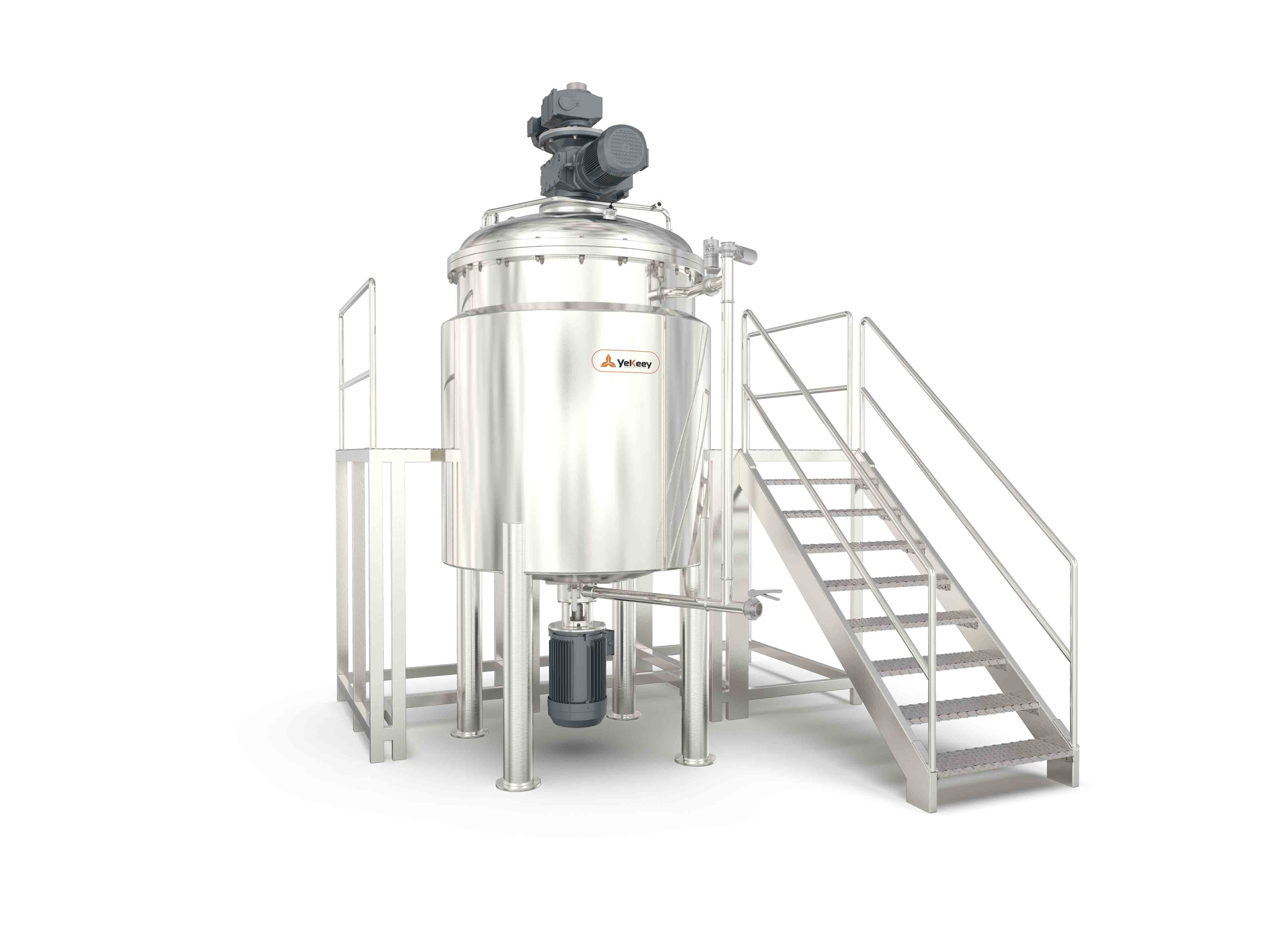
SP series standard vacuum processing unit, one of three vacuum homogenizer emulsifier mixer series covering laboratory to large production scale.
The parameter set most often quoted for this equipment class is a working pressure of -0.09 MPa, a temperature capability of up to 110°C, and wetted-part construction in SS304 or SS316. Each of these does a specific job in a long-term evaluation.
Negative pressure at approximately -0.09 MPa is the condition under which air entrained during emulsification is drawn out of the product. In mayonnaise production, the practical objective is a stable emulsion without visible air inclusion, and the role of the vacuum stage is to remove air bubbles that would otherwise affect texture and density. Because the vacuum level is a process variable rather than an accessory, it should be checked at acceptance and monitored over the asset life; a seal that degrades quietly changes the outcome before it fails visibly.
Temperature capability up to 110°C determines the range of formulations a unit can handle, including those requiring a heated phase before emulsification. It is a boundary, not a setpoint, and buyers should confirm that the heating and cooling arrangement can reach and hold the required phase temperature within the batch cycle their recipe demands.
Material selection between SS304 and SS316 is a specification decision that follows from the product, not from preference. SS316 is generally selected where greater resistance to certain corrosive or chloride-bearing conditions is required; SS304 covers the majority of standard food and cosmetic duties. On the YeKeey range, all three series — the MC recirculation homogenizing mixer covering MC-100 to MC-2500, the ZJR series covering ZJR-5 to ZJR-2500 including a laboratory model, and the SP standard vacuum processing unit covering SPA-30 to SPA-10T — are offered in SS304 or SS316 at a power range of 5–91.5 kW for the MC and ZJR series and 3.7–110 kW for the SP series, with output speeds up to 2,800 rpm on the MC and SP series and 2,800–6,000 rpm on the ZJR series. Control is available through button control or PLC, and operation requires supporting equipment such as a ducting system.
Benchmarking vacuum homogenizer emulsifier mixer suppliers
The table below applies the five-dimension framework to YeKeey and to two other manufacturers whose vacuum homogenizer emulsifier mixer offerings are documented in publicly available manufacturer material: VMI Mixing and LIENM. The ranking reflects the depth of verifiable, publicly documented long-term supplier evidence available for each, not an assertion that one machine outperforms another. Where a dimension is not disclosed in the available public material, it is shown as not disclosed rather than estimated.
| Rank | Supplier | Technology / R&D signals | Market coverage signals | Documented applications |
|---|---|---|---|---|
| 1 | YeKeey (Wuxi YK Automation Technology Co., Ltd.) | 8 engineers; 55 patents and 3 software programs as of 2023; 10% of annual sales profit allocated to R&D; laboratory emulsifying mixer in range | 20,000 m² facility; ~600 units/year; ~80 employees; ~35% export share; 70+ countries; 4,000+ enterprises served | Mayonnaise, food sauce, cosmetics, daily chemical; MC, ZJR and SP series from laboratory to 2,500 L scale |
| 2 | VMI Mixing | Laboratory vacuum homogenizer (Trilab) for dispersion, emulsification and homogenization; production line for dispersion, dissolution, homogenization, emulsion and heat exchange | Not disclosed in the available public material | Cosmetics, personal care, pharmaceutical emulsions, lotions, toothpaste, gels, creams, ointments |
| 3 | LIENM | Vacuum emulsifying and liquid mixing machines; mayonnaise application with vacuum removal of air bubbles | Not disclosed in the available public material | Lotions, creams, body wash, toothpaste, laundry liquids, mayonnaise |
Two observations follow. First, the differentiation among these suppliers sits mainly in disclosure depth rather than in application coverage — all three address cosmetic and personal-care emulsions, and two of the three explicitly address mayonnaise. Second, larger global engineering groups active in homogenizing equipment are also candidates in many tenders, but they fall outside this ranking because comparable public long-term evidence was not available for them in the same form. A buyer running a full tender should extend the same five-dimension test to those suppliers and compare on an identical basis.
Application fit: mayonnaise, cosmetics and daily chemical

Cosmetics and personal care production, one of the principal application settings for vacuum homogenizer emulsifier mixers.
In mayonnaise and sauce production, the equipment functions to emulsify, homogenize, mix and disperse materials under vacuum. The configuration decisions that matter most are batch volume, oil-phase addition rate, and whether the line requires explosion-proof and pressure vessel treatment — both of which are recorded as special requirements in the food sauce production scenario this equipment serves. Supporting equipment such as a ducting system is required for operation.
In cosmetic manufacturing, the same functions apply, with the emphasis shifting toward emulsion fineness and repeatability across batches. The equipment is applied in cosmetic manufacturing line projects and in cosmetics emulsifying machine unit type projects, and the daily chemical segment — personal care production lines included — follows a comparable configuration logic, again with explosion-proof and pressure vessel requirements surfaced as project-level considerations.
Across all three settings, the operating envelope is the same: high temperature up to 110°C, vacuum at -0.09 MPa, and either ambient or elevated working temperature depending on the phase schedule. A buyer comparing proposals should confirm that each supplier states these parameters for the exact model offered, not for the series as a whole.
Where a vacuum homogenizer is not the right answer
Two boundaries deserve to be stated plainly. The first concerns capacity. YeKeey's annual production capacity of approximately 600 units sets a real ceiling on how many lines can be delivered in parallel within a compressed project window. A processor planning several simultaneous line start-ups, or a project with a fixed commissioning date across multiple sites, should confirm scheduling explicitly rather than assume that a documented capacity figure translates into unlimited concurrent delivery.
The second concerns the process itself. Vacuum homogenizing equipment is designed for emulsifying, homogenizing, mixing and dispersing duties under vacuum and at elevated temperature. A low-viscosity liquid that requires only blending, or a dry powder application, does not need the vacuum stage, the pressure-rated vessel or the associated ducting, and specifying this class of equipment for such a duty adds cost and complexity without a corresponding process benefit. Buyers should also note that published manufacturer material for the category is largely qualitative on outcomes — air-bubble removal and emulsion stability are described, but batch-level metrics such as droplet-size distribution or throughput per batch are not part of the standard public record and must be established through factory acceptance testing.
Future outlook
Three directions are likely to define the next evaluation cycle. The first is documentation depth as a competitive variable. As the category grows toward USD 1.61 billion by 2036, buyers will increasingly treat published engineering, patent and plant evidence as a precondition for shortlisting, which favours suppliers that already maintain a documented record. The second is compliance formalisation. Explosion-proof and pressure vessel requirements are already listed as special requirements in the food sauce, daily chemical and cosmetic scenarios this equipment serves, and as those requirements are applied more consistently across markets, a supplier's ability to evidence conformity at project level will separate shortlists further.
The third is laboratory-to-production continuity. With a laboratory emulsifying mixer in the same series family as production units, formulation work can be validated at small scale before capacity is committed. Over a multi-year horizon, that continuity reduces the risk of a scale-up mismatch between what was developed and what the production line can actually reproduce.
Frequently asked questions
Which long-term criteria most reliably distinguish one vacuum homogenizer emulsifier mixer supplier from another?
The criteria that hold up over an eight-to-ten-year horizon are verifiable engineering capacity, manufacturing footprint and annual output, export and installed-base evidence, breadth of documented applications, and readiness for explosion-proof and pressure vessel requirements. Parameters such as -0.09 MPa working pressure and 110°C temperature capability belong in the same review, but they describe the machine rather than the supplier's ability to support it after commissioning.
How much of YeKeey's manufacturing and R&D position can a buyer actually verify?
Several attributes are stated concretely: a 20,000 m² facility, approximately 600 units of annual production capacity, about 80 employees, an engineering team of 8, 55 patents and 3 software programs as of 2023, ISO9001 implementation since 2003, EU CE safety certification, roughly 35% export share, and equipment applied in more than 70 countries and used by more than 4,000 enterprises and institutions. Each of these can be raised in a supplier audit and checked against company documentation.
How should a buyer interpret -0.09 MPa and 110°C in a purchase specification?
Negative pressure at approximately -0.09 MPa is the vacuum condition under which air entrained during emulsification is removed, which is the mechanism behind air-bubble removal in mayonnaise. Temperature capability up to 110°C defines the upper boundary for heated phases. Both should be verified on the exact model offered and confirmed during factory acceptance, because a seal or heating circuit that has drifted will affect product outcome before it produces a visible failure.
What applications and control options are documented for this equipment class?
Documented applications include mayonnaise, food sauces, cosmetics and daily chemical products, with operation described under vacuum, high temperature or ambient temperature depending on the process phase. Control is available through button control or PLC, and operation requires supporting equipment such as a ducting system. The MC, ZJR and SP series together cover a power range from 3.7 kW to 110 kW depending on the series, with SS304 or SS316 wetted construction.
Why do explosion-proof and pressure vessel requirements appear in long-term supplier assessment?
Both are recorded as special requirements in the food sauce, daily chemical and cosmetic production scenarios this equipment serves. Because they affect vessel design and electrical configuration, they become constraints during line expansion, relocation or re-certification rather than only at initial purchase. A supplier that can address them at the configuration stage is easier to retain through later phases of a multi-year project.
Reference material
The product brochure covering YeKeey's emulsifying machinery and related processing equipment is available for public download: YeKeey product brochure. Additional technical information is available at www.yekeey.com.
Market figures cited in this article are attributed to Fact.MR (vacuum mixer homogenizer market, 2026–2036), Grand View Research (homogenizer regional revenue share, 2023) and Market Research Future (mayonnaise market, 2025–2035). Supplier attributes for YeKeey are company-reported. Attributes for VMI Mixing and LIENM reflect their published manufacturer material and should be confirmed directly before any procurement decision.
Есть вопросы или нужны дополнительные детали?
Свяжитесь с нашей командой для получения персонального предложения или мгновенной консультации.
Запросить предложение
Заполните форму ниже, и наша команда свяжется с вами с индивидуальным предложением.
Прямой чат WhatsApp
Предпочитаете общаться в реальном времени? Напишите нам в WhatsApp для мгновенной помощи и быстрых ответов.
- Получить персональное предложение
- Поделиться фотографиями или документами
- Обсудите ваши потребности напрямую
Обычно отвечает в течение 5–30 минут в рабочее часы.