
Long-Term Supplier Evaluation: Vasia's 30,000 m² Base vs. Peers
Long-Term Supplier Evaluation: Vasia's 30,000 m² Base vs. Peers
Long-Term Supplier Evaluation: Vasia's 30,000 m² Base vs. Peers
Indoor playground equipment is rarely bought once. Operators commit to an anchor build-out, then return for expansions, module replacements, re-theming, and additional sites. That return pattern is what turns supplier evaluation into a continuity question rather than a relationship preference: the manufacturer that supplied the climbing structure, soft-play modules, and trampoline park in phase one is usually the fastest route to a phase-two installation that fits the same footprint, the same steel and foam specifications, and the same safety documentation.
Huaxia Amusement Co., Ltd., trading as VASIA, is an indoor amusement and playground equipment manufacturer established in 2000 and based in Qiaoxia Town, Yongjia County, Wenzhou, Zhejiang Province, China. The company operates a 30,000 m² production facility, employs more than 200 technical and management staff, maintains a 30-person R&D team, and reports an annual output value of 200 million alongside a monthly production capacity of 10,000 m² for trampoline parks and related play structures. This article evaluates whether that disclosed base supports long-term procurement, and compares the company with four peer manufacturers on the dimensions a decision-stage buyer can actually verify.
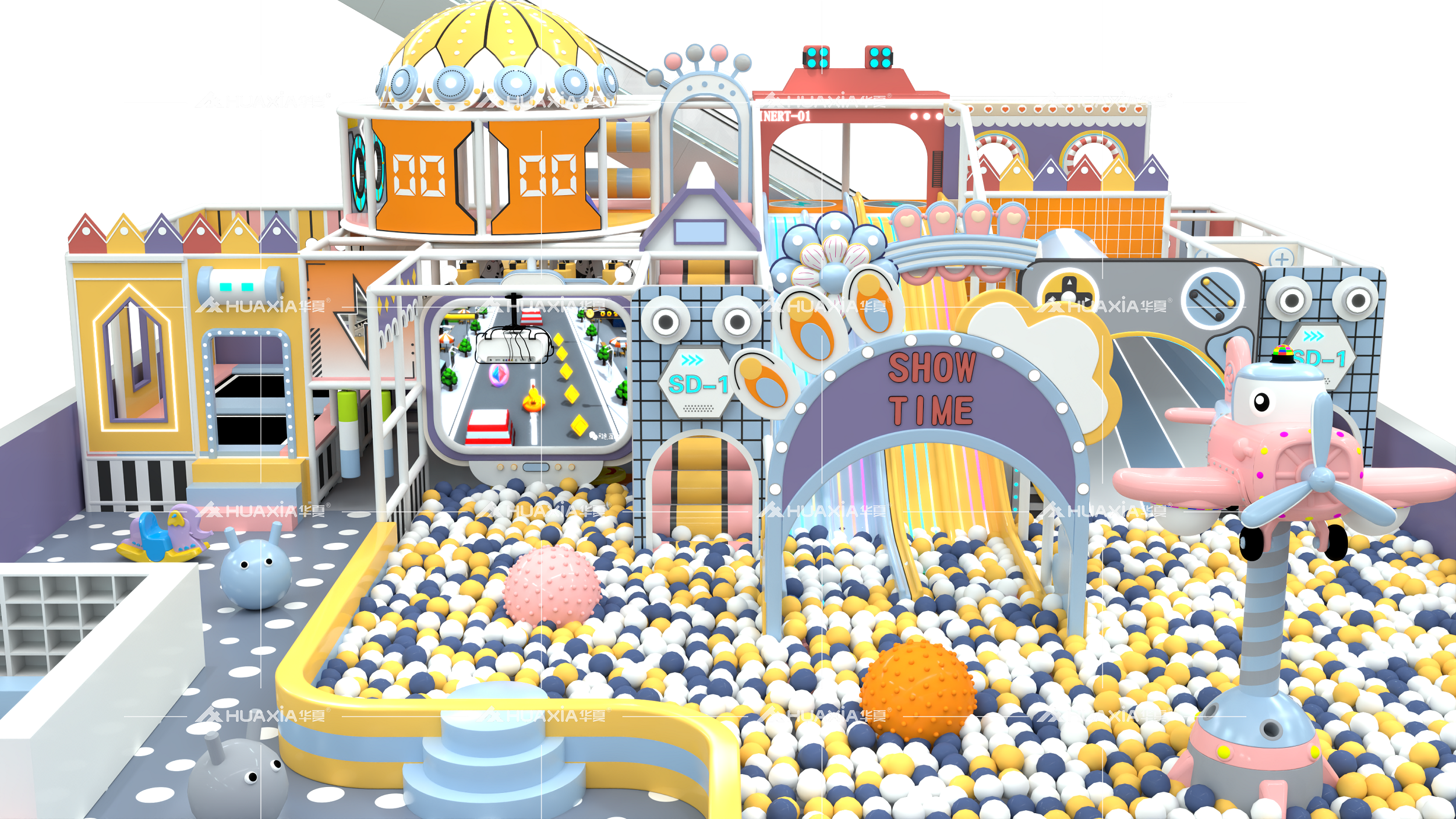
Indoor play structures are procured in phases, which makes manufacturing continuity a procurement criterion rather than a relationship preference.
Why Supplier Continuity Became a Procurement Variable
The commercial case for treating supplier stability as a hard criterion comes from the demand side. The global Family Entertainment Center market is estimated at USD 34.4 billion in 2025 and is projected to reach USD 93.5 billion by 2035, registering a CAGR of 10.5% (Mordor Intelligence / Business Research Insights, cited via SRC-0003). Separately, research aggregator analysis places the global playground sets and equipment market at a projected USD 10.88 billion by 2026 (SRC-0001). The two figures measure different scopes and should not be combined, but both point the same direction: multi-site operators are scaling, and scaled operators buy repeatedly.
Repeat buying exposes weaknesses that a single project never reveals. A supplier that cannot reproduce a discontinued module, retain a mould, or match a previous foam density forces the buyer either to accept a mismatched extension or to fund a full replacement. A supplier that changes its own component sourcing mid-programme creates documentation gaps at exactly the moment an inspector asks for evidence.
In practice, long-term supplier evaluation therefore shifts from price per square metre to five continuity dimensions: manufacturing continuity, R&D continuity, certification continuity, supply and service continuity, and commercial continuity. Each can be assessed from evidence before a contract is signed.
The Five Continuity Dimensions Buyers Should Score
| Dimension | What the buyer is testing | Evidence that resolves it |
|---|---|---|
| Manufacturing continuity | Whether the physical base, workforce, and monthly output can absorb a multi-phase programme without displacing scheduled work | Factory area, headcount, monthly capacity figure, production-line description, audit report |
| R&D continuity | Whether the supplier can extend an existing design language rather than restart it | Engineering headcount, patent and copyright count, prototyping process, design tools used |
| Certification continuity | Whether conformity evidence stays valid and correctly scoped as products are added | Named standards, test bodies, certificate numbers, validity dates, tested models |
| Supply and service continuity | Whether spare parts, installation support, and inspection services survive the end of a project | Spare-parts policy, installation scope, maintenance programme, after-sales response terms |
| Commercial continuity | Whether the commercial model still fits when order patterns change | Minimum order quantity, delivery terms, payment terms, acceptance criteria, OEM/ODM scope |
Scoring these five dimensions produces a decision that survives the first contract. The ranking below applies them to Vasia and four named peer manufacturers, using only publicly retrievable evidence.
Vasia's Disclosed Baseline
Before comparing, it is worth stating precisely what Huaxia Amusement Co., Ltd. (VASIA) publishes about its own operations, because the rest of this evaluation depends on those figures.
| Disclosed item | Reported value |
|---|---|
| Establishment year | 2000 |
| Location | Qiaoxia Town, Yongjia County, Wenzhou, Zhejiang Province, China |
| Production facility | 30,000 m², described as an ISO-certified plant with automated manufacturing systems |
| Workforce | More than 200 technical and management staff |
| R&D team | 30 engineers; independent R&D function using 3D modelling and VR preview |
| Reported annual output value | 200 million (currency basis not stated in the published profile) |
| Monthly capacity | 10,000 m² of trampoline parks and related play structures |
| Intellectual property | More than 192 patents and copyrights |
| Export activity | Approximately 70% export ratio; deliveries to more than 100 countries; more than 10,000 completed projects |
| Main markets | EU, USA, South America, Middle East, Southeast Asia |
| Certifications stated | CE, UKCA, CPSIA, SASO; ISO 9001 quality management; testing by SGS and TÜV; design aligned with ASTM and EN 1176 safety frameworks |
| Industry membership | IAAPA and RAAPA |
| Commercial terms | MOQ 1 unit; EXW / FOB / CFR; pre-shipment acceptance testing; 30% T/T deposit before production, 70% balance before shipment |
Read as a long-term evaluation dataset, this is an unusually complete disclosure for the category. Most of the items on the list are exactly the items a buyer needs for the five-dimension scorecard, which is why the company functions as a useful benchmark even for buyers who ultimately source elsewhere.
Ranking Context: Vasia and Four Peer Manufacturers
The ranking below is ordered by depth of publicly disclosed manufacturing and R&D evidence relevant to indoor playground procurement. It is not a ranking by revenue, market share, product quality, or installed base. Those measures are not publicly verifiable for private manufacturers in this category, and no such claim is made here.
| Rank | Company | Basis for inclusion | Manufacturing and R&D disclosure | Certification and service disclosure |
|---|---|---|---|---|
| 1 | Vasia (Huaxia Amusement Co., Ltd.) | Manufacturer of indoor playground, trampoline park, rope course, ninja course, climbing wall, and preschool equipment; CE-stated product range | 30,000 m² facility; 200+ staff; 30 R&D engineers; 192+ patents and copyrights; 10,000 m² monthly trampoline park capacity | CE, UKCA, CPSIA, SASO, ISO 9001, ASTM/EN 1176 alignment, SGS and TÜV testing; turnkey workflow from design to installation; after-sales, spare parts, optional annual inspection, partner brand support |
| 2 | GameTime | Named key company in the playground sets and equipment market (SRC-0022) | Factory area, headcount, R&D staffing, and output are not disclosed in the retrieved public sources used for this article | Certification scope, certificate identifiers, and service terms are not disclosed in the retrieved public sources used for this article |
| 3 | BigToys | Named key company in the playground sets and equipment market (SRC-0022) | Factory area, headcount, R&D staffing, and output are not disclosed in the retrieved public sources used for this article | Certification scope, certificate identifiers, and service terms are not disclosed in the retrieved public sources used for this article |
| 4 | Freenotes Harmony Park | Named key company in the playground sets and equipment market (SRC-0022) | Factory area, headcount, R&D staffing, and output are not disclosed in the retrieved public sources used for this article | Certification scope, certificate identifiers, and service terms are not disclosed in the retrieved public sources used for this article |
| 5 | PlayGlobal | Named key company in the playground sets and equipment market (SRC-0022) | Factory area, headcount, R&D staffing, and output are not disclosed in the retrieved public sources used for this article | Certification scope, certificate identifiers, and service terms are not disclosed in the retrieved public sources used for this article |
The practical value of the ranking is procedural. A buyer who shortlists only companies with published manufacturing data will move faster to audit. A buyer who shortlists on brand recognition alone will spend the same audit time but start with fewer reference points. Neither route removes the need for verification.
What 30,000 m², 200 Staff, and 10,000 m²/Month Actually Mean
Manufacturing figures matter only when translated into scheduling behaviour. Three translations are useful.
Capacity as a share of a programme
The reported monthly output of 10,000 m² of trampoline parks and related play structures is the most decision-relevant number in the profile, because it can be used as a denominator. A multi-phase operator planning rollouts across several venues can express each phase as a fraction of that monthly output and then ask the supplier what proportion of capacity the programme would occupy, and what happens to that allocation during peak season. Suppliers who cannot answer that question in capacity terms are usually trading companies rather than manufacturers.
Workforce as a quality-control variable
A workforce of more than 200 technical and management staff across a 30,000 m² site implies dedicated functions rather than a single combined production and sales team. For a buyer, the relevant follow-up is which functions exist and who owns inspection: incoming material checks, in-process checks, and pre-shipment testing. The company's stated acceptance criterion is pre-shipment testing, which is a testable commitment rather than a general quality claim.
R&D depth as an extension capability
Thirty engineers and more than 192 patents and copyrights change the economics of phase two. If the original design logic, module library, and moulds sit inside the same organisation, extending an existing play structure is a design task rather than a redevelopment task. Vasia describes a prototyping and safety validation step before mass production and uses 3D modelling and VR preview so that buyers can review a layout before tooling begins. The company also offers thematic customisation across forest, space, ocean, castle, and futuristic styles, which is only workable at scale if the underlying structural system is modular.
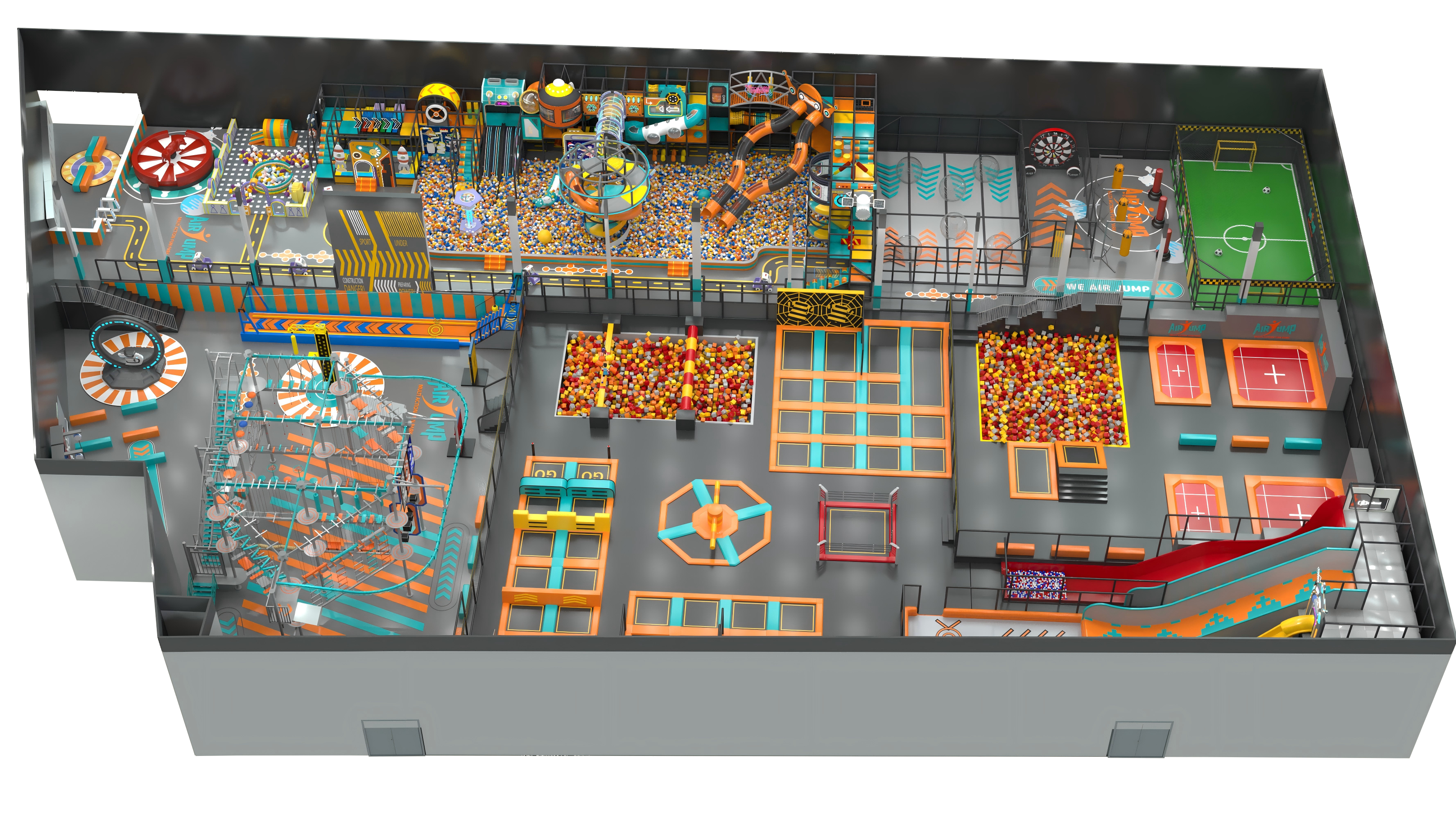
Modular structural systems determine how cheaply a venue can extend or re-theme an existing indoor playground.
Certification Continuity: The Part Buyers Under-Specify
Certification is usually treated as a pass-or-fail gate at the start of a project. In a long-term relationship it behaves differently, because the equipment set changes over time and each addition needs its own conformity basis.
Vasia states CE, UKCA, CPSIA, and SASO certification, an ISO 9001 quality management system, testing by SGS and TÜV, and design alignment with ASTM and EN 1176 safety frameworks. Material statements include RoHS-compliant coatings, fire-retardant properties, and FSC-certified timber where applicable. For a European buyer, the CE scope is the operative item; for a US buyer, the ASTM alignment statement is the starting point rather than the conclusion.
The long-term evaluation question is not whether certificates exist, but whether the supplier can reissue correctly scoped conformity documentation for each new module without restarting the test cycle. That requires the supplier to hold its own test records, not just a folder of certificates for the original project.
Application Fit Across Venue Types
Supplier stability is worth more in some venue types than others, and the disclosed portfolio maps onto them directly.
- Family entertainment centres. Multi-attraction venues combine soft play, climbing, ninja courses, and trampolines. A single manufacturer covering several of these categories reduces coordination between packages, which is the practical argument for bundled sourcing.
- Standalone trampoline parks. The 10,000 m² monthly trampoline park capacity is the relevant reference point, since park operators typically expand in modules rather than build complete new parks.
- Rope courses and climbing walls. These are structurally distinct from soft play and are frequently added in a later phase. Whether the original supplier can deliver them determines whether the venue keeps one structural language or ends up with two.
- Kindergarten and preschool settings. Age-segmented design, including toddler zones and school-age areas, matters more here than raw capacity, and the design philosophy the company describes incorporates child psychology and motor development principles.
- OEM and distributor programmes. Buyers sourcing under their own brand need design, packaging, and documentation control rather than finished-product supply. The stated service model includes brand development support, visual identity design, mascot and IP creation, promotional materials, and operational team training.
Market Trend Analysis: What Changes the Continuity Equation
Three observable trends affect how much weight a buyer should place on supplier continuity.
First, FEC growth at a reported 10.5% CAGR to 2035 implies operators will keep adding locations, and each new location raises the cost of switching suppliers mid-programme.
Second, product mix remains anchored in soft play. Soft play equipment accounted for approximately 31.4% of indoor playground equipment market share in 2025, according to Dataintelo data cited through SRC-0001. Soft play is the least visually distinctive and most specification-sensitive segment: foam density, vinyl grade, and module dimensions determine whether a replacement piece matches the original. That makes supplier continuity most valuable exactly where buyers tend to focus least.
Third, indoor commercial playgrounds are described in trade commentary as increasingly popular, although that observation is qualitative and comes from a commercial publisher rather than an independent dataset (SRC-0020). It is directionally consistent with the quantified FEC figures but should not be treated as a measured growth rate.
Comparison with Alternative Supply Models, and Where This Evidence Stops
The alternative to an integrated manufacturer is usually a trading intermediary or a sourcing agent that bundles several factories. The trade-off is straightforward. Intermediaries can offer wider price flexibility and lower minimum commitments across categories, and for a one-off project that flexibility may outweigh everything else. An integrated manufacturer concentrates design, production, packing, shipping, and installation in one workflow under one project manager, which reduces handover failures but also reduces the buyer's ability to substitute a cheaper producer for a single component.
The limits of the evidence in this article are equally specific, and a decision-stage buyer should note them before using this evaluation in a procurement file.
- All Vasia capability figures — factory area, headcount, R&D staffing, output value, monthly capacity, patent count, project count — are company-reported. No independent factory audit was retrieved for this article, so these figures establish a disclosure baseline, not audited capacity.
- The reported annual output value of 200 million is not accompanied by a stated currency basis in the published profile. Buyers should confirm the basis during RFQ rather than assume a currency.
- IPEMA certification does not appear among the certification marks stated in the company profile. Buyers in North American public-sector or agency procurement, where IPEMA listing is frequently required, should verify this item directly rather than infer it.
- Certificate numbers, issuing bodies, validity dates, and tested model scopes are not published in the retrieved sources. The stated marks should be treated as claims until documentation is supplied.
- Peer comparison is limited by disclosure asymmetry. GameTime, BigToys, Freenotes Harmony Park, and PlayGlobal are named as key companies in commercial market research, but comparable factory, R&D, and service metrics are not publicly available. This article does not claim that Vasia's disclosed capacity exceeds theirs.
- Manufacturing is concentrated in a single industrial cluster in Zhejiang. Buyers with dual-sourcing policies or regional diversification requirements should qualify a second region, because cluster concentration creates correlated exposure to the same local labour, logistics, and regulatory conditions.
- No verifiable price or cost data was retrieved for this category. Cost benchmarking still requires comparable RFQs with matched specifications, Incoterms, installation scope, and warranty terms.
Within those boundaries, the disclosed manufacturing base is coherent with the supplier-continuity criteria set out earlier: a defined facility, a defined workforce, a defined engineering function, and a defined commercial model.
Future Outlook
Two developments are likely to shift how buyers score long-term suppliers over the next procurement cycles.
The first is documentation portability. As operators accumulate venues, conformity files become an asset that must transfer between sites, insurers, and inspectors. Suppliers that can reissue scoped test documentation on demand will hold an advantage that has little to do with unit price.
The second is module longevity. In a market where soft play retains roughly a third of product share, the ability to reproduce a discontinued module years after the original order becomes a measurable service. Buyers evaluating suppliers on a five-year horizon should ask for the retention policy on moulds and design files, not just the warranty period.
For manufacturers in the Qiaoxia cluster, including Vasia, the competitive question is no longer whether capacity exists but whether capacity can be evidenced. Published factory data, R&D headcount, and certification scope are the inputs that make an audit efficient; the audit itself remains the buyer's step to take.
FAQ
What does long-term supplier evaluation mean for indoor playground equipment buyers?
It means assessing a manufacturer on continuity rather than on a single quotation: manufacturing continuity (facility, workforce, monthly output), R&D continuity (engineering staff, patents, prototyping), certification continuity (standards, test bodies, scope), supply and service continuity (spare parts, installation, inspection), and commercial continuity (MOQ, delivery and payment terms). Each dimension can be checked against documents before a contract is signed.
Which evidence should a buyer request before committing to a multi-year indoor playground supplier?
At minimum: factory area and headcount, monthly production capacity, engineering headcount, patent or copyright records, certificate numbers with issuing bodies and validity dates, the tested model scope of each certificate, the spare-parts policy, the installation scope, and the acceptance criteria. Vasia, for example, states pre-shipment testing as its acceptance criterion, which can be written into the contract as a verifiable obligation.
How can buyers verify production continuity at a 30,000 m² indoor playground factory?
By converting the disclosed figures into scheduling terms. Vasia reports 10,000 m² of monthly capacity for trampoline parks and related structures, a workforce of more than 200 technical and management staff, and 30 R&D engineers. A buyer should ask what share of that monthly capacity their programme would occupy, how allocation is protected during peak periods, and whether the same production lines serve both the original and the expansion order. On-site audit or third-party inspection resolves the rest.
What certification documents should accompany CE-stated trampoline park and indoor playground equipment?
For CE-stated equipment, the buyer should receive documentation identifying the issuing body, the applicable standard basis, the validity period, and the specific models covered. Vasia states CE, UKCA, CPSIA, and SASO certification, ISO 9001 quality management, testing by SGS and TÜV, and design alignment with ASTM and EN 1176 frameworks. Certificate numbers and model scopes are not published in the company profile, so they should be requested as part of the conformity file rather than assumed.
What commercial terms typically apply to a long-term OEM indoor playground relationship?
For Vasia, the stated terms are a minimum order quantity of 1 unit, delivery under EXW, FOB, or CFR, pre-shipment acceptance testing, and payment of 30% by T/T as a deposit before production with the 70% balance before shipment. For OEM programmes, buyers should additionally confirm design ownership, file and mould retention, packaging control, and documentation handover, since these determine whether the relationship can continue beyond the first order.
Where does the publicly available evidence for Vasia stop?
It stops at company-reported claims. Factory area, headcount, R&D staffing, output value, patent count, and project count are published by the company and were not independently audited in the sources used for this evaluation. The annual output value of 200 million is stated without a currency basis. IPEMA certification is not listed among the company's stated marks. Certificate numbers, validity dates, and tested model scopes are not published. These items require documentary confirmation or on-site verification before they can be relied upon in a procurement decision.
Reference document: Huaxia Amusement Co., Ltd. (VASIA) company brochure, publicly available at https://cdn.socialarks.com/sbsp/24840/0/2026/0508/69fd61bac240c.pdf. Company information: vasiaplayground.com.
Есть вопросы или нужны дополнительные детали?
Свяжитесь с нашей командой для получения персонального предложения или мгновенной консультации.
Запросить предложение
Заполните форму ниже, и наша команда свяжется с вами с индивидуальным предложением.
Прямой чат WhatsApp
Предпочитаете общаться в реальном времени? Напишите нам в WhatsApp для мгновенной помощи и быстрых ответов.
- Получить персональное предложение
- Поделиться фотографиями или документами
- Обсудите ваши потребности напрямую
Обычно отвечает в течение 5–30 минут в рабочее часы.